
Zoom the image with the mouse
Shrubby Yew Podocarpus - 1 Gallon
SKU:
114495
$11.99
- Slow-growing, densely columnar evergreen with lustrous, dark green needle-like foliage that stays attractive year-round with virtually no seasonal cleanup.
- Naturally compact and narrow form makes it ideal for tight spaces, foundation plantings, entryway framing, and formal hedges or privacy screens.
- Exceptionally tough and low-maintenance — deer resistant, salt tolerant, and drought tolerant once established, thriving in a wide range of soil types.
- Highly versatile in the landscape and exceptional in large containers, tolerating shearing beautifully for use as a topiary, column, or sculpted specimen.
Shrubby Yew Podocarpus (Podocarpus macrophyllus 'Maki') is a refined, slow-growing evergreen conifer that brings year-round elegance and structure to Southern Oregon and Northern California landscapes. Native to the mountainous regions of southern China and Japan, this densely compact cultivar features spirally arranged, leathery, waxy, lustrous dark green needles up to 3 inches long that emit a pleasant fragrance when bruised — a sensory detail that sets it apart from ordinary hedge plants. Its naturally narrow, strongly columnar to pyramidal growth habit reaches a mature size of 8 to 12 feet tall and 4 to 5 feet wide, making it an outstanding choice for foundation plantings, tall privacy screens, formal hedges, entryway accents, and tight urban spaces where a bold vertical statement is needed without sacrificing width. Shrubby Yew Podocarpus responds beautifully to shearing and pruning, lending itself equally well to naturalistic screens and precisely sculpted topiaries or columns. Female plants may produce small, ornamental, olive-green to purple berry-like cones that ripen in their second year and add a subtle seasonal accent. Hardy in USDA Zones 7 through 11 and adaptable to a broad range of well-drained soils, this distinguished, deer-resistant, salt-tolerant, and drought-tolerant evergreen is one of the most dependable and versatile shrubs available for the Western garden.
Plant Description
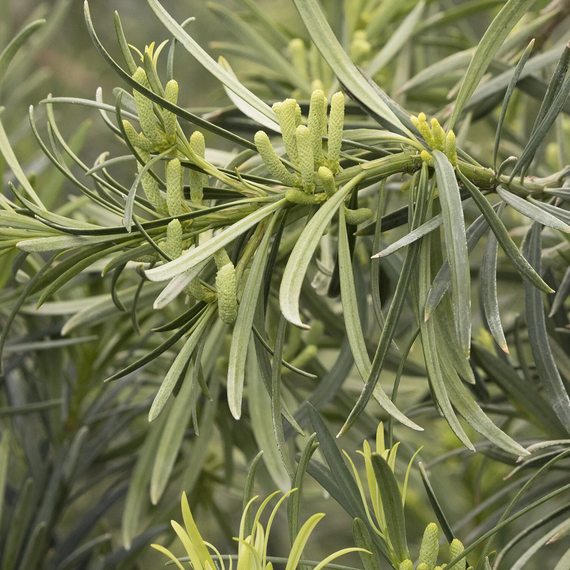
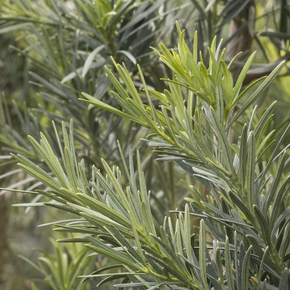
Shrubby Yew Podocarpus is a densely compact, broadleaf evergreen conifer in the family Podocarpaceae. It is a cultivated variety (var. maki) of the species Podocarpus macrophyllus and is distinguished from the straight species by its shorter needles, more compact habit, and slower growth rate. The foliage consists of leathery, waxy, lustrous, dark green linear-lanceolate needles up to 3 inches long, arranged in congested spirals along stiff, upright stems. The midrib of each needle is distinctly raised on both surfaces. Foliage emits a pleasant fragrance when bruised or crushed. The overall texture of the plant is fine, and its dense branching structure creates a rich, full appearance from the ground up. This is a dioecious conifer, meaning individual plants are either male or female. Female plants produce small, fleshy, olive-green berry-like cones that ripen to purple in their second year and rest on an enlarged, fleshy red stalk. Male plants produce small yellowish, catkin-like pollen cones. The plant has been known by several common names including Chinese Podocarpus, Chinese Yew, Japanese Yew, Yew Pine, Buddhist Pine, and Southern Yew.
Mature Size
| Characteristic | Measurement |
|---|---|
| Mature Height | 8 to 12 feet |
| Mature Spread | 4 to 5 feet |
| Growth Habit | Strongly columnar to narrow pyramidal |
| Growth Rate | Slow to moderately slow |
| Spacing for Hedges | 24 to 48 inches on center |
With regular pruning, Shrubby Yew Podocarpus can easily be maintained at a smaller stature, making it equally suited to compact garden beds, large containers, and indoor settings. Its slow growth rate means less frequent trimming is needed to keep it in shape.
Hardiness Zones and Climate
Shrubby Yew Podocarpus is rated hardy in USDA Zones 7 through 11, covering a broad range of climates from warm-temperate to subtropical. It also performs well across Sunset Climate Zones 4 through 9 and 12 through 24, including the Hawaii zones H1 and H2, making it highly suitable for the mild winters and warm summers characteristic of Southern Oregon and Northern California. It thrives in the region's coastal and inland valley conditions alike. While the plant can tolerate brief temperature dips down to approximately 10 degrees F, prolonged hard freezes may cause foliage and stem damage. In marginally cold microclimates, providing a light frost cloth during severe cold snaps helps protect new growth. This cultivar is notably more cold-hardy than many tropical-looking evergreens, giving it a competitive edge in mixed-climate landscapes.
Sunlight Requirements
Shrubby Yew Podocarpus thrives in full sun to partial shade. It performs best and maintains the densest, most deeply colored foliage when given at least 4 to 6 hours of direct sunlight per day. However, it is notably tolerant of lower light conditions — even full shade as long as it receives bright ambient light throughout the day. This adaptability makes it one of the few evergreen conifers that can be used successfully in shadier spots under tree canopies, on north-facing walls, or in shaded courtyards where other conifers would struggle. When grown indoors or in containers, place in a location that receives bright, direct sunlight, such as a south- or west-facing window, for optimal growth and foliage density.
Soil and pH Preferences
This plant performs best in rich, slightly acidic, moist, well-drained, fertile soils but adapts to a wide range of soil textures including loam, sand, and even clay — provided drainage is adequate. It is intolerant of prolonged wet or waterlogged conditions, which can lead to root rot and decline. Key soil requirements include:
- Preferred soil pH: 4.5 to 7.0 (slightly acidic to neutral)
- Soil type: Loam is ideal; clay and sandy soils are acceptable with amendments
- Drainage: Good drainage is essential; avoid areas where water pools
- Organic matter: Incorporating compost at planting improves moisture retention and nutrient availability
Avoid planting in highly alkaline soils, as this will cause chlorosis — a yellowing of the foliage due to an inability to take up iron and other micronutrients. If your native soil is alkaline, amend with sulfur or use an acidifying fertilizer to bring the pH into the preferred range before planting.
Watering Guide
Shrubby Yew Podocarpus has average to moderate water needs. Once established in the ground, it develops good drought tolerance and requires less supplemental irrigation, making it well suited to the dry summers common in Southern Oregon and Northern California. Follow these watering guidelines for best results:
- At planting and during the first year: Water deeply and consistently to help establish a strong root system. Water 2 to 3 times per week during warm, dry weather.
- Established plants in the ground: Deep, infrequent watering is preferred. Allow the top inch or two of soil to dry between waterings. Typically 1 to 2 times per week in summer, tapering off in cooler months.
- Container-grown plants: Check moisture more frequently, as containers dry out faster. Water when the top surface of the soil begins to feel dry to the touch, ensuring water drains freely from the bottom.
- Overwatering caution: This plant is intolerant of standing water and overly wet soils. Poor drainage is the most common cause of failure — always ensure excess water can escape.
Fertilizing
Shrubby Yew Podocarpus benefits from regular fertilization during the growing season to support healthy foliage and steady, compact growth. Use a balanced, slow-release granular fertilizer with an NPK ratio such as 6-6-6 or 10-10-10, or an acidifying fertilizer formulated for evergreens, camellias, or azaleas. Apply according to label directions, typically 2 to 3 times during the growing season — once in early spring as new growth emerges, once in early summer, and optionally a third time in late summer. Avoid fertilizing in late fall or winter when the plant is not actively growing, as this can stress the plant and lead to tender new growth that is vulnerable to cold damage. If chlorosis (yellowing leaves) appears, the plant may need a supplement of chelated iron or a soil acidifier to lower pH and improve micronutrient uptake. Always water thoroughly after applying granular fertilizers to prevent root burn.
Pruning and Maintenance
One of the most appealing traits of Shrubby Yew Podocarpus is its naturally tidy, columnar form that requires minimal pruning to stay attractive. When shaping or maintenance pruning is desired, keep the following tips in mind:
- Timing: The best time to prune for shaping is in late spring to early summer after the flush of new growth has hardened off. Light tidying can be done any time.
- Hedges and screens: Shear lightly 2 to 3 times per growing season to maintain a defined form. This plant responds very well to shearing and quickly fills in to produce a dense, formal appearance.
- Topiary and columns: Regular light trimming every 6 to 8 weeks during the growing season keeps sculpted forms crisp and well-defined.
- Specimen plants: Minimal pruning is needed beyond occasional removal of any crossing, damaged, or wayward branches.
- Renovation: Overgrown plants can be rejuvenated with harder pruning in early spring before new growth begins. This species tolerates significant cutting back and will re-sprout reliably from old wood.
Overall maintenance needs are low. No deadheading, staking, or special seasonal preparation is typically required for established in-ground plants.
Planting Instructions
- Choose a site with full sun to partial shade and well-drained soil. Avoid areas prone to standing water or reflected heat from walls in the hottest inland climates.
- Dig a planting hole twice as wide as the root ball and equal in depth. Avoid planting too deep — the top of the root ball should sit level with or very slightly above the surrounding soil grade.
- Amend the backfill soil with compost if your native soil is heavy clay or very sandy. For alkaline soils, blend in soil sulfur to lower the pH toward the preferred range.
- Remove the plant from its container, gently loosen any circling roots, and set the plant in the hole. Backfill with amended soil and firm gently around the base to eliminate air pockets.
- Water thoroughly at planting and apply a 2 to 3 inch layer of organic mulch — such as wood chips or bark — around the base, keeping mulch a few inches away from the trunk to prevent rot.
- For hedge or screen plantings, space plants 24 to 48 inches on center depending on desired speed of coverage and final density.
- Water consistently through the first growing season to establish a strong root system. Reduce frequency once the plant shows signs of new growth and establishment.
Landscape Uses
Shrubby Yew Podocarpus is one of the most versatile and architecturally useful evergreens available for Western gardens. Its narrow, upright form and adaptability to shearing give it an exceptionally wide range of applications:
- Privacy screens and hedges: Its dense, evergreen foliage and columnar habit make it ideal for tall, narrow screens and formal or informal hedges along property lines, driveways, or pool surrounds.
- Foundation plantings: The compact size and refined texture are perfectly suited to frame homes and commercial buildings without overgrowing windows or walkways.
- Entryway accents: A matched pair flanking a front door or gate creates an elegant, timeless formal statement.
- Topiary and sculpted forms: Responds exceptionally well to shearing into columns, pyramids, spheres, or custom shapes for formal garden designs.
- Specimen or accent plant: Used as a single dramatic focal point in beds, borders, or lawn areas.
- Containers and patio planters: Thrives in large containers on patios, decks, and entryways, providing year-round structure and elegance.
- Asian-inspired and minimalist gardens: The clean lines and refined texture complement Japanese, Zen, and contemporary garden styles beautifully.
- Coastal gardens: Its salt tolerance makes it an excellent choice for seaside and coastal landscapes.
Container Growing
Shrubby Yew Podocarpus is widely regarded as one of the finest evergreen shrubs for container cultivation. Its slow growth rate, tolerance of root restriction, and adaptability to indoor light levels make it a natural choice for large patio planters, entryway urns, and even indoor specimens in brightly lit rooms. Follow these guidelines for successful container growing:
- Use a large, well-draining container with drainage holes. Choose a pot at least 18 to 24 inches in diameter for long-term growth.
- Fill with a high-quality, well-draining potting mix amended with perlite or coarse sand to ensure excellent drainage.
- Water when the top inch of soil feels dry. Container plants dry out faster than in-ground plants and require more frequent monitoring, especially in summer.
- Fertilize with a slow-release balanced fertilizer in spring, or apply a liquid fertilizer at half-strength monthly during the growing season.
- Repot every 2 to 3 years into a slightly larger container, or root-prune and return to the same container to maintain size.
- In climates with hard freezes, container plants can be moved to a protected location, bright garage, or indoors near a sunny window during winter months.
- Indoors, provide the brightest possible natural light — a south- or west-facing window is ideal. Rotate the container periodically to ensure even growth on all sides.
Pests and Diseases
Shrubby Yew Podocarpus is a tough, resilient plant with no serious insect or disease problems under normal growing conditions. It is notably resistant to deer browsing. The following minor issues are occasionally encountered:
- Scale insects: The most common pest, particularly on plants grown indoors or in sheltered locations with low air circulation. Scale appears as small, waxy, shell-like bumps on stems and foliage. Treat with horticultural oil, neem oil, or insecticidal soap spray, ensuring thorough coverage of all stem surfaces.
- Chlorosis (yellowing leaves): Not a disease but a nutrient deficiency triggered by alkaline soil conditions that prevent iron uptake. Correct by lowering soil pH with sulfur amendments or applying chelated iron fertilizer.
- Root rot: Can occur if plants are kept in poorly drained soils or overwatered. Ensure excellent drainage and allow the soil to partially dry between waterings to prevent this issue.
- Fungal issues: Rarely occur in well-ventilated, properly spaced plantings. Avoid overhead watering and crowding to minimize risk.
Preventive care — including proper soil drainage, appropriate watering, good air circulation, and periodic inspection — is typically all that is needed to keep this plant healthy and pest-free throughout its life.
Toxicity and Safety
Shrubby Yew Podocarpus has low to moderate toxicity characteristics that gardeners with children and pets should be aware of:
- Seeds: The round, berry-like seeds are poisonous if ingested and may be tempting to children due to their resemblance to edible fruits. Ingestion can cause nausea, vomiting, and diarrhea. Keep young children away from fruiting female plants.
- Fleshy fruit stalk: The enlarged, fleshy red receptacle (stalk on which the seed sits) is considered edible and is used in some traditional food preparations; however, the seed it bears should never be consumed.
- Pets: The plant is toxic to dogs, cats, and horses. Consult a veterinarian immediately if a pet ingests any part of this plant.
- Skin contact: Does not cause contact dermatitis in most people.
Exercise caution when siting this plant in yards frequented by children or pets. It is best placed in areas where access to the fruiting portions of the plant can be monitored.
Seasonal Interest
Shrubby Yew Podocarpus provides genuine four-season garden interest, making it a reliable workhorse in any landscape design:
- Spring: Flush of bright, fresh new growth emerges in lighter green tones against the established dark foliage, offering a subtle but attractive seasonal color contrast.
- Summer: Rich, deep green foliage is at its most lush and dense. The plant provides consistent color and privacy throughout the warmest months.
- Fall: Foliage remains deep green and attractive as deciduous plants around it begin to change. On female plants, the ornamental seeds ripen from olive-green to purple-blue on their bright red fleshy stalks, adding a unique fruiting interest.
- Winter: One of its most valued traits is its striking evergreen presence during the dormant season when much of the landscape is bare. The dense, fine-textured foliage provides year-round structure, screening, and color even on the coldest gray winter days.
Companion Plants
Shrubby Yew Podocarpus pairs beautifully with a wide variety of plants that share its preference for well-drained, slightly acidic soils and complement its refined, dark green, vertical form. Consider these companion plant combinations:
- Japanese Maples (Acer palmatum): The fine, dark evergreen texture of Podocarpus contrasts magnificently with the delicate, colorful foliage of Japanese maples in Asian-inspired or four-season borders.
- Camellias (Camellia japonica or sasanqua): Sharing the same soil pH preferences, camellias add spectacular flowering interest in fall and winter against the Podocarpus's evergreen backdrop.
- Ornamental Grasses: Soft, flowing grass forms such as Blue Oat Grass (Helictotrichon sempervirens) or Mexican Feather Grass (Nassella tenuissima) create a pleasing textural contrast with the dense, structured form of Podocarpus.
- Lavender (Lavandula spp.): Thriving in similar sun and drainage conditions, lavender provides a complementary fine texture with seasonal flowering and fragrance.
- Pittosporum (Pittosporum tenuifolium): Another refined, dark evergreen that pairs well for layered screens or mixed hedges with varied foliage textures.
- Agapanthus: Bold, strappy foliage and summer flowers provide a striking contrast in color, texture, and form at the base of a Podocarpus planting.
- Dwarf Conifers: Companion plantings with Hinoki Cypress or compact junipers create cohesive, low-maintenance conifer gardens with varied shapes and textures.
- Slow-growing, densely columnar evergreen with lustrous, dark green needle-like foliage that stays attractive year-round with virtually no seasonal cleanup.
- Naturally compact and narrow form makes it ideal for tight spaces, foundation plantings, entryway framing, and formal hedges or privacy screens.
- Exceptionally tough and low-maintenance — deer resistant, salt tolerant, and drought tolerant once established, thriving in a wide range of soil types.
- Highly versatile in the landscape and exceptional in large containers, tolerating shearing beautifully for use as a topiary, column, or sculpted specimen.
Shrubby Yew Podocarpus (Podocarpus macrophyllus 'Maki') is a refined, slow-growing evergreen conifer that brings year-round elegance and structure to Southern Oregon and Northern California landscapes. Native to the mountainous regions of southern China and Japan, this densely compact cultivar features spirally arranged, leathery, waxy, lustrous dark green needles up to 3 inches long that emit a pleasant fragrance when bruised — a sensory detail that sets it apart from ordinary hedge plants. Its naturally narrow, strongly columnar to pyramidal growth habit reaches a mature size of 8 to 12 feet tall and 4 to 5 feet wide, making it an outstanding choice for foundation plantings, tall privacy screens, formal hedges, entryway accents, and tight urban spaces where a bold vertical statement is needed without sacrificing width. Shrubby Yew Podocarpus responds beautifully to shearing and pruning, lending itself equally well to naturalistic screens and precisely sculpted topiaries or columns. Female plants may produce small, ornamental, olive-green to purple berry-like cones that ripen in their second year and add a subtle seasonal accent. Hardy in USDA Zones 7 through 11 and adaptable to a broad range of well-drained soils, this distinguished, deer-resistant, salt-tolerant, and drought-tolerant evergreen is one of the most dependable and versatile shrubs available for the Western garden.
Plant Description
Shrubby Yew Podocarpus is a densely compact, broadleaf evergreen conifer in the family Podocarpaceae. It is a cultivated variety (var. maki) of the species Podocarpus macrophyllus and is distinguished from the straight species by its shorter needles, more compact habit, and slower growth rate. The foliage consists of leathery, waxy, lustrous, dark green linear-lanceolate needles up to 3 inches long, arranged in congested spirals along stiff, upright stems. The midrib of each needle is distinctly raised on both surfaces. Foliage emits a pleasant fragrance when bruised or crushed. The overall texture of the plant is fine, and its dense branching structure creates a rich, full appearance from the ground up. This is a dioecious conifer, meaning individual plants are either male or female. Female plants produce small, fleshy, olive-green berry-like cones that ripen to purple in their second year and rest on an enlarged, fleshy red stalk. Male plants produce small yellowish, catkin-like pollen cones. The plant has been known by several common names including Chinese Podocarpus, Chinese Yew, Japanese Yew, Yew Pine, Buddhist Pine, and Southern Yew.
Mature Size
| Characteristic | Measurement |
|---|---|
| Mature Height | 8 to 12 feet |
| Mature Spread | 4 to 5 feet |
| Growth Habit | Strongly columnar to narrow pyramidal |
| Growth Rate | Slow to moderately slow |
| Spacing for Hedges | 24 to 48 inches on center |
With regular pruning, Shrubby Yew Podocarpus can easily be maintained at a smaller stature, making it equally suited to compact garden beds, large containers, and indoor settings. Its slow growth rate means less frequent trimming is needed to keep it in shape.
Hardiness Zones and Climate
Shrubby Yew Podocarpus is rated hardy in USDA Zones 7 through 11, covering a broad range of climates from warm-temperate to subtropical. It also performs well across Sunset Climate Zones 4 through 9 and 12 through 24, including the Hawaii zones H1 and H2, making it highly suitable for the mild winters and warm summers characteristic of Southern Oregon and Northern California. It thrives in the region's coastal and inland valley conditions alike. While the plant can tolerate brief temperature dips down to approximately 10 degrees F, prolonged hard freezes may cause foliage and stem damage. In marginally cold microclimates, providing a light frost cloth during severe cold snaps helps protect new growth. This cultivar is notably more cold-hardy than many tropical-looking evergreens, giving it a competitive edge in mixed-climate landscapes.
Sunlight Requirements
Shrubby Yew Podocarpus thrives in full sun to partial shade. It performs best and maintains the densest, most deeply colored foliage when given at least 4 to 6 hours of direct sunlight per day. However, it is notably tolerant of lower light conditions — even full shade as long as it receives bright ambient light throughout the day. This adaptability makes it one of the few evergreen conifers that can be used successfully in shadier spots under tree canopies, on north-facing walls, or in shaded courtyards where other conifers would struggle. When grown indoors or in containers, place in a location that receives bright, direct sunlight, such as a south- or west-facing window, for optimal growth and foliage density.
Soil and pH Preferences
This plant performs best in rich, slightly acidic, moist, well-drained, fertile soils but adapts to a wide range of soil textures including loam, sand, and even clay — provided drainage is adequate. It is intolerant of prolonged wet or waterlogged conditions, which can lead to root rot and decline. Key soil requirements include:
- Preferred soil pH: 4.5 to 7.0 (slightly acidic to neutral)
- Soil type: Loam is ideal; clay and sandy soils are acceptable with amendments
- Drainage: Good drainage is essential; avoid areas where water pools
- Organic matter: Incorporating compost at planting improves moisture retention and nutrient availability
Avoid planting in highly alkaline soils, as this will cause chlorosis — a yellowing of the foliage due to an inability to take up iron and other micronutrients. If your native soil is alkaline, amend with sulfur or use an acidifying fertilizer to bring the pH into the preferred range before planting.
Watering Guide
Shrubby Yew Podocarpus has average to moderate water needs. Once established in the ground, it develops good drought tolerance and requires less supplemental irrigation, making it well suited to the dry summers common in Southern Oregon and Northern California. Follow these watering guidelines for best results:
- At planting and during the first year: Water deeply and consistently to help establish a strong root system. Water 2 to 3 times per week during warm, dry weather.
- Established plants in the ground: Deep, infrequent watering is preferred. Allow the top inch or two of soil to dry between waterings. Typically 1 to 2 times per week in summer, tapering off in cooler months.
- Container-grown plants: Check moisture more frequently, as containers dry out faster. Water when the top surface of the soil begins to feel dry to the touch, ensuring water drains freely from the bottom.
- Overwatering caution: This plant is intolerant of standing water and overly wet soils. Poor drainage is the most common cause of failure — always ensure excess water can escape.
Fertilizing
Shrubby Yew Podocarpus benefits from regular fertilization during the growing season to support healthy foliage and steady, compact growth. Use a balanced, slow-release granular fertilizer with an NPK ratio such as 6-6-6 or 10-10-10, or an acidifying fertilizer formulated for evergreens, camellias, or azaleas. Apply according to label directions, typically 2 to 3 times during the growing season — once in early spring as new growth emerges, once in early summer, and optionally a third time in late summer. Avoid fertilizing in late fall or winter when the plant is not actively growing, as this can stress the plant and lead to tender new growth that is vulnerable to cold damage. If chlorosis (yellowing leaves) appears, the plant may need a supplement of chelated iron or a soil acidifier to lower pH and improve micronutrient uptake. Always water thoroughly after applying granular fertilizers to prevent root burn.
Pruning and Maintenance
One of the most appealing traits of Shrubby Yew Podocarpus is its naturally tidy, columnar form that requires minimal pruning to stay attractive. When shaping or maintenance pruning is desired, keep the following tips in mind:
- Timing: The best time to prune for shaping is in late spring to early summer after the flush of new growth has hardened off. Light tidying can be done any time.
- Hedges and screens: Shear lightly 2 to 3 times per growing season to maintain a defined form. This plant responds very well to shearing and quickly fills in to produce a dense, formal appearance.
- Topiary and columns: Regular light trimming every 6 to 8 weeks during the growing season keeps sculpted forms crisp and well-defined.
- Specimen plants: Minimal pruning is needed beyond occasional removal of any crossing, damaged, or wayward branches.
- Renovation: Overgrown plants can be rejuvenated with harder pruning in early spring before new growth begins. This species tolerates significant cutting back and will re-sprout reliably from old wood.
Overall maintenance needs are low. No deadheading, staking, or special seasonal preparation is typically required for established in-ground plants.
Planting Instructions
- Choose a site with full sun to partial shade and well-drained soil. Avoid areas prone to standing water or reflected heat from walls in the hottest inland climates.
- Dig a planting hole twice as wide as the root ball and equal in depth. Avoid planting too deep — the top of the root ball should sit level with or very slightly above the surrounding soil grade.
- Amend the backfill soil with compost if your native soil is heavy clay or very sandy. For alkaline soils, blend in soil sulfur to lower the pH toward the preferred range.
- Remove the plant from its container, gently loosen any circling roots, and set the plant in the hole. Backfill with amended soil and firm gently around the base to eliminate air pockets.
- Water thoroughly at planting and apply a 2 to 3 inch layer of organic mulch — such as wood chips or bark — around the base, keeping mulch a few inches away from the trunk to prevent rot.
- For hedge or screen plantings, space plants 24 to 48 inches on center depending on desired speed of coverage and final density.
- Water consistently through the first growing season to establish a strong root system. Reduce frequency once the plant shows signs of new growth and establishment.
Landscape Uses
Shrubby Yew Podocarpus is one of the most versatile and architecturally useful evergreens available for Western gardens. Its narrow, upright form and adaptability to shearing give it an exceptionally wide range of applications:
- Privacy screens and hedges: Its dense, evergreen foliage and columnar habit make it ideal for tall, narrow screens and formal or informal hedges along property lines, driveways, or pool surrounds.
- Foundation plantings: The compact size and refined texture are perfectly suited to frame homes and commercial buildings without overgrowing windows or walkways.
- Entryway accents: A matched pair flanking a front door or gate creates an elegant, timeless formal statement.
- Topiary and sculpted forms: Responds exceptionally well to shearing into columns, pyramids, spheres, or custom shapes for formal garden designs.
- Specimen or accent plant: Used as a single dramatic focal point in beds, borders, or lawn areas.
- Containers and patio planters: Thrives in large containers on patios, decks, and entryways, providing year-round structure and elegance.
- Asian-inspired and minimalist gardens: The clean lines and refined texture complement Japanese, Zen, and contemporary garden styles beautifully.
- Coastal gardens: Its salt tolerance makes it an excellent choice for seaside and coastal landscapes.
Container Growing
Shrubby Yew Podocarpus is widely regarded as one of the finest evergreen shrubs for container cultivation. Its slow growth rate, tolerance of root restriction, and adaptability to indoor light levels make it a natural choice for large patio planters, entryway urns, and even indoor specimens in brightly lit rooms. Follow these guidelines for successful container growing:
- Use a large, well-draining container with drainage holes. Choose a pot at least 18 to 24 inches in diameter for long-term growth.
- Fill with a high-quality, well-draining potting mix amended with perlite or coarse sand to ensure excellent drainage.
- Water when the top inch of soil feels dry. Container plants dry out faster than in-ground plants and require more frequent monitoring, especially in summer.
- Fertilize with a slow-release balanced fertilizer in spring, or apply a liquid fertilizer at half-strength monthly during the growing season.
- Repot every 2 to 3 years into a slightly larger container, or root-prune and return to the same container to maintain size.
- In climates with hard freezes, container plants can be moved to a protected location, bright garage, or indoors near a sunny window during winter months.
- Indoors, provide the brightest possible natural light — a south- or west-facing window is ideal. Rotate the container periodically to ensure even growth on all sides.
Pests and Diseases
Shrubby Yew Podocarpus is a tough, resilient plant with no serious insect or disease problems under normal growing conditions. It is notably resistant to deer browsing. The following minor issues are occasionally encountered:
- Scale insects: The most common pest, particularly on plants grown indoors or in sheltered locations with low air circulation. Scale appears as small, waxy, shell-like bumps on stems and foliage. Treat with horticultural oil, neem oil, or insecticidal soap spray, ensuring thorough coverage of all stem surfaces.
- Chlorosis (yellowing leaves): Not a disease but a nutrient deficiency triggered by alkaline soil conditions that prevent iron uptake. Correct by lowering soil pH with sulfur amendments or applying chelated iron fertilizer.
- Root rot: Can occur if plants are kept in poorly drained soils or overwatered. Ensure excellent drainage and allow the soil to partially dry between waterings to prevent this issue.
- Fungal issues: Rarely occur in well-ventilated, properly spaced plantings. Avoid overhead watering and crowding to minimize risk.
Preventive care — including proper soil drainage, appropriate watering, good air circulation, and periodic inspection — is typically all that is needed to keep this plant healthy and pest-free throughout its life.
Toxicity and Safety
Shrubby Yew Podocarpus has low to moderate toxicity characteristics that gardeners with children and pets should be aware of:
- Seeds: The round, berry-like seeds are poisonous if ingested and may be tempting to children due to their resemblance to edible fruits. Ingestion can cause nausea, vomiting, and diarrhea. Keep young children away from fruiting female plants.
- Fleshy fruit stalk: The enlarged, fleshy red receptacle (stalk on which the seed sits) is considered edible and is used in some traditional food preparations; however, the seed it bears should never be consumed.
- Pets: The plant is toxic to dogs, cats, and horses. Consult a veterinarian immediately if a pet ingests any part of this plant.
- Skin contact: Does not cause contact dermatitis in most people.
Exercise caution when siting this plant in yards frequented by children or pets. It is best placed in areas where access to the fruiting portions of the plant can be monitored.
Seasonal Interest
Shrubby Yew Podocarpus provides genuine four-season garden interest, making it a reliable workhorse in any landscape design:
- Spring: Flush of bright, fresh new growth emerges in lighter green tones against the established dark foliage, offering a subtle but attractive seasonal color contrast.
- Summer: Rich, deep green foliage is at its most lush and dense. The plant provides consistent color and privacy throughout the warmest months.
- Fall: Foliage remains deep green and attractive as deciduous plants around it begin to change. On female plants, the ornamental seeds ripen from olive-green to purple-blue on their bright red fleshy stalks, adding a unique fruiting interest.
- Winter: One of its most valued traits is its striking evergreen presence during the dormant season when much of the landscape is bare. The dense, fine-textured foliage provides year-round structure, screening, and color even on the coldest gray winter days.
Companion Plants
Shrubby Yew Podocarpus pairs beautifully with a wide variety of plants that share its preference for well-drained, slightly acidic soils and complement its refined, dark green, vertical form. Consider these companion plant combinations:
- Japanese Maples (Acer palmatum): The fine, dark evergreen texture of Podocarpus contrasts magnificently with the delicate, colorful foliage of Japanese maples in Asian-inspired or four-season borders.
- Camellias (Camellia japonica or sasanqua): Sharing the same soil pH preferences, camellias add spectacular flowering interest in fall and winter against the Podocarpus's evergreen backdrop.
- Ornamental Grasses: Soft, flowing grass forms such as Blue Oat Grass (Helictotrichon sempervirens) or Mexican Feather Grass (Nassella tenuissima) create a pleasing textural contrast with the dense, structured form of Podocarpus.
- Lavender (Lavandula spp.): Thriving in similar sun and drainage conditions, lavender provides a complementary fine texture with seasonal flowering and fragrance.
- Pittosporum (Pittosporum tenuifolium): Another refined, dark evergreen that pairs well for layered screens or mixed hedges with varied foliage textures.
- Agapanthus: Bold, strappy foliage and summer flowers provide a striking contrast in color, texture, and form at the base of a Podocarpus planting.
- Dwarf Conifers: Companion plantings with Hinoki Cypress or compact junipers create cohesive, low-maintenance conifer gardens with varied shapes and textures.