
Zoom the image with the mouse
Goldfinger Shrubby Cinquefoil - Gallon
SKU:
1880315
UPC:
014949666814
$14.99
- Smothered in large, rich golden-yellow blooms up to 1.5 inches across from late spring through the first hard frost — one of the longest flowering seasons of any landscape shrub.
- Exceptionally tough and low-maintenance: tolerates drought, poor soils, salt, and hard winters, yet remains virtually pest- and disease-free in the right conditions.
- Naturally deer- and rabbit-resistant with a tidy, mounded, fine-textured form that fits beautifully into borders, foundation plantings, low informal hedges, and containers.
- A pollinator magnet — the prolific blossoms attract butterflies and bees throughout the entire growing season, adding wildlife value to any sunny garden.
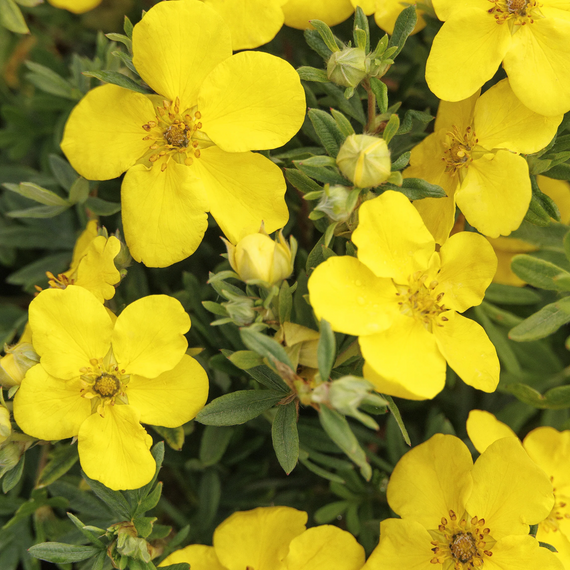
Potentilla fruticosa 'Goldfinger' — commonly known as Goldfinger Shrubby Cinquefoil — is a compact, deciduous flowering shrub that has earned a well-deserved reputation as one of the most reliable and cheerful performers in the landscape. Bearing masses of bright, buttercup-yellow flowers nearly 1.5 inches wide, the blossoms are so prolific during their extended season — from late spring all the way to the first fall frost — that they often completely smother the plant in color. The blooms are beautifully set off against the finely textured, pinnate, dark green foliage that forms a dense, naturally mounded habit reaching 2 to 3 feet tall and spreading 3 to 4 feet wide. A member of the rose family (Rosaceae), 'Goldfinger' is native in origin to the circumpolar Northern Hemisphere, giving it extraordinary cold hardiness into USDA Zone 2, while also tolerating summer heat when sited correctly. It adapts readily to a wide range of well-drained soils — including chalk, sand, loam, and even clay — and is tolerant of poor fertility, drought once established, urban air pollution, and salt exposure. Maintenance demands are minimal: little fertilizer is needed, flowers are self-cleaning, and only an occasional light shaping or periodic rejuvenation prune is required to keep this shrub looking its best for decades. Whether used as a colorful accent specimen, massed along a sunny slope for erosion control, planted as a low informal hedge, incorporated into a mixed shrub border, or grown in a container on a sunny patio, Goldfinger Potentilla delivers season-long golden color with almost effortless grace.
Plant Description
Goldfinger Potentilla (Potentilla fruticosa 'Goldfinger') is a bushy, deciduous shrub of upright yet mounded habit. Its stems — reddish when young and developing attractive cinnamon-brown exfoliating bark with age — are clad in small, pinnate leaves composed of 5 to 7 narrow, elliptic leaflets that are dark green and slightly silky above. The foliage has a fine, delicate texture that creates excellent contrast with coarser-leaved plants in the garden. From late spring through fall, the plant is covered in a continuous display of bright, rich golden-yellow flowers, each a saucer-shaped, 5-petaled bloom approximately 1.5 inches (4 cm) across, centered with a cluster of golden stamens. The blossoms are so abundant they virtually hide the foliage during peak bloom periods. This cultivar is particularly noted for having noticeably larger flowers than many other yellow-flowered potentilla selections, making it one of the showiest of its kind. As a member of the Rosaceae family, 'Goldfinger' shares kinship with roses, strawberries, and other beloved garden plants. The common name "cinquefoil" derives from the French cinq feuilles, meaning "five leaves," a reference to the characteristic five leaflets on each compound leaf.
Mature Size
| Characteristic | Measurement |
|---|---|
| Mature Height | 2 to 3 feet |
| Mature Spread | 3 to 4 feet |
| Growth Rate | Moderate |
| Habit | Dense, mounded, slightly spreading |
| Recommended Spacing | 36 to 48 inches on center |
Goldfinger is one of the more compact shrubby cinquefoil cultivars available, maturing at a tidy 2 to 3 feet tall and 3 to 4 feet wide — a size that fits neatly into modern home landscapes without requiring constant cutting back. Its naturally mounded, spreading form means it rarely needs pruning for size control, though light shaping can be done to refine its outline. The moderate growth rate means it fills in attractively without quickly outgrowing its allotted space.
Hardiness and Climate
Goldfinger Potentilla is exceptionally cold-hardy, thriving in USDA Hardiness Zones 2 through 7, making it one of the most cold-tolerant flowering shrubs available to home gardeners. Its wild ancestors are native to arctic tundra, alpine meadows, and cool northern forests across North America, Europe, and Asia, which explains its remarkable ability to survive extreme winter temperatures with little to no protection. In Southern Oregon and Northern California, it performs excellently in the higher-elevation, cooler zones of the region. It is best suited to climates with cool to moderate summers; in areas with very hot, humid summers (south of USDA Zone 7 in the Southeast), it can struggle. However, in the Mediterranean-influenced climate of the Pacific Northwest and upper California, it adapts very well. It is tolerant of urban conditions including air pollution, salt spray, and reflected heat from pavement, making it suitable for a wide range of challenging garden sites.
Sunlight Requirements
For the most prolific flowering, Goldfinger Potentilla performs best in full sun, receiving at least 6 to 8 hours of direct sunlight per day. Full sun encourages the densest, most abundant bloom production and keeps the plant's naturally compact, tidy form. It will tolerate partial shade (4 to 6 hours of sun), but expect noticeably fewer flowers and a somewhat looser, more open growth habit under reduced light. In climates with very intense afternoon sun and summer heat, a site that receives some light afternoon shade can help prolong the blooming season and keep the vivid yellow flower color from fading. Overall, the sunnier the spot, the more spectacular the display.
Soil and pH Preferences
One of the standout qualities of Goldfinger Potentilla is its remarkable soil adaptability. It grows well in chalk, loam, and sandy soils and tolerates clay soils provided drainage is adequate. Good drainage is the single most important soil requirement — this shrub does not tolerate consistently waterlogged or poorly draining conditions, which can lead to root rot. It performs well across a broad pH range from mildly acidic to mildly alkaline (approximately pH 5.0 to 7.5), and it actually thrives in poor to moderately fertile soils. Excessively rich or heavily amended soils tend to promote lush, floppy vegetative growth at the expense of flowering. Yellowing leaves or stunted growth can sometimes indicate iron deficiency or a pH that is too high; in such cases, a soil test is recommended, and sulfur or chelated iron can be applied to correct the issue.
Watering Guide
During the first growing season after planting, water Goldfinger Potentilla regularly to help establish a deep, healthy root system — approximately 1 inch of water per week, either from rainfall or supplemental irrigation. Once established (typically after one full growing season), this shrub has good drought tolerance and generally requires only occasional deep watering during extended dry spells. Avoid overhead watering when possible; instead, use drip irrigation or a soaker hose at the base of the plant to keep foliage dry and reduce the risk of fungal diseases. Overwatering or allowing the roots to sit in standing water is the most common cause of poor performance and decline in this shrub. Allow the soil to partially dry out between waterings once the plant is established. During extreme summer heat, plants may benefit from a deep soak once or twice a week to prevent wilt stress.
Fertilizing
Goldfinger Potentilla is a light feeder and requires very little supplemental fertilization, especially once established. Over-fertilizing — particularly with high-nitrogen products — encourages excessive leafy growth, legginess, and reduced flowering. In spring, as new growth begins to emerge, a light application of a balanced, slow-release granular fertilizer (such as a 10-10-10 formulation) or a 2-inch top-dressing of compost around the base of the plant is sufficient to support healthy growth for the season. Avoid applying fertilizer in late summer or fall, as this can stimulate tender new growth that is vulnerable to cold damage. In naturally fertile soils, no fertilization may be needed at all. An annual mulching with organic material such as shredded bark or compost provides a steady, gentle nutrient release while also conserving soil moisture and suppressing weeds.
Pruning and Maintenance
Goldfinger Potentilla is one of the easiest landscape shrubs to maintain. The flowers are self-cleaning — they drop their petals cleanly without the need for deadheading — and the plant maintains a naturally tidy, mounded form that rarely requires pruning for size control. That said, a light annual pruning improves the plant's vigor and floral display over time. Follow these guidelines:
- Annual maintenance prune: In late winter or very early spring, before new growth begins, cut out any dead, damaged, or crossing branches and lightly shape the plant to maintain its mounded form. Remove approximately one-third of the oldest, woodiest stems at the base to encourage vigorous new growth from the center.
- Mid-season trim: After the first main flush of bloom in midsummer, a light shearing can help tidy the plant and encourage a fresh flush of flowers for fall.
- Rejuvenation pruning: Older, overgrown, or leggy plants can be cut back hard — to as low as 4 to 6 inches from the ground — in late winter every 4 to 5 years to completely renew the plant. It will regrow vigorously and bloom heavily by the following summer.
- Avoid heavy fall pruning: Do not prune heavily in late summer or fall, as the remaining stems provide some insulation and protection from winter cold.
Planting Instructions
- Choose the right site: Select a location that receives at least 6 hours of full sun per day and has well-drained soil. Avoid low spots where water pools.
- Prepare the soil: Loosen the soil in the planting area to a depth of 10 to 12 inches. Incorporate compost to improve drainage in clay soils or water retention in sandy soils. Potentilla does not need rich soil — avoid over-amending.
- Dig the hole: Dig a hole approximately 1.5 times the width of the root ball and equal to or slightly shallower than its depth.
- Set the plant: Place the shrub in the hole so that the top of the root ball sits at or just slightly above the surrounding soil level. Planting high helps prevent crown rot, especially in heavier soils.
- Backfill and firm: Fill in around the root ball with the native soil, gently firming it to eliminate large air pockets. Do not amend the backfill heavily with compost, as this can discourage roots from spreading outward.
- Water thoroughly: Give the plant a generous, deep watering immediately after planting to settle the soil and hydrate the roots.
- Mulch: Apply a 2-inch layer of organic mulch (shredded bark or wood chips) around the base of the plant, keeping it 1 inch away from the stems to prevent rot and discourage rodents.
- Spacing: Plant 36 to 48 inches apart (on center) for mass plantings or hedge rows.
Best planting times are early spring or early fall when temperatures are mild and root establishment is easiest. Spring planting gives the roots a full growing season to establish before facing summer heat or winter cold.
Seasonal Interest
| Season | What to Expect |
|---|---|
| Spring | Fine-textured, dark green foliage emerges; flower buds begin to appear by late spring; first golden-yellow blooms open. |
| Summer | Peak bloom period; the plant is smothered in large, rich yellow flowers from early through late summer; a continuous, non-stop show throughout the hottest months. |
| Fall | Flowering continues right up to the first hard frost; foliage may take on subtle bronze to reddish tones as temperatures cool, adding warm fall color interest. |
| Winter | Deciduous; stems remain attractive in the winter landscape with cinnamon-brown, slightly exfoliating bark that catches the light and provides subtle structure in the dormant garden. |
Landscape Uses
Goldfinger Potentilla is one of the most versatile and adaptable flowering shrubs for the home landscape. Its long bloom season, tidy habit, and easy-care nature make it suitable for a wide variety of uses:
- Mixed shrub borders: Use as a colorful mid-border accent alongside other flowering shrubs and perennials for months of continuous yellow color.
- Foundation plantings: The compact, mounded form and non-invasive roots make it an excellent choice for planting along home foundations and building entrances.
- Informal hedges and screens: Mass several plants in a row for a low to medium-height informal flowering hedge along pathways, driveways, or property lines.
- Rock gardens: The plant's tolerance for poor, rocky, well-drained soil makes it ideal for rock garden settings where many other shrubs would struggle.
- Slope planting and erosion control: The fibrous root system helps stabilize slopes and banks while the spreading habit provides excellent ground coverage.
- Cottage and informal garden styles: Its cheerful, casual yellow flowers fit naturally into cottage-style, coastal, and informal garden designs.
- Container gardening: Grows well in large containers (15 gallons or larger) on sunny patios and decks; bring containers to a sheltered location in winter in colder zones.
- Pollinator gardens: Plant in drifts with other pollinator-friendly perennials to support butterflies, bees, and other beneficial insects throughout the long blooming season.
- Urban and coastal gardens: Tolerates salt air, air pollution, and challenging urban conditions, making it a reliable choice for streetscapes and seaside gardens.
Companion Plants
Goldfinger Potentilla pairs beautifully with many sun-loving perennials and shrubs that share its preference for well-drained soil and full sun. The following companions complement its golden-yellow blooms and fine-textured foliage particularly well:
- Catmint (Nepeta spp.): Soft blue-purple flower spikes create a classic, high-contrast pairing with the bright yellow blooms; both are long-blooming and drought-tolerant.
- Lavender (Lavandula angustifolia): The silvery foliage and purple flower spikes of lavender provide stunning color contrast and complement Goldfinger's fine-textured green foliage.
- Russian Sage (Perovskia atriplicifolia): The airy, violet-blue haze of Russian sage makes an excellent tall backdrop that dramatically offsets the warm yellow tones of Goldfinger.
- Coreopsis: Yellow and golden coreopsis varieties extend and echo the warm color palette, while the fine-textured foliage echoes that of the potentilla.
- Black-Eyed Susan (Rudbeckia): The warm gold and brown tones of rudbeckia harmonize beautifully with Goldfinger for a sunny, naturalistic planting.
- Ornamental grasses (Festuca, Pennisetum): The contrasting texture of fine-bladed grasses adds movement and complements the mounded form of Goldfinger.
- Yarrow (Achillea): Flat-topped flower clusters in yellow, white, or pink tones, combined with feathery foliage, create a cottage-garden feel alongside Goldfinger.
- Sedum (Hylotelephium): Low-water, late-season bloomers that take over as autumn progresses, extending the garden's interest after Goldfinger's final flush of flowers.
- Mexican Daisy (Erigeron karvinskianus): Delicate white-to-pink daisy flowers provide a soft, cloud-like foil to the bold yellow blooms of Goldfinger.
Pests and Diseases
When planted in the right conditions — well-drained soil, full sun, and good air circulation — Goldfinger Potentilla is remarkably resistant to pests and diseases and is considered virtually trouble-free. The following issues are occasionally encountered:
- Spider mites: May appear during hot, dry conditions, causing bronzed or stippled foliage and fine webbing on the undersides of leaves. Treat with a strong spray of water to dislodge mites, or apply insecticidal soap or neem oil if infestations are heavy.
- Powdery mildew: A fungal disease that can appear as a white, powdery coating on leaves in conditions of high humidity, poor air circulation, or excessive shade. Improve air circulation by thinning congested stems, avoid overhead watering, and treat with a sulfur-based fungicide or neem oil if needed.
- Aphids: Occasionally appear on new growth in spring. Usually controlled by natural predators (ladybugs, lacewings) or a strong blast of water.
- Fungal leaf spot: Can occur in overly humid or shaded conditions. Remove and dispose of affected foliage and improve air flow around the plant.
- Root rot: The most serious problem, typically caused by overwatering or poor drainage. Ensure excellent drainage and avoid waterlogged soils. There is no cure for severe root rot; prevention is essential.
Goldfinger Potentilla is also reliably deer-resistant and rabbit-resistant, as the foliage contains bitter compounds that browsing animals find unappealing.
Wildlife Value
Goldfinger Potentilla is a valuable addition to pollinator-friendly and wildlife gardens. The prolific, long-blooming flowers are an excellent nectar and pollen source for a wide range of beneficial insects throughout the entire growing season — from late spring through fall. Butterflies are particularly attracted to the open, accessible blooms, and bees of many species, including native bumblebees and honeybees, visit the flowers regularly. Because blooming spans approximately 5 months of the growing season, the plant provides a sustained and reliable food source during a period when many other shrubs have finished flowering. The plant is deer-resistant and rabbit-resistant, making it an excellent choice for gardens in areas with high wildlife pressure. The dense, twiggy branching structure can also offer nesting cover for small songbirds during the growing season. Goldfinger Potentilla is not invasive and does not aggressively self-seed, so it supports local biodiversity without threatening native plant communities.
Container Growing
Goldfinger Potentilla adapts well to container culture and makes a striking specimen on a sunny patio, deck, or entryway. For best results, follow these guidelines:
- Container size: Use a pot that is at least 15 gallons in volume to accommodate the mature root system and allow for several seasons of growth without repotting. Ensure the container has drainage holes.
- Potting mix: Use a well-draining potting mix. Incorporating perlite or coarse sand (up to 20 to 30% of the mix) improves drainage and reduces the risk of root rot.
- Watering: Container-grown plants dry out faster than in-ground plants and will require more frequent watering — check soil moisture every few days in summer and water when the top 2 to 3 inches of soil are dry.
- Fertilizing: Feed container plants with a balanced slow-release fertilizer in spring, as nutrients leach from containers more quickly with regular watering.
- Winter care: In USDA Zones 4 and colder, move containers to an unheated but frost-protected garage, shed, or cool basement when temperatures drop below 20°F. Water sparingly (about once a month) during winter dormancy. In Zones 5 to 7, containers may overwinter outdoors in a sheltered location with mulch or burlap insulation around the pot.
- Repotting: Repot or refresh the growing medium every 3 years to maintain plant vigor.
Propagation
Goldfinger Potentilla can be propagated by home gardeners using the following methods:
- Softwood cuttings (recommended): Take 4 to 6-inch tip cuttings of non-flowering new growth in early summer (June). Strip the lower leaves, dip the cut end in rooting hormone powder, and insert into a well-draining propagation mix (equal parts perlite and peat, or a commercial cutting mix). Keep cuttings moist and in bright indirect light until roots form, typically within 2 to 3 weeks. Rooting success is typically very high with this method.
- Division: Established plants can be carefully dug and divided in early spring before new growth begins. Each division should have at least 3 to 5 healthy stems and a good root section. Replant immediately and water well. Division both propagates the plant and rejuvenates older specimens.
- Hardwood cuttings: Can be taken in late fall or winter from dormant stems and rooted in a cold frame or cool greenhouse over winter.
Growing from seed is not recommended for this named cultivar, as seed-grown plants will not reliably reproduce the superior flower size, bloom duration, and compact habit that define 'Goldfinger.'
- Smothered in large, rich golden-yellow blooms up to 1.5 inches across from late spring through the first hard frost — one of the longest flowering seasons of any landscape shrub.
- Exceptionally tough and low-maintenance: tolerates drought, poor soils, salt, and hard winters, yet remains virtually pest- and disease-free in the right conditions.
- Naturally deer- and rabbit-resistant with a tidy, mounded, fine-textured form that fits beautifully into borders, foundation plantings, low informal hedges, and containers.
- A pollinator magnet — the prolific blossoms attract butterflies and bees throughout the entire growing season, adding wildlife value to any sunny garden.
Potentilla fruticosa 'Goldfinger' — commonly known as Goldfinger Shrubby Cinquefoil — is a compact, deciduous flowering shrub that has earned a well-deserved reputation as one of the most reliable and cheerful performers in the landscape. Bearing masses of bright, buttercup-yellow flowers nearly 1.5 inches wide, the blossoms are so prolific during their extended season — from late spring all the way to the first fall frost — that they often completely smother the plant in color. The blooms are beautifully set off against the finely textured, pinnate, dark green foliage that forms a dense, naturally mounded habit reaching 2 to 3 feet tall and spreading 3 to 4 feet wide. A member of the rose family (Rosaceae), 'Goldfinger' is native in origin to the circumpolar Northern Hemisphere, giving it extraordinary cold hardiness into USDA Zone 2, while also tolerating summer heat when sited correctly. It adapts readily to a wide range of well-drained soils — including chalk, sand, loam, and even clay — and is tolerant of poor fertility, drought once established, urban air pollution, and salt exposure. Maintenance demands are minimal: little fertilizer is needed, flowers are self-cleaning, and only an occasional light shaping or periodic rejuvenation prune is required to keep this shrub looking its best for decades. Whether used as a colorful accent specimen, massed along a sunny slope for erosion control, planted as a low informal hedge, incorporated into a mixed shrub border, or grown in a container on a sunny patio, Goldfinger Potentilla delivers season-long golden color with almost effortless grace.
Plant Description
Goldfinger Potentilla (Potentilla fruticosa 'Goldfinger') is a bushy, deciduous shrub of upright yet mounded habit. Its stems — reddish when young and developing attractive cinnamon-brown exfoliating bark with age — are clad in small, pinnate leaves composed of 5 to 7 narrow, elliptic leaflets that are dark green and slightly silky above. The foliage has a fine, delicate texture that creates excellent contrast with coarser-leaved plants in the garden. From late spring through fall, the plant is covered in a continuous display of bright, rich golden-yellow flowers, each a saucer-shaped, 5-petaled bloom approximately 1.5 inches (4 cm) across, centered with a cluster of golden stamens. The blossoms are so abundant they virtually hide the foliage during peak bloom periods. This cultivar is particularly noted for having noticeably larger flowers than many other yellow-flowered potentilla selections, making it one of the showiest of its kind. As a member of the Rosaceae family, 'Goldfinger' shares kinship with roses, strawberries, and other beloved garden plants. The common name "cinquefoil" derives from the French cinq feuilles, meaning "five leaves," a reference to the characteristic five leaflets on each compound leaf.
Mature Size
| Characteristic | Measurement |
|---|---|
| Mature Height | 2 to 3 feet |
| Mature Spread | 3 to 4 feet |
| Growth Rate | Moderate |
| Habit | Dense, mounded, slightly spreading |
| Recommended Spacing | 36 to 48 inches on center |
Goldfinger is one of the more compact shrubby cinquefoil cultivars available, maturing at a tidy 2 to 3 feet tall and 3 to 4 feet wide — a size that fits neatly into modern home landscapes without requiring constant cutting back. Its naturally mounded, spreading form means it rarely needs pruning for size control, though light shaping can be done to refine its outline. The moderate growth rate means it fills in attractively without quickly outgrowing its allotted space.
Hardiness and Climate
Goldfinger Potentilla is exceptionally cold-hardy, thriving in USDA Hardiness Zones 2 through 7, making it one of the most cold-tolerant flowering shrubs available to home gardeners. Its wild ancestors are native to arctic tundra, alpine meadows, and cool northern forests across North America, Europe, and Asia, which explains its remarkable ability to survive extreme winter temperatures with little to no protection. In Southern Oregon and Northern California, it performs excellently in the higher-elevation, cooler zones of the region. It is best suited to climates with cool to moderate summers; in areas with very hot, humid summers (south of USDA Zone 7 in the Southeast), it can struggle. However, in the Mediterranean-influenced climate of the Pacific Northwest and upper California, it adapts very well. It is tolerant of urban conditions including air pollution, salt spray, and reflected heat from pavement, making it suitable for a wide range of challenging garden sites.
Sunlight Requirements
For the most prolific flowering, Goldfinger Potentilla performs best in full sun, receiving at least 6 to 8 hours of direct sunlight per day. Full sun encourages the densest, most abundant bloom production and keeps the plant's naturally compact, tidy form. It will tolerate partial shade (4 to 6 hours of sun), but expect noticeably fewer flowers and a somewhat looser, more open growth habit under reduced light. In climates with very intense afternoon sun and summer heat, a site that receives some light afternoon shade can help prolong the blooming season and keep the vivid yellow flower color from fading. Overall, the sunnier the spot, the more spectacular the display.
Soil and pH Preferences
One of the standout qualities of Goldfinger Potentilla is its remarkable soil adaptability. It grows well in chalk, loam, and sandy soils and tolerates clay soils provided drainage is adequate. Good drainage is the single most important soil requirement — this shrub does not tolerate consistently waterlogged or poorly draining conditions, which can lead to root rot. It performs well across a broad pH range from mildly acidic to mildly alkaline (approximately pH 5.0 to 7.5), and it actually thrives in poor to moderately fertile soils. Excessively rich or heavily amended soils tend to promote lush, floppy vegetative growth at the expense of flowering. Yellowing leaves or stunted growth can sometimes indicate iron deficiency or a pH that is too high; in such cases, a soil test is recommended, and sulfur or chelated iron can be applied to correct the issue.
Watering Guide
During the first growing season after planting, water Goldfinger Potentilla regularly to help establish a deep, healthy root system — approximately 1 inch of water per week, either from rainfall or supplemental irrigation. Once established (typically after one full growing season), this shrub has good drought tolerance and generally requires only occasional deep watering during extended dry spells. Avoid overhead watering when possible; instead, use drip irrigation or a soaker hose at the base of the plant to keep foliage dry and reduce the risk of fungal diseases. Overwatering or allowing the roots to sit in standing water is the most common cause of poor performance and decline in this shrub. Allow the soil to partially dry out between waterings once the plant is established. During extreme summer heat, plants may benefit from a deep soak once or twice a week to prevent wilt stress.
Fertilizing
Goldfinger Potentilla is a light feeder and requires very little supplemental fertilization, especially once established. Over-fertilizing — particularly with high-nitrogen products — encourages excessive leafy growth, legginess, and reduced flowering. In spring, as new growth begins to emerge, a light application of a balanced, slow-release granular fertilizer (such as a 10-10-10 formulation) or a 2-inch top-dressing of compost around the base of the plant is sufficient to support healthy growth for the season. Avoid applying fertilizer in late summer or fall, as this can stimulate tender new growth that is vulnerable to cold damage. In naturally fertile soils, no fertilization may be needed at all. An annual mulching with organic material such as shredded bark or compost provides a steady, gentle nutrient release while also conserving soil moisture and suppressing weeds.
Pruning and Maintenance
Goldfinger Potentilla is one of the easiest landscape shrubs to maintain. The flowers are self-cleaning — they drop their petals cleanly without the need for deadheading — and the plant maintains a naturally tidy, mounded form that rarely requires pruning for size control. That said, a light annual pruning improves the plant's vigor and floral display over time. Follow these guidelines:
- Annual maintenance prune: In late winter or very early spring, before new growth begins, cut out any dead, damaged, or crossing branches and lightly shape the plant to maintain its mounded form. Remove approximately one-third of the oldest, woodiest stems at the base to encourage vigorous new growth from the center.
- Mid-season trim: After the first main flush of bloom in midsummer, a light shearing can help tidy the plant and encourage a fresh flush of flowers for fall.
- Rejuvenation pruning: Older, overgrown, or leggy plants can be cut back hard — to as low as 4 to 6 inches from the ground — in late winter every 4 to 5 years to completely renew the plant. It will regrow vigorously and bloom heavily by the following summer.
- Avoid heavy fall pruning: Do not prune heavily in late summer or fall, as the remaining stems provide some insulation and protection from winter cold.
Planting Instructions
- Choose the right site: Select a location that receives at least 6 hours of full sun per day and has well-drained soil. Avoid low spots where water pools.
- Prepare the soil: Loosen the soil in the planting area to a depth of 10 to 12 inches. Incorporate compost to improve drainage in clay soils or water retention in sandy soils. Potentilla does not need rich soil — avoid over-amending.
- Dig the hole: Dig a hole approximately 1.5 times the width of the root ball and equal to or slightly shallower than its depth.
- Set the plant: Place the shrub in the hole so that the top of the root ball sits at or just slightly above the surrounding soil level. Planting high helps prevent crown rot, especially in heavier soils.
- Backfill and firm: Fill in around the root ball with the native soil, gently firming it to eliminate large air pockets. Do not amend the backfill heavily with compost, as this can discourage roots from spreading outward.
- Water thoroughly: Give the plant a generous, deep watering immediately after planting to settle the soil and hydrate the roots.
- Mulch: Apply a 2-inch layer of organic mulch (shredded bark or wood chips) around the base of the plant, keeping it 1 inch away from the stems to prevent rot and discourage rodents.
- Spacing: Plant 36 to 48 inches apart (on center) for mass plantings or hedge rows.
Best planting times are early spring or early fall when temperatures are mild and root establishment is easiest. Spring planting gives the roots a full growing season to establish before facing summer heat or winter cold.
Seasonal Interest
| Season | What to Expect |
|---|---|
| Spring | Fine-textured, dark green foliage emerges; flower buds begin to appear by late spring; first golden-yellow blooms open. |
| Summer | Peak bloom period; the plant is smothered in large, rich yellow flowers from early through late summer; a continuous, non-stop show throughout the hottest months. |
| Fall | Flowering continues right up to the first hard frost; foliage may take on subtle bronze to reddish tones as temperatures cool, adding warm fall color interest. |
| Winter | Deciduous; stems remain attractive in the winter landscape with cinnamon-brown, slightly exfoliating bark that catches the light and provides subtle structure in the dormant garden. |
Landscape Uses
Goldfinger Potentilla is one of the most versatile and adaptable flowering shrubs for the home landscape. Its long bloom season, tidy habit, and easy-care nature make it suitable for a wide variety of uses:
- Mixed shrub borders: Use as a colorful mid-border accent alongside other flowering shrubs and perennials for months of continuous yellow color.
- Foundation plantings: The compact, mounded form and non-invasive roots make it an excellent choice for planting along home foundations and building entrances.
- Informal hedges and screens: Mass several plants in a row for a low to medium-height informal flowering hedge along pathways, driveways, or property lines.
- Rock gardens: The plant's tolerance for poor, rocky, well-drained soil makes it ideal for rock garden settings where many other shrubs would struggle.
- Slope planting and erosion control: The fibrous root system helps stabilize slopes and banks while the spreading habit provides excellent ground coverage.
- Cottage and informal garden styles: Its cheerful, casual yellow flowers fit naturally into cottage-style, coastal, and informal garden designs.
- Container gardening: Grows well in large containers (15 gallons or larger) on sunny patios and decks; bring containers to a sheltered location in winter in colder zones.
- Pollinator gardens: Plant in drifts with other pollinator-friendly perennials to support butterflies, bees, and other beneficial insects throughout the long blooming season.
- Urban and coastal gardens: Tolerates salt air, air pollution, and challenging urban conditions, making it a reliable choice for streetscapes and seaside gardens.
Companion Plants
Goldfinger Potentilla pairs beautifully with many sun-loving perennials and shrubs that share its preference for well-drained soil and full sun. The following companions complement its golden-yellow blooms and fine-textured foliage particularly well:
- Catmint (Nepeta spp.): Soft blue-purple flower spikes create a classic, high-contrast pairing with the bright yellow blooms; both are long-blooming and drought-tolerant.
- Lavender (Lavandula angustifolia): The silvery foliage and purple flower spikes of lavender provide stunning color contrast and complement Goldfinger's fine-textured green foliage.
- Russian Sage (Perovskia atriplicifolia): The airy, violet-blue haze of Russian sage makes an excellent tall backdrop that dramatically offsets the warm yellow tones of Goldfinger.
- Coreopsis: Yellow and golden coreopsis varieties extend and echo the warm color palette, while the fine-textured foliage echoes that of the potentilla.
- Black-Eyed Susan (Rudbeckia): The warm gold and brown tones of rudbeckia harmonize beautifully with Goldfinger for a sunny, naturalistic planting.
- Ornamental grasses (Festuca, Pennisetum): The contrasting texture of fine-bladed grasses adds movement and complements the mounded form of Goldfinger.
- Yarrow (Achillea): Flat-topped flower clusters in yellow, white, or pink tones, combined with feathery foliage, create a cottage-garden feel alongside Goldfinger.
- Sedum (Hylotelephium): Low-water, late-season bloomers that take over as autumn progresses, extending the garden's interest after Goldfinger's final flush of flowers.
- Mexican Daisy (Erigeron karvinskianus): Delicate white-to-pink daisy flowers provide a soft, cloud-like foil to the bold yellow blooms of Goldfinger.
Pests and Diseases
When planted in the right conditions — well-drained soil, full sun, and good air circulation — Goldfinger Potentilla is remarkably resistant to pests and diseases and is considered virtually trouble-free. The following issues are occasionally encountered:
- Spider mites: May appear during hot, dry conditions, causing bronzed or stippled foliage and fine webbing on the undersides of leaves. Treat with a strong spray of water to dislodge mites, or apply insecticidal soap or neem oil if infestations are heavy.
- Powdery mildew: A fungal disease that can appear as a white, powdery coating on leaves in conditions of high humidity, poor air circulation, or excessive shade. Improve air circulation by thinning congested stems, avoid overhead watering, and treat with a sulfur-based fungicide or neem oil if needed.
- Aphids: Occasionally appear on new growth in spring. Usually controlled by natural predators (ladybugs, lacewings) or a strong blast of water.
- Fungal leaf spot: Can occur in overly humid or shaded conditions. Remove and dispose of affected foliage and improve air flow around the plant.
- Root rot: The most serious problem, typically caused by overwatering or poor drainage. Ensure excellent drainage and avoid waterlogged soils. There is no cure for severe root rot; prevention is essential.
Goldfinger Potentilla is also reliably deer-resistant and rabbit-resistant, as the foliage contains bitter compounds that browsing animals find unappealing.
Wildlife Value
Goldfinger Potentilla is a valuable addition to pollinator-friendly and wildlife gardens. The prolific, long-blooming flowers are an excellent nectar and pollen source for a wide range of beneficial insects throughout the entire growing season — from late spring through fall. Butterflies are particularly attracted to the open, accessible blooms, and bees of many species, including native bumblebees and honeybees, visit the flowers regularly. Because blooming spans approximately 5 months of the growing season, the plant provides a sustained and reliable food source during a period when many other shrubs have finished flowering. The plant is deer-resistant and rabbit-resistant, making it an excellent choice for gardens in areas with high wildlife pressure. The dense, twiggy branching structure can also offer nesting cover for small songbirds during the growing season. Goldfinger Potentilla is not invasive and does not aggressively self-seed, so it supports local biodiversity without threatening native plant communities.
Container Growing
Goldfinger Potentilla adapts well to container culture and makes a striking specimen on a sunny patio, deck, or entryway. For best results, follow these guidelines:
- Container size: Use a pot that is at least 15 gallons in volume to accommodate the mature root system and allow for several seasons of growth without repotting. Ensure the container has drainage holes.
- Potting mix: Use a well-draining potting mix. Incorporating perlite or coarse sand (up to 20 to 30% of the mix) improves drainage and reduces the risk of root rot.
- Watering: Container-grown plants dry out faster than in-ground plants and will require more frequent watering — check soil moisture every few days in summer and water when the top 2 to 3 inches of soil are dry.
- Fertilizing: Feed container plants with a balanced slow-release fertilizer in spring, as nutrients leach from containers more quickly with regular watering.
- Winter care: In USDA Zones 4 and colder, move containers to an unheated but frost-protected garage, shed, or cool basement when temperatures drop below 20°F. Water sparingly (about once a month) during winter dormancy. In Zones 5 to 7, containers may overwinter outdoors in a sheltered location with mulch or burlap insulation around the pot.
- Repotting: Repot or refresh the growing medium every 3 years to maintain plant vigor.
Propagation
Goldfinger Potentilla can be propagated by home gardeners using the following methods:
- Softwood cuttings (recommended): Take 4 to 6-inch tip cuttings of non-flowering new growth in early summer (June). Strip the lower leaves, dip the cut end in rooting hormone powder, and insert into a well-draining propagation mix (equal parts perlite and peat, or a commercial cutting mix). Keep cuttings moist and in bright indirect light until roots form, typically within 2 to 3 weeks. Rooting success is typically very high with this method.
- Division: Established plants can be carefully dug and divided in early spring before new growth begins. Each division should have at least 3 to 5 healthy stems and a good root section. Replant immediately and water well. Division both propagates the plant and rejuvenates older specimens.
- Hardwood cuttings: Can be taken in late fall or winter from dormant stems and rooted in a cold frame or cool greenhouse over winter.
Growing from seed is not recommended for this named cultivar, as seed-grown plants will not reliably reproduce the superior flower size, bloom duration, and compact habit that define 'Goldfinger.'
Related Products