
Zoom the image with the mouse
Shrubby Yew Podocarpus - 1 Gallon
SKU:
2096195
UPC:
014949033647
$24.99
- Slow-growing, densely columnar evergreen shrub with lustrous, dark green needle-like foliage that delivers refined, year-round elegance in the landscape
- Exceptionally versatile — thrives as a formal hedge, privacy screen, topiary specimen, foundation planting, or striking container plant
- Tough and low-maintenance with outstanding tolerance to drought, coastal salt spray, deer browsing, and a wide range of soil types
- Well-suited to narrow spaces and smaller yards, with a naturally upright, pyramidal habit that requires minimal corrective pruning
Podocarpus macrophyllus 'Maki', commonly known as Shrubby Yew Podocarpus or Chinese Podocarpus, is a refined and versatile broadleaf evergreen conifer prized across warm-climate gardens for its dense, upright pyramidal form and rich, deep green foliage. Native to southern China, Japan, Taiwan, and northern Myanmar, this slow-growing cultivar of the larger yew podocarpus species produces spirally arranged, leathery, waxy, lance-shaped needles that remain glossy and vibrant throughout all four seasons, making it one of the most dependable year-round evergreens available for landscapes in USDA Zones 7 through 11. Reaching a mature height of 8 to 15 feet with a compact spread of just 2 to 4 feet, 'Maki' is ideally proportioned for tight spaces, narrow side yards, and foundation plantings where a tall, slender profile is desired without the sprawling footprint of broader shrubs. Its naturally formal, columnar silhouette responds beautifully to shearing, making it equally at home clipped into a crisp privacy hedge or sculpted into elegant topiary. Beyond its ornamental qualities, Shrubby Yew Podocarpus earns its place in the landscape through exceptional adaptability — tolerating drought once established, resisting deer browsing, withstanding coastal salt exposure, and performing well in a broad range of well-drained soils from sandy loam to clay. Whether used as a sleek architectural accent, a low-maintenance screen, or a long-lived container specimen for patios and entryways, Podocarpus 'Maki' delivers enduring beauty with minimal fuss, making it an outstanding choice for Southern Oregon and Northern California gardens.
Plant Description
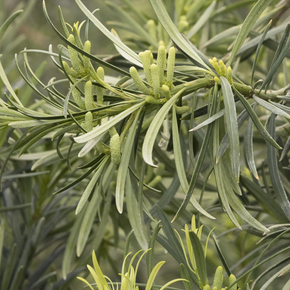
Podocarpus macrophyllus 'Maki' is a densely compact, broadleaf evergreen conifer belonging to the Podocarpaceae family. It produces spirally arranged, linear to lance-shaped needles that measure approximately 0.5 to 2.7 inches long, with a leathery, waxy texture and a lustrous, deep green color accented by a pale, raised midrib visible on both surfaces. The foliage is pleasantly fragrant when crushed or bruised. The overall growth habit is strongly upright and narrowly pyramidal, with dense branching that holds its refined form with little intervention. Unlike many conifers, this dioecious species produces small, fleshy, olive-green berry-like cones on female plants that ripen to a deep blue-purple in their second year and are borne on swollen, bright red, fleshy stalks that add a subtle ornamental accent. While the red receptacle stalks are edible, the seeds themselves are toxic and should be kept away from children and pets.
Mature Size
| Characteristic | Measurement |
|---|---|
| Mature Height | 8 to 15 feet |
| Mature Spread | 2 to 4 feet |
| Growth Rate | Slow (typically 3 to 6 inches per year) |
| Plant Form | Narrow, upright, columnar to pyramidal |
| Recommended Spacing (hedge) | 24 to 48 inches on center |
| Texture | Fine |
With pruning and shearing, Shrubby Yew Podocarpus can easily be maintained at a shorter, more compact size. Its slow growth rate makes it a long-lived, low-effort addition to the landscape that rarely outgrows its allotted space.
Hardiness Zones and Climate
Podocarpus macrophyllus 'Maki' is rated hardy in USDA Plant Hardiness Zones 7 through 11, and performs well across Sunset Climate Zones 4, 5, 6, 7, 8, 9, and 12 through 24, including Hawaii zones H1 and H2. It is heat-tolerant through AHS Heat Zones 7 to 12. This makes it an excellent choice for the mild, dry summers and cool winters characteristic of Southern Oregon and Northern California's inland valleys and coastal regions. The plant can tolerate temperatures down to approximately 0 to 10 degrees F before significant foliage or stem damage occurs. In borderline Zone 7 locations, a light frost cover during severe cold snaps is recommended to protect tender new growth. In coastal settings, its strong salt tolerance makes it a reliable performer in marine-influenced microclimates.
Sunlight Requirements
Shrubby Yew Podocarpus is highly adaptable when it comes to light exposure. It performs best in full sun (6 or more hours of direct sunlight per day) but grows very well in partial shade (2 to 6 hours of direct sun). It can even tolerate deep shade as long as it receives good ambient brightness throughout the day. In shadier conditions the plant remains healthy but may develop a slightly more open habit; full sun tends to produce the densest, most compact growth and the richest foliage color. In hot inland gardens, afternoon shade can help prevent moisture stress during the peak of summer. This wide light tolerance makes 'Maki' suitable for a broad range of landscape placements, from open, sunny borders to shaded side yards and sheltered entryways.
Soil and pH Preferences
Podocarpus 'Maki' thrives in a wide range of soil types, including sandy loam, loam, clay, and chalk-based soils, provided drainage is adequate. It strongly prefers moist but well-drained conditions and is intolerant of constantly saturated or waterlogged soils, which can quickly lead to root rot and decline. For best results, amend heavy clay soils with coarse sand and organic compost to improve drainage before planting. In very sandy, fast-draining soils, the addition of compost or peat moss helps retain some moisture around the root zone.
- Preferred soil pH: 4.5 to 7.5 (slightly acidic to neutral is ideal)
- Avoid highly alkaline soils, which can cause iron chlorosis (yellowing of foliage)
- If chlorosis develops, amend with soil sulfur, aluminum sulfate, or a chelated iron product to lower pH
- Mulching with pine straw or wood chips helps maintain slight soil acidity over time
- Test soil pH before planting if alkaline conditions are suspected in your area
Watering Guide
Proper watering is most critical during the establishment period immediately following planting. Once established, Shrubby Yew Podocarpus becomes quite drought tolerant and requires minimal supplemental irrigation in most Pacific Coast climates.
- At planting: Thoroughly soak the root ball and surrounding soil to the full depth of the root ball immediately after planting.
- First growing season: Water deeply and infrequently, allowing the top inch or two of soil to partially dry between waterings. Deep, less frequent soaking encourages deeper root development and is far preferable to shallow daily watering.
- Established plants: In most garden settings, established plants require little to no supplemental irrigation. During prolonged summer drought, water if you observe wilting of new leaves or drooping stem tips.
- Container plants: Check moisture regularly; water when the top 2 inches of potting mix feel dry to the touch. Containers dry out much faster than in-ground plantings, especially in summer heat.
- Important: Never allow the root zone to remain constantly wet or boggy. Overwatering is the most common cause of decline in podocarpus.
- When using automated irrigation, program watering cycles for early morning to minimize fungal disease risk.
Fertilizing
Podocarpus 'Maki' is not a heavy feeder and grows well without aggressive fertilization. However, regular feeding supports healthy foliage color, steady growth, and overall plant vigor.
- In-ground plants: Apply a slow-release shrub and tree fertilizer in early spring as new growth emerges. Choose a formula that includes iron and sulfur to promote deep, rich green foliage color and help maintain slightly acidic soil conditions.
- Container plants: Use a slow-release granular fertilizer or a balanced, water-soluble liquid fertilizer formulated for container plants. Apply according to label directions through the active growing season.
- A balanced NPK ratio such as 6-6-6 or 8-8-8 applied up to three times during the growing season (spring, early summer, midsummer) is effective for in-ground plants.
- Organic fertilizers or compost top-dressings are excellent supplemental options that also improve soil biology over time.
- Important: Stop all fertilization at least 2 months before the average first frost date in your area to prevent stimulating tender new growth that could be damaged by cold.
- Do not fertilize during winter dormancy.
Pruning and Maintenance
One of the most appealing qualities of Shrubby Yew Podocarpus is its naturally tidy, upright habit that requires very little corrective pruning under normal circumstances. However, it responds exceptionally well to shearing and shaping, making it a favorite choice for formal hedges, privacy screens, and topiary.
- Formal hedging and shaping: Shear or trim to shape at almost any time during the growing season. For the cleanest results on formal hedges, shear once in late spring after the first flush of new growth and again in midsummer if needed.
- Hard pruning for size reduction or topiary: Perform significant size reduction cuts in late winter or early spring, just before new growth emerges. This allows the plant to recover quickly and fill in evenly.
- Damage removal: Remove any broken, dead, or diseased branches promptly, cutting at least 2 inches below the point of damage into healthy wood.
- Always use sharp, clean bypass pruners or loppers to make smooth cuts and reduce disease entry points.
- Important: Cease all pruning at least 2 months before the expected first fall frost to avoid triggering frost-susceptible new growth late in the season.
- No deadheading is required, as the plant does not produce showy flowers.
Planting Instructions
- Choose a site with full sun to partial shade and well-drained soil. Test soil drainage and pH before planting; amend as needed to achieve a pH of 4.5 to 7.5 and good water movement through the soil profile.
- Dig a planting hole at least 2 to 3 times as wide as the root ball and no deeper than the root ball height. A wide, shallow hole encourages lateral root spread.
- In dense clay soils, mix the excavated soil with coarse sand, compost, or a quality planting mix at a 50/50 ratio. In sandy soils, incorporate compost or peat moss to improve moisture retention.
- Remove the plant from its container and gently loosen any circling roots around the sides and base of the root ball.
- Set the plant in the hole so that the top of the root ball sits at or very slightly above the surrounding soil grade to allow for settling. Never plant too deep.
- Backfill with the amended soil mixture, tamping gently as you go to eliminate air pockets. Do not mound soil over the top of the root ball.
- Construct a shallow water-retention berm around the outer edge of the planting hole to direct irrigation water down to the root zone.
- Water deeply and thoroughly immediately after planting. A root stimulator solution applied at this stage helps reduce transplant shock and encourages early root development.
- Apply a 2-inch layer of shredded bark mulch or pine straw around the base of the plant, keeping mulch several inches away from the trunk to prevent bark rot and fungal issues.
- For hedge plantings, space plants 24 to 48 inches on center depending on the desired density and the timeline for screening.
Landscape Uses
Podocarpus macrophyllus 'Maki' is one of the most versatile and architecturally striking evergreen shrubs available for warm-climate gardens. Its narrow, upright form and fine-textured foliage suit a remarkably broad range of applications:
- Privacy screens and hedges: Its dense branching, fast-filling habit, and tolerance for shearing make it an outstanding choice for tall, narrow privacy hedges along property lines, fences, or walls where horizontal space is limited.
- Foundation planting: The columnar form is ideal alongside structures, framing entryways and doorways without overwhelming sightlines or intruding on walkways.
- Specimen or accent plant: A single plant makes a strong vertical focal point in mixed borders, courtyard gardens, or Japanese-inspired landscapes.
- Topiary: Its tolerance for pruning and naturally fine texture make it a premier choice for sculpted shapes, columns, cones, and other formal topiary forms.
- Containers and patio planters: Thrives in large containers, providing year-round structure and elegance on patios, decks, and entryways. Can be overwintered indoors in colder climates.
- Narrow side yards and tight spaces: Its slender profile fills vertical space without consuming limited square footage.
- Asian and formal garden design: A natural fit for Japanese, Chinese, and formal European garden styles where clean lines and evergreen structure are paramount.
- Windbreaks and coastal gardens: Salt tolerance and wind resilience make it a dependable performer in exposed coastal settings.
Container Growing
Shrubby Yew Podocarpus is one of the finest large evergreen shrubs for container culture, offering elegant year-round structure in a manageable, mobile form. Its slow growth rate means it will thrive in the same container for several years before needing to be repotted.
- Select a container with ample drainage holes. Choose a pot at least 6 to 8 inches wider than the current root ball to allow 2 to 3 years of growth.
- Use a high-quality potting mix with excellent drainage. Blending in 10 to 20% perlite or pumice further improves aeration and drainage.
- Line the bottom of the container with landscape fabric or shade cloth to prevent drainage holes from becoming blocked with soil.
- Position the root ball so its top edge sits about 1 inch below the container rim to allow for watering without overflow.
- Water when the top 2 inches of potting mix feel dry; never allow the container to sit in standing water.
- Feed with a slow-release or balanced water-soluble fertilizer throughout the growing season; container plants require more frequent feeding than in-ground plants.
- In Zone 7 or colder, move containers to a protected location or indoors near a bright window during hard freezes.
- Podocarpus 'Maki' also makes an outstanding long-term bonsai subject, responding well to root pruning, wiring, and repeated shaping.
Pests and Diseases
Podocarpus 'Maki' is notably resistant to most serious pest and disease problems, making it one of the most trouble-free evergreen shrubs for home landscapes. However, a few conditions are worth watching for:
- Scale insects: The most common pest issue, particularly on container-grown or indoor plants. Look for small, armored bumps on stems and the undersides of foliage. Treat with horticultural oil, neem oil spray, or insecticidal soap applied thoroughly to all surfaces. Repeat applications may be needed.
- Iron chlorosis: Yellowing of foliage, particularly between leaf veins, caused by iron deficiency in alkaline soils. Correct by lowering soil pH with sulfur or aluminum sulfate, or apply a chelated iron fertilizer. Maintaining a slightly acidic soil pH prevents this issue from occurring.
- Root rot: Results from consistently waterlogged or poorly drained soils. Prevent by ensuring excellent drainage at the planting site and avoiding overwatering. There is no effective cure once root rot is advanced; prevention is essential.
- Fungal leaf diseases: Rare but possible when foliage remains wet for extended periods. Water at the base of the plant rather than overhead, and water in the morning to allow foliage to dry during the day.
- Deer resistance: This plant is notably resistant to deer browsing, making it a reliable choice in areas with heavy deer pressure.
Toxicity Information
Podocarpus macrophyllus 'Maki' has low to moderate toxicity characteristics that gardeners and pet owners should be aware of:
- Seeds: The round, fleshy seeds are toxic to humans and animals if ingested, potentially causing nausea, vomiting, and diarrhea. The seeds can resemble berries and may attract the curiosity of young children.
- Pets: The plant is considered toxic to dogs, cats, and horses. Keep pets away from fallen seeds or berries.
- Edible portion: The fleshy, bright red receptacle (aril) that surrounds the seed is generally considered edible, but the seed itself must not be consumed.
- Allergy note: Male podocarpus plants produce pollen cones and are considered highly allergenic (OPALS allergy rating of 10). Female plants, which capture pollen without producing it, have a very low allergy rating of 1 and are considered "allergy-fighting." Because 'Maki' is a dioecious species grown from seed, the sex of any individual plant cannot be guaranteed in advance.
- Plant in locations away from children's play areas if the presence of seed-bearing female plants is a concern.
Seasonal Interest
Podocarpus macrophyllus 'Maki' provides dependable four-season ornamental value in the garden, making it a reliable anchor in mixed borders and formal landscapes alike:
- Spring: Fresh, bright green new growth emerges from the branch tips, creating a pleasing two-tone contrast with the older, darker foliage. This flush of new needles is the most rapid growth period of the year.
- Summer: Foliage matures to a deep, lustrous dark green. The plant maintains its dense, refined appearance through the heat of summer, and on established female plants, small olive-green cones begin to develop.
- Fall: Foliage remains vibrant and evergreen while surrounding deciduous plants change color and drop their leaves. Female plants may display ripening blue-purple seeds held on their showy red, fleshy stalks, adding quiet color interest.
- Winter: The plant retains its full, deep green canopy through winter, providing essential structure and color in the garden when most other plants are dormant. Its narrow columnar silhouette is especially striking when dusted with light frost.
Companion Plants
The refined texture, deep green color, and upright form of Podocarpus 'Maki' combine beautifully with a wide range of companion plants. Consider the following pairings for cohesive, attractive garden designs:
- Japanese Maples (Acer palmatum): The lacy, colorful foliage of Japanese maples provides a striking textural and color contrast against the fine, dark green needles of podocarpus in Asian-inspired garden settings.
- Camellias (Camellia japonica or C. sasanqua): Flowering camellias pair naturally with podocarpus in formal and woodland-edge plantings, sharing similar soil and light preferences while adding seasonal bloom color.
- Gardenias (Gardenia jasminoides): Both plants share a preference for slightly acidic, well-drained soils and complement each other in warm-climate foundation plantings, with gardenias adding fragrant summer blooms.
- Loropetalum (Loropetalum chinense): The burgundy or chartreuse foliage of fringe flower makes a vivid color contrast with the deep green podocarpus columns in mixed shrub borders.
- Heavenly Bamboo (Nandina domestica): Shares similar cultural requirements and provides seasonal foliage color changes that complement the year-round evergreen constancy of 'Maki'.
- Ornamental grasses: Soft, flowing grasses like Blue Oat Grass (Helictotrichon sempervirens) or Japanese Forest Grass (Hakonechloa macra) soften the formal upright lines of podocarpus in mixed borders.
- Azaleas and Rhododendrons: Sharing the same preference for slightly acidic soil, these flowering evergreens work beautifully as mid-border companions, adding seasonal color against the podocarpus backdrop.
- Slow-growing, densely columnar evergreen shrub with lustrous, dark green needle-like foliage that delivers refined, year-round elegance in the landscape
- Exceptionally versatile — thrives as a formal hedge, privacy screen, topiary specimen, foundation planting, or striking container plant
- Tough and low-maintenance with outstanding tolerance to drought, coastal salt spray, deer browsing, and a wide range of soil types
- Well-suited to narrow spaces and smaller yards, with a naturally upright, pyramidal habit that requires minimal corrective pruning
Podocarpus macrophyllus 'Maki', commonly known as Shrubby Yew Podocarpus or Chinese Podocarpus, is a refined and versatile broadleaf evergreen conifer prized across warm-climate gardens for its dense, upright pyramidal form and rich, deep green foliage. Native to southern China, Japan, Taiwan, and northern Myanmar, this slow-growing cultivar of the larger yew podocarpus species produces spirally arranged, leathery, waxy, lance-shaped needles that remain glossy and vibrant throughout all four seasons, making it one of the most dependable year-round evergreens available for landscapes in USDA Zones 7 through 11. Reaching a mature height of 8 to 15 feet with a compact spread of just 2 to 4 feet, 'Maki' is ideally proportioned for tight spaces, narrow side yards, and foundation plantings where a tall, slender profile is desired without the sprawling footprint of broader shrubs. Its naturally formal, columnar silhouette responds beautifully to shearing, making it equally at home clipped into a crisp privacy hedge or sculpted into elegant topiary. Beyond its ornamental qualities, Shrubby Yew Podocarpus earns its place in the landscape through exceptional adaptability — tolerating drought once established, resisting deer browsing, withstanding coastal salt exposure, and performing well in a broad range of well-drained soils from sandy loam to clay. Whether used as a sleek architectural accent, a low-maintenance screen, or a long-lived container specimen for patios and entryways, Podocarpus 'Maki' delivers enduring beauty with minimal fuss, making it an outstanding choice for Southern Oregon and Northern California gardens.
Plant Description
Podocarpus macrophyllus 'Maki' is a densely compact, broadleaf evergreen conifer belonging to the Podocarpaceae family. It produces spirally arranged, linear to lance-shaped needles that measure approximately 0.5 to 2.7 inches long, with a leathery, waxy texture and a lustrous, deep green color accented by a pale, raised midrib visible on both surfaces. The foliage is pleasantly fragrant when crushed or bruised. The overall growth habit is strongly upright and narrowly pyramidal, with dense branching that holds its refined form with little intervention. Unlike many conifers, this dioecious species produces small, fleshy, olive-green berry-like cones on female plants that ripen to a deep blue-purple in their second year and are borne on swollen, bright red, fleshy stalks that add a subtle ornamental accent. While the red receptacle stalks are edible, the seeds themselves are toxic and should be kept away from children and pets.
Mature Size
| Characteristic | Measurement |
|---|---|
| Mature Height | 8 to 15 feet |
| Mature Spread | 2 to 4 feet |
| Growth Rate | Slow (typically 3 to 6 inches per year) |
| Plant Form | Narrow, upright, columnar to pyramidal |
| Recommended Spacing (hedge) | 24 to 48 inches on center |
| Texture | Fine |
With pruning and shearing, Shrubby Yew Podocarpus can easily be maintained at a shorter, more compact size. Its slow growth rate makes it a long-lived, low-effort addition to the landscape that rarely outgrows its allotted space.
Hardiness Zones and Climate
Podocarpus macrophyllus 'Maki' is rated hardy in USDA Plant Hardiness Zones 7 through 11, and performs well across Sunset Climate Zones 4, 5, 6, 7, 8, 9, and 12 through 24, including Hawaii zones H1 and H2. It is heat-tolerant through AHS Heat Zones 7 to 12. This makes it an excellent choice for the mild, dry summers and cool winters characteristic of Southern Oregon and Northern California's inland valleys and coastal regions. The plant can tolerate temperatures down to approximately 0 to 10 degrees F before significant foliage or stem damage occurs. In borderline Zone 7 locations, a light frost cover during severe cold snaps is recommended to protect tender new growth. In coastal settings, its strong salt tolerance makes it a reliable performer in marine-influenced microclimates.
Sunlight Requirements
Shrubby Yew Podocarpus is highly adaptable when it comes to light exposure. It performs best in full sun (6 or more hours of direct sunlight per day) but grows very well in partial shade (2 to 6 hours of direct sun). It can even tolerate deep shade as long as it receives good ambient brightness throughout the day. In shadier conditions the plant remains healthy but may develop a slightly more open habit; full sun tends to produce the densest, most compact growth and the richest foliage color. In hot inland gardens, afternoon shade can help prevent moisture stress during the peak of summer. This wide light tolerance makes 'Maki' suitable for a broad range of landscape placements, from open, sunny borders to shaded side yards and sheltered entryways.
Soil and pH Preferences
Podocarpus 'Maki' thrives in a wide range of soil types, including sandy loam, loam, clay, and chalk-based soils, provided drainage is adequate. It strongly prefers moist but well-drained conditions and is intolerant of constantly saturated or waterlogged soils, which can quickly lead to root rot and decline. For best results, amend heavy clay soils with coarse sand and organic compost to improve drainage before planting. In very sandy, fast-draining soils, the addition of compost or peat moss helps retain some moisture around the root zone.
- Preferred soil pH: 4.5 to 7.5 (slightly acidic to neutral is ideal)
- Avoid highly alkaline soils, which can cause iron chlorosis (yellowing of foliage)
- If chlorosis develops, amend with soil sulfur, aluminum sulfate, or a chelated iron product to lower pH
- Mulching with pine straw or wood chips helps maintain slight soil acidity over time
- Test soil pH before planting if alkaline conditions are suspected in your area
Watering Guide
Proper watering is most critical during the establishment period immediately following planting. Once established, Shrubby Yew Podocarpus becomes quite drought tolerant and requires minimal supplemental irrigation in most Pacific Coast climates.
- At planting: Thoroughly soak the root ball and surrounding soil to the full depth of the root ball immediately after planting.
- First growing season: Water deeply and infrequently, allowing the top inch or two of soil to partially dry between waterings. Deep, less frequent soaking encourages deeper root development and is far preferable to shallow daily watering.
- Established plants: In most garden settings, established plants require little to no supplemental irrigation. During prolonged summer drought, water if you observe wilting of new leaves or drooping stem tips.
- Container plants: Check moisture regularly; water when the top 2 inches of potting mix feel dry to the touch. Containers dry out much faster than in-ground plantings, especially in summer heat.
- Important: Never allow the root zone to remain constantly wet or boggy. Overwatering is the most common cause of decline in podocarpus.
- When using automated irrigation, program watering cycles for early morning to minimize fungal disease risk.
Fertilizing
Podocarpus 'Maki' is not a heavy feeder and grows well without aggressive fertilization. However, regular feeding supports healthy foliage color, steady growth, and overall plant vigor.
- In-ground plants: Apply a slow-release shrub and tree fertilizer in early spring as new growth emerges. Choose a formula that includes iron and sulfur to promote deep, rich green foliage color and help maintain slightly acidic soil conditions.
- Container plants: Use a slow-release granular fertilizer or a balanced, water-soluble liquid fertilizer formulated for container plants. Apply according to label directions through the active growing season.
- A balanced NPK ratio such as 6-6-6 or 8-8-8 applied up to three times during the growing season (spring, early summer, midsummer) is effective for in-ground plants.
- Organic fertilizers or compost top-dressings are excellent supplemental options that also improve soil biology over time.
- Important: Stop all fertilization at least 2 months before the average first frost date in your area to prevent stimulating tender new growth that could be damaged by cold.
- Do not fertilize during winter dormancy.
Pruning and Maintenance
One of the most appealing qualities of Shrubby Yew Podocarpus is its naturally tidy, upright habit that requires very little corrective pruning under normal circumstances. However, it responds exceptionally well to shearing and shaping, making it a favorite choice for formal hedges, privacy screens, and topiary.
- Formal hedging and shaping: Shear or trim to shape at almost any time during the growing season. For the cleanest results on formal hedges, shear once in late spring after the first flush of new growth and again in midsummer if needed.
- Hard pruning for size reduction or topiary: Perform significant size reduction cuts in late winter or early spring, just before new growth emerges. This allows the plant to recover quickly and fill in evenly.
- Damage removal: Remove any broken, dead, or diseased branches promptly, cutting at least 2 inches below the point of damage into healthy wood.
- Always use sharp, clean bypass pruners or loppers to make smooth cuts and reduce disease entry points.
- Important: Cease all pruning at least 2 months before the expected first fall frost to avoid triggering frost-susceptible new growth late in the season.
- No deadheading is required, as the plant does not produce showy flowers.
Planting Instructions
- Choose a site with full sun to partial shade and well-drained soil. Test soil drainage and pH before planting; amend as needed to achieve a pH of 4.5 to 7.5 and good water movement through the soil profile.
- Dig a planting hole at least 2 to 3 times as wide as the root ball and no deeper than the root ball height. A wide, shallow hole encourages lateral root spread.
- In dense clay soils, mix the excavated soil with coarse sand, compost, or a quality planting mix at a 50/50 ratio. In sandy soils, incorporate compost or peat moss to improve moisture retention.
- Remove the plant from its container and gently loosen any circling roots around the sides and base of the root ball.
- Set the plant in the hole so that the top of the root ball sits at or very slightly above the surrounding soil grade to allow for settling. Never plant too deep.
- Backfill with the amended soil mixture, tamping gently as you go to eliminate air pockets. Do not mound soil over the top of the root ball.
- Construct a shallow water-retention berm around the outer edge of the planting hole to direct irrigation water down to the root zone.
- Water deeply and thoroughly immediately after planting. A root stimulator solution applied at this stage helps reduce transplant shock and encourages early root development.
- Apply a 2-inch layer of shredded bark mulch or pine straw around the base of the plant, keeping mulch several inches away from the trunk to prevent bark rot and fungal issues.
- For hedge plantings, space plants 24 to 48 inches on center depending on the desired density and the timeline for screening.
Landscape Uses
Podocarpus macrophyllus 'Maki' is one of the most versatile and architecturally striking evergreen shrubs available for warm-climate gardens. Its narrow, upright form and fine-textured foliage suit a remarkably broad range of applications:
- Privacy screens and hedges: Its dense branching, fast-filling habit, and tolerance for shearing make it an outstanding choice for tall, narrow privacy hedges along property lines, fences, or walls where horizontal space is limited.
- Foundation planting: The columnar form is ideal alongside structures, framing entryways and doorways without overwhelming sightlines or intruding on walkways.
- Specimen or accent plant: A single plant makes a strong vertical focal point in mixed borders, courtyard gardens, or Japanese-inspired landscapes.
- Topiary: Its tolerance for pruning and naturally fine texture make it a premier choice for sculpted shapes, columns, cones, and other formal topiary forms.
- Containers and patio planters: Thrives in large containers, providing year-round structure and elegance on patios, decks, and entryways. Can be overwintered indoors in colder climates.
- Narrow side yards and tight spaces: Its slender profile fills vertical space without consuming limited square footage.
- Asian and formal garden design: A natural fit for Japanese, Chinese, and formal European garden styles where clean lines and evergreen structure are paramount.
- Windbreaks and coastal gardens: Salt tolerance and wind resilience make it a dependable performer in exposed coastal settings.
Container Growing
Shrubby Yew Podocarpus is one of the finest large evergreen shrubs for container culture, offering elegant year-round structure in a manageable, mobile form. Its slow growth rate means it will thrive in the same container for several years before needing to be repotted.
- Select a container with ample drainage holes. Choose a pot at least 6 to 8 inches wider than the current root ball to allow 2 to 3 years of growth.
- Use a high-quality potting mix with excellent drainage. Blending in 10 to 20% perlite or pumice further improves aeration and drainage.
- Line the bottom of the container with landscape fabric or shade cloth to prevent drainage holes from becoming blocked with soil.
- Position the root ball so its top edge sits about 1 inch below the container rim to allow for watering without overflow.
- Water when the top 2 inches of potting mix feel dry; never allow the container to sit in standing water.
- Feed with a slow-release or balanced water-soluble fertilizer throughout the growing season; container plants require more frequent feeding than in-ground plants.
- In Zone 7 or colder, move containers to a protected location or indoors near a bright window during hard freezes.
- Podocarpus 'Maki' also makes an outstanding long-term bonsai subject, responding well to root pruning, wiring, and repeated shaping.
Pests and Diseases
Podocarpus 'Maki' is notably resistant to most serious pest and disease problems, making it one of the most trouble-free evergreen shrubs for home landscapes. However, a few conditions are worth watching for:
- Scale insects: The most common pest issue, particularly on container-grown or indoor plants. Look for small, armored bumps on stems and the undersides of foliage. Treat with horticultural oil, neem oil spray, or insecticidal soap applied thoroughly to all surfaces. Repeat applications may be needed.
- Iron chlorosis: Yellowing of foliage, particularly between leaf veins, caused by iron deficiency in alkaline soils. Correct by lowering soil pH with sulfur or aluminum sulfate, or apply a chelated iron fertilizer. Maintaining a slightly acidic soil pH prevents this issue from occurring.
- Root rot: Results from consistently waterlogged or poorly drained soils. Prevent by ensuring excellent drainage at the planting site and avoiding overwatering. There is no effective cure once root rot is advanced; prevention is essential.
- Fungal leaf diseases: Rare but possible when foliage remains wet for extended periods. Water at the base of the plant rather than overhead, and water in the morning to allow foliage to dry during the day.
- Deer resistance: This plant is notably resistant to deer browsing, making it a reliable choice in areas with heavy deer pressure.
Toxicity Information
Podocarpus macrophyllus 'Maki' has low to moderate toxicity characteristics that gardeners and pet owners should be aware of:
- Seeds: The round, fleshy seeds are toxic to humans and animals if ingested, potentially causing nausea, vomiting, and diarrhea. The seeds can resemble berries and may attract the curiosity of young children.
- Pets: The plant is considered toxic to dogs, cats, and horses. Keep pets away from fallen seeds or berries.
- Edible portion: The fleshy, bright red receptacle (aril) that surrounds the seed is generally considered edible, but the seed itself must not be consumed.
- Allergy note: Male podocarpus plants produce pollen cones and are considered highly allergenic (OPALS allergy rating of 10). Female plants, which capture pollen without producing it, have a very low allergy rating of 1 and are considered "allergy-fighting." Because 'Maki' is a dioecious species grown from seed, the sex of any individual plant cannot be guaranteed in advance.
- Plant in locations away from children's play areas if the presence of seed-bearing female plants is a concern.
Seasonal Interest
Podocarpus macrophyllus 'Maki' provides dependable four-season ornamental value in the garden, making it a reliable anchor in mixed borders and formal landscapes alike:
- Spring: Fresh, bright green new growth emerges from the branch tips, creating a pleasing two-tone contrast with the older, darker foliage. This flush of new needles is the most rapid growth period of the year.
- Summer: Foliage matures to a deep, lustrous dark green. The plant maintains its dense, refined appearance through the heat of summer, and on established female plants, small olive-green cones begin to develop.
- Fall: Foliage remains vibrant and evergreen while surrounding deciduous plants change color and drop their leaves. Female plants may display ripening blue-purple seeds held on their showy red, fleshy stalks, adding quiet color interest.
- Winter: The plant retains its full, deep green canopy through winter, providing essential structure and color in the garden when most other plants are dormant. Its narrow columnar silhouette is especially striking when dusted with light frost.
Companion Plants
The refined texture, deep green color, and upright form of Podocarpus 'Maki' combine beautifully with a wide range of companion plants. Consider the following pairings for cohesive, attractive garden designs:
- Japanese Maples (Acer palmatum): The lacy, colorful foliage of Japanese maples provides a striking textural and color contrast against the fine, dark green needles of podocarpus in Asian-inspired garden settings.
- Camellias (Camellia japonica or C. sasanqua): Flowering camellias pair naturally with podocarpus in formal and woodland-edge plantings, sharing similar soil and light preferences while adding seasonal bloom color.
- Gardenias (Gardenia jasminoides): Both plants share a preference for slightly acidic, well-drained soils and complement each other in warm-climate foundation plantings, with gardenias adding fragrant summer blooms.
- Loropetalum (Loropetalum chinense): The burgundy or chartreuse foliage of fringe flower makes a vivid color contrast with the deep green podocarpus columns in mixed shrub borders.
- Heavenly Bamboo (Nandina domestica): Shares similar cultural requirements and provides seasonal foliage color changes that complement the year-round evergreen constancy of 'Maki'.
- Ornamental grasses: Soft, flowing grasses like Blue Oat Grass (Helictotrichon sempervirens) or Japanese Forest Grass (Hakonechloa macra) soften the formal upright lines of podocarpus in mixed borders.
- Azaleas and Rhododendrons: Sharing the same preference for slightly acidic soil, these flowering evergreens work beautifully as mid-border companions, adding seasonal color against the podocarpus backdrop.