

Zoom the image with the mouse
Sapphire Indigo Clematis - 2 Gallon
SKU:
1880005
UPC:
014949108727
$39.99
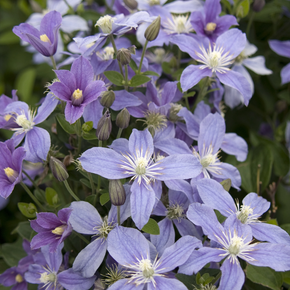
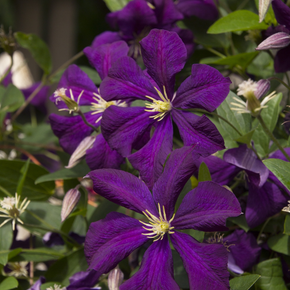
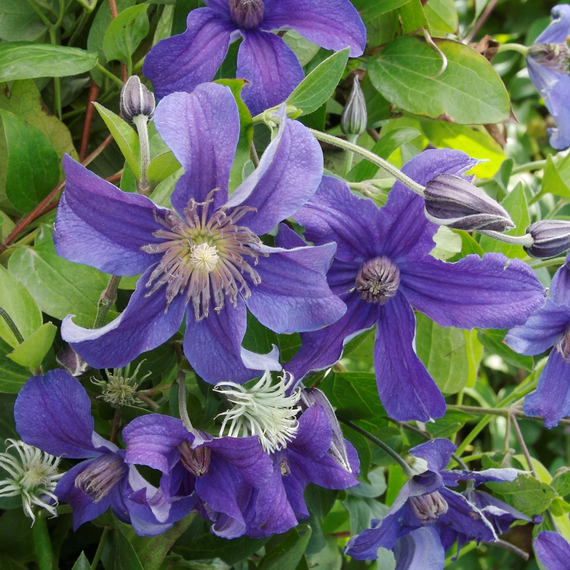
- Spectacular 4-inch sapphire-blue to deep purple star-shaped blooms with striking dark indigo-purple anthers appear continuously from June through September, delivering months of breathtaking color.
- Uniquely versatile and compact — train it up a short trellis or arbor as a climber, let it sprawl as a showy flowering groundcover, or grow it as a dramatic focal point in a large container or hanging basket.
- Exceptionally cold-hardy and low-maintenance, thriving in USDA Zones 4-9 with good deer resistance, rabbit resistance, and tolerance of black walnut toxicity.
- A magnet for pollinators — nectar- and pollen-rich flowers attract bees, butterflies, and hummingbirds, making it as ecologically valuable as it is visually stunning.
Clematis Sapphire Indigo (Clematis 'Cleminov 51', PP#17,012) is a truly extraordinary hybrid clematis that breaks all the rules in the best possible way. Bred in France in 1994 from a cross between the classic vining Clematis 'The President' and the non-vining Clematis 'Olgae', this compact, mound-forming perennial vine produces a near-continuous succession of luminous 4-inch, star-shaped blooms in rich sapphire-blue to deep purple, each flower punctuated by a bold central cluster of dark indigo-purple anthers. Unlike many traditional large-flowered clematis, Sapphire Indigo offers exceptional versatility — grow it with light support on a short trellis, fence, or arbor for an upright display reaching up to 4 feet, or allow it to sprawl unsupported into a lush, arching mound of flowering stems that works beautifully as a groundcover, a companion weaving through shrubs and roses, or a spectacular spiller in a barrel planter or large container. Its naturally compact, shrubby habit and remarkably long bloom season from early summer through early fall make it a standout performer in mixed borders, cottage gardens, and landscape beds throughout Southern Oregon and Northern California. Hardy, low-maintenance, deer and rabbit resistant, and tolerant of challenging black walnut soils, Clematis Sapphire Indigo is one of the most reliable and rewarding flowering vines available to home gardeners today.
Plant Description
Clematis Sapphire Indigo is a compact, deciduous, mound-forming perennial vine belonging to the Ranunculaceae (buttercup) family. The cultivar name 'Cleminov 51' was selected in 2002 by Laurence Arene-Querard of Agri Obtentions in France, chosen from a 1994 cross between the well-known large-flowered vining clematis 'The President' and the sprawling, non-vining clematis 'Olgae'. The result is a uniquely shrubby, semi-vining plant with flexible, arching stems clad in attractive, delicate green foliage. Flowers are single, measuring approximately 4 inches across, with 4 to 5 recurved, satiny tepals in a rich sapphire-blue to deep purple that gradually lighten slightly as they age. Each bloom is centered with a striking mass of dark purple to near-black anthers that perfectly complement the petal color. The plant blooms prolifically and nearly continuously from June through September, providing one of the longest floral displays of any clematis available. It is deciduous, dying back in winter and re-emerging each spring from established roots and crown.
Mature Size
| Characteristic | Details |
|---|---|
| Height (unsupported) | 2 to 3 feet as a sprawling mound |
| Height (with trellis support) | Up to 4 feet |
| Spread | 3 to 4 feet wide |
| Growth Habit | Compact, mound-forming, arching stems |
| Growth Rate | Moderate; reaches full size in 2 to 3 seasons |
| Plant Type | Deciduous perennial vine / shrubby groundcover |
Hardiness Zones
Clematis Sapphire Indigo is reliably cold-hardy in USDA Hardiness Zones 4 through 9, making it well-suited to a very wide range of climates including the diverse growing conditions found across Southern Oregon and Northern California. In Zone 4 it can withstand winter temperatures as low as -30°F when properly mulched, while in the warmer end of Zone 9 it performs as a long-lived perennial with excellent summer blooming. In very hot, dry inland climates (upper Zone 9), some afternoon shade during the hottest months will help prolong flowering and protect foliage. Established plants are notably resilient once their root systems have matured through one or two growing seasons.
Sunlight Requirements
Sapphire Indigo clematis thrives in full sun to partial shade. For the most prolific blooming and truest, deepest flower color, a site receiving at least 6 hours of direct sunlight per day is ideal. In very hot, sun-intense climates — as is common in parts of Northern California and inland Southern Oregon during summer — light afternoon shade can be beneficial, preventing flower fade and leaf scorch while maintaining plant vigor. Like all clematis, Sapphire Indigo grows best when the upper portion of the plant receives good sun exposure while the root zone remains cool and shaded. Planting low-growing companion plants around the base, using a thick layer of mulch, or situating the plant where neighboring plants shade its feet naturally are all effective strategies for keeping roots cool and ensuring the longest possible bloom season.
Soil and pH Preferences
Clematis Sapphire Indigo grows best in fertile, well-drained soil that retains consistent moisture without becoming waterlogged. Heavy clay soils should be amended with compost or other organic matter to improve drainage and aeration. Sandy soils benefit from added compost to improve water and nutrient retention. The ideal soil pH range is slightly acidic to neutral — between 6.0 and 7.0 — though the plant shows good adaptability and can tolerate mildly alkaline conditions. One particularly useful trait of Sapphire Indigo is its tolerance of soil containing juglone, the natural compound produced by black walnut trees (Juglans nigra) that is toxic to many garden plants. A 2 to 3 inch layer of organic mulch over the root zone helps maintain even soil moisture, moderate soil temperature, and gradually improves soil structure over time.
Watering Guide
Consistent, moderate moisture is the key to keeping Clematis Sapphire Indigo healthy and blooming at its best. Water deeply and regularly after planting to help establish a strong root system. Once established, water when the top inch or two of soil becomes dry, being careful never to allow the soil to remain completely dry for extended periods. Equally important is avoiding overwatering and waterlogged conditions — clematis roots are highly susceptible to rot in poorly drained, saturated soils. Drip irrigation or soaker hoses that deliver water directly to the root zone without wetting the foliage are ideal, as wet foliage can encourage fungal disease. During the hot, dry summers typical of Southern Oregon and Northern California, consistent watering is especially important to maintain flowering and plant health. A thick mulch layer significantly reduces the frequency of watering needed by slowing surface evaporation.
Fertilizing
Feed Clematis Sapphire Indigo with a balanced, slow-release granular fertilizer or a water-soluble fertilizer formulated for flowering plants in early spring as new growth emerges. A second application in mid-summer helps sustain the plant's exceptional long bloom season through late summer and early fall. Avoid over-fertilizing with high-nitrogen products, which can promote excessive leafy growth at the expense of flowers. Incorporating compost into the planting hole at establishment time and top-dressing around the root zone with compost in early spring provides excellent slow-release nutrition while also improving soil structure and moisture retention. In soils that test low in potassium or phosphorus, a fertilizer higher in those nutrients (e.g., a 5-10-10 formulation) can be especially beneficial to support robust root development and heavy flowering.
Pruning and Maintenance
Clematis Sapphire Indigo is classified as a Pruning Group 2 clematis, which means it blooms on both old wood (stems from the previous season) and new wood (current-season growth). This classification has important implications for how and when you prune:
- In early spring, look carefully for swelling leaf buds beginning to emerge along the stems before cutting anything.
- Remove only dead, brittle, or damaged stems above the lowest healthy set of leaf buds.
- Avoid cutting the plant to the ground in fall or early spring — doing so will significantly delay or reduce the first flush of blooms, since much of the initial flowering comes from mature stems that overwintered.
- If rejuvenation is needed, cut back by approximately one-half in early spring to encourage a flush of new branching growth.
- Re-tie remaining stems to any support structure as new growth begins to fill in.
- Due to its naturally compact, bushy habit, Sapphire Indigo typically requires far less pruning than traditional large-flowered climbing clematis.
- In late fall, leaving the stems intact through winter also provides some insulation for the crown and root system.
Planting Instructions
- Choose a site with full sun to partial shade and well-drained soil. Have any trellis or support structure in place before planting.
- Dig a planting hole approximately 12 to 18 inches deep and equally wide. Loosen the surrounding soil and amend it with a generous amount of compost.
- Place the root ball into the hole so that the first set of leaf nodes (the points where leaves emerge from the stem) is positioned 2 to 3 inches below the soil surface. Planting slightly deeper than normal encourages the crown to produce multiple stems and helps the plant recover if stems are damaged by frost or disease.
- Remove any leaves or growth that will be buried below soil level.
- Backfill halfway with amended soil, gently firm the soil around the roots, and water thoroughly to settle out air pockets.
- Loosely tie the top growth to your support structure and continue backfilling. Water again deeply.
- Apply a 2 to 3 inch layer of mulch over the root zone, keeping mulch a few inches away from the base of the stems to prevent rot.
- Keep soil consistently moist during the first growing season to ensure strong establishment. Space multiple plants 2 to 3 feet apart.
Landscape Uses
Clematis Sapphire Indigo is one of the most versatile flowering vines available, offering a range of landscape applications that most clematis cannot match:
- Trellis or Arbor Climber: Train stems up a short decorative trellis, fence, mailbox post, lamppost, or low garden arbor for a stunning vertical accent reaching up to 4 feet.
- Flowering Groundcover: Allowed to sprawl without support, it forms a lush, flowering 3-foot-wide mound — outstanding for covering slopes, banks, or filling large bed spaces.
- Mixed Border: Weave it through mid-border shrubs, ornamental grasses, or perennials for a loose, naturalistic look with months of sapphire-blue color.
- Container and Patio Planting: Spectacular spilling from large barrels, raised planters, or oversized patio containers.
- Companion to Roses: The deep blue-purple flowers create a stunning contrast planted alongside shrub roses or climbing roses.
- Cottage and Informal Gardens: Its relaxed, arching habit suits informal, cottage-style planting schemes beautifully.
- Cut Flower: Blooms can be cut and used as a fresh-cut flower in arrangements.
Companion Plants
The rich sapphire-blue and purple tones of Clematis Sapphire Indigo pair beautifully with a wide range of garden plants. Consider these excellent companions:
- Shrub and climbing roses: Classic partners — the cool blue of Sapphire Indigo contrasts elegantly with warm pink, red, or white roses, and low-growing roses help shade the clematis roots naturally.
- Hostas: Their broad, lush foliage shades the root zone and provides a bold textural contrast to the delicate clematis flowers.
- Hardy Geraniums (Cranesbill): Low-growing, spreading geraniums shade the soil around the clematis base while offering complementary flower colors.
- Salvia and Nepeta (Catmint): The lavender-blue or purple tones of these perennials echo the clematis bloom colors and together create a long-blooming, pollinator-friendly combination.
- Ornamental Grasses: Fine-textured grasses like Festuca or Calamagrostis provide movement, contrast, and natural root shading.
- Echinacea (Coneflower): Bold, upright blooms in pink and purple make a striking mid-border pairing that blooms at the same time.
- Lavender: Shares similar sun, soil, and drainage preferences and creates a harmonious blue-purple color palette.
Container Growing
Clematis Sapphire Indigo is an outstanding choice for container culture, particularly because its compact, naturally mounding habit is well-suited to large pots, barrels, and raised planters. For best results:
- Select a container that is at least 18 to 24 inches in diameter and depth to accommodate the root system and allow for proper moisture retention.
- Ensure the container has adequate drainage holes — standing water around roots will cause rot.
- Use a high-quality, well-draining potting mix amended with compost or slow-release fertilizer.
- Container plants dry out faster than in-ground plantings, especially during the hot, dry summers of Southern Oregon and Northern California — check soil moisture frequently and water more often than you would in-ground plants.
- Place the container where the plant receives full sun to partial shade, and where the pot itself is shaded from direct afternoon sun to keep roots cool.
- Feed container-grown plants with a balanced liquid fertilizer every 2 to 3 weeks during the growing season for the best blooming performance.
- In colder zones, move containers to a sheltered, unheated garage or outbuilding during winter to prevent the root ball from freezing solid.
- Repot every 2 to 3 years or when roots begin circling the bottom of the container.
Wildlife Value
Clematis Sapphire Indigo is a valuable plant for supporting garden wildlife. Its nectar- and pollen-rich flowers are attractive to a wide range of beneficial insects and animals throughout its long June-to-September bloom season:
- Bees: Both honeybees and native bees are drawn to the open, accessible flowers, making this an excellent addition to pollinator gardens.
- Butterflies: The abundant nectar supply attracts a variety of butterfly species that use the plant as a foraging stop.
- Hummingbirds: The brightly colored blooms are visited by hummingbirds, providing an important nectar source during the long blooming period.
- Deer and Rabbit Resistance: Natural compounds in the foliage make the plant unpalatable to deer and rabbits, reducing browse damage in areas where these animals are common — a significant practical benefit for gardens in rural Southern Oregon and Northern California.
Pests and Diseases
While Clematis Sapphire Indigo is considered a relatively low-maintenance and disease-resistant plant, it is susceptible to some common clematis pests and diseases. Early identification and prompt action are key to keeping plants healthy.
- Clematis Wilt (Stem Rot): The most serious disease of clematis, caused by the fungal pathogen Phoma clematidina, which causes otherwise healthy stems to suddenly wilt and collapse. Cut affected stems back to healthy tissue at or below soil level — the plant will typically re-shoot from the root crown. The deeper planting recommended for clematis (nodes below soil level) helps the plant recover.
- Powdery Mildew: A fungal disease favored by warm days and cool nights with poor air circulation. Improves with better airflow around plants and treatment with appropriate fungicide if needed.
- Leaf Spots and Rust: Various fungal leaf spot diseases can cause cosmetic damage; avoid overhead watering and remove heavily infected leaves.
- Aphids: Small, soft-bodied insects that cluster on new growth and stems. Control with a strong jet of water, insecticidal soap, or neem oil.
- Spider Mites: More common in hot, dry conditions. Look for fine webbing on leaves; treat with insecticidal soap or neem oil and ensure adequate watering.
- Vine Weevils and Slugs/Snails: Can damage roots and foliage, especially on younger plants. Use appropriate physical or chemical controls as needed.
- Scale: Treat with horticultural oil during the dormant season if detected on stems.
Toxicity Information
All parts of Clematis Sapphire Indigo are considered toxic to humans, dogs, and cats. The plant contains irritating compounds (protoanemonin) that can cause adverse reactions if ingested or if the sap contacts skin. Symptoms of ingestion in humans may include nausea, vomiting, diarrhea, and dizziness. In pets, signs may include drooling, vomiting, weakness, and in severe cases, more serious reactions. Direct handling of stems and sap can cause skin irritation in sensitive individuals — wearing gloves when pruning is recommended. Plant Clematis Sapphire Indigo in areas of the garden that are not readily accessible to young children or pets, or supervise accordingly. If ingestion is suspected, contact Poison Control at (800) 222-1222 for humans, or the Pet Poison Helpline at (800) 213-6680 for animals, or seek emergency veterinary care immediately.
Seasonal Interest
Clematis Sapphire Indigo delivers exceptional garden interest across multiple seasons:
- Spring: Fresh, bright green foliage emerges from dormant stems and the root crown, quickly producing vigorous new growth. The first flower buds typically begin forming in late spring.
- Early Summer (June): The first spectacular flush of large, deep sapphire-blue to purple flowers opens, often covering the plant in a mass of color.
- Midsummer (July - August): Near-continuous bloom continues, with successive waves of flowers on both old and new growth. Pollinators are active at the plant throughout this period.
- Late Summer to Early Fall (September): Flowering continues well into fall, providing color in the garden long after many other perennials have finished. Wispy, ornamental seed heads may develop at the end of the season, adding textural interest.
- Winter: The plant is dormant and deciduous. Some gardeners leave the old stems in place through winter for crown protection, cutting back to healthy growth in early spring.
- Spectacular 4-inch sapphire-blue to deep purple star-shaped blooms with striking dark indigo-purple anthers appear continuously from June through September, delivering months of breathtaking color.
- Uniquely versatile and compact — train it up a short trellis or arbor as a climber, let it sprawl as a showy flowering groundcover, or grow it as a dramatic focal point in a large container or hanging basket.
- Exceptionally cold-hardy and low-maintenance, thriving in USDA Zones 4-9 with good deer resistance, rabbit resistance, and tolerance of black walnut toxicity.
- A magnet for pollinators — nectar- and pollen-rich flowers attract bees, butterflies, and hummingbirds, making it as ecologically valuable as it is visually stunning.
Clematis Sapphire Indigo (Clematis 'Cleminov 51', PP#17,012) is a truly extraordinary hybrid clematis that breaks all the rules in the best possible way. Bred in France in 1994 from a cross between the classic vining Clematis 'The President' and the non-vining Clematis 'Olgae', this compact, mound-forming perennial vine produces a near-continuous succession of luminous 4-inch, star-shaped blooms in rich sapphire-blue to deep purple, each flower punctuated by a bold central cluster of dark indigo-purple anthers. Unlike many traditional large-flowered clematis, Sapphire Indigo offers exceptional versatility — grow it with light support on a short trellis, fence, or arbor for an upright display reaching up to 4 feet, or allow it to sprawl unsupported into a lush, arching mound of flowering stems that works beautifully as a groundcover, a companion weaving through shrubs and roses, or a spectacular spiller in a barrel planter or large container. Its naturally compact, shrubby habit and remarkably long bloom season from early summer through early fall make it a standout performer in mixed borders, cottage gardens, and landscape beds throughout Southern Oregon and Northern California. Hardy, low-maintenance, deer and rabbit resistant, and tolerant of challenging black walnut soils, Clematis Sapphire Indigo is one of the most reliable and rewarding flowering vines available to home gardeners today.
Plant Description
Clematis Sapphire Indigo is a compact, deciduous, mound-forming perennial vine belonging to the Ranunculaceae (buttercup) family. The cultivar name 'Cleminov 51' was selected in 2002 by Laurence Arene-Querard of Agri Obtentions in France, chosen from a 1994 cross between the well-known large-flowered vining clematis 'The President' and the sprawling, non-vining clematis 'Olgae'. The result is a uniquely shrubby, semi-vining plant with flexible, arching stems clad in attractive, delicate green foliage. Flowers are single, measuring approximately 4 inches across, with 4 to 5 recurved, satiny tepals in a rich sapphire-blue to deep purple that gradually lighten slightly as they age. Each bloom is centered with a striking mass of dark purple to near-black anthers that perfectly complement the petal color. The plant blooms prolifically and nearly continuously from June through September, providing one of the longest floral displays of any clematis available. It is deciduous, dying back in winter and re-emerging each spring from established roots and crown.
Mature Size
| Characteristic | Details |
|---|---|
| Height (unsupported) | 2 to 3 feet as a sprawling mound |
| Height (with trellis support) | Up to 4 feet |
| Spread | 3 to 4 feet wide |
| Growth Habit | Compact, mound-forming, arching stems |
| Growth Rate | Moderate; reaches full size in 2 to 3 seasons |
| Plant Type | Deciduous perennial vine / shrubby groundcover |
Hardiness Zones
Clematis Sapphire Indigo is reliably cold-hardy in USDA Hardiness Zones 4 through 9, making it well-suited to a very wide range of climates including the diverse growing conditions found across Southern Oregon and Northern California. In Zone 4 it can withstand winter temperatures as low as -30°F when properly mulched, while in the warmer end of Zone 9 it performs as a long-lived perennial with excellent summer blooming. In very hot, dry inland climates (upper Zone 9), some afternoon shade during the hottest months will help prolong flowering and protect foliage. Established plants are notably resilient once their root systems have matured through one or two growing seasons.
Sunlight Requirements
Sapphire Indigo clematis thrives in full sun to partial shade. For the most prolific blooming and truest, deepest flower color, a site receiving at least 6 hours of direct sunlight per day is ideal. In very hot, sun-intense climates — as is common in parts of Northern California and inland Southern Oregon during summer — light afternoon shade can be beneficial, preventing flower fade and leaf scorch while maintaining plant vigor. Like all clematis, Sapphire Indigo grows best when the upper portion of the plant receives good sun exposure while the root zone remains cool and shaded. Planting low-growing companion plants around the base, using a thick layer of mulch, or situating the plant where neighboring plants shade its feet naturally are all effective strategies for keeping roots cool and ensuring the longest possible bloom season.
Soil and pH Preferences
Clematis Sapphire Indigo grows best in fertile, well-drained soil that retains consistent moisture without becoming waterlogged. Heavy clay soils should be amended with compost or other organic matter to improve drainage and aeration. Sandy soils benefit from added compost to improve water and nutrient retention. The ideal soil pH range is slightly acidic to neutral — between 6.0 and 7.0 — though the plant shows good adaptability and can tolerate mildly alkaline conditions. One particularly useful trait of Sapphire Indigo is its tolerance of soil containing juglone, the natural compound produced by black walnut trees (Juglans nigra) that is toxic to many garden plants. A 2 to 3 inch layer of organic mulch over the root zone helps maintain even soil moisture, moderate soil temperature, and gradually improves soil structure over time.
Watering Guide
Consistent, moderate moisture is the key to keeping Clematis Sapphire Indigo healthy and blooming at its best. Water deeply and regularly after planting to help establish a strong root system. Once established, water when the top inch or two of soil becomes dry, being careful never to allow the soil to remain completely dry for extended periods. Equally important is avoiding overwatering and waterlogged conditions — clematis roots are highly susceptible to rot in poorly drained, saturated soils. Drip irrigation or soaker hoses that deliver water directly to the root zone without wetting the foliage are ideal, as wet foliage can encourage fungal disease. During the hot, dry summers typical of Southern Oregon and Northern California, consistent watering is especially important to maintain flowering and plant health. A thick mulch layer significantly reduces the frequency of watering needed by slowing surface evaporation.
Fertilizing
Feed Clematis Sapphire Indigo with a balanced, slow-release granular fertilizer or a water-soluble fertilizer formulated for flowering plants in early spring as new growth emerges. A second application in mid-summer helps sustain the plant's exceptional long bloom season through late summer and early fall. Avoid over-fertilizing with high-nitrogen products, which can promote excessive leafy growth at the expense of flowers. Incorporating compost into the planting hole at establishment time and top-dressing around the root zone with compost in early spring provides excellent slow-release nutrition while also improving soil structure and moisture retention. In soils that test low in potassium or phosphorus, a fertilizer higher in those nutrients (e.g., a 5-10-10 formulation) can be especially beneficial to support robust root development and heavy flowering.
Pruning and Maintenance
Clematis Sapphire Indigo is classified as a Pruning Group 2 clematis, which means it blooms on both old wood (stems from the previous season) and new wood (current-season growth). This classification has important implications for how and when you prune:
- In early spring, look carefully for swelling leaf buds beginning to emerge along the stems before cutting anything.
- Remove only dead, brittle, or damaged stems above the lowest healthy set of leaf buds.
- Avoid cutting the plant to the ground in fall or early spring — doing so will significantly delay or reduce the first flush of blooms, since much of the initial flowering comes from mature stems that overwintered.
- If rejuvenation is needed, cut back by approximately one-half in early spring to encourage a flush of new branching growth.
- Re-tie remaining stems to any support structure as new growth begins to fill in.
- Due to its naturally compact, bushy habit, Sapphire Indigo typically requires far less pruning than traditional large-flowered climbing clematis.
- In late fall, leaving the stems intact through winter also provides some insulation for the crown and root system.
Planting Instructions
- Choose a site with full sun to partial shade and well-drained soil. Have any trellis or support structure in place before planting.
- Dig a planting hole approximately 12 to 18 inches deep and equally wide. Loosen the surrounding soil and amend it with a generous amount of compost.
- Place the root ball into the hole so that the first set of leaf nodes (the points where leaves emerge from the stem) is positioned 2 to 3 inches below the soil surface. Planting slightly deeper than normal encourages the crown to produce multiple stems and helps the plant recover if stems are damaged by frost or disease.
- Remove any leaves or growth that will be buried below soil level.
- Backfill halfway with amended soil, gently firm the soil around the roots, and water thoroughly to settle out air pockets.
- Loosely tie the top growth to your support structure and continue backfilling. Water again deeply.
- Apply a 2 to 3 inch layer of mulch over the root zone, keeping mulch a few inches away from the base of the stems to prevent rot.
- Keep soil consistently moist during the first growing season to ensure strong establishment. Space multiple plants 2 to 3 feet apart.
Landscape Uses
Clematis Sapphire Indigo is one of the most versatile flowering vines available, offering a range of landscape applications that most clematis cannot match:
- Trellis or Arbor Climber: Train stems up a short decorative trellis, fence, mailbox post, lamppost, or low garden arbor for a stunning vertical accent reaching up to 4 feet.
- Flowering Groundcover: Allowed to sprawl without support, it forms a lush, flowering 3-foot-wide mound — outstanding for covering slopes, banks, or filling large bed spaces.
- Mixed Border: Weave it through mid-border shrubs, ornamental grasses, or perennials for a loose, naturalistic look with months of sapphire-blue color.
- Container and Patio Planting: Spectacular spilling from large barrels, raised planters, or oversized patio containers.
- Companion to Roses: The deep blue-purple flowers create a stunning contrast planted alongside shrub roses or climbing roses.
- Cottage and Informal Gardens: Its relaxed, arching habit suits informal, cottage-style planting schemes beautifully.
- Cut Flower: Blooms can be cut and used as a fresh-cut flower in arrangements.
Companion Plants
The rich sapphire-blue and purple tones of Clematis Sapphire Indigo pair beautifully with a wide range of garden plants. Consider these excellent companions:
- Shrub and climbing roses: Classic partners — the cool blue of Sapphire Indigo contrasts elegantly with warm pink, red, or white roses, and low-growing roses help shade the clematis roots naturally.
- Hostas: Their broad, lush foliage shades the root zone and provides a bold textural contrast to the delicate clematis flowers.
- Hardy Geraniums (Cranesbill): Low-growing, spreading geraniums shade the soil around the clematis base while offering complementary flower colors.
- Salvia and Nepeta (Catmint): The lavender-blue or purple tones of these perennials echo the clematis bloom colors and together create a long-blooming, pollinator-friendly combination.
- Ornamental Grasses: Fine-textured grasses like Festuca or Calamagrostis provide movement, contrast, and natural root shading.
- Echinacea (Coneflower): Bold, upright blooms in pink and purple make a striking mid-border pairing that blooms at the same time.
- Lavender: Shares similar sun, soil, and drainage preferences and creates a harmonious blue-purple color palette.
Container Growing
Clematis Sapphire Indigo is an outstanding choice for container culture, particularly because its compact, naturally mounding habit is well-suited to large pots, barrels, and raised planters. For best results:
- Select a container that is at least 18 to 24 inches in diameter and depth to accommodate the root system and allow for proper moisture retention.
- Ensure the container has adequate drainage holes — standing water around roots will cause rot.
- Use a high-quality, well-draining potting mix amended with compost or slow-release fertilizer.
- Container plants dry out faster than in-ground plantings, especially during the hot, dry summers of Southern Oregon and Northern California — check soil moisture frequently and water more often than you would in-ground plants.
- Place the container where the plant receives full sun to partial shade, and where the pot itself is shaded from direct afternoon sun to keep roots cool.
- Feed container-grown plants with a balanced liquid fertilizer every 2 to 3 weeks during the growing season for the best blooming performance.
- In colder zones, move containers to a sheltered, unheated garage or outbuilding during winter to prevent the root ball from freezing solid.
- Repot every 2 to 3 years or when roots begin circling the bottom of the container.
Wildlife Value
Clematis Sapphire Indigo is a valuable plant for supporting garden wildlife. Its nectar- and pollen-rich flowers are attractive to a wide range of beneficial insects and animals throughout its long June-to-September bloom season:
- Bees: Both honeybees and native bees are drawn to the open, accessible flowers, making this an excellent addition to pollinator gardens.
- Butterflies: The abundant nectar supply attracts a variety of butterfly species that use the plant as a foraging stop.
- Hummingbirds: The brightly colored blooms are visited by hummingbirds, providing an important nectar source during the long blooming period.
- Deer and Rabbit Resistance: Natural compounds in the foliage make the plant unpalatable to deer and rabbits, reducing browse damage in areas where these animals are common — a significant practical benefit for gardens in rural Southern Oregon and Northern California.
Pests and Diseases
While Clematis Sapphire Indigo is considered a relatively low-maintenance and disease-resistant plant, it is susceptible to some common clematis pests and diseases. Early identification and prompt action are key to keeping plants healthy.
- Clematis Wilt (Stem Rot): The most serious disease of clematis, caused by the fungal pathogen Phoma clematidina, which causes otherwise healthy stems to suddenly wilt and collapse. Cut affected stems back to healthy tissue at or below soil level — the plant will typically re-shoot from the root crown. The deeper planting recommended for clematis (nodes below soil level) helps the plant recover.
- Powdery Mildew: A fungal disease favored by warm days and cool nights with poor air circulation. Improves with better airflow around plants and treatment with appropriate fungicide if needed.
- Leaf Spots and Rust: Various fungal leaf spot diseases can cause cosmetic damage; avoid overhead watering and remove heavily infected leaves.
- Aphids: Small, soft-bodied insects that cluster on new growth and stems. Control with a strong jet of water, insecticidal soap, or neem oil.
- Spider Mites: More common in hot, dry conditions. Look for fine webbing on leaves; treat with insecticidal soap or neem oil and ensure adequate watering.
- Vine Weevils and Slugs/Snails: Can damage roots and foliage, especially on younger plants. Use appropriate physical or chemical controls as needed.
- Scale: Treat with horticultural oil during the dormant season if detected on stems.
Toxicity Information
All parts of Clematis Sapphire Indigo are considered toxic to humans, dogs, and cats. The plant contains irritating compounds (protoanemonin) that can cause adverse reactions if ingested or if the sap contacts skin. Symptoms of ingestion in humans may include nausea, vomiting, diarrhea, and dizziness. In pets, signs may include drooling, vomiting, weakness, and in severe cases, more serious reactions. Direct handling of stems and sap can cause skin irritation in sensitive individuals — wearing gloves when pruning is recommended. Plant Clematis Sapphire Indigo in areas of the garden that are not readily accessible to young children or pets, or supervise accordingly. If ingestion is suspected, contact Poison Control at (800) 222-1222 for humans, or the Pet Poison Helpline at (800) 213-6680 for animals, or seek emergency veterinary care immediately.
Seasonal Interest
Clematis Sapphire Indigo delivers exceptional garden interest across multiple seasons:
- Spring: Fresh, bright green foliage emerges from dormant stems and the root crown, quickly producing vigorous new growth. The first flower buds typically begin forming in late spring.
- Early Summer (June): The first spectacular flush of large, deep sapphire-blue to purple flowers opens, often covering the plant in a mass of color.
- Midsummer (July - August): Near-continuous bloom continues, with successive waves of flowers on both old and new growth. Pollinators are active at the plant throughout this period.
- Late Summer to Early Fall (September): Flowering continues well into fall, providing color in the garden long after many other perennials have finished. Wispy, ornamental seed heads may develop at the end of the season, adding textural interest.
- Winter: The plant is dormant and deciduous. Some gardeners leave the old stems in place through winter for crown protection, cutting back to healthy growth in early spring.