Zoom the image with the mouse
Bellini Grape Crape Myrtle - 2 Gallon
SKU:
2325155
UPC:
014949450437
$39.99
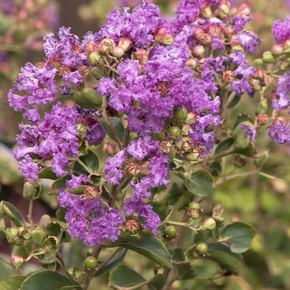
- Stunning grape-purple flower panicles bloom from midsummer into fall, emerging from distinctive red buds against glossy dark green foliage — delivering bold, saturated color when most other shrubs have finished flowering.
- A true breakthrough in compact size, this densely mounded deciduous shrub reaches just 3-4 feet tall and wide, making it ideal for foundation plantings, low borders, and patio containers without ever outgrowing its space.
- Built-in resistance to powdery mildew and deer, combined with proven drought tolerance once established, makes Bellini Grape one of the lowest-maintenance flowering shrubs available for sunny landscapes.
- Four seasons of interest: rich purple summer blooms, warm orange and yellow fall foliage, attractive branching structure in winter, and fresh green glossy leaves emerging in spring.
Bellini Grape Crape Myrtle (Lagerstroemia indica 'Congrabel', PP #28,975) is a compact, mounded deciduous shrub that redefines what a crape myrtle can offer in a smaller garden space. Part of the breakthrough Bellini series, this selection was specifically bred for its truly dwarf habit, blooming earlier than many traditional crape myrtle varieties and producing generous panicles of rich, dark lavender-purple blooms that light up the summer landscape from midsummer all the way into early fall. The flowers emerge from eye-catching deep red buds and are displayed beautifully against dense, glossy dark green foliage. As the seasons transition into autumn, the foliage transforms into a warm tapestry of orange and yellow tones before the plant enters its winter rest. Staying at a refined 3 to 4 feet in both height and spread, Bellini Grape is perfectly proportioned for foundation plantings, mixed shrub borders, low hedges, and container arrangements on patios and porches. Its excellent resistance to powdery mildew, tolerance for heat and urban conditions, and drought resilience once established make it an outstanding, low-fuss choice for gardeners in USDA Hardiness Zones 5 through 10 who want maximum floral impact with minimal upkeep. Bees and butterflies are drawn to its blooms throughout the long flowering season, adding important pollinator value to the summer garden.
Plant Description
Bellini Grape Crape Myrtle is a dense, multi-stemmed deciduous shrub with a naturally mounded, compact form. Its relatively fine-textured foliage sets it apart from coarser-leaved landscape plants, giving it a refined appearance even when not in bloom. The oval, glossy dark green leaves provide a rich backdrop that makes the vibrant grape-purple flower clusters pop with dramatic visual contrast. Flower panicles emerge from distinctive deep red buds at the tips of new branches, opening into frilly, crinkled purple blooms that are characteristic of the crape myrtle family. The overall habit is dense and symmetrical, filling in all the way to the ground without requiring filler plants in front. This is a patented variety (PP #28,975) selected specifically for its breakthrough compact size, earlier bloom time, and superior disease resistance compared to older crape myrtle selections of similar color.
Mature Size and Growth Rate
| Characteristic | Detail |
|---|---|
| Mature Height | 3 to 4 feet |
| Mature Spread | 3 to 4 feet |
| Growth Habit | Compact, dense, mounded |
| Growth Rate | Moderate |
| Plant Type | Deciduous shrub |
| Estimated Lifespan | Approximately 20 years under ideal conditions |
Because of its naturally dwarf stature, Bellini Grape will stay below most window sills and porch railings without aggressive pruning. It fills in fully to ground level, making it an excellent front-of-border plant that does not require companion groundcovers to hide a bare base.
Hardiness Zones and Climate
Bellini Grape Crape Myrtle is rated for USDA Hardiness Zones 5 through 10, making it one of the hardier crape myrtle selections available. It thrives in the heat and sun of Southern Oregon and Northern California summers, performing exceptionally well in the long, warm, dry summers of the Rogue Valley and the Sacramento Valley region. It is highly tolerant of urban heat and pollution, making it well-suited for street-side plantings, parking lot islands, and contained urban garden spaces. In colder portions of its range (Zones 5 and 6), the plant may experience some die-back on the tops of stems in harsh winters, but it reliably re-sprouts from the roots and base in spring. In Zones 7 through 10, where winters are mild, the woody structure remains largely intact year after year.
Sunlight Requirements
Bellini Grape Crape Myrtle performs best in full sun, which means a minimum of 6 hours of direct, unfiltered sunlight each day. The more sun this shrub receives, the more profusely it blooms and the more compact and sturdy its growth habit becomes. It can tolerate partial sun conditions (4 to 6 hours of direct light), but flowering will be noticeably reduced and the plant may develop a slightly more open, less tidy form. Shaded growing conditions also increase susceptibility to powdery mildew and other fungal issues. For the best flower display and healthiest plant, choose a planting site that receives full sun from morning through afternoon, with good air circulation around the foliage.
Soil and pH Preferences
This crape myrtle adapts to a range of soil types, including clay, loam, sandy, and silt soils, as long as drainage is adequate. Standing water and consistently waterlogged soils will stress or kill the plant. Bellini Grape prefers slightly acidic to acidic soil conditions, ideally in the pH range of 5.0 to 6.5. In alkaline soils (pH above 7.0), the plant may exhibit chlorosis — a yellowing of the foliage caused by the inability to absorb iron and other micronutrients. If your soil is alkaline, amend the planting area with sulfur or acidifying compost, or apply an acidifying fertilizer to help maintain appropriate pH over time. Incorporating organic matter such as compost into the planting hole will improve drainage in heavy clay soils and water retention in sandy soils, giving roots a healthy environment for establishment.
Watering Guide
During the first growing season after planting, water Bellini Grape regularly and deeply to encourage a strong, extensive root system. Allow the top inch or two of soil to dry out between waterings rather than keeping the soil constantly moist. Deep, infrequent watering is far more beneficial than frequent, shallow irrigation. Once the shrub is fully established — typically after one to two full growing seasons — it develops notable drought tolerance and requires supplemental irrigation only during prolonged dry spells. In the hot, dry summers of Southern Oregon and Northern California, established plants generally benefit from a deep watering every one to two weeks when there has been no significant rainfall. Avoid overhead irrigation when possible, as wet foliage can contribute to fungal disease pressure. Drip irrigation or soaker hose systems directed at the root zone are ideal.
Fertilizing
Feed Bellini Grape Crape Myrtle once in early spring, just as new growth begins to emerge, using a balanced or bloom-boosting fertilizer. A granular fertilizer formulated for flowering shrubs or acid-loving plants works well; apply according to package directions and water in thoroughly. Avoid heavy applications of high-nitrogen fertilizers, as excess nitrogen encourages vigorous leafy growth at the expense of flowers and can make new shoots more vulnerable to cold damage in late fall. A light supplemental application of fertilizer in early summer can help extend and intensify the bloom period. Cease fertilizing by midsummer to allow the plant to harden off naturally before the onset of cooler temperatures. Mulching around the root zone with 2 to 3 inches of organic compost each spring also gently feeds the plant as it breaks down.
Pruning and Maintenance
One of the greatest advantages of Bellini Grape is that its naturally compact and mounded form rarely requires hard pruning to maintain an appropriate size. Avoid the common practice of "crape murder" — the severe, indiscriminate topping or stubbing back of crape myrtles — as this disfigures the natural graceful branching and is entirely unnecessary with a true dwarf variety like Bellini Grape. Instead, follow these light maintenance guidelines:
- Deadhead spent flower clusters during the blooming season to encourage additional flushes of bloom through late summer and into fall.
- In late winter or very early spring, before new growth begins, lightly shape the plant by removing any crossing or dead stems and tipping back longer branches to maintain the rounded mounded form.
- Remove any root suckers from the base of the plant promptly to keep the shrub's dense, well-defined habit.
- Prune lightly — never remove more than one-third of the plant's overall mass in a single season.
- Always use clean, sharp pruning tools to minimize tearing of the bark, which is relatively thin and susceptible to mechanical damage.
Planting Instructions
- Choose a planting site that receives at least 6 hours of full sun per day with good air circulation and well-drained soil.
- Dig a hole two to three times wider than the root ball and the same depth, so the top of the root ball sits level with or slightly above the surrounding soil grade.
- Loosen and lightly score the sides of the root ball if roots are circling, then place the plant in the center of the hole.
- Backfill with the native soil, gently firming it around the roots to eliminate air pockets. Amend with compost if the soil is very poor or has drainage issues.
- Water deeply and thoroughly immediately after planting.
- Apply a 2 to 3 inch layer of mulch (shredded bark, wood chips, or similar) over the root zone, keeping the mulch pulled back a few inches from the base of the stems to prevent rot and disease.
- Space multiple plants 3 to 4 feet apart when planting as a low hedge or massed grouping. For individual specimen plants, allow 4 to 5 feet from other structures or plants.
Seasonal Interest
| Season | What to Expect |
|---|---|
| Spring | Fresh, glossy dark green oval leaves emerge; plant leafs out from the base upward as temperatures warm. |
| Early Summer | Deep red flower buds form at the tips of branches; plant begins blooming earlier than many crape myrtle varieties. |
| Midsummer to Early Fall | Peak bloom period — rich grape-purple flower panicles cover the plant, attracting bees and butterflies. |
| Fall | Foliage transitions to warm shades of orange and yellow; small brown seed capsules develop after blooms fade. |
| Winter | Attractive multi-stemmed branching structure remains visible after leaf drop; plant is dormant. |
Landscape Uses
Bellini Grape's compact mounded form and long bloom season make it one of the most versatile small flowering shrubs for sunny landscapes. Recommended uses include:
- Foundation Planting: Stays naturally below windows and under eaves without the need for continual hard pruning.
- Low Hedge or Border: Plant in a series 3 feet apart along a walkway, driveway, or property edge for a colorful, low-maintenance living border.
- Mixed Shrub Border: Use as a mid-border accent for summer and fall color among evergreen shrubs that provide winter structure.
- Mass Planting: Plant in groups of three or more for a bold, repeating color statement in larger landscapes.
- Container Planting: Works beautifully as the "thriller" in a large patio container — at least 18 inches wide with drainage — surrounded by lower-growing spillers and fillers.
- Pollinator Garden: The abundant blooms draw bees and butterflies throughout the long flowering season.
- Urban and Street-Side Planting: Tolerates heat, reflected light, and urban pollution without complaint.
Container Growing
Bellini Grape is an excellent choice for container gardening on patios, decks, and porches. Select a pot that is at least 18 inches in diameter with multiple drainage holes to prevent waterlogging. Use a high-quality, well-draining potting mix rather than garden soil, which can compact and restrict roots in a container environment. Because containers dry out more quickly than in-ground plantings — especially in the heat of a Southern Oregon or Northern California summer — plan to water container-grown plants more frequently, checking soil moisture every day or two during hot weather. Fertilize container plants with a slow-release granular fertilizer at the beginning of the season, supplemented with occasional liquid bloom-booster applications through midsummer. In climates where winter temperatures drop below 0°F, consider moving containers into an unheated garage or shed for winter protection, as containerized roots are more exposed to cold than in-ground roots.
Wildlife and Pollinator Value
Bellini Grape Crape Myrtle is a magnet for beneficial pollinators during its long summer bloom season. The abundant flower clusters are visited regularly by honeybees, native bumble bees, and a variety of butterfly species seeking nectar during the hot months of summer and early fall when other nectar sources can become scarce. The plant is rated as not preferred by deer, making it a reliable choice in landscapes where deer browsing is a recurring challenge. The small brown seed capsules that follow the flowers provide minimal but notable winter interest and can attract small seed-eating birds. Because of its non-invasive nature and compact size, it integrates well into wildlife-friendly garden designs without spreading aggressively beyond its planting area.
Pests and Diseases
Bellini Grape Crape Myrtle was bred with strong resistance to powdery mildew, which is one of the most common and disfiguring problems affecting older crape myrtle varieties. Planting in full sun with good air circulation further reduces the risk of fungal diseases. Watch for the following occasional issues:
- Powdery Mildew: Low risk with this variety when planted in full sun. If observed, improve air circulation and avoid overhead watering. Resistant varieties like Bellini Grape rarely require treatment.
- Aphids: Can colonize new growth and flower buds, excreting honeydew that leads to sooty mold on leaves. A strong blast of water from a hose or an application of insecticidal soap will typically control infestations.
- Sooty Mold: A cosmetic black fungal coating that grows on aphid honeydew deposits. Controlling aphids eliminates the food source for sooty mold, after which the coating will weather away on its own.
- Crape Myrtle Bark Scale: A relatively new pest appearing as white or gray waxy crusts on stems and branches. Monitor plants regularly and treat with horticultural oil or systemic insecticides if infestations are confirmed.
- Cercospora Leaf Spot: Fungal leaf spots that can appear during warm, moist periods. Selecting well-draining sites and avoiding overhead irrigation minimizes this risk.
Companion Plants
Bellini Grape pairs beautifully with plants that complement its color, bloom timing, and full-sun, well-drained preferences. Consider these companion plant combinations:
- Russian Sage (Perovskia atriplicifolia): The soft silver-blue spikes of Russian sage harmonize with the grape-purple blooms and share a love of heat, sun, and dry conditions.
- Daylilies (Hemerocallis): Yellow or orange daylilies create a warm contrast to the cool purple tones of Bellini Grape and extend the overall bloom season into midsummer.
- Indian Hawthorn (Raphiolepis indica): An evergreen shrub that provides year-round structure and spring flowers, filling in the landscape when Bellini Grape is dormant in winter.
- Liriope (Liriope muscari): A tidy, low-growing grass-like perennial that forms a neat edging below the shrub and adds its own late-summer purple spikes.
- Salvia (Salvia nemorosa or similar): Upright blue or purple salvia wands create a complementary color echo and attract additional pollinators throughout the season.
- Ornamental Grasses (Pennisetum or Muhlenbergia): Fine-textured grasses provide movement and contrast alongside the dense mounded form of Bellini Grape.
- Catmint (Nepeta x faassenii): A low-growing, drought-tolerant perennial with soft lavender-blue flowers that bridges the gap between Bellini Grape and the front of a border beautifully.
- Stunning grape-purple flower panicles bloom from midsummer into fall, emerging from distinctive red buds against glossy dark green foliage — delivering bold, saturated color when most other shrubs have finished flowering.
- A true breakthrough in compact size, this densely mounded deciduous shrub reaches just 3-4 feet tall and wide, making it ideal for foundation plantings, low borders, and patio containers without ever outgrowing its space.
- Built-in resistance to powdery mildew and deer, combined with proven drought tolerance once established, makes Bellini Grape one of the lowest-maintenance flowering shrubs available for sunny landscapes.
- Four seasons of interest: rich purple summer blooms, warm orange and yellow fall foliage, attractive branching structure in winter, and fresh green glossy leaves emerging in spring.
Bellini Grape Crape Myrtle (Lagerstroemia indica 'Congrabel', PP #28,975) is a compact, mounded deciduous shrub that redefines what a crape myrtle can offer in a smaller garden space. Part of the breakthrough Bellini series, this selection was specifically bred for its truly dwarf habit, blooming earlier than many traditional crape myrtle varieties and producing generous panicles of rich, dark lavender-purple blooms that light up the summer landscape from midsummer all the way into early fall. The flowers emerge from eye-catching deep red buds and are displayed beautifully against dense, glossy dark green foliage. As the seasons transition into autumn, the foliage transforms into a warm tapestry of orange and yellow tones before the plant enters its winter rest. Staying at a refined 3 to 4 feet in both height and spread, Bellini Grape is perfectly proportioned for foundation plantings, mixed shrub borders, low hedges, and container arrangements on patios and porches. Its excellent resistance to powdery mildew, tolerance for heat and urban conditions, and drought resilience once established make it an outstanding, low-fuss choice for gardeners in USDA Hardiness Zones 5 through 10 who want maximum floral impact with minimal upkeep. Bees and butterflies are drawn to its blooms throughout the long flowering season, adding important pollinator value to the summer garden.
Plant Description
Bellini Grape Crape Myrtle is a dense, multi-stemmed deciduous shrub with a naturally mounded, compact form. Its relatively fine-textured foliage sets it apart from coarser-leaved landscape plants, giving it a refined appearance even when not in bloom. The oval, glossy dark green leaves provide a rich backdrop that makes the vibrant grape-purple flower clusters pop with dramatic visual contrast. Flower panicles emerge from distinctive deep red buds at the tips of new branches, opening into frilly, crinkled purple blooms that are characteristic of the crape myrtle family. The overall habit is dense and symmetrical, filling in all the way to the ground without requiring filler plants in front. This is a patented variety (PP #28,975) selected specifically for its breakthrough compact size, earlier bloom time, and superior disease resistance compared to older crape myrtle selections of similar color.
Mature Size and Growth Rate
| Characteristic | Detail |
|---|---|
| Mature Height | 3 to 4 feet |
| Mature Spread | 3 to 4 feet |
| Growth Habit | Compact, dense, mounded |
| Growth Rate | Moderate |
| Plant Type | Deciduous shrub |
| Estimated Lifespan | Approximately 20 years under ideal conditions |
Because of its naturally dwarf stature, Bellini Grape will stay below most window sills and porch railings without aggressive pruning. It fills in fully to ground level, making it an excellent front-of-border plant that does not require companion groundcovers to hide a bare base.
Hardiness Zones and Climate
Bellini Grape Crape Myrtle is rated for USDA Hardiness Zones 5 through 10, making it one of the hardier crape myrtle selections available. It thrives in the heat and sun of Southern Oregon and Northern California summers, performing exceptionally well in the long, warm, dry summers of the Rogue Valley and the Sacramento Valley region. It is highly tolerant of urban heat and pollution, making it well-suited for street-side plantings, parking lot islands, and contained urban garden spaces. In colder portions of its range (Zones 5 and 6), the plant may experience some die-back on the tops of stems in harsh winters, but it reliably re-sprouts from the roots and base in spring. In Zones 7 through 10, where winters are mild, the woody structure remains largely intact year after year.
Sunlight Requirements
Bellini Grape Crape Myrtle performs best in full sun, which means a minimum of 6 hours of direct, unfiltered sunlight each day. The more sun this shrub receives, the more profusely it blooms and the more compact and sturdy its growth habit becomes. It can tolerate partial sun conditions (4 to 6 hours of direct light), but flowering will be noticeably reduced and the plant may develop a slightly more open, less tidy form. Shaded growing conditions also increase susceptibility to powdery mildew and other fungal issues. For the best flower display and healthiest plant, choose a planting site that receives full sun from morning through afternoon, with good air circulation around the foliage.
Soil and pH Preferences
This crape myrtle adapts to a range of soil types, including clay, loam, sandy, and silt soils, as long as drainage is adequate. Standing water and consistently waterlogged soils will stress or kill the plant. Bellini Grape prefers slightly acidic to acidic soil conditions, ideally in the pH range of 5.0 to 6.5. In alkaline soils (pH above 7.0), the plant may exhibit chlorosis — a yellowing of the foliage caused by the inability to absorb iron and other micronutrients. If your soil is alkaline, amend the planting area with sulfur or acidifying compost, or apply an acidifying fertilizer to help maintain appropriate pH over time. Incorporating organic matter such as compost into the planting hole will improve drainage in heavy clay soils and water retention in sandy soils, giving roots a healthy environment for establishment.
Watering Guide
During the first growing season after planting, water Bellini Grape regularly and deeply to encourage a strong, extensive root system. Allow the top inch or two of soil to dry out between waterings rather than keeping the soil constantly moist. Deep, infrequent watering is far more beneficial than frequent, shallow irrigation. Once the shrub is fully established — typically after one to two full growing seasons — it develops notable drought tolerance and requires supplemental irrigation only during prolonged dry spells. In the hot, dry summers of Southern Oregon and Northern California, established plants generally benefit from a deep watering every one to two weeks when there has been no significant rainfall. Avoid overhead irrigation when possible, as wet foliage can contribute to fungal disease pressure. Drip irrigation or soaker hose systems directed at the root zone are ideal.
Fertilizing
Feed Bellini Grape Crape Myrtle once in early spring, just as new growth begins to emerge, using a balanced or bloom-boosting fertilizer. A granular fertilizer formulated for flowering shrubs or acid-loving plants works well; apply according to package directions and water in thoroughly. Avoid heavy applications of high-nitrogen fertilizers, as excess nitrogen encourages vigorous leafy growth at the expense of flowers and can make new shoots more vulnerable to cold damage in late fall. A light supplemental application of fertilizer in early summer can help extend and intensify the bloom period. Cease fertilizing by midsummer to allow the plant to harden off naturally before the onset of cooler temperatures. Mulching around the root zone with 2 to 3 inches of organic compost each spring also gently feeds the plant as it breaks down.
Pruning and Maintenance
One of the greatest advantages of Bellini Grape is that its naturally compact and mounded form rarely requires hard pruning to maintain an appropriate size. Avoid the common practice of "crape murder" — the severe, indiscriminate topping or stubbing back of crape myrtles — as this disfigures the natural graceful branching and is entirely unnecessary with a true dwarf variety like Bellini Grape. Instead, follow these light maintenance guidelines:
- Deadhead spent flower clusters during the blooming season to encourage additional flushes of bloom through late summer and into fall.
- In late winter or very early spring, before new growth begins, lightly shape the plant by removing any crossing or dead stems and tipping back longer branches to maintain the rounded mounded form.
- Remove any root suckers from the base of the plant promptly to keep the shrub's dense, well-defined habit.
- Prune lightly — never remove more than one-third of the plant's overall mass in a single season.
- Always use clean, sharp pruning tools to minimize tearing of the bark, which is relatively thin and susceptible to mechanical damage.
Planting Instructions
- Choose a planting site that receives at least 6 hours of full sun per day with good air circulation and well-drained soil.
- Dig a hole two to three times wider than the root ball and the same depth, so the top of the root ball sits level with or slightly above the surrounding soil grade.
- Loosen and lightly score the sides of the root ball if roots are circling, then place the plant in the center of the hole.
- Backfill with the native soil, gently firming it around the roots to eliminate air pockets. Amend with compost if the soil is very poor or has drainage issues.
- Water deeply and thoroughly immediately after planting.
- Apply a 2 to 3 inch layer of mulch (shredded bark, wood chips, or similar) over the root zone, keeping the mulch pulled back a few inches from the base of the stems to prevent rot and disease.
- Space multiple plants 3 to 4 feet apart when planting as a low hedge or massed grouping. For individual specimen plants, allow 4 to 5 feet from other structures or plants.
Seasonal Interest
| Season | What to Expect |
|---|---|
| Spring | Fresh, glossy dark green oval leaves emerge; plant leafs out from the base upward as temperatures warm. |
| Early Summer | Deep red flower buds form at the tips of branches; plant begins blooming earlier than many crape myrtle varieties. |
| Midsummer to Early Fall | Peak bloom period — rich grape-purple flower panicles cover the plant, attracting bees and butterflies. |
| Fall | Foliage transitions to warm shades of orange and yellow; small brown seed capsules develop after blooms fade. |
| Winter | Attractive multi-stemmed branching structure remains visible after leaf drop; plant is dormant. |
Landscape Uses
Bellini Grape's compact mounded form and long bloom season make it one of the most versatile small flowering shrubs for sunny landscapes. Recommended uses include:
- Foundation Planting: Stays naturally below windows and under eaves without the need for continual hard pruning.
- Low Hedge or Border: Plant in a series 3 feet apart along a walkway, driveway, or property edge for a colorful, low-maintenance living border.
- Mixed Shrub Border: Use as a mid-border accent for summer and fall color among evergreen shrubs that provide winter structure.
- Mass Planting: Plant in groups of three or more for a bold, repeating color statement in larger landscapes.
- Container Planting: Works beautifully as the "thriller" in a large patio container — at least 18 inches wide with drainage — surrounded by lower-growing spillers and fillers.
- Pollinator Garden: The abundant blooms draw bees and butterflies throughout the long flowering season.
- Urban and Street-Side Planting: Tolerates heat, reflected light, and urban pollution without complaint.
Container Growing
Bellini Grape is an excellent choice for container gardening on patios, decks, and porches. Select a pot that is at least 18 inches in diameter with multiple drainage holes to prevent waterlogging. Use a high-quality, well-draining potting mix rather than garden soil, which can compact and restrict roots in a container environment. Because containers dry out more quickly than in-ground plantings — especially in the heat of a Southern Oregon or Northern California summer — plan to water container-grown plants more frequently, checking soil moisture every day or two during hot weather. Fertilize container plants with a slow-release granular fertilizer at the beginning of the season, supplemented with occasional liquid bloom-booster applications through midsummer. In climates where winter temperatures drop below 0°F, consider moving containers into an unheated garage or shed for winter protection, as containerized roots are more exposed to cold than in-ground roots.
Wildlife and Pollinator Value
Bellini Grape Crape Myrtle is a magnet for beneficial pollinators during its long summer bloom season. The abundant flower clusters are visited regularly by honeybees, native bumble bees, and a variety of butterfly species seeking nectar during the hot months of summer and early fall when other nectar sources can become scarce. The plant is rated as not preferred by deer, making it a reliable choice in landscapes where deer browsing is a recurring challenge. The small brown seed capsules that follow the flowers provide minimal but notable winter interest and can attract small seed-eating birds. Because of its non-invasive nature and compact size, it integrates well into wildlife-friendly garden designs without spreading aggressively beyond its planting area.
Pests and Diseases
Bellini Grape Crape Myrtle was bred with strong resistance to powdery mildew, which is one of the most common and disfiguring problems affecting older crape myrtle varieties. Planting in full sun with good air circulation further reduces the risk of fungal diseases. Watch for the following occasional issues:
- Powdery Mildew: Low risk with this variety when planted in full sun. If observed, improve air circulation and avoid overhead watering. Resistant varieties like Bellini Grape rarely require treatment.
- Aphids: Can colonize new growth and flower buds, excreting honeydew that leads to sooty mold on leaves. A strong blast of water from a hose or an application of insecticidal soap will typically control infestations.
- Sooty Mold: A cosmetic black fungal coating that grows on aphid honeydew deposits. Controlling aphids eliminates the food source for sooty mold, after which the coating will weather away on its own.
- Crape Myrtle Bark Scale: A relatively new pest appearing as white or gray waxy crusts on stems and branches. Monitor plants regularly and treat with horticultural oil or systemic insecticides if infestations are confirmed.
- Cercospora Leaf Spot: Fungal leaf spots that can appear during warm, moist periods. Selecting well-draining sites and avoiding overhead irrigation minimizes this risk.
Companion Plants
Bellini Grape pairs beautifully with plants that complement its color, bloom timing, and full-sun, well-drained preferences. Consider these companion plant combinations:
- Russian Sage (Perovskia atriplicifolia): The soft silver-blue spikes of Russian sage harmonize with the grape-purple blooms and share a love of heat, sun, and dry conditions.
- Daylilies (Hemerocallis): Yellow or orange daylilies create a warm contrast to the cool purple tones of Bellini Grape and extend the overall bloom season into midsummer.
- Indian Hawthorn (Raphiolepis indica): An evergreen shrub that provides year-round structure and spring flowers, filling in the landscape when Bellini Grape is dormant in winter.
- Liriope (Liriope muscari): A tidy, low-growing grass-like perennial that forms a neat edging below the shrub and adds its own late-summer purple spikes.
- Salvia (Salvia nemorosa or similar): Upright blue or purple salvia wands create a complementary color echo and attract additional pollinators throughout the season.
- Ornamental Grasses (Pennisetum or Muhlenbergia): Fine-textured grasses provide movement and contrast alongside the dense mounded form of Bellini Grape.
- Catmint (Nepeta x faassenii): A low-growing, drought-tolerant perennial with soft lavender-blue flowers that bridges the gap between Bellini Grape and the front of a border beautifully.
Related Products