


Zoom the image with the mouse
Catawba Crape Myrtle - 5 Gallon
SKU:
2173901
UPC:
852991002897
$59.99
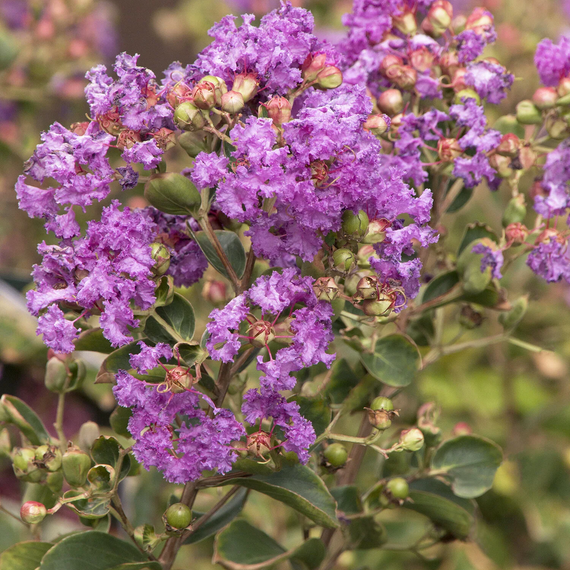
- Stunning dark purple flower panicles bloom from mid-summer through early fall, retaining their rich color intensity without fading — a standout trait among purple-flowering crape myrtles
- Delivers year-round visual appeal with bronze-tinted spring foliage, attractive summer blooms, brilliant orange-red fall color, and smooth exfoliating bark for striking winter structure
- Bred for improved resistance to powdery mildew and highly adaptable to heat, drought, and urban conditions once established
- A pollinator magnet — the large crepe-textured flower clusters attract butterflies, bees, and other beneficial insects throughout the long bloom season
Catawba Crape Myrtle (Lagerstroemia indica 'Catawba') is a showstopping deciduous small tree or multi-stemmed large shrub celebrated for its exceptionally long-lasting, deep purple flowers that grace the landscape from mid-summer well into early fall. Unlike many purple-flowered selections that fade quickly after opening, 'Catawba' is prized for holding its vivid color intensity throughout the bloom cycle, making it one of the most reliable and dramatic purple crape myrtles available. Bronze-tinted new foliage emerges in spring and transitions to a lush deep green canopy through the growing season, before putting on a final spectacular display of brilliant orange-red fall color. Even in winter, the smooth, exfoliating, multicolored bark adds artful texture and visual interest to the garden. Reaching a mature height of 10 to 15 feet with a spread of 8 to 12 feet, 'Catawba' fits comfortably in smaller residential yards, mixed borders, and urban landscapes alike. Bred for improved mildew resistance and adaptability to a wide range of well-drained soils, this low-maintenance flowering tree thrives in full sun across USDA Hardiness Zones 7 through 9 — perfectly suited to the hot summers and mild winters of Southern Oregon and Northern California. Whether planted as a bold specimen, in mass groupings, or as a flowering screen, Catawba Crape Myrtle delivers four seasons of ornamental value with minimal care required.
Plant Description
Catawba Crape Myrtle is a deciduous small tree or large multi-stemmed shrub in the family Lythraceae, native to China and Korea as a species but selected and developed as a cultivar in the United States. Its botanical name, Lagerstroemia indica 'Catawba', reflects its species origin and its cultivar name, which is shared with the Catawba River region of the American Southeast. The plant is particularly distinguished among purple crape myrtles for producing large panicles of ruffled, crepe-textured dark purple flowers that hold their color intensity far better than most comparable cultivars — a characteristic that has sustained its long-standing popularity in American landscapes. The plant naturally grows with multiple trunks and a rounded, vase-like canopy, though it can be trained to a single trunk with early formative pruning. Its smooth, attractively mottled bark in shades of cinnamon, gray, and tan exfoliates seasonally to reveal fresh inner layers, providing a compelling structural feature even when the tree is leafless in winter.
Mature Size and Growth Rate
| Characteristic | Detail |
|---|---|
| Mature Height | 10 to 15 feet |
| Mature Spread | 8 to 12 feet |
| Growth Habit | Upright-spreading, rounded, naturally multi-trunked |
| Growth Rate | Medium — typically 1 to 2 feet per year under good conditions |
| Plant Type | Deciduous tree or large shrub |
'Catawba' is considered a mid-size crape myrtle — large enough to serve as a true specimen or small flowering tree, yet compact enough to integrate into residential landscapes and smaller garden spaces without overwhelming its surroundings. Its natural vase-shaped form develops gracefully over time when allowed to grow without heavy topping or heading cuts.
Hardiness Zones and Climate Suitability
Catawba Crape Myrtle is reliably cold-hardy in USDA Hardiness Zones 7 through 9, and some sources extend the range to Zone 6b with winter mulching protection for the root zone. It thrives in the heat typical of inland valleys and low-elevation foothills of Southern Oregon and Northern California, where long, dry, hot summers and relatively mild winters provide ideal growing conditions. The species is highly heat-tolerant and flourishes in full-sun exposures with good air circulation. In Zone 6 or at the colder edge of Zone 7, top growth may experience some dieback in severe winters, but established plants will typically regenerate vigorously from the root system in spring. Young plants benefit from a 3- to 4-inch layer of organic mulch over the root zone during the first couple of winters to insulate the roots during cold snaps. Once fully established, 'Catawba' is considerably more cold-tolerant and generally rebounds reliably each season.
Sunlight Requirements
Catawba Crape Myrtle requires full sun for peak performance — a minimum of 6 to 8 hours of direct sunlight per day is essential to produce the best flowering display and maintain a healthy, upright form. Planting in a location that receives full sun from morning through afternoon yields the most abundant and richest-colored blooms. While the plant can tolerate partial shade, reduced sunlight results in significantly fewer flowers, weaker and arching branch structure, and increased susceptibility to powdery mildew due to diminished air circulation and reduced drying of foliage. For Southern Oregon and Northern California gardens, a south- or west-facing exposure that captures the maximum summer sun will allow this tree to perform at its absolute best.
Soil and pH Preferences
'Catawba' Crape Myrtle is impressively adaptable to a wide range of soil types, including sandy loam, clay loam, and nutrient-poor soils — provided drainage is adequate. Standing water or consistently wet, poorly drained soils are the primary soil-related cause of decline and root rot. Ideal conditions are moist, well-drained, slightly acidic to neutral soils with a pH range of approximately 5.5 to 7.0. The species also demonstrates good tolerance for urban soils, coastal conditions, and compacted soils — making it well-suited for use along driveways, parking areas, and street-side plantings. If your native soil is particularly heavy clay, amending the planting area and surrounding soil with compost before planting will improve drainage and promote healthy root establishment. A soil pH test is recommended before applying any amendments; in many areas of Southern Oregon and Northern California, native soils naturally fall within the acceptable pH range for this tree.
Watering Guide
During the first growing season, consistent, deep watering is critical to successful establishment. Water newly planted trees thoroughly at the time of planting to settle the soil around the roots, and continue to water deeply once per week — or more frequently during periods of extreme heat or drought — keeping the root zone evenly moist but never waterlogged. Once established, Catawba Crape Myrtle becomes notably drought-tolerant and requires far less supplemental irrigation. Mature, established plants in the ground typically need deep watering only during extended dry spells. Always water at the base of the plant rather than overhead, as wet foliage promotes powdery mildew and Cercospora leaf spot. Allow the soil to dry slightly between waterings to discourage fungal disease and root rot. Applying a 2- to 3-inch layer of organic mulch over the root zone — kept several inches away from the trunk base — will significantly help retain soil moisture, regulate soil temperature, and reduce watering frequency.
Fertilizing
Catawba Crape Myrtle is not a heavy feeder, and over-fertilizing — particularly with nitrogen-rich products — can actually reduce flowering by stimulating excess vegetative growth at the expense of blooms. A soil test is always the most reliable guide for determining whether and what to fertilize. In most well-amended garden soils, little to no supplemental fertilizer is needed. If fertilizing is desired, apply a balanced, slow-release granular fertilizer (such as a 10-10-10 or similar formulation) once in early spring as the tree breaks dormancy, following label rates carefully. Avoid fertilizing after midsummer, as this can stimulate late-season soft growth that is more vulnerable to cold injury. Topdressing the root zone annually with a 1- to 2-inch layer of finished compost in spring or fall provides a gentle, natural source of slow-release nutrients and improves soil structure over time without the risk of over-feeding. Excessive nitrogen from nearby lawn fertilizer applications can also inadvertently affect crape myrtle performance — keep lawn fertilizer well away from the tree's root zone.
Pruning and Maintenance
Catawba Crape Myrtle blooms on new wood — meaning the current season's new growth produces the flowers — so timing and technique for pruning are both important. The best time to prune is in late winter to early spring, just before the plant breaks dormancy (typically February through March in most of Southern Oregon and Northern California). At this time, remove any dead, damaged, or crossing branches, and lightly thin the canopy to improve air circulation and light penetration. The goal is to preserve and enhance the tree's natural vase-shaped structure rather than alter it drastically. It is critically important to avoid the practice known as "crape murder" — the heavy topping or heading back of main trunks and branches to stubs — which disfigures the tree, creates structurally weak regrowth, and makes the plant significantly more susceptible to pest and disease problems. If spent flower panicles are removed (deadheaded) after the first flush of bloom, a second flush of flowering can often be encouraged later in the season. Basal suckers that emerge from the trunk base or root system are normal and can be removed at any time while they are small and tender.
Planting Instructions
- Select a planting location in full sun with well-drained soil. Avoid areas prone to standing water or where soil remains consistently wet.
- Dig a planting hole that is twice as wide as the root ball but no deeper than the height of the root ball. The top of the root ball should sit level with or just slightly above the surrounding soil grade.
- Before placing the tree in the hole, inspect the root ball. If roots are circling or matted along the edges of the pot, gently loosen and untangle them to encourage outward growth into the surrounding soil.
- Backfill the hole using the original native soil. Tamp lightly to eliminate large air pockets but avoid compacting the soil heavily.
- Form a shallow watering basin or berm around the outer edge of the planting hole to direct irrigation water to the root zone.
- Water thoroughly and deeply immediately after planting.
- Apply a 2- to 3-inch layer of organic mulch (bark chips, wood chips, or shredded leaves) over the root zone, extending at least to the drip line. Keep mulch pulled back 3 to 4 inches from the base of the trunk to prevent rot and pest harborage.
- Space multiple plants 8 to 12 feet apart to allow adequate room for mature canopy development and good air circulation.
Seasonal Interest
| Season | Ornamental Feature |
|---|---|
| Spring | Attractive bronze-copper new foliage emerges; late to leaf out compared to most trees — this is normal |
| Summer | Large, long-lasting panicles of rich, non-fading dark purple crepe-textured flowers bloom from mid-summer onward; lush deep green canopy |
| Fall | Foliage transitions to brilliant shades of orange and red before dropping; seed capsule clusters develop at branch tips |
| Winter | Smooth, multicolored exfoliating bark in cinnamon, tan, and gray tones provides striking sculptural interest; persistent seed capsule clusters add subtle texture |
Landscape Uses
The mid-size stature and bold ornamental features of Catawba Crape Myrtle make it one of the most versatile flowering trees for Southern Oregon and Northern California gardens. Use it as a single specimen focal point in a lawn or mixed border to showcase its purple blooms and exfoliating bark. Plant in small groupings of three or more for a stunning mass of summer color along a property boundary or driveway. Its tolerance for urban soils, heat, and drought makes it suitable for streetside and parking lot plantings. 'Catawba' also works well when planted in a row as a flowering screen or informal hedge. For smaller gardens, its manageable size makes it an excellent alternative to larger shade trees where overhead clearance is a concern. Note that fallen flower panicles can stain walkways, driveways, and car surfaces, so avoid siting the tree directly over paved areas that are frequently used or parked under. The tree can also be grown in large containers for patio or courtyard settings, though container-grown plants require more diligent watering and winter protection in colder zones.
Companion Plants
Catawba Crape Myrtle pairs beautifully with plants that share its love of full sun and well-drained soil, and that complement or contrast with its bold purple summer blooms and warm fall foliage. Consider the following companions for a cohesive and seasonally layered planting:
- Lavender (Lavandula spp.) — shares drought tolerance and full-sun preference; silver-gray foliage and purple-blue flowers harmonize beautifully beneath the crape myrtle canopy
- Purple Coneflower (Echinacea purpurea) — echoes the purple color palette, attracts pollinators, and blooms simultaneously in summer
- Ornamental Grasses (such as Muhlenbergia or Pennisetum) — flowing textures provide a soft, naturalistic contrast to the tree's bold flower panicles and structured bark
- Russian Sage (Perovskia atriplicifolia) — feathery silver stems and lavender-blue flowers complement the deep purple of 'Catawba' and tolerate heat and drought equally well
- Black-Eyed Susan (Rudbeckia hirta) — golden-yellow flowers create a vivid color contrast with the purple blooms and reinforce the warm orange tones of fall foliage
- Salvia species — heat-tolerant, pollinator-friendly, and available in colors that blend or contrast with the purple flower panicles
- Daylilies (Hemerocallis) — low-maintenance perennials that fill the foreground with color and thrive in the same full-sun, well-drained conditions
Pests and Diseases
Catawba Crape Myrtle has been bred for improved resistance to powdery mildew and is generally regarded as a low-maintenance, pest-resistant tree. However, like all landscape plants, it may occasionally encounter the following issues:
- Powdery Mildew (Erysiphe lagerstroemiae) — a white to grayish fungal coating on leaves, young stems, and flower buds; most common in shaded locations with poor air circulation. 'Catawba' has some inherent resistance. Ensure full sun siting and good spacing to minimize risk. Treat severe cases with myclobutanil, propiconazole, or copper-based fungicides.
- Crape Myrtle Aphid (Sarucallis kahawaluokalani) — tiny pale-yellow insects on leaf undersides that excrete sticky honeydew, which supports black sooty mold growth. Control with a strong water spray, insecticidal soap, horticultural oil, or neem oil. Natural predators such as ladybugs and lacewings are effective biological controls — avoid broad-spectrum pesticides that harm beneficials.
- Crape Myrtle Bark Scale (Acanthococcus lagerstroemiae) — white, cottony-looking scale clusters on bark in branch forks and furrows; associated with honeydew and sooty mold. Manage with dormant oil applications, careful pruning of heavily infested branches, or systemic insecticide treatments in severe cases.
- Cercospora Leaf Spot (Cercospora lythracearum) — yellow spots on upper leaf surfaces during warm, wet weather that can cause late-summer defoliation in susceptible plants. Good air circulation and avoiding overhead irrigation reduce risk. Treat with thiophanate-methyl or myclobutanil if needed.
- Japanese Beetles — adults skeletonize leaves and feed on flower petals during summer. Hand-pick and drop in soapy water, or apply neem oil or appropriate labeled insecticides.
- Sooty Mold — a secondary black fungal coating that grows on honeydew deposits from aphids or scale insects. Control the underlying insect pest to eliminate the mold source; foliage can be washed with a diluted soap solution if desired.
The most effective overall disease and pest prevention strategy is proper siting in full sun with adequate plant spacing to maximize air circulation, combined with appropriate pruning practices and avoidance of excess nitrogen fertilization.
Wildlife Value
Catawba Crape Myrtle is a valuable addition to pollinator-friendly garden designs. The large, nectar-rich flower panicles that bloom throughout the long summer season are attractive to a wide variety of beneficial insects, including bumblebees, honeybees, native solitary bees, and numerous butterfly species. The high visibility and accessibility of the flowers make this tree a reliable resource for pollinators during the peak of the summer heat when many other flowering plants have finished blooming. As the flowers fade and seed capsules develop, small songbirds may visit to feed on the persistent seed clusters through fall and into winter, adding additional wildlife value. The multi-stemmed branching structure can also offer nesting sites and protective cover for birds. The tree is generally considered non-toxic to cats and dogs, making it a pet-friendly choice in residential landscapes. Deer tend to avoid established crape myrtles, making 'Catawba' a particularly practical choice in areas where deer browsing pressure is a concern.
Container Growing
Catawba Crape Myrtle can be grown successfully in large containers for patio, courtyard, and entryway settings, allowing gardeners in borderline hardiness zones or with limited ground space to enjoy this spectacular flowering tree. For best results, choose a container with a minimum volume of 25 to 30 gallons with adequate drainage holes. Use a high-quality, well-draining potting mix amended with perlite to prevent waterlogging. Container-grown plants dry out more rapidly than those in the ground and will require more frequent watering — check soil moisture regularly and water deeply whenever the top 2 inches of potting mix feel dry. Feed container plants with a balanced, slow-release fertilizer applied in early spring at label-recommended rates. Container plants may need root pruning or repotting every 2 to 3 years to prevent the plant from becoming severely root-bound. In Zone 7 and at the cooler edges of the recommended range, move containers to a sheltered, frost-protected location such as a garage or covered porch during hard freezes, as roots in containers are far more vulnerable to cold damage than roots insulated in the ground. Bring plants back outdoors to full sun once frost risk has passed in spring.
- Stunning dark purple flower panicles bloom from mid-summer through early fall, retaining their rich color intensity without fading — a standout trait among purple-flowering crape myrtles
- Delivers year-round visual appeal with bronze-tinted spring foliage, attractive summer blooms, brilliant orange-red fall color, and smooth exfoliating bark for striking winter structure
- Bred for improved resistance to powdery mildew and highly adaptable to heat, drought, and urban conditions once established
- A pollinator magnet — the large crepe-textured flower clusters attract butterflies, bees, and other beneficial insects throughout the long bloom season
Catawba Crape Myrtle (Lagerstroemia indica 'Catawba') is a showstopping deciduous small tree or multi-stemmed large shrub celebrated for its exceptionally long-lasting, deep purple flowers that grace the landscape from mid-summer well into early fall. Unlike many purple-flowered selections that fade quickly after opening, 'Catawba' is prized for holding its vivid color intensity throughout the bloom cycle, making it one of the most reliable and dramatic purple crape myrtles available. Bronze-tinted new foliage emerges in spring and transitions to a lush deep green canopy through the growing season, before putting on a final spectacular display of brilliant orange-red fall color. Even in winter, the smooth, exfoliating, multicolored bark adds artful texture and visual interest to the garden. Reaching a mature height of 10 to 15 feet with a spread of 8 to 12 feet, 'Catawba' fits comfortably in smaller residential yards, mixed borders, and urban landscapes alike. Bred for improved mildew resistance and adaptability to a wide range of well-drained soils, this low-maintenance flowering tree thrives in full sun across USDA Hardiness Zones 7 through 9 — perfectly suited to the hot summers and mild winters of Southern Oregon and Northern California. Whether planted as a bold specimen, in mass groupings, or as a flowering screen, Catawba Crape Myrtle delivers four seasons of ornamental value with minimal care required.
Plant Description
Catawba Crape Myrtle is a deciduous small tree or large multi-stemmed shrub in the family Lythraceae, native to China and Korea as a species but selected and developed as a cultivar in the United States. Its botanical name, Lagerstroemia indica 'Catawba', reflects its species origin and its cultivar name, which is shared with the Catawba River region of the American Southeast. The plant is particularly distinguished among purple crape myrtles for producing large panicles of ruffled, crepe-textured dark purple flowers that hold their color intensity far better than most comparable cultivars — a characteristic that has sustained its long-standing popularity in American landscapes. The plant naturally grows with multiple trunks and a rounded, vase-like canopy, though it can be trained to a single trunk with early formative pruning. Its smooth, attractively mottled bark in shades of cinnamon, gray, and tan exfoliates seasonally to reveal fresh inner layers, providing a compelling structural feature even when the tree is leafless in winter.
Mature Size and Growth Rate
| Characteristic | Detail |
|---|---|
| Mature Height | 10 to 15 feet |
| Mature Spread | 8 to 12 feet |
| Growth Habit | Upright-spreading, rounded, naturally multi-trunked |
| Growth Rate | Medium — typically 1 to 2 feet per year under good conditions |
| Plant Type | Deciduous tree or large shrub |
'Catawba' is considered a mid-size crape myrtle — large enough to serve as a true specimen or small flowering tree, yet compact enough to integrate into residential landscapes and smaller garden spaces without overwhelming its surroundings. Its natural vase-shaped form develops gracefully over time when allowed to grow without heavy topping or heading cuts.
Hardiness Zones and Climate Suitability
Catawba Crape Myrtle is reliably cold-hardy in USDA Hardiness Zones 7 through 9, and some sources extend the range to Zone 6b with winter mulching protection for the root zone. It thrives in the heat typical of inland valleys and low-elevation foothills of Southern Oregon and Northern California, where long, dry, hot summers and relatively mild winters provide ideal growing conditions. The species is highly heat-tolerant and flourishes in full-sun exposures with good air circulation. In Zone 6 or at the colder edge of Zone 7, top growth may experience some dieback in severe winters, but established plants will typically regenerate vigorously from the root system in spring. Young plants benefit from a 3- to 4-inch layer of organic mulch over the root zone during the first couple of winters to insulate the roots during cold snaps. Once fully established, 'Catawba' is considerably more cold-tolerant and generally rebounds reliably each season.
Sunlight Requirements
Catawba Crape Myrtle requires full sun for peak performance — a minimum of 6 to 8 hours of direct sunlight per day is essential to produce the best flowering display and maintain a healthy, upright form. Planting in a location that receives full sun from morning through afternoon yields the most abundant and richest-colored blooms. While the plant can tolerate partial shade, reduced sunlight results in significantly fewer flowers, weaker and arching branch structure, and increased susceptibility to powdery mildew due to diminished air circulation and reduced drying of foliage. For Southern Oregon and Northern California gardens, a south- or west-facing exposure that captures the maximum summer sun will allow this tree to perform at its absolute best.
Soil and pH Preferences
'Catawba' Crape Myrtle is impressively adaptable to a wide range of soil types, including sandy loam, clay loam, and nutrient-poor soils — provided drainage is adequate. Standing water or consistently wet, poorly drained soils are the primary soil-related cause of decline and root rot. Ideal conditions are moist, well-drained, slightly acidic to neutral soils with a pH range of approximately 5.5 to 7.0. The species also demonstrates good tolerance for urban soils, coastal conditions, and compacted soils — making it well-suited for use along driveways, parking areas, and street-side plantings. If your native soil is particularly heavy clay, amending the planting area and surrounding soil with compost before planting will improve drainage and promote healthy root establishment. A soil pH test is recommended before applying any amendments; in many areas of Southern Oregon and Northern California, native soils naturally fall within the acceptable pH range for this tree.
Watering Guide
During the first growing season, consistent, deep watering is critical to successful establishment. Water newly planted trees thoroughly at the time of planting to settle the soil around the roots, and continue to water deeply once per week — or more frequently during periods of extreme heat or drought — keeping the root zone evenly moist but never waterlogged. Once established, Catawba Crape Myrtle becomes notably drought-tolerant and requires far less supplemental irrigation. Mature, established plants in the ground typically need deep watering only during extended dry spells. Always water at the base of the plant rather than overhead, as wet foliage promotes powdery mildew and Cercospora leaf spot. Allow the soil to dry slightly between waterings to discourage fungal disease and root rot. Applying a 2- to 3-inch layer of organic mulch over the root zone — kept several inches away from the trunk base — will significantly help retain soil moisture, regulate soil temperature, and reduce watering frequency.
Fertilizing
Catawba Crape Myrtle is not a heavy feeder, and over-fertilizing — particularly with nitrogen-rich products — can actually reduce flowering by stimulating excess vegetative growth at the expense of blooms. A soil test is always the most reliable guide for determining whether and what to fertilize. In most well-amended garden soils, little to no supplemental fertilizer is needed. If fertilizing is desired, apply a balanced, slow-release granular fertilizer (such as a 10-10-10 or similar formulation) once in early spring as the tree breaks dormancy, following label rates carefully. Avoid fertilizing after midsummer, as this can stimulate late-season soft growth that is more vulnerable to cold injury. Topdressing the root zone annually with a 1- to 2-inch layer of finished compost in spring or fall provides a gentle, natural source of slow-release nutrients and improves soil structure over time without the risk of over-feeding. Excessive nitrogen from nearby lawn fertilizer applications can also inadvertently affect crape myrtle performance — keep lawn fertilizer well away from the tree's root zone.
Pruning and Maintenance
Catawba Crape Myrtle blooms on new wood — meaning the current season's new growth produces the flowers — so timing and technique for pruning are both important. The best time to prune is in late winter to early spring, just before the plant breaks dormancy (typically February through March in most of Southern Oregon and Northern California). At this time, remove any dead, damaged, or crossing branches, and lightly thin the canopy to improve air circulation and light penetration. The goal is to preserve and enhance the tree's natural vase-shaped structure rather than alter it drastically. It is critically important to avoid the practice known as "crape murder" — the heavy topping or heading back of main trunks and branches to stubs — which disfigures the tree, creates structurally weak regrowth, and makes the plant significantly more susceptible to pest and disease problems. If spent flower panicles are removed (deadheaded) after the first flush of bloom, a second flush of flowering can often be encouraged later in the season. Basal suckers that emerge from the trunk base or root system are normal and can be removed at any time while they are small and tender.
Planting Instructions
- Select a planting location in full sun with well-drained soil. Avoid areas prone to standing water or where soil remains consistently wet.
- Dig a planting hole that is twice as wide as the root ball but no deeper than the height of the root ball. The top of the root ball should sit level with or just slightly above the surrounding soil grade.
- Before placing the tree in the hole, inspect the root ball. If roots are circling or matted along the edges of the pot, gently loosen and untangle them to encourage outward growth into the surrounding soil.
- Backfill the hole using the original native soil. Tamp lightly to eliminate large air pockets but avoid compacting the soil heavily.
- Form a shallow watering basin or berm around the outer edge of the planting hole to direct irrigation water to the root zone.
- Water thoroughly and deeply immediately after planting.
- Apply a 2- to 3-inch layer of organic mulch (bark chips, wood chips, or shredded leaves) over the root zone, extending at least to the drip line. Keep mulch pulled back 3 to 4 inches from the base of the trunk to prevent rot and pest harborage.
- Space multiple plants 8 to 12 feet apart to allow adequate room for mature canopy development and good air circulation.
Seasonal Interest
| Season | Ornamental Feature |
|---|---|
| Spring | Attractive bronze-copper new foliage emerges; late to leaf out compared to most trees — this is normal |
| Summer | Large, long-lasting panicles of rich, non-fading dark purple crepe-textured flowers bloom from mid-summer onward; lush deep green canopy |
| Fall | Foliage transitions to brilliant shades of orange and red before dropping; seed capsule clusters develop at branch tips |
| Winter | Smooth, multicolored exfoliating bark in cinnamon, tan, and gray tones provides striking sculptural interest; persistent seed capsule clusters add subtle texture |
Landscape Uses
The mid-size stature and bold ornamental features of Catawba Crape Myrtle make it one of the most versatile flowering trees for Southern Oregon and Northern California gardens. Use it as a single specimen focal point in a lawn or mixed border to showcase its purple blooms and exfoliating bark. Plant in small groupings of three or more for a stunning mass of summer color along a property boundary or driveway. Its tolerance for urban soils, heat, and drought makes it suitable for streetside and parking lot plantings. 'Catawba' also works well when planted in a row as a flowering screen or informal hedge. For smaller gardens, its manageable size makes it an excellent alternative to larger shade trees where overhead clearance is a concern. Note that fallen flower panicles can stain walkways, driveways, and car surfaces, so avoid siting the tree directly over paved areas that are frequently used or parked under. The tree can also be grown in large containers for patio or courtyard settings, though container-grown plants require more diligent watering and winter protection in colder zones.
Companion Plants
Catawba Crape Myrtle pairs beautifully with plants that share its love of full sun and well-drained soil, and that complement or contrast with its bold purple summer blooms and warm fall foliage. Consider the following companions for a cohesive and seasonally layered planting:
- Lavender (Lavandula spp.) — shares drought tolerance and full-sun preference; silver-gray foliage and purple-blue flowers harmonize beautifully beneath the crape myrtle canopy
- Purple Coneflower (Echinacea purpurea) — echoes the purple color palette, attracts pollinators, and blooms simultaneously in summer
- Ornamental Grasses (such as Muhlenbergia or Pennisetum) — flowing textures provide a soft, naturalistic contrast to the tree's bold flower panicles and structured bark
- Russian Sage (Perovskia atriplicifolia) — feathery silver stems and lavender-blue flowers complement the deep purple of 'Catawba' and tolerate heat and drought equally well
- Black-Eyed Susan (Rudbeckia hirta) — golden-yellow flowers create a vivid color contrast with the purple blooms and reinforce the warm orange tones of fall foliage
- Salvia species — heat-tolerant, pollinator-friendly, and available in colors that blend or contrast with the purple flower panicles
- Daylilies (Hemerocallis) — low-maintenance perennials that fill the foreground with color and thrive in the same full-sun, well-drained conditions
Pests and Diseases
Catawba Crape Myrtle has been bred for improved resistance to powdery mildew and is generally regarded as a low-maintenance, pest-resistant tree. However, like all landscape plants, it may occasionally encounter the following issues:
- Powdery Mildew (Erysiphe lagerstroemiae) — a white to grayish fungal coating on leaves, young stems, and flower buds; most common in shaded locations with poor air circulation. 'Catawba' has some inherent resistance. Ensure full sun siting and good spacing to minimize risk. Treat severe cases with myclobutanil, propiconazole, or copper-based fungicides.
- Crape Myrtle Aphid (Sarucallis kahawaluokalani) — tiny pale-yellow insects on leaf undersides that excrete sticky honeydew, which supports black sooty mold growth. Control with a strong water spray, insecticidal soap, horticultural oil, or neem oil. Natural predators such as ladybugs and lacewings are effective biological controls — avoid broad-spectrum pesticides that harm beneficials.
- Crape Myrtle Bark Scale (Acanthococcus lagerstroemiae) — white, cottony-looking scale clusters on bark in branch forks and furrows; associated with honeydew and sooty mold. Manage with dormant oil applications, careful pruning of heavily infested branches, or systemic insecticide treatments in severe cases.
- Cercospora Leaf Spot (Cercospora lythracearum) — yellow spots on upper leaf surfaces during warm, wet weather that can cause late-summer defoliation in susceptible plants. Good air circulation and avoiding overhead irrigation reduce risk. Treat with thiophanate-methyl or myclobutanil if needed.
- Japanese Beetles — adults skeletonize leaves and feed on flower petals during summer. Hand-pick and drop in soapy water, or apply neem oil or appropriate labeled insecticides.
- Sooty Mold — a secondary black fungal coating that grows on honeydew deposits from aphids or scale insects. Control the underlying insect pest to eliminate the mold source; foliage can be washed with a diluted soap solution if desired.
The most effective overall disease and pest prevention strategy is proper siting in full sun with adequate plant spacing to maximize air circulation, combined with appropriate pruning practices and avoidance of excess nitrogen fertilization.
Wildlife Value
Catawba Crape Myrtle is a valuable addition to pollinator-friendly garden designs. The large, nectar-rich flower panicles that bloom throughout the long summer season are attractive to a wide variety of beneficial insects, including bumblebees, honeybees, native solitary bees, and numerous butterfly species. The high visibility and accessibility of the flowers make this tree a reliable resource for pollinators during the peak of the summer heat when many other flowering plants have finished blooming. As the flowers fade and seed capsules develop, small songbirds may visit to feed on the persistent seed clusters through fall and into winter, adding additional wildlife value. The multi-stemmed branching structure can also offer nesting sites and protective cover for birds. The tree is generally considered non-toxic to cats and dogs, making it a pet-friendly choice in residential landscapes. Deer tend to avoid established crape myrtles, making 'Catawba' a particularly practical choice in areas where deer browsing pressure is a concern.
Container Growing
Catawba Crape Myrtle can be grown successfully in large containers for patio, courtyard, and entryway settings, allowing gardeners in borderline hardiness zones or with limited ground space to enjoy this spectacular flowering tree. For best results, choose a container with a minimum volume of 25 to 30 gallons with adequate drainage holes. Use a high-quality, well-draining potting mix amended with perlite to prevent waterlogging. Container-grown plants dry out more rapidly than those in the ground and will require more frequent watering — check soil moisture regularly and water deeply whenever the top 2 inches of potting mix feel dry. Feed container plants with a balanced, slow-release fertilizer applied in early spring at label-recommended rates. Container plants may need root pruning or repotting every 2 to 3 years to prevent the plant from becoming severely root-bound. In Zone 7 and at the cooler edges of the recommended range, move containers to a sheltered, frost-protected location such as a garage or covered porch during hard freezes, as roots in containers are far more vulnerable to cold damage than roots insulated in the ground. Bring plants back outdoors to full sun once frost risk has passed in spring.


