

Zoom the image with the mouse
Miner's Merlot Spurge - 1 Gallon
SKU:
2165200
UPC:
014949041383
$12.99
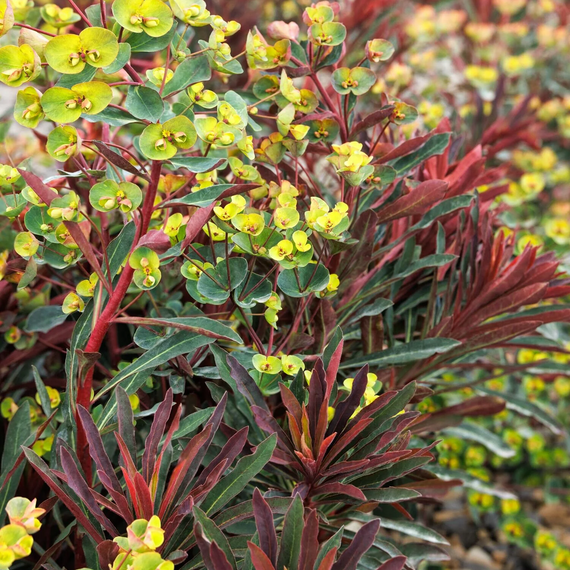
- Stunning year-round foliage transitions from deep wine-red new growth to burgundy-tinted olive green with rich red undersides — darkening to near-black in cool fall temperatures for dramatic seasonal contrast
- Long-lasting chartreuse to yellow-green flower clusters bloom from late spring through summer, standing out brilliantly against the dark foliage and attracting bees and other pollinators
- Exceptionally heat and drought tolerant once established, with strong resistance to deer, rabbits, and most pest and disease problems — a truly low-maintenance choice for water-wise gardens
- Compact, upright mounding habit reaching 18-24 inches tall and wide makes it a versatile fit for borders, rock gardens, xeriscape designs, and mixed containers
Euphorbia 'Miner's Merlot' (Euphorbia x 'KM-MM024', PP32,321) is a standout hybrid spurge that brings bold, ever-changing color and effortless charm to the garden from season to season. New stems emerge in a striking deep wine-red, maturing through tones of burgundy-tinged olive green, all while maintaining vivid red undersides toward the stem tips throughout the growing season — a characteristic that sets this cultivar apart from other dark-leaved euphorbias. As cooler autumn temperatures arrive, the foliage deepens to near-black, making it one of the most dramatically colored perennials available for fall interest. From late spring through summer, upright stems are topped with dense clusters of saucer-shaped, chartreuse to yellow-green flowers held on rich burgundy stems, creating a stunning complementary contrast to the dark foliage and providing valuable nectar for pollinators. Growing in a tidy, vigorous mound 18-24 inches tall and equally wide, this evergreen to semi-evergreen perennial is perfectly suited to Southern Oregon and Northern California gardens, where its exceptional heat tolerance, drought resilience once established, and resistance to deer, rabbits, and most pests make it a reliable, low-care performer in borders, rock gardens, gravel gardens, hillside plantings, and mixed container arrangements. Whether used as a bold accent, massed for landscape impact, or featured in a water-wise xeriscape design, Euphorbia 'Miner's Merlot' delivers year-round structure, texture, and color with minimal effort.
Plant Description
Euphorbia 'Miner's Merlot' is a patented hybrid spurge (PP32,321) that belongs to the family Euphorbiaceae. It is a compact, clump-forming, evergreen to semi-evergreen perennial with a strongly upright, mounding habit. The plant is celebrated for its exceptional foliage display: narrow, linear leaves emerge in a deep wine-red or merlot color, transitioning through rich burgundy to olive green, while retaining vivid red-purple coloring on the undersides of leaves toward the stem ends throughout the season. Unlike many dark-leaved euphorbias, 'Miner's Merlot' is noted for its vigorous, dense growth habit. As temperatures drop in autumn, the foliage deepens dramatically to near-black, providing some of the most striking cold-season color available in a perennial. Whorls of narrow leaves are spirally arranged along upright stems that harden and become semi-woody at the base as the plant matures. Like all euphorbias, cut or broken stems exude a milky white latex sap that is irritating to skin and eyes and toxic if ingested — gloves and eye protection should always be worn when handling this plant.
Flowers and Seasonal Interest
From late spring through summer, and often continuing into fall, 'Miner's Merlot' produces abundant clusters of small, saucer-shaped flowers held in showy, long-lasting chartreuse to yellow-green bracts at the tips of upright burgundy-red stems. The vibrant lime-green flower heads create a bold, striking contrast against the dark wine-red and olive foliage, making this one of the most colorful combinations in any sunny border. The flowers are attractive to bees, butterflies, hummingbirds, and a wide range of other pollinators, earning this plant a place in wildlife and pollinator-friendly garden designs. The flower bracts are long-lasting in the garden and can also be cut for fresh floral arrangements — take care to avoid contact with the milky sap when cutting stems, and consider searing the cut ends or letting them callus to seal the latex before placing in a vase. In fall, as flowers fade and temperatures cool, the foliage deepens to near-black, offering a rich second act of visual interest that carries through winter in mild climates.
Mature Size and Growth Habit
| Characteristic | Detail |
|---|---|
| Mature Height | 18-24 inches |
| Mature Spread | 18-24 inches |
| Growth Habit | Upright mound, clump-forming |
| Growth Rate | Moderate |
| Time to Maturity | 2-5 years to ultimate size |
| Plant Type | Evergreen to semi-evergreen perennial |
Hardiness Zones and Climate Tolerance
'Miner's Merlot' spurge is reliably hardy in USDA Hardiness Zones 7-9, making it an excellent perennial choice for much of Southern Oregon and Northern California. It performs exceptionally well in the heat of summer and tolerates a wide range of conditions. In milder areas within Zone 7, the plant remains evergreen or semi-evergreen through winter. While it is quite cold-hardy for a spurge hybrid, prolonged exposure to wet winter soils is more damaging than cold temperatures alone — excellent drainage is essential year-round. This plant excels in warm, dry-summer climates and is highly tolerant of heat, humidity fluctuations, drought, wind, poor soils, and urban growing conditions. A layer of mulch over the root zone can provide added protection during unusual cold snaps in borderline zones.
Sunlight Requirements
'Miner's Merlot' performs best in full sun, receiving at least 6 hours of direct sunlight per day. Full sun promotes the most intense foliage coloration, the most vigorous mounding growth habit, and the heaviest flower production. It will also grow in part shade (2-6 hours of direct sun), but foliage color may be less vivid, stems may become slightly more open, and flower production may be reduced. In the hot, dry summers of Southern Oregon and Northern California, a position with full morning sun and light afternoon shade can help the plant thrive while reducing heat stress. South- and west-facing exposures are ideal for maximizing color and bloom performance.
Soil and pH Preferences
'Miner's Merlot' is remarkably adaptable to a wide range of soil types and pH levels, but excellent drainage is non-negotiable. Soggy or consistently wet soil — especially during winter — is the primary cause of decline or plant loss. Ideal soil conditions include:
- Well-drained loam, sandy loam, or rocky/gravelly soil
- Tolerates poor, lean soils and slopes where drainage is inherently good
- Soil pH adaptable from acidic to neutral to mildly alkaline (approximately 6.0-8.0)
- Does not tolerate heavy clay or waterlogged conditions
- Amend dense soils with coarse sand, perlite, or fine gravel to improve drainage before planting
- Raised beds and berms work well in areas with heavier native soil
Watering Guide
Once established, 'Miner's Merlot' is notably drought tolerant and one of the most water-wise perennial choices available for Western gardens. During the establishment period (the first growing season), water regularly to keep the root zone consistently moist but never waterlogged. After the plant is established, reduce watering significantly. A deep watering every 2-3 weeks during hot, dry summer periods is typically sufficient. Avoid frequent shallow watering, which encourages surface root development. During cool or wet seasons, allow the soil to dry out between waterings. Overwatering is the most common cause of problems — yellowing leaves, wilting despite moist soil, and stem base softening are signs of excess moisture. Good drainage eliminates the majority of watering-related issues. In the Pacific Northwest-influenced climates of Southern Oregon, natural winter rainfall is usually adequate and supplemental irrigation should be suspended entirely during the rainy season.
Fertilizing
'Miner's Merlot' spurge thrives in lean conditions and does not require heavy feeding. Overfertilizing, especially with high-nitrogen formulas, can result in excessively lush, floppy growth and diminished foliage color. Recommended fertilizing approach:
- Apply a light application of a balanced, slow-release granular fertilizer (such as a 10-10-10 or similar formula) in early spring as new growth emerges
- A second light application in mid-summer can support continued flower production if the soil is particularly poor
- In average garden soils, a single spring application — or even none at all — is typically sufficient
- Avoid high-nitrogen fertilizers that promote soft, weak growth at the expense of foliage color and compact form
- Top-dressing with a thin layer of compost in spring is an excellent low-input alternative to synthetic fertilizers
Pruning and Maintenance
'Miner's Merlot' is a low-maintenance perennial that requires minimal pruning. Key maintenance guidelines include:
- Pruning is optional and generally not required for plant health — the natural mounding habit stays tidy on its own
- If tidying is desired, the best time to prune is in late winter to early spring, just before new growth begins — remove any dead, damaged, or tired-looking stems back to the base
- Do NOT prune hard in fall, as this can reduce cold hardiness and stress the plant heading into winter
- Wear gloves, long sleeves, and eye protection whenever pruning — the milky white latex sap is a significant skin and eye irritant
- Wash tools and hands thoroughly after working with the plant
- Deadheading spent flower heads after bloom can keep the plant looking fresh; this is also a good time to remove any biennial stems that have completed their flowering cycle
- This cultivar is a patented plant (PP32,321) — vegetative propagation for sale or trade is prohibited by law
Planting Instructions
Follow these steps for successful establishment of 'Miner's Merlot' spurge in the garden:
- Choose a site with full sun to part shade and well-drained soil. Avoid low spots or areas prone to standing water.
- Amend heavy or poorly drained soils with coarse sand, perlite, or gravel before planting.
- The best planting times are spring (after frost risk has passed) or early fall when temperatures are moderate, allowing the root system to establish before extreme heat or cold.
- Dig a planting hole twice as wide as the root ball and approximately the same depth — do not plant too deep. The crown should sit at or just slightly above the surrounding soil level.
- Wear gloves when handling the plant to protect against contact with the latex sap.
- Backfill with the native soil (amended if necessary), firming gently around the base to eliminate air pockets.
- Water thoroughly after planting to settle the soil and hydrate the root system.
- Apply a 2-3 inch layer of mulch around (but not directly against) the crown to conserve moisture and moderate soil temperature during establishment.
- For groupings, space plants 18 inches apart; for mixed borders with other plants, allow 24-36 inches between 'Miner's Merlot' and neighboring specimens to accommodate mature spread and air circulation.
Landscape Uses
'Miner's Merlot' is a highly versatile landscape plant whose bold, colorful foliage makes it a natural focal point in a wide range of garden styles and settings:
- Mixed perennial borders: Use as a mid-border accent or repeated element for rhythm and color cohesion
- Rock and gravel gardens: Thrives in the sharp drainage and lean soils of rock garden settings
- Xeriscape and water-wise gardens: Ideal for low-irrigation landscapes in hot, dry summer climates
- Slope and bank stabilization: Tolerates poor, rocky soils and helps control erosion on challenging sites
- Container planting: Compact size and dramatic foliage make it an outstanding specimen or thriller component in large mixed containers
- Coastal and urban gardens: Tolerates salt spray, wind exposure, pollution, and other urban stresses
- Wildlife and pollinator gardens: Flower heads attract bees, butterflies, and hummingbirds
- Cottage and informal gardens: The wine-red and chartreuse color palette pairs beautifully with soft-textured cottage perennials
- Cut flower gardens: Long-lasting chartreuse bracts add unique texture and color to fresh arrangements
Companion Plants
The deep burgundy-to-olive foliage and chartreuse flowers of 'Miner's Merlot' create striking combinations with a wide range of companion plants. For best visual impact, pair with plants that share its sun and drought tolerance:
- Agastache (Hyssop): Upright lavender or orange spikes contrast beautifully with dark foliage; shares drought tolerance and pollinator appeal
- Echinacea (Coneflower): Bold daisy-form flowers in pink, orange, or white complement the chartreuse blooms and dark leaves
- Salvia: Purple, blue, or red salvias create vivid contrast against the wine-red foliage and mirror the drought-tolerant requirements
- Ornamental grasses (Festuca, Nassella, Pennisetum): Fine-textured grasses provide airy contrast to the dense, upright habit of 'Miner's Merlot'
- Sedum / Stonecrop: Succulent rosettes and flat-topped flower heads offer interesting textural contrast in rock garden combinations
- Lavender (Lavandula): Silver-gray foliage and purple flower spikes set off the dark merlot tones perfectly
- Tulips and Alliums: Spring bulbs emerging through a mass planting of 'Miner's Merlot' create dramatic seasonal vignettes
- Catmint (Nepeta): Soft blue-purple flowers and gray-green foliage create a cool-toned pairing with warm burgundy spurge
Avoid pairing with moisture-loving plants such as hostas or impatiens, as their water requirements will conflict with 'Miner's Merlot's' preference for drier conditions.
Container Growing
'Miner's Merlot' is an excellent choice for container gardens, where its compact, upright mounding form, dramatic foliage, and long bloom season create an eye-catching display throughout the growing season. Follow these guidelines for success in containers:
- Select a container with a minimum diameter of 12 inches and drainage holes in the bottom — drainage is essential
- Use a well-draining potting mix: a blend of approximately 50% quality potting soil, 30% perlite or coarse sand, and 20% compost works well
- Place containers in a full sun to part shade location; at least 6 hours of sun produces the best foliage color
- Allow the top inch or two of soil to dry out between waterings; never allow the container to sit in a saucer of standing water
- Container-grown plants may require more frequent watering in peak summer heat than in-ground specimens
- Apply a slow-release balanced fertilizer at planting and supplement with a diluted liquid fertilizer monthly during the growing season
- In Zone 7 winters, move containers to a sheltered location or garage if hard freezes are expected, as container roots are more exposed to cold than in-ground roots
- Works exceptionally well as the "thriller" element in mixed container arrangements, paired with trailing plants and mounding fillers
Pests and Diseases
'Miner's Merlot' is notably resistant to most pests and diseases, making it one of the more trouble-free perennials for the garden. Key points to be aware of:
- Aphids: Occasionally may colonize soft new growth in spring; treat with a strong spray of water or apply insecticidal soap or neem oil at first sign of infestation
- Spider mites: Can appear in hot, dry conditions; improve air circulation and apply neem oil or insecticidal soap as needed
- Mealybugs: Uncommon but possible; treat with neem oil or insecticidal soap
- Root rot: The most serious disease threat, almost always caused by overwatering or poorly drained soils; prevent by planting in well-drained sites and avoiding excessive irrigation
- Powdery mildew: Occasional issue in conditions with poor air circulation; ensure adequate plant spacing and avoid overhead watering
- Gray mold (Botrytis): Can occur in overly wet or humid conditions; good drainage and air circulation are the best preventive measures
- Deer and rabbit resistance: The toxic milky latex sap makes 'Miner's Merlot' highly resistant to browsing by deer and rabbits
- Overall pest and disease pressure is low; healthy plants in well-drained soil with adequate sun rarely experience significant problems
Toxicity and Safe Handling
'Miner's Merlot', like all euphorbias, contains a milky white latex sap in all plant parts that requires careful handling. Please observe the following safety precautions:
- Skin irritant: The latex sap can cause mild to severe contact dermatitis, including redness, rash, and blistering in sensitive individuals — always wear gloves and long sleeves when pruning, planting, or handling the plant
- Eye hazard: Sap contact with eyes can cause significant irritation and, in serious cases, temporary or permanent corneal damage — wear eye protection when pruning or working closely with the plant
- Toxic if ingested: All parts of the plant — leaves, stems, flowers, fruit, seeds, and roots — are toxic to humans, dogs, cats, and other pets if eaten; blistering of the lips and oral mucosa may occur
- Wash thoroughly: After any contact with the plant, wash hands and any exposed skin with soap and water immediately
- Keep away from children and pets: Plant in areas inaccessible to young children and pets, or supervise closely
- Cut flower handling: When cutting stems for arrangements, seal the cut end by briefly searing it or allowing it to callus for a few minutes to prevent the sap from dripping
- If sap contacts eyes or if any part of the plant is ingested, contact Poison Control (1-800-222-1222) or a veterinarian immediately
Wildlife Value
'Miner's Merlot' offers meaningful wildlife value, particularly for pollinators, while its toxic sap provides natural resistance to browsing animals:
- Bees: The chartreuse flower clusters are rich in nectar and pollen, making this plant a valuable early and mid-season resource for both native bees and honeybees
- Butterflies: Attracts a variety of butterfly species seeking nectar during the bloom period from late spring through fall
- Hummingbirds: The bright flower heads and long bloom season attract hummingbirds to the garden
- Other pollinators: A broad range of beneficial insects, including hover flies and other native pollinators, are drawn to the flowers — earning this plant recognition as a pollinator-friendly selection
- Deer resistant: The milky latex sap is highly deterrent to deer browsing, making this an excellent choice in areas with high deer pressure
- Rabbit resistant: Similarly, rabbits avoid the plant due to the irritating and toxic sap
- Stunning year-round foliage transitions from deep wine-red new growth to burgundy-tinted olive green with rich red undersides — darkening to near-black in cool fall temperatures for dramatic seasonal contrast
- Long-lasting chartreuse to yellow-green flower clusters bloom from late spring through summer, standing out brilliantly against the dark foliage and attracting bees and other pollinators
- Exceptionally heat and drought tolerant once established, with strong resistance to deer, rabbits, and most pest and disease problems — a truly low-maintenance choice for water-wise gardens
- Compact, upright mounding habit reaching 18-24 inches tall and wide makes it a versatile fit for borders, rock gardens, xeriscape designs, and mixed containers
Euphorbia 'Miner's Merlot' (Euphorbia x 'KM-MM024', PP32,321) is a standout hybrid spurge that brings bold, ever-changing color and effortless charm to the garden from season to season. New stems emerge in a striking deep wine-red, maturing through tones of burgundy-tinged olive green, all while maintaining vivid red undersides toward the stem tips throughout the growing season — a characteristic that sets this cultivar apart from other dark-leaved euphorbias. As cooler autumn temperatures arrive, the foliage deepens to near-black, making it one of the most dramatically colored perennials available for fall interest. From late spring through summer, upright stems are topped with dense clusters of saucer-shaped, chartreuse to yellow-green flowers held on rich burgundy stems, creating a stunning complementary contrast to the dark foliage and providing valuable nectar for pollinators. Growing in a tidy, vigorous mound 18-24 inches tall and equally wide, this evergreen to semi-evergreen perennial is perfectly suited to Southern Oregon and Northern California gardens, where its exceptional heat tolerance, drought resilience once established, and resistance to deer, rabbits, and most pests make it a reliable, low-care performer in borders, rock gardens, gravel gardens, hillside plantings, and mixed container arrangements. Whether used as a bold accent, massed for landscape impact, or featured in a water-wise xeriscape design, Euphorbia 'Miner's Merlot' delivers year-round structure, texture, and color with minimal effort.
Plant Description
Euphorbia 'Miner's Merlot' is a patented hybrid spurge (PP32,321) that belongs to the family Euphorbiaceae. It is a compact, clump-forming, evergreen to semi-evergreen perennial with a strongly upright, mounding habit. The plant is celebrated for its exceptional foliage display: narrow, linear leaves emerge in a deep wine-red or merlot color, transitioning through rich burgundy to olive green, while retaining vivid red-purple coloring on the undersides of leaves toward the stem ends throughout the season. Unlike many dark-leaved euphorbias, 'Miner's Merlot' is noted for its vigorous, dense growth habit. As temperatures drop in autumn, the foliage deepens dramatically to near-black, providing some of the most striking cold-season color available in a perennial. Whorls of narrow leaves are spirally arranged along upright stems that harden and become semi-woody at the base as the plant matures. Like all euphorbias, cut or broken stems exude a milky white latex sap that is irritating to skin and eyes and toxic if ingested — gloves and eye protection should always be worn when handling this plant.
Flowers and Seasonal Interest
From late spring through summer, and often continuing into fall, 'Miner's Merlot' produces abundant clusters of small, saucer-shaped flowers held in showy, long-lasting chartreuse to yellow-green bracts at the tips of upright burgundy-red stems. The vibrant lime-green flower heads create a bold, striking contrast against the dark wine-red and olive foliage, making this one of the most colorful combinations in any sunny border. The flowers are attractive to bees, butterflies, hummingbirds, and a wide range of other pollinators, earning this plant a place in wildlife and pollinator-friendly garden designs. The flower bracts are long-lasting in the garden and can also be cut for fresh floral arrangements — take care to avoid contact with the milky sap when cutting stems, and consider searing the cut ends or letting them callus to seal the latex before placing in a vase. In fall, as flowers fade and temperatures cool, the foliage deepens to near-black, offering a rich second act of visual interest that carries through winter in mild climates.
Mature Size and Growth Habit
| Characteristic | Detail |
|---|---|
| Mature Height | 18-24 inches |
| Mature Spread | 18-24 inches |
| Growth Habit | Upright mound, clump-forming |
| Growth Rate | Moderate |
| Time to Maturity | 2-5 years to ultimate size |
| Plant Type | Evergreen to semi-evergreen perennial |
Hardiness Zones and Climate Tolerance
'Miner's Merlot' spurge is reliably hardy in USDA Hardiness Zones 7-9, making it an excellent perennial choice for much of Southern Oregon and Northern California. It performs exceptionally well in the heat of summer and tolerates a wide range of conditions. In milder areas within Zone 7, the plant remains evergreen or semi-evergreen through winter. While it is quite cold-hardy for a spurge hybrid, prolonged exposure to wet winter soils is more damaging than cold temperatures alone — excellent drainage is essential year-round. This plant excels in warm, dry-summer climates and is highly tolerant of heat, humidity fluctuations, drought, wind, poor soils, and urban growing conditions. A layer of mulch over the root zone can provide added protection during unusual cold snaps in borderline zones.
Sunlight Requirements
'Miner's Merlot' performs best in full sun, receiving at least 6 hours of direct sunlight per day. Full sun promotes the most intense foliage coloration, the most vigorous mounding growth habit, and the heaviest flower production. It will also grow in part shade (2-6 hours of direct sun), but foliage color may be less vivid, stems may become slightly more open, and flower production may be reduced. In the hot, dry summers of Southern Oregon and Northern California, a position with full morning sun and light afternoon shade can help the plant thrive while reducing heat stress. South- and west-facing exposures are ideal for maximizing color and bloom performance.
Soil and pH Preferences
'Miner's Merlot' is remarkably adaptable to a wide range of soil types and pH levels, but excellent drainage is non-negotiable. Soggy or consistently wet soil — especially during winter — is the primary cause of decline or plant loss. Ideal soil conditions include:
- Well-drained loam, sandy loam, or rocky/gravelly soil
- Tolerates poor, lean soils and slopes where drainage is inherently good
- Soil pH adaptable from acidic to neutral to mildly alkaline (approximately 6.0-8.0)
- Does not tolerate heavy clay or waterlogged conditions
- Amend dense soils with coarse sand, perlite, or fine gravel to improve drainage before planting
- Raised beds and berms work well in areas with heavier native soil
Watering Guide
Once established, 'Miner's Merlot' is notably drought tolerant and one of the most water-wise perennial choices available for Western gardens. During the establishment period (the first growing season), water regularly to keep the root zone consistently moist but never waterlogged. After the plant is established, reduce watering significantly. A deep watering every 2-3 weeks during hot, dry summer periods is typically sufficient. Avoid frequent shallow watering, which encourages surface root development. During cool or wet seasons, allow the soil to dry out between waterings. Overwatering is the most common cause of problems — yellowing leaves, wilting despite moist soil, and stem base softening are signs of excess moisture. Good drainage eliminates the majority of watering-related issues. In the Pacific Northwest-influenced climates of Southern Oregon, natural winter rainfall is usually adequate and supplemental irrigation should be suspended entirely during the rainy season.
Fertilizing
'Miner's Merlot' spurge thrives in lean conditions and does not require heavy feeding. Overfertilizing, especially with high-nitrogen formulas, can result in excessively lush, floppy growth and diminished foliage color. Recommended fertilizing approach:
- Apply a light application of a balanced, slow-release granular fertilizer (such as a 10-10-10 or similar formula) in early spring as new growth emerges
- A second light application in mid-summer can support continued flower production if the soil is particularly poor
- In average garden soils, a single spring application — or even none at all — is typically sufficient
- Avoid high-nitrogen fertilizers that promote soft, weak growth at the expense of foliage color and compact form
- Top-dressing with a thin layer of compost in spring is an excellent low-input alternative to synthetic fertilizers
Pruning and Maintenance
'Miner's Merlot' is a low-maintenance perennial that requires minimal pruning. Key maintenance guidelines include:
- Pruning is optional and generally not required for plant health — the natural mounding habit stays tidy on its own
- If tidying is desired, the best time to prune is in late winter to early spring, just before new growth begins — remove any dead, damaged, or tired-looking stems back to the base
- Do NOT prune hard in fall, as this can reduce cold hardiness and stress the plant heading into winter
- Wear gloves, long sleeves, and eye protection whenever pruning — the milky white latex sap is a significant skin and eye irritant
- Wash tools and hands thoroughly after working with the plant
- Deadheading spent flower heads after bloom can keep the plant looking fresh; this is also a good time to remove any biennial stems that have completed their flowering cycle
- This cultivar is a patented plant (PP32,321) — vegetative propagation for sale or trade is prohibited by law
Planting Instructions
Follow these steps for successful establishment of 'Miner's Merlot' spurge in the garden:
- Choose a site with full sun to part shade and well-drained soil. Avoid low spots or areas prone to standing water.
- Amend heavy or poorly drained soils with coarse sand, perlite, or gravel before planting.
- The best planting times are spring (after frost risk has passed) or early fall when temperatures are moderate, allowing the root system to establish before extreme heat or cold.
- Dig a planting hole twice as wide as the root ball and approximately the same depth — do not plant too deep. The crown should sit at or just slightly above the surrounding soil level.
- Wear gloves when handling the plant to protect against contact with the latex sap.
- Backfill with the native soil (amended if necessary), firming gently around the base to eliminate air pockets.
- Water thoroughly after planting to settle the soil and hydrate the root system.
- Apply a 2-3 inch layer of mulch around (but not directly against) the crown to conserve moisture and moderate soil temperature during establishment.
- For groupings, space plants 18 inches apart; for mixed borders with other plants, allow 24-36 inches between 'Miner's Merlot' and neighboring specimens to accommodate mature spread and air circulation.
Landscape Uses
'Miner's Merlot' is a highly versatile landscape plant whose bold, colorful foliage makes it a natural focal point in a wide range of garden styles and settings:
- Mixed perennial borders: Use as a mid-border accent or repeated element for rhythm and color cohesion
- Rock and gravel gardens: Thrives in the sharp drainage and lean soils of rock garden settings
- Xeriscape and water-wise gardens: Ideal for low-irrigation landscapes in hot, dry summer climates
- Slope and bank stabilization: Tolerates poor, rocky soils and helps control erosion on challenging sites
- Container planting: Compact size and dramatic foliage make it an outstanding specimen or thriller component in large mixed containers
- Coastal and urban gardens: Tolerates salt spray, wind exposure, pollution, and other urban stresses
- Wildlife and pollinator gardens: Flower heads attract bees, butterflies, and hummingbirds
- Cottage and informal gardens: The wine-red and chartreuse color palette pairs beautifully with soft-textured cottage perennials
- Cut flower gardens: Long-lasting chartreuse bracts add unique texture and color to fresh arrangements
Companion Plants
The deep burgundy-to-olive foliage and chartreuse flowers of 'Miner's Merlot' create striking combinations with a wide range of companion plants. For best visual impact, pair with plants that share its sun and drought tolerance:
- Agastache (Hyssop): Upright lavender or orange spikes contrast beautifully with dark foliage; shares drought tolerance and pollinator appeal
- Echinacea (Coneflower): Bold daisy-form flowers in pink, orange, or white complement the chartreuse blooms and dark leaves
- Salvia: Purple, blue, or red salvias create vivid contrast against the wine-red foliage and mirror the drought-tolerant requirements
- Ornamental grasses (Festuca, Nassella, Pennisetum): Fine-textured grasses provide airy contrast to the dense, upright habit of 'Miner's Merlot'
- Sedum / Stonecrop: Succulent rosettes and flat-topped flower heads offer interesting textural contrast in rock garden combinations
- Lavender (Lavandula): Silver-gray foliage and purple flower spikes set off the dark merlot tones perfectly
- Tulips and Alliums: Spring bulbs emerging through a mass planting of 'Miner's Merlot' create dramatic seasonal vignettes
- Catmint (Nepeta): Soft blue-purple flowers and gray-green foliage create a cool-toned pairing with warm burgundy spurge
Avoid pairing with moisture-loving plants such as hostas or impatiens, as their water requirements will conflict with 'Miner's Merlot's' preference for drier conditions.
Container Growing
'Miner's Merlot' is an excellent choice for container gardens, where its compact, upright mounding form, dramatic foliage, and long bloom season create an eye-catching display throughout the growing season. Follow these guidelines for success in containers:
- Select a container with a minimum diameter of 12 inches and drainage holes in the bottom — drainage is essential
- Use a well-draining potting mix: a blend of approximately 50% quality potting soil, 30% perlite or coarse sand, and 20% compost works well
- Place containers in a full sun to part shade location; at least 6 hours of sun produces the best foliage color
- Allow the top inch or two of soil to dry out between waterings; never allow the container to sit in a saucer of standing water
- Container-grown plants may require more frequent watering in peak summer heat than in-ground specimens
- Apply a slow-release balanced fertilizer at planting and supplement with a diluted liquid fertilizer monthly during the growing season
- In Zone 7 winters, move containers to a sheltered location or garage if hard freezes are expected, as container roots are more exposed to cold than in-ground roots
- Works exceptionally well as the "thriller" element in mixed container arrangements, paired with trailing plants and mounding fillers
Pests and Diseases
'Miner's Merlot' is notably resistant to most pests and diseases, making it one of the more trouble-free perennials for the garden. Key points to be aware of:
- Aphids: Occasionally may colonize soft new growth in spring; treat with a strong spray of water or apply insecticidal soap or neem oil at first sign of infestation
- Spider mites: Can appear in hot, dry conditions; improve air circulation and apply neem oil or insecticidal soap as needed
- Mealybugs: Uncommon but possible; treat with neem oil or insecticidal soap
- Root rot: The most serious disease threat, almost always caused by overwatering or poorly drained soils; prevent by planting in well-drained sites and avoiding excessive irrigation
- Powdery mildew: Occasional issue in conditions with poor air circulation; ensure adequate plant spacing and avoid overhead watering
- Gray mold (Botrytis): Can occur in overly wet or humid conditions; good drainage and air circulation are the best preventive measures
- Deer and rabbit resistance: The toxic milky latex sap makes 'Miner's Merlot' highly resistant to browsing by deer and rabbits
- Overall pest and disease pressure is low; healthy plants in well-drained soil with adequate sun rarely experience significant problems
Toxicity and Safe Handling
'Miner's Merlot', like all euphorbias, contains a milky white latex sap in all plant parts that requires careful handling. Please observe the following safety precautions:
- Skin irritant: The latex sap can cause mild to severe contact dermatitis, including redness, rash, and blistering in sensitive individuals — always wear gloves and long sleeves when pruning, planting, or handling the plant
- Eye hazard: Sap contact with eyes can cause significant irritation and, in serious cases, temporary or permanent corneal damage — wear eye protection when pruning or working closely with the plant
- Toxic if ingested: All parts of the plant — leaves, stems, flowers, fruit, seeds, and roots — are toxic to humans, dogs, cats, and other pets if eaten; blistering of the lips and oral mucosa may occur
- Wash thoroughly: After any contact with the plant, wash hands and any exposed skin with soap and water immediately
- Keep away from children and pets: Plant in areas inaccessible to young children and pets, or supervise closely
- Cut flower handling: When cutting stems for arrangements, seal the cut end by briefly searing it or allowing it to callus for a few minutes to prevent the sap from dripping
- If sap contacts eyes or if any part of the plant is ingested, contact Poison Control (1-800-222-1222) or a veterinarian immediately
Wildlife Value
'Miner's Merlot' offers meaningful wildlife value, particularly for pollinators, while its toxic sap provides natural resistance to browsing animals:
- Bees: The chartreuse flower clusters are rich in nectar and pollen, making this plant a valuable early and mid-season resource for both native bees and honeybees
- Butterflies: Attracts a variety of butterfly species seeking nectar during the bloom period from late spring through fall
- Hummingbirds: The bright flower heads and long bloom season attract hummingbirds to the garden
- Other pollinators: A broad range of beneficial insects, including hover flies and other native pollinators, are drawn to the flowers — earning this plant recognition as a pollinator-friendly selection
- Deer resistant: The milky latex sap is highly deterrent to deer browsing, making this an excellent choice in areas with high deer pressure
- Rabbit resistant: Similarly, rabbits avoid the plant due to the irritating and toxic sap
Related Products