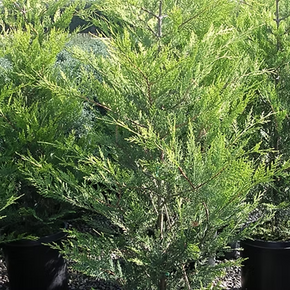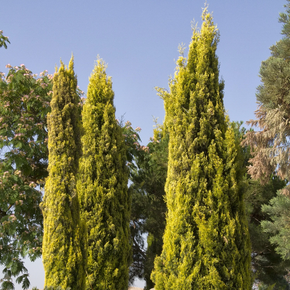

Swane's Golden Italian Cypress (Cupressus sempervirens 'Swane's Golden') is a standout evergreen conifer that brings year-round golden color and bold vertical structure to any garden or landscape. Originating in 1944 as a seedling of the classic columnar Italian Cypress at Swane Brothers nursery in New South Wales, Australia, this refined selection earned its own plant patent and has since become one of the most sought-after ornamental conifers for warm, Mediterranean-climate gardens. Its tightly upright, fastigiate habit reaches a mature height of 15 to 20 feet while remaining a mere 2 to 3 feet wide, making it one of the most space-efficient trees available for narrow spaces, entryways, and formal garden designs. The fine-textured, scale-like foliage emerges in vivid golden yellow and retains excellent color throughout all four seasons, offering a refreshing and luminous twist on the traditional green Italian Cypress silhouette. Once established, Swane's Golden is remarkably drought tolerant, thrives in full sun, and adapts to a range of well-drained soils, from sandy to loamy. It is resistant to verticillium wilt, tolerates coastal exposure, and is largely ignored by deer, making it a reliable and low-maintenance choice for gardeners throughout Southern Oregon and Northern California looking to add permanent golden structure and Mediterranean elegance to their outdoor spaces.
Swane's Golden Italian Cypress is a narrowly columnar, evergreen conifer with a strong central leader and an exceptionally upright, fastigiate growth habit. The foliage consists of fine, scale-like sprays arranged along densely packed branchlets that give the tree a feathery, delicate texture despite its bold, architectural silhouette. New foliage emerges in a bright, luminous golden yellow and holds its warm color throughout the entire growing season and into winter, fading only slightly in reduced light. The tree produces small, rounded cones typical of the Cupressus genus, though it is primarily grown for its outstanding foliage and columnar form. This selection is a cultivated variety of the Mediterranean or Italian Cypress, a species native to the eastern Mediterranean region and widely naturalized across Southern Europe. It was first propagated at the Swane Brothers nursery in New South Wales, Australia in 1944 as a golden-foliaged seedling of the Stricta group and was awarded a US plant patent in 1976.
| Characteristic | Detail |
|---|---|
| Mature Height | 15 to 20 feet |
| Mature Width | 2 to 3 feet |
| Growth Habit | Narrowly columnar, fastigiate |
| Growth Rate | Moderate; approximately 12 to 24 inches per year under ideal conditions |
| Time to Maturity | Approximately 5 to 10 years to reach near-mature size |
| Longevity | 60 years or more under ideal growing conditions |
| Canopy Clearance | Branches begin near ground level; suitable for planting under power lines |
Swane's Golden Italian Cypress is hardy in USDA Zones 7 through 9, making it an excellent fit for the mild winters and warm, dry summers of Southern Oregon and Northern California. It thrives in a Mediterranean-style climate characterized by hot, dry summers and cool, wet winters. It tolerates coastal conditions well, withstanding salt-laden breezes and moderate coastal winds. While it performs best in warm, sunny exposures, it should be protected from prolonged extreme cold or severe frost, particularly when young. In Sunset Climate Zones, it performs well in Zones 8 through 15 and 18 through 21, aligning perfectly with the diverse microclimates of the Rogue Valley, Umpqua Valley, and Northern California foothills and valleys.
This cypress demands full sun for best performance and most vibrant foliage color. It requires a minimum of 6 to 8 hours of direct sunlight per day. The golden yellow foliage color is significantly less pronounced when the tree is planted in partial shade or in locations that receive limited direct light. For the most striking year-round gold display, choose the sunniest available spot in the landscape. Avoid planting in the dense shade of buildings or larger trees, as this will result in greener, less colorful foliage and a more open, less dense growth habit.
Swane's Golden Italian Cypress is adaptable to a wide range of soil types but requires excellent drainage above all else. It grows best in sandy, loamy, or gravelly soils and will decline or die in poorly drained areas where water pools around the roots. Standing water is one of the few conditions this plant cannot tolerate. It is not particularly sensitive to soil pH, performing well across a range from slightly acidic to neutral, ideally between 6.0 and 7.5. Sandy soils are preferred as they naturally promote the fast drainage this tree needs. It has some tolerance for urban soil conditions and is noted to be resistant to verticillium wilt, a fungal disease that affects many other garden plants. Amending heavy clay soils with coarse sand, grit, or perlite before planting is strongly recommended.
While establishing during the first growing season, Swane's Golden Italian Cypress should be watered deeply and consistently, approximately once per week, to encourage deep root development. Gradually reduce irrigation frequency as the tree becomes established, typically after the first full year in the ground. Once mature, this cypress is notably drought tolerant and requires only occasional, deep watering during prolonged dry spells. Overwatering is a common mistake and one of the primary causes of decline in this tree. Allow the soil to dry out between watering cycles. Never allow water to stand around the base of the tree. In dry summer climates like those of Southern Oregon and Northern California, established trees may need a deep soak once every two to three weeks during the hottest months, but should receive little to no supplemental irrigation in the cooler, wetter months.
Swane's Golden Italian Cypress is not a heavy feeder and performs well in average soils without aggressive fertilization. For best results, apply a balanced, slow-release granular fertilizer formulated for conifers or trees in early spring as new growth begins. A second light application in early to midsummer can support vigorous foliage development. Avoid fertilizing in late summer or fall, as this can stimulate tender new growth that is susceptible to cold damage heading into winter. Do not over-fertilize, as excess nitrogen can promote overly rapid, soft growth and may diminish the intensity of the golden foliage color. A soil test every few years is helpful to identify any nutrient deficiencies that may need to be corrected with targeted amendments.
One of the great advantages of Swane's Golden Italian Cypress is its naturally tidy, columnar habit that requires very little pruning to maintain its shape. Minimal intervention is needed under normal circumstances. When pruning is desired, the best time is late winter to early spring, just before new growth emerges, or lightly in early summer after the initial flush of new growth has hardened off. Avoid heavy pruning into old wood, as Italian Cypress does not reliably regenerate growth from older, bare stems. Remove any dead, damaged, or crossing branches as needed throughout the year. The tree can be lightly sheared to keep it looking sharp in formal settings or even trained into a spiral topiary form, though this requires consistent, careful attention. Do not top the tree, as this ruins the natural columnar form and creates an entry point for disease.
The slim, vertical profile and year-round golden color of Swane's Golden Italian Cypress make it one of the most versatile and impactful trees available for a wide range of landscape applications. Its uses include:
Swane's Golden Italian Cypress earns its place in the garden with genuine four-season appeal. In spring, the flush of bright golden yellow new growth is particularly vivid and eye-catching, providing one of the most striking color displays of the season. Throughout summer, the foliage retains its warm golden lime-green tones, glowing brilliantly in full sun. In autumn, when most deciduous trees are shedding leaves, this cypress continues to provide uninterrupted color and structure. During winter, the evergreen foliage holds its color reasonably well, providing much-needed warmth and life in the dormant garden. The narrow columnar silhouette adds strong architectural interest in winter when the rest of the landscape is bare. Small rounded cones develop on mature trees and add modest textural detail to the fine-textured branchlets throughout the year.
Swane's Golden Italian Cypress pairs beautifully with plants that share its preference for full sun and well-drained, low to moderate moisture soils. Consider the following companions to create a cohesive, water-wise planting:
Swane's Golden Italian Cypress is generally a robust and low-maintenance tree with few serious pest or disease problems when sited and cared for correctly. Potential issues to be aware of include:
This cultivar is notably resistant to verticillium wilt, giving it an advantage over many other ornamental trees in garden soils with a history of this disease.
Swane's Golden Italian Cypress is an excellent candidate for container culture, particularly for patios, rooftop gardens, courtyard entries, and formal outdoor living spaces. Select a large, sturdy container with multiple drainage holes at the base. A container at least 18 to 24 inches in diameter and of similar depth will allow adequate root development. Use a premium, fast-draining potting mix blended with coarse perlite or coarse sand to ensure the rapid drainage this tree requires. Position the container in a full-sun location for best foliage color. Container-grown trees dry out more quickly than in-ground plants and will need more frequent watering during summer, but always allow the top inch or two of soil to dry out between waterings. Fertilize lightly with a slow-release conifer fertilizer in spring and again in early summer. Repot every two to three years into the next size container, or root-prune and refresh the soil if the tree has reached the desired size. Containers may need to be moved or insulated during hard freezes, as roots in containers are more vulnerable to cold damage than in-ground roots.
Swane's Golden Italian Cypress offers moderate wildlife value in the garden. The dense, evergreen foliage provides shelter and potential nesting sites for small birds, particularly songbirds that appreciate the protection of its tightly packed branches. Mature trees produce small rounded cones whose seeds can occasionally attract seed-eating birds. This cypress is considered deer resistant. The foliage is aromatic and resinous, and deer typically find it unpalatable, making it a reliable choice for gardens in areas with heavy deer pressure such as the foothills and rural areas throughout Southern Oregon and Northern California. While no plant is completely deer-proof under conditions of extreme hunger, Swane's Golden is among the more reliably avoided conifers. It does not have significant value for pollinators, as it is wind-pollinated and does not produce nectar-bearing flowers.
Cupressus sempervirens, the Italian or Mediterranean Cypress, is one of the oldest cultivated trees in human history, with a presence in Mediterranean landscapes, gardens, and artwork stretching back thousands of years. Its native range spans the eastern Mediterranean, from Greece and Turkey through the Levant, and it has been widely planted across Southern Europe, North Africa, and Western Asia for centuries. The species name sempervirens means "always living" or "evergreen" in Latin, a fitting tribute to its remarkable longevity and persistent foliage. The cultivar 'Swane's Golden' originated in 1944 as a chance seedling at the Swane Brothers nursery in Penrith, New South Wales, Australia, selected for its distinctly golden yellow foliage from among seedlings of the columnar Stricta group. It was later granted a US plant patent (PP3,839) in 1976 and has been widely grown in California, the Pacific Northwest, and other warm-temperate regions ever since. The Cupressaceae family to which it belongs also includes junipers, arborvitae, and dawn redwood.
Swane's Golden Italian Cypress (Cupressus sempervirens 'Swane's Golden') is a standout evergreen conifer that brings year-round golden color and bold vertical structure to any garden or landscape. Originating in 1944 as a seedling of the classic columnar Italian Cypress at Swane Brothers nursery in New South Wales, Australia, this refined selection earned its own plant patent and has since become one of the most sought-after ornamental conifers for warm, Mediterranean-climate gardens. Its tightly upright, fastigiate habit reaches a mature height of 15 to 20 feet while remaining a mere 2 to 3 feet wide, making it one of the most space-efficient trees available for narrow spaces, entryways, and formal garden designs. The fine-textured, scale-like foliage emerges in vivid golden yellow and retains excellent color throughout all four seasons, offering a refreshing and luminous twist on the traditional green Italian Cypress silhouette. Once established, Swane's Golden is remarkably drought tolerant, thrives in full sun, and adapts to a range of well-drained soils, from sandy to loamy. It is resistant to verticillium wilt, tolerates coastal exposure, and is largely ignored by deer, making it a reliable and low-maintenance choice for gardeners throughout Southern Oregon and Northern California looking to add permanent golden structure and Mediterranean elegance to their outdoor spaces.
Swane's Golden Italian Cypress is a narrowly columnar, evergreen conifer with a strong central leader and an exceptionally upright, fastigiate growth habit. The foliage consists of fine, scale-like sprays arranged along densely packed branchlets that give the tree a feathery, delicate texture despite its bold, architectural silhouette. New foliage emerges in a bright, luminous golden yellow and holds its warm color throughout the entire growing season and into winter, fading only slightly in reduced light. The tree produces small, rounded cones typical of the Cupressus genus, though it is primarily grown for its outstanding foliage and columnar form. This selection is a cultivated variety of the Mediterranean or Italian Cypress, a species native to the eastern Mediterranean region and widely naturalized across Southern Europe. It was first propagated at the Swane Brothers nursery in New South Wales, Australia in 1944 as a golden-foliaged seedling of the Stricta group and was awarded a US plant patent in 1976.
| Characteristic | Detail |
|---|---|
| Mature Height | 15 to 20 feet |
| Mature Width | 2 to 3 feet |
| Growth Habit | Narrowly columnar, fastigiate |
| Growth Rate | Moderate; approximately 12 to 24 inches per year under ideal conditions |
| Time to Maturity | Approximately 5 to 10 years to reach near-mature size |
| Longevity | 60 years or more under ideal growing conditions |
| Canopy Clearance | Branches begin near ground level; suitable for planting under power lines |
Swane's Golden Italian Cypress is hardy in USDA Zones 7 through 9, making it an excellent fit for the mild winters and warm, dry summers of Southern Oregon and Northern California. It thrives in a Mediterranean-style climate characterized by hot, dry summers and cool, wet winters. It tolerates coastal conditions well, withstanding salt-laden breezes and moderate coastal winds. While it performs best in warm, sunny exposures, it should be protected from prolonged extreme cold or severe frost, particularly when young. In Sunset Climate Zones, it performs well in Zones 8 through 15 and 18 through 21, aligning perfectly with the diverse microclimates of the Rogue Valley, Umpqua Valley, and Northern California foothills and valleys.
This cypress demands full sun for best performance and most vibrant foliage color. It requires a minimum of 6 to 8 hours of direct sunlight per day. The golden yellow foliage color is significantly less pronounced when the tree is planted in partial shade or in locations that receive limited direct light. For the most striking year-round gold display, choose the sunniest available spot in the landscape. Avoid planting in the dense shade of buildings or larger trees, as this will result in greener, less colorful foliage and a more open, less dense growth habit.
Swane's Golden Italian Cypress is adaptable to a wide range of soil types but requires excellent drainage above all else. It grows best in sandy, loamy, or gravelly soils and will decline or die in poorly drained areas where water pools around the roots. Standing water is one of the few conditions this plant cannot tolerate. It is not particularly sensitive to soil pH, performing well across a range from slightly acidic to neutral, ideally between 6.0 and 7.5. Sandy soils are preferred as they naturally promote the fast drainage this tree needs. It has some tolerance for urban soil conditions and is noted to be resistant to verticillium wilt, a fungal disease that affects many other garden plants. Amending heavy clay soils with coarse sand, grit, or perlite before planting is strongly recommended.
While establishing during the first growing season, Swane's Golden Italian Cypress should be watered deeply and consistently, approximately once per week, to encourage deep root development. Gradually reduce irrigation frequency as the tree becomes established, typically after the first full year in the ground. Once mature, this cypress is notably drought tolerant and requires only occasional, deep watering during prolonged dry spells. Overwatering is a common mistake and one of the primary causes of decline in this tree. Allow the soil to dry out between watering cycles. Never allow water to stand around the base of the tree. In dry summer climates like those of Southern Oregon and Northern California, established trees may need a deep soak once every two to three weeks during the hottest months, but should receive little to no supplemental irrigation in the cooler, wetter months.
Swane's Golden Italian Cypress is not a heavy feeder and performs well in average soils without aggressive fertilization. For best results, apply a balanced, slow-release granular fertilizer formulated for conifers or trees in early spring as new growth begins. A second light application in early to midsummer can support vigorous foliage development. Avoid fertilizing in late summer or fall, as this can stimulate tender new growth that is susceptible to cold damage heading into winter. Do not over-fertilize, as excess nitrogen can promote overly rapid, soft growth and may diminish the intensity of the golden foliage color. A soil test every few years is helpful to identify any nutrient deficiencies that may need to be corrected with targeted amendments.
One of the great advantages of Swane's Golden Italian Cypress is its naturally tidy, columnar habit that requires very little pruning to maintain its shape. Minimal intervention is needed under normal circumstances. When pruning is desired, the best time is late winter to early spring, just before new growth emerges, or lightly in early summer after the initial flush of new growth has hardened off. Avoid heavy pruning into old wood, as Italian Cypress does not reliably regenerate growth from older, bare stems. Remove any dead, damaged, or crossing branches as needed throughout the year. The tree can be lightly sheared to keep it looking sharp in formal settings or even trained into a spiral topiary form, though this requires consistent, careful attention. Do not top the tree, as this ruins the natural columnar form and creates an entry point for disease.
The slim, vertical profile and year-round golden color of Swane's Golden Italian Cypress make it one of the most versatile and impactful trees available for a wide range of landscape applications. Its uses include:
Swane's Golden Italian Cypress earns its place in the garden with genuine four-season appeal. In spring, the flush of bright golden yellow new growth is particularly vivid and eye-catching, providing one of the most striking color displays of the season. Throughout summer, the foliage retains its warm golden lime-green tones, glowing brilliantly in full sun. In autumn, when most deciduous trees are shedding leaves, this cypress continues to provide uninterrupted color and structure. During winter, the evergreen foliage holds its color reasonably well, providing much-needed warmth and life in the dormant garden. The narrow columnar silhouette adds strong architectural interest in winter when the rest of the landscape is bare. Small rounded cones develop on mature trees and add modest textural detail to the fine-textured branchlets throughout the year.
Swane's Golden Italian Cypress pairs beautifully with plants that share its preference for full sun and well-drained, low to moderate moisture soils. Consider the following companions to create a cohesive, water-wise planting:
Swane's Golden Italian Cypress is generally a robust and low-maintenance tree with few serious pest or disease problems when sited and cared for correctly. Potential issues to be aware of include:
This cultivar is notably resistant to verticillium wilt, giving it an advantage over many other ornamental trees in garden soils with a history of this disease.
Swane's Golden Italian Cypress is an excellent candidate for container culture, particularly for patios, rooftop gardens, courtyard entries, and formal outdoor living spaces. Select a large, sturdy container with multiple drainage holes at the base. A container at least 18 to 24 inches in diameter and of similar depth will allow adequate root development. Use a premium, fast-draining potting mix blended with coarse perlite or coarse sand to ensure the rapid drainage this tree requires. Position the container in a full-sun location for best foliage color. Container-grown trees dry out more quickly than in-ground plants and will need more frequent watering during summer, but always allow the top inch or two of soil to dry out between waterings. Fertilize lightly with a slow-release conifer fertilizer in spring and again in early summer. Repot every two to three years into the next size container, or root-prune and refresh the soil if the tree has reached the desired size. Containers may need to be moved or insulated during hard freezes, as roots in containers are more vulnerable to cold damage than in-ground roots.
Swane's Golden Italian Cypress offers moderate wildlife value in the garden. The dense, evergreen foliage provides shelter and potential nesting sites for small birds, particularly songbirds that appreciate the protection of its tightly packed branches. Mature trees produce small rounded cones whose seeds can occasionally attract seed-eating birds. This cypress is considered deer resistant. The foliage is aromatic and resinous, and deer typically find it unpalatable, making it a reliable choice for gardens in areas with heavy deer pressure such as the foothills and rural areas throughout Southern Oregon and Northern California. While no plant is completely deer-proof under conditions of extreme hunger, Swane's Golden is among the more reliably avoided conifers. It does not have significant value for pollinators, as it is wind-pollinated and does not produce nectar-bearing flowers.
Cupressus sempervirens, the Italian or Mediterranean Cypress, is one of the oldest cultivated trees in human history, with a presence in Mediterranean landscapes, gardens, and artwork stretching back thousands of years. Its native range spans the eastern Mediterranean, from Greece and Turkey through the Levant, and it has been widely planted across Southern Europe, North Africa, and Western Asia for centuries. The species name sempervirens means "always living" or "evergreen" in Latin, a fitting tribute to its remarkable longevity and persistent foliage. The cultivar 'Swane's Golden' originated in 1944 as a chance seedling at the Swane Brothers nursery in Penrith, New South Wales, Australia, selected for its distinctly golden yellow foliage from among seedlings of the columnar Stricta group. It was later granted a US plant patent (PP3,839) in 1976 and has been widely grown in California, the Pacific Northwest, and other warm-temperate regions ever since. The Cupressaceae family to which it belongs also includes junipers, arborvitae, and dawn redwood.