

Zoom the image with the mouse
Singing In The Rain Itoh Peony - 5 Gallon
SKU:
2054380
UPC:
014949358115
$99.99
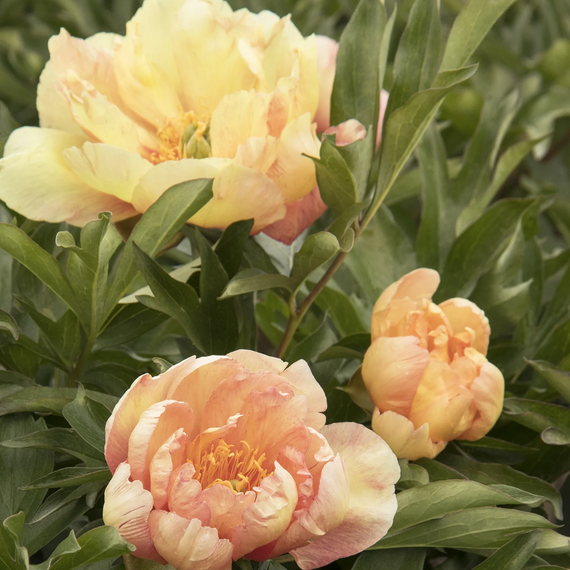
- Rare intersectional Itoh hybrid peony bearing enormous semi-double blooms that open creamy apricot-salmon and age to soft creamy yellow, each centered with a ring of golden stamens — a color combination rarely found in herbaceous peonies.
- Exceptionally long bloom season in late spring to early summer, with multiple side buds opening in succession and lasting up to 4 weeks in cooler climates, atop strong, upright stems that are perfect for cutting.
- Compact, rounded habit with lush, deeply dissected dark green foliage that emerges bronzy-red in spring, remains ornamental all season, and is deer and rabbit resistant.
- A remarkably long-lived, low-maintenance garden perennial that can thrive undisturbed for decades and produce 50 or more blooms on a mature plant — all with a pleasant, spicy-sweet fragrance.
Paeonia 'Singing in the Rain' is a stunning intersectional Itoh peony — a rare and coveted hybrid between a tree peony (Paeonia suffruticosa) and a classic herbaceous garden peony (Paeonia lactiflora) — that delivers the very best qualities of both parents in one spectacular, easy-care perennial. Each late spring to early summer, this award-worthy peony produces a profusion of huge, semi-double, softly fragrant blooms that open in warm shades of creamy apricot and salmon, delicately flushing toward creamy yellow as they mature, all surrounding a showy ring of long golden stamens and green-tipped carpels. The blooms, which can measure up to 8 inches across, are held proudly on strong, upright stems well above a compact, rounded mound of deeply dissected, glossy dark green foliage that emerges with attractive bronzy-red tones in spring and again in autumn. Unlike standard herbaceous peonies, 'Singing in the Rain' features multiple side buds that open in sequence after the primary bloom, extending the flowering display up to four weeks and ensuring an extended vantage of color in the garden. Reaching 3 to 4 feet tall and equally wide at maturity, this vigorous, clump-forming perennial dies back to the ground each winter like an herbaceous peony but regrows reliably each spring with extraordinary hybrid vigor. Its sturdy stems rarely require staking, its handsome foliage remains attractive through fall, and its deep root system allows it to live and bloom prolifically for 50 years or more with minimal disturbance. Hardy in USDA Zones 4 through 9, deer and rabbit resistant, and a favorite of butterflies, Paeonia 'Singing in the Rain' is an exceptional long-term investment for cottage gardens, mixed perennial borders, cutting gardens, and landscape focal points throughout Southern Oregon and Northern California.
Plant Description
Paeonia 'Singing in the Rain' is an intersectional hybrid peony, also known as an Itoh peony, created by crossing a tree peony with a herbaceous garden peony. This breeding breakthrough, pioneered by Japanese horticulturist Toichi Itoh in 1948, produced plants with unique characteristics not found in either parent alone. 'Singing in the Rain' produces enormous semi-double flowers that open in warm creamy apricot-salmon tones, beautifully flushed and transitioning to soft creamy yellow as they mature. Each bloom is centered with green carpels tipped creamy white and encircled by a striking ring of long golden stamens. The flowers carry a pleasant, spicy-sweet fragrance and are held upright on sturdy stems. The deeply dissected, glossy foliage resembles that of a tree peony and emerges with rich bronzy-red tones in spring before settling into deep green through summer, then briefly taking on bronzy-red tints again in autumn. The plant forms a compact, wide-spreading, symmetrical mound and dies back completely to the ground each winter, re-emerging reliably each spring from a long-lived, fleshy root system.
Mature Size
| Attribute | Measurement |
|---|---|
| Mature Height | 3 to 4 feet (90 to 120 cm) |
| Mature Spread | 3 to 4 feet (90 to 120 cm) |
| Recommended Spacing | 36 to 48 inches (90 to 120 cm) on center |
| Growth Rate | Moderate; reaches full size in 2 to 5 years |
| Bloom Size | Up to 8 inches across per individual flower |
| Bloom Count (mature plant) | 50 or more blooms per season |
Hardiness and Climate
Paeonia 'Singing in the Rain' is cold hardy in USDA Hardiness Zones 4 through 9, tolerating winter temperatures down to approximately -20°F (-29°C) with reliable root protection. It also performs well across AHS Heat Zones 1 through 8. This variety thrives in the temperate climates of Southern Oregon and Northern California, where warm sunny days, cool nights, and moderate winter chill provide ideal growing conditions. In hotter inland areas, afternoon shade helps protect the blooms and extends their vase life on the plant. In zones 3 and 4, apply additional mulch over the crown before the onset of hard winter freezes for added insulation. Because Itoh peonies die back to the ground each winter like herbaceous peonies, the fleshy roots and buds are naturally protected beneath the soil surface from freezing temperatures.
Sunlight Requirements
'Singing in the Rain' performs best in full sun, receiving a minimum of 6 to 8 hours of direct sunlight per day. Full sun exposure encourages the strongest stems, the most abundant blooms, and the most vivid flower coloration. In regions with intense afternoon heat — particularly in the inland valleys of Southern Oregon and Northern California — light afternoon shade is beneficial, as it prolongs bloom time and keeps flowers looking their best. While this peony will tolerate partial shade, flowering becomes less prolific and stems may become slightly lax with reduced light. Choose a planting site with an east-, south-, or west-facing aspect, and avoid dense shade from large trees or structures. Good air circulation around the plant is also important to reduce the risk of fungal diseases.
Soil and pH Preferences
'Singing in the Rain' is adaptable to a range of soil types, including chalk, clay, loam, and sandy soils, but it performs best in deep, fertile, organically rich, moist but well-drained soil. Poor drainage or waterlogged conditions can lead to crown rot and root disease. The ideal soil pH is slightly acidic to neutral, in the range of 6.5 to 7.0, though this variety tolerates mildly acid to mildly alkaline conditions. Before planting, amend heavy clay or sandy soils with 2 to 4 inches of well-aged compost, leaf mold, or composted manure worked deeply into the planting area. Good soil aeration down to 18 to 24 inches is beneficial, as peonies develop extensive root systems. Avoid planting near large trees or shrubs that will compete aggressively for moisture and nutrients.
Watering Guide
Itoh peonies like 'Singing in the Rain' require consistent, even moisture throughout the growing season, especially during bud development and bloom. Aim to provide approximately 1 inch of water per week from rainfall or supplemental irrigation. During the warm, dry summers common to Southern Oregon and Northern California, regular deep watering is essential to maintain healthy foliage and strong bud set for the following year. Always water at the base of the plant rather than overhead to help prevent fungal disease on the foliage and blooms. Water deeply to reach the extensive root system, moistening the surrounding soil thoroughly. While this peony can tolerate brief dry spells once established, prolonged drought will stress the plant, reduce flowering, and may cause early leaf drop. Avoid overwatering and never allow the root zone to sit in standing water, as saturated soil promotes crown and root rot.
Fertilizing
Feed 'Singing in the Rain' to support vigorous growth and prolific blooming each season. A balanced approach to fertilizing promotes strong root development and abundant flower production without pushing excessive leafy growth at the expense of blooms.
- Early Spring: Apply a slow-release granular fertilizer with a low-nitrogen, high-phosphorus analysis such as 5-10-10 or 5-20-20 as new growth emerges. This supports root and bloom development.
- Bud Formation: A second application or supplemental feeding with a phosphorus-rich formula, kelp, fish emulsion, or alfalfa-based fertilizer at bud formation encourages strong bloom development.
- Late Summer: A light third feeding in late summer helps the plant store energy in its root tubers for the following season's bloom cycle.
- Avoid: High-nitrogen fertilizers, which promote excessive leaf and stem growth at the expense of flowers. Do not fertilize after late summer, as this can interfere with the plant entering dormancy naturally.
- Topdress: Annual topdressing with well-aged compost around the plant (not on top of the crown) improves soil fertility and moisture retention over time.
Planting Instructions
For best results, plant 'Singing in the Rain' in early fall to allow roots to establish before winter, or plant in early spring before significant heat arrives. Follow these steps for a successful planting:
- Select a site with full sun (6 to 8 hours daily), excellent drainage, and good air circulation.
- Dig a generous planting hole at least 18 to 24 inches wide and 18 inches deep.
- Amend backfill soil with compost or aged manure to improve fertility, drainage, and aeration.
- For container-grown plants, set the crown so that the top of the root ball sits level with or just barely below the surrounding soil surface — no more than 1 to 2 inches deep. Planting too deeply is the most common reason peonies fail to bloom.
- Backfill firmly, eliminating air pockets, and water in thoroughly.
- Apply 2 to 3 inches of mulch around (not over) the crown to conserve moisture and moderate soil temperature.
- Space plants 36 to 48 inches apart to allow for mature spread and adequate air circulation.
- Keep away from competing tree and shrub roots. Do not crowd with other large plants.
Note: Newly planted peonies may not bloom the first or even the second season as they focus energy on establishing a strong root system. Patience is rewarded with decades of spectacular blooms.
Pruning and Maintenance
'Singing in the Rain' is a low-maintenance perennial once established. Follow this simple seasonal care routine to keep the plant healthy and flowering at its best:
- Deadheading: Remove spent flowers as they fade to maintain a tidy appearance and redirect energy away from seed production. This does not extend the bloom season but improves the look of the plant.
- Fall Cutback: After the first hard frost causes the foliage to die back and brown, cut all stems down to just above ground level. Remove and dispose of (do not compost) all cut foliage to prevent fungal spores from overwintering near the crown.
- Mulching: Apply a fresh 2- to 3-inch layer of mulch over the root zone after cutback, keeping mulch away from direct contact with the crown itself. In colder zones, increase mulch depth for added winter protection.
- Staking: Itoh peonies like 'Singing in the Rain' have notably sturdy stems compared to standard herbaceous peonies and rarely require staking. However, in exposed, windy sites or after heavy rain, peony cages or grow-through supports can be placed over the crown in early spring before growth emerges as a precaution.
- Division: Peonies do not need to be divided regularly and do not respond well to disturbance. Divide only if the plant becomes severely crowded or bloom quality declines noticeably. Divide in September or October, ensuring each division retains 3 to 5 healthy bud eyes.
Bloom Season and Seasonal Interest
'Singing in the Rain' offers multi-season ornamental interest from early spring through late autumn.
- Spring (Early): New growth emerges with striking bronzy-red tones, adding early-season color contrast to the garden border.
- Spring (Late) to Early Summer: The primary bloom season. A single plant can produce 50 or more flowers, with the main bud opening first, followed by several side buds in sequence, extending the display for 2 to 4 weeks. Blooms are warmly colored in creamy apricot-salmon aging to creamy yellow, with a pleasant spicy-sweet fragrance.
- Summer: After bloom, the deeply cut, glossy dark green foliage forms an attractive, dense, shrub-like mound that provides excellent structure and texture in the landscape through the entire summer.
- Autumn: Foliage takes on subtle bronzy-red tints before dying back, providing one final season of color before winter dormancy.
- Winter: The plant dies back fully to the ground, resting in dormancy until spring. No pruning is required during this period beyond the fall cleanup.
Landscape Uses
The versatile, compact form and spectacular blooms of 'Singing in the Rain' make it suitable for a wide range of landscape applications:
- Mixed Perennial Borders: A stunning focal point in spring and summer borders, combining beautifully with ornamental grasses, salvias, alliums, and bearded irises.
- Cottage and Informal Gardens: The soft, romantic bloom colors and lush foliage are perfectly suited to the relaxed aesthetic of cottage-style planting schemes.
- Cutting Garden: One of the finest peonies for cut flower production, with long-stemmed blooms that last over a week in a vase when cut in the bud stage.
- Specimen Planting: Stunning as a standalone specimen plant where the full mounding form and floral display can be fully appreciated.
- Border Edging: The compact, symmetrical habit makes it excellent for bordering a garden path, walkway, or driveway.
- Informal Hedge or Mass Planting: When planted in groups at 3- to 4-foot spacings, multiple plants create a beautiful informal flowering hedge or mass planting display.
- City and Courtyard Gardens: Its tidy habit and low-maintenance nature make it well-suited to smaller urban and courtyard garden spaces.
Companion Plants
The soft creamy apricot-to-yellow blooms and deep green mounding foliage of 'Singing in the Rain' pair beautifully with a wide array of companion plants. Consider these combinations for a cohesive, long-season border display:
- Iris germanica (Bearded Iris): Blooms at a similar time and shares the same cultural needs. Purple, lavender, or deep blue bearded iris varieties provide outstanding color contrast against the creamy peony blooms.
- Allium 'Globemaster' (Ornamental Onion): The bold purple globe flowers of ornamental alliums rise through and above the peony foliage and create a dramatic spring partnership.
- Geranium x magnificum (Purple Cranesbill): Low-growing, with vibrant violet-purple flowers that complement the soft peach tones of the peony and continue blooming after the peony's season.
- Alchemilla mollis (Lady's Mantle): The soft, chartreuse-yellow frothy flowers and scalloped foliage of Lady's Mantle provide a lovely, harmonizing edge plant beneath taller peonies.
- Salvia nemorosa (Ornamental Sage): Violet-blue spikes contrast beautifully with the warm peachy-cream blooms and continue flowering well into summer.
- Campanula persicifolia (Peach-Leaved Bellflower): Tall, airy blue or white bells complement the full, rounded peony blooms with elegant vertical interest.
- Rosa (Shrub Roses): Soft yellow, blush, or apricot roses harmonize naturally with the color-shifting peony blooms and extend the cutting garden season.
- Artemisia ludoviciana (White Sage): The silver-white foliage acts as a luminous foil that brightens and enhances the warm peachy tones of the peony throughout the season.
Pests and Diseases
Paeonia 'Singing in the Rain' is notably more disease resistant than standard herbaceous peonies, one of the key benefits of its Itoh hybrid nature. However, gardeners should be aware of the following potential issues:
- Botrytis Blight (Peony Wilt): The most common peony disease, caused by the fungus Botrytis paeoniae. Symptoms include blackened, wilting stems and buds, and gray fuzzy mold on affected tissue. Prevent by ensuring good air circulation, avoiding overhead watering, removing and disposing of all fall foliage, and not overwatering or overfertilizing. Remove affected plant parts immediately if symptoms appear.
- Peony Leaf Blotch: Causes reddish-purple or brown blotches on leaves and stems. Manage with proper spacing for airflow, fall cleanup of all debris, and avoiding wetting the foliage when watering.
- Powdery Mildew: A gray-white powdery coating on leaves and stems, most common in warm days and cool nights with poor air circulation. Treat early with horticultural oil or neem oil and improve spacing.
- Honey Fungus and Verticillium Wilt: Uncommon but possible in poorly drained or infected soils. Ensure excellent drainage and healthy soil conditions to prevent these issues.
- Ants: Frequently seen on peony buds, feeding on the sweet nectar secreted by the plant. Ants are completely harmless to the peony and do not need to be treated.
- Swift Moth Caterpillars: Soil-dwelling larvae can occasionally damage roots. Good soil cultivation and healthy growing conditions help prevent infestations.
- Deer and Rabbits: 'Singing in the Rain' is resistant to deer and rabbit browsing, making it an excellent choice for gardens in areas where these animals are common.
Toxicity note: All parts of this plant may cause stomach discomfort if ingested. It is toxic to dogs, cats, and horses and should be planted away from areas accessible to pets.
Cut Flower Use
'Singing in the Rain' is an outstanding cut flower peony, producing large, sweetly fragrant blooms on long, strong stems that are ideal for fresh arrangements. To maximize vase life and cut flower quality, follow these tips:
- Cut stems in the early morning when buds are still soft and closed — at the "marshmallow stage" when the bud feels soft but petals have not yet opened. This stage gives the longest vase life, typically over one week.
- Use clean, sharp scissors or pruners to cut stems at a 45-degree angle, leaving at least two sets of leaves on the plant to support continued photosynthesis.
- Immediately place cut stems in a clean vase of cool water. Re-cut the stems underwater to prevent air from entering the vascular tissue.
- Remove any foliage that would sit below the waterline to prevent bacterial buildup.
- Place the arrangement in a cool location, away from direct sunlight and heat, to extend bloom life.
- Blooms can also be cut in the tight bud stage and refrigerated at 32 to 35°F, wrapped in damp paper and stored in a plastic bag, for several weeks — allowing you to stage blooms for a special occasion.
Wildlife Value
Paeonia 'Singing in the Rain' offers meaningful wildlife value in the garden, particularly for pollinators during its late spring to early summer bloom period.
- Butterflies: The large, open semi-double blooms with their prominent ring of golden stamens are attractive to butterflies seeking nectar and pollen. This is one of the notable wildlife benefits of the semi-double Itoh flower form, which allows pollinators easier access to the pollen than fully double forms.
- Bees: Native bees and honeybees are also drawn to the accessible stamens and pollen of the open blooms.
- Ants: Peonies produce sweet nectar from their buds that attracts ants. These ant visitors are beneficial — they deter other harmful insects and cause no harm to the plant.
- Deer and Rabbit Resistance: The plant is unpalatable to deer and rabbits, making it a reliable, low-risk choice for gardens in wildlife-heavy areas of Southern Oregon and Northern California.
Container Growing
While 'Singing in the Rain' is primarily grown as a long-term in-ground perennial, it can be successfully grown in large containers with careful attention to its needs. Keep the following guidelines in mind:
- Choose a large, heavy container with a minimum diameter of 18 to 24 inches and excellent drainage holes. Itoh peonies develop deep, extensive root systems and require generous root room.
- Use a high-quality, well-draining potting mix amended with compost and perlite for added aeration and drainage.
- Plant the crown at the same depth as for in-ground planting — no more than 1 to 2 inches below the soil surface.
- Container-grown peonies dry out more quickly than in-ground plants and will need more frequent watering, especially during the warm summers typical of Southern Oregon and Northern California.
- Fertilize more regularly than in-ground specimens, as nutrients leach from containers with frequent watering. A slow-release balanced fertilizer in spring, followed by a phosphorus-rich supplement at bud formation, works well.
- In colder zones, containers may need to be moved to a sheltered, frost-protected location in winter to prevent the root ball from freezing solid, as container roots receive less insulation than in-ground roots.
- Because Itoh peonies strongly prefer permanent planting sites and do not respond well to disturbance, container culture is best considered a temporary or display situation rather than a permanent growing solution.
- Rare intersectional Itoh hybrid peony bearing enormous semi-double blooms that open creamy apricot-salmon and age to soft creamy yellow, each centered with a ring of golden stamens — a color combination rarely found in herbaceous peonies.
- Exceptionally long bloom season in late spring to early summer, with multiple side buds opening in succession and lasting up to 4 weeks in cooler climates, atop strong, upright stems that are perfect for cutting.
- Compact, rounded habit with lush, deeply dissected dark green foliage that emerges bronzy-red in spring, remains ornamental all season, and is deer and rabbit resistant.
- A remarkably long-lived, low-maintenance garden perennial that can thrive undisturbed for decades and produce 50 or more blooms on a mature plant — all with a pleasant, spicy-sweet fragrance.
Paeonia 'Singing in the Rain' is a stunning intersectional Itoh peony — a rare and coveted hybrid between a tree peony (Paeonia suffruticosa) and a classic herbaceous garden peony (Paeonia lactiflora) — that delivers the very best qualities of both parents in one spectacular, easy-care perennial. Each late spring to early summer, this award-worthy peony produces a profusion of huge, semi-double, softly fragrant blooms that open in warm shades of creamy apricot and salmon, delicately flushing toward creamy yellow as they mature, all surrounding a showy ring of long golden stamens and green-tipped carpels. The blooms, which can measure up to 8 inches across, are held proudly on strong, upright stems well above a compact, rounded mound of deeply dissected, glossy dark green foliage that emerges with attractive bronzy-red tones in spring and again in autumn. Unlike standard herbaceous peonies, 'Singing in the Rain' features multiple side buds that open in sequence after the primary bloom, extending the flowering display up to four weeks and ensuring an extended vantage of color in the garden. Reaching 3 to 4 feet tall and equally wide at maturity, this vigorous, clump-forming perennial dies back to the ground each winter like an herbaceous peony but regrows reliably each spring with extraordinary hybrid vigor. Its sturdy stems rarely require staking, its handsome foliage remains attractive through fall, and its deep root system allows it to live and bloom prolifically for 50 years or more with minimal disturbance. Hardy in USDA Zones 4 through 9, deer and rabbit resistant, and a favorite of butterflies, Paeonia 'Singing in the Rain' is an exceptional long-term investment for cottage gardens, mixed perennial borders, cutting gardens, and landscape focal points throughout Southern Oregon and Northern California.
Plant Description
Paeonia 'Singing in the Rain' is an intersectional hybrid peony, also known as an Itoh peony, created by crossing a tree peony with a herbaceous garden peony. This breeding breakthrough, pioneered by Japanese horticulturist Toichi Itoh in 1948, produced plants with unique characteristics not found in either parent alone. 'Singing in the Rain' produces enormous semi-double flowers that open in warm creamy apricot-salmon tones, beautifully flushed and transitioning to soft creamy yellow as they mature. Each bloom is centered with green carpels tipped creamy white and encircled by a striking ring of long golden stamens. The flowers carry a pleasant, spicy-sweet fragrance and are held upright on sturdy stems. The deeply dissected, glossy foliage resembles that of a tree peony and emerges with rich bronzy-red tones in spring before settling into deep green through summer, then briefly taking on bronzy-red tints again in autumn. The plant forms a compact, wide-spreading, symmetrical mound and dies back completely to the ground each winter, re-emerging reliably each spring from a long-lived, fleshy root system.
Mature Size
| Attribute | Measurement |
|---|---|
| Mature Height | 3 to 4 feet (90 to 120 cm) |
| Mature Spread | 3 to 4 feet (90 to 120 cm) |
| Recommended Spacing | 36 to 48 inches (90 to 120 cm) on center |
| Growth Rate | Moderate; reaches full size in 2 to 5 years |
| Bloom Size | Up to 8 inches across per individual flower |
| Bloom Count (mature plant) | 50 or more blooms per season |
Hardiness and Climate
Paeonia 'Singing in the Rain' is cold hardy in USDA Hardiness Zones 4 through 9, tolerating winter temperatures down to approximately -20°F (-29°C) with reliable root protection. It also performs well across AHS Heat Zones 1 through 8. This variety thrives in the temperate climates of Southern Oregon and Northern California, where warm sunny days, cool nights, and moderate winter chill provide ideal growing conditions. In hotter inland areas, afternoon shade helps protect the blooms and extends their vase life on the plant. In zones 3 and 4, apply additional mulch over the crown before the onset of hard winter freezes for added insulation. Because Itoh peonies die back to the ground each winter like herbaceous peonies, the fleshy roots and buds are naturally protected beneath the soil surface from freezing temperatures.
Sunlight Requirements
'Singing in the Rain' performs best in full sun, receiving a minimum of 6 to 8 hours of direct sunlight per day. Full sun exposure encourages the strongest stems, the most abundant blooms, and the most vivid flower coloration. In regions with intense afternoon heat — particularly in the inland valleys of Southern Oregon and Northern California — light afternoon shade is beneficial, as it prolongs bloom time and keeps flowers looking their best. While this peony will tolerate partial shade, flowering becomes less prolific and stems may become slightly lax with reduced light. Choose a planting site with an east-, south-, or west-facing aspect, and avoid dense shade from large trees or structures. Good air circulation around the plant is also important to reduce the risk of fungal diseases.
Soil and pH Preferences
'Singing in the Rain' is adaptable to a range of soil types, including chalk, clay, loam, and sandy soils, but it performs best in deep, fertile, organically rich, moist but well-drained soil. Poor drainage or waterlogged conditions can lead to crown rot and root disease. The ideal soil pH is slightly acidic to neutral, in the range of 6.5 to 7.0, though this variety tolerates mildly acid to mildly alkaline conditions. Before planting, amend heavy clay or sandy soils with 2 to 4 inches of well-aged compost, leaf mold, or composted manure worked deeply into the planting area. Good soil aeration down to 18 to 24 inches is beneficial, as peonies develop extensive root systems. Avoid planting near large trees or shrubs that will compete aggressively for moisture and nutrients.
Watering Guide
Itoh peonies like 'Singing in the Rain' require consistent, even moisture throughout the growing season, especially during bud development and bloom. Aim to provide approximately 1 inch of water per week from rainfall or supplemental irrigation. During the warm, dry summers common to Southern Oregon and Northern California, regular deep watering is essential to maintain healthy foliage and strong bud set for the following year. Always water at the base of the plant rather than overhead to help prevent fungal disease on the foliage and blooms. Water deeply to reach the extensive root system, moistening the surrounding soil thoroughly. While this peony can tolerate brief dry spells once established, prolonged drought will stress the plant, reduce flowering, and may cause early leaf drop. Avoid overwatering and never allow the root zone to sit in standing water, as saturated soil promotes crown and root rot.
Fertilizing
Feed 'Singing in the Rain' to support vigorous growth and prolific blooming each season. A balanced approach to fertilizing promotes strong root development and abundant flower production without pushing excessive leafy growth at the expense of blooms.
- Early Spring: Apply a slow-release granular fertilizer with a low-nitrogen, high-phosphorus analysis such as 5-10-10 or 5-20-20 as new growth emerges. This supports root and bloom development.
- Bud Formation: A second application or supplemental feeding with a phosphorus-rich formula, kelp, fish emulsion, or alfalfa-based fertilizer at bud formation encourages strong bloom development.
- Late Summer: A light third feeding in late summer helps the plant store energy in its root tubers for the following season's bloom cycle.
- Avoid: High-nitrogen fertilizers, which promote excessive leaf and stem growth at the expense of flowers. Do not fertilize after late summer, as this can interfere with the plant entering dormancy naturally.
- Topdress: Annual topdressing with well-aged compost around the plant (not on top of the crown) improves soil fertility and moisture retention over time.
Planting Instructions
For best results, plant 'Singing in the Rain' in early fall to allow roots to establish before winter, or plant in early spring before significant heat arrives. Follow these steps for a successful planting:
- Select a site with full sun (6 to 8 hours daily), excellent drainage, and good air circulation.
- Dig a generous planting hole at least 18 to 24 inches wide and 18 inches deep.
- Amend backfill soil with compost or aged manure to improve fertility, drainage, and aeration.
- For container-grown plants, set the crown so that the top of the root ball sits level with or just barely below the surrounding soil surface — no more than 1 to 2 inches deep. Planting too deeply is the most common reason peonies fail to bloom.
- Backfill firmly, eliminating air pockets, and water in thoroughly.
- Apply 2 to 3 inches of mulch around (not over) the crown to conserve moisture and moderate soil temperature.
- Space plants 36 to 48 inches apart to allow for mature spread and adequate air circulation.
- Keep away from competing tree and shrub roots. Do not crowd with other large plants.
Note: Newly planted peonies may not bloom the first or even the second season as they focus energy on establishing a strong root system. Patience is rewarded with decades of spectacular blooms.
Pruning and Maintenance
'Singing in the Rain' is a low-maintenance perennial once established. Follow this simple seasonal care routine to keep the plant healthy and flowering at its best:
- Deadheading: Remove spent flowers as they fade to maintain a tidy appearance and redirect energy away from seed production. This does not extend the bloom season but improves the look of the plant.
- Fall Cutback: After the first hard frost causes the foliage to die back and brown, cut all stems down to just above ground level. Remove and dispose of (do not compost) all cut foliage to prevent fungal spores from overwintering near the crown.
- Mulching: Apply a fresh 2- to 3-inch layer of mulch over the root zone after cutback, keeping mulch away from direct contact with the crown itself. In colder zones, increase mulch depth for added winter protection.
- Staking: Itoh peonies like 'Singing in the Rain' have notably sturdy stems compared to standard herbaceous peonies and rarely require staking. However, in exposed, windy sites or after heavy rain, peony cages or grow-through supports can be placed over the crown in early spring before growth emerges as a precaution.
- Division: Peonies do not need to be divided regularly and do not respond well to disturbance. Divide only if the plant becomes severely crowded or bloom quality declines noticeably. Divide in September or October, ensuring each division retains 3 to 5 healthy bud eyes.
Bloom Season and Seasonal Interest
'Singing in the Rain' offers multi-season ornamental interest from early spring through late autumn.
- Spring (Early): New growth emerges with striking bronzy-red tones, adding early-season color contrast to the garden border.
- Spring (Late) to Early Summer: The primary bloom season. A single plant can produce 50 or more flowers, with the main bud opening first, followed by several side buds in sequence, extending the display for 2 to 4 weeks. Blooms are warmly colored in creamy apricot-salmon aging to creamy yellow, with a pleasant spicy-sweet fragrance.
- Summer: After bloom, the deeply cut, glossy dark green foliage forms an attractive, dense, shrub-like mound that provides excellent structure and texture in the landscape through the entire summer.
- Autumn: Foliage takes on subtle bronzy-red tints before dying back, providing one final season of color before winter dormancy.
- Winter: The plant dies back fully to the ground, resting in dormancy until spring. No pruning is required during this period beyond the fall cleanup.
Landscape Uses
The versatile, compact form and spectacular blooms of 'Singing in the Rain' make it suitable for a wide range of landscape applications:
- Mixed Perennial Borders: A stunning focal point in spring and summer borders, combining beautifully with ornamental grasses, salvias, alliums, and bearded irises.
- Cottage and Informal Gardens: The soft, romantic bloom colors and lush foliage are perfectly suited to the relaxed aesthetic of cottage-style planting schemes.
- Cutting Garden: One of the finest peonies for cut flower production, with long-stemmed blooms that last over a week in a vase when cut in the bud stage.
- Specimen Planting: Stunning as a standalone specimen plant where the full mounding form and floral display can be fully appreciated.
- Border Edging: The compact, symmetrical habit makes it excellent for bordering a garden path, walkway, or driveway.
- Informal Hedge or Mass Planting: When planted in groups at 3- to 4-foot spacings, multiple plants create a beautiful informal flowering hedge or mass planting display.
- City and Courtyard Gardens: Its tidy habit and low-maintenance nature make it well-suited to smaller urban and courtyard garden spaces.
Companion Plants
The soft creamy apricot-to-yellow blooms and deep green mounding foliage of 'Singing in the Rain' pair beautifully with a wide array of companion plants. Consider these combinations for a cohesive, long-season border display:
- Iris germanica (Bearded Iris): Blooms at a similar time and shares the same cultural needs. Purple, lavender, or deep blue bearded iris varieties provide outstanding color contrast against the creamy peony blooms.
- Allium 'Globemaster' (Ornamental Onion): The bold purple globe flowers of ornamental alliums rise through and above the peony foliage and create a dramatic spring partnership.
- Geranium x magnificum (Purple Cranesbill): Low-growing, with vibrant violet-purple flowers that complement the soft peach tones of the peony and continue blooming after the peony's season.
- Alchemilla mollis (Lady's Mantle): The soft, chartreuse-yellow frothy flowers and scalloped foliage of Lady's Mantle provide a lovely, harmonizing edge plant beneath taller peonies.
- Salvia nemorosa (Ornamental Sage): Violet-blue spikes contrast beautifully with the warm peachy-cream blooms and continue flowering well into summer.
- Campanula persicifolia (Peach-Leaved Bellflower): Tall, airy blue or white bells complement the full, rounded peony blooms with elegant vertical interest.
- Rosa (Shrub Roses): Soft yellow, blush, or apricot roses harmonize naturally with the color-shifting peony blooms and extend the cutting garden season.
- Artemisia ludoviciana (White Sage): The silver-white foliage acts as a luminous foil that brightens and enhances the warm peachy tones of the peony throughout the season.
Pests and Diseases
Paeonia 'Singing in the Rain' is notably more disease resistant than standard herbaceous peonies, one of the key benefits of its Itoh hybrid nature. However, gardeners should be aware of the following potential issues:
- Botrytis Blight (Peony Wilt): The most common peony disease, caused by the fungus Botrytis paeoniae. Symptoms include blackened, wilting stems and buds, and gray fuzzy mold on affected tissue. Prevent by ensuring good air circulation, avoiding overhead watering, removing and disposing of all fall foliage, and not overwatering or overfertilizing. Remove affected plant parts immediately if symptoms appear.
- Peony Leaf Blotch: Causes reddish-purple or brown blotches on leaves and stems. Manage with proper spacing for airflow, fall cleanup of all debris, and avoiding wetting the foliage when watering.
- Powdery Mildew: A gray-white powdery coating on leaves and stems, most common in warm days and cool nights with poor air circulation. Treat early with horticultural oil or neem oil and improve spacing.
- Honey Fungus and Verticillium Wilt: Uncommon but possible in poorly drained or infected soils. Ensure excellent drainage and healthy soil conditions to prevent these issues.
- Ants: Frequently seen on peony buds, feeding on the sweet nectar secreted by the plant. Ants are completely harmless to the peony and do not need to be treated.
- Swift Moth Caterpillars: Soil-dwelling larvae can occasionally damage roots. Good soil cultivation and healthy growing conditions help prevent infestations.
- Deer and Rabbits: 'Singing in the Rain' is resistant to deer and rabbit browsing, making it an excellent choice for gardens in areas where these animals are common.
Toxicity note: All parts of this plant may cause stomach discomfort if ingested. It is toxic to dogs, cats, and horses and should be planted away from areas accessible to pets.
Cut Flower Use
'Singing in the Rain' is an outstanding cut flower peony, producing large, sweetly fragrant blooms on long, strong stems that are ideal for fresh arrangements. To maximize vase life and cut flower quality, follow these tips:
- Cut stems in the early morning when buds are still soft and closed — at the "marshmallow stage" when the bud feels soft but petals have not yet opened. This stage gives the longest vase life, typically over one week.
- Use clean, sharp scissors or pruners to cut stems at a 45-degree angle, leaving at least two sets of leaves on the plant to support continued photosynthesis.
- Immediately place cut stems in a clean vase of cool water. Re-cut the stems underwater to prevent air from entering the vascular tissue.
- Remove any foliage that would sit below the waterline to prevent bacterial buildup.
- Place the arrangement in a cool location, away from direct sunlight and heat, to extend bloom life.
- Blooms can also be cut in the tight bud stage and refrigerated at 32 to 35°F, wrapped in damp paper and stored in a plastic bag, for several weeks — allowing you to stage blooms for a special occasion.
Wildlife Value
Paeonia 'Singing in the Rain' offers meaningful wildlife value in the garden, particularly for pollinators during its late spring to early summer bloom period.
- Butterflies: The large, open semi-double blooms with their prominent ring of golden stamens are attractive to butterflies seeking nectar and pollen. This is one of the notable wildlife benefits of the semi-double Itoh flower form, which allows pollinators easier access to the pollen than fully double forms.
- Bees: Native bees and honeybees are also drawn to the accessible stamens and pollen of the open blooms.
- Ants: Peonies produce sweet nectar from their buds that attracts ants. These ant visitors are beneficial — they deter other harmful insects and cause no harm to the plant.
- Deer and Rabbit Resistance: The plant is unpalatable to deer and rabbits, making it a reliable, low-risk choice for gardens in wildlife-heavy areas of Southern Oregon and Northern California.
Container Growing
While 'Singing in the Rain' is primarily grown as a long-term in-ground perennial, it can be successfully grown in large containers with careful attention to its needs. Keep the following guidelines in mind:
- Choose a large, heavy container with a minimum diameter of 18 to 24 inches and excellent drainage holes. Itoh peonies develop deep, extensive root systems and require generous root room.
- Use a high-quality, well-draining potting mix amended with compost and perlite for added aeration and drainage.
- Plant the crown at the same depth as for in-ground planting — no more than 1 to 2 inches below the soil surface.
- Container-grown peonies dry out more quickly than in-ground plants and will need more frequent watering, especially during the warm summers typical of Southern Oregon and Northern California.
- Fertilize more regularly than in-ground specimens, as nutrients leach from containers with frequent watering. A slow-release balanced fertilizer in spring, followed by a phosphorus-rich supplement at bud formation, works well.
- In colder zones, containers may need to be moved to a sheltered, frost-protected location in winter to prevent the root ball from freezing solid, as container roots receive less insulation than in-ground roots.
- Because Itoh peonies strongly prefer permanent planting sites and do not respond well to disturbance, container culture is best considered a temporary or display situation rather than a permanent growing solution.