
Zoom the image with the mouse
Russian Sage - 1 Gallon
SKU:
218335
UPC:
757992603763
$11.99
- Stunning lavender-blue flower spires bloom from mid-summer through fall, delivering months of continuous color in sunny borders and landscapes.
- Exceptionally drought-tolerant and heat-hardy once established, making it an ideal low-water, xeriscape-friendly perennial for hot, dry climates.
- Aromatic silver-green foliage on white-silver stems adds striking textural contrast all season long while naturally deterring deer, rabbits, and most garden pests.
- A powerful pollinator magnet that draws bees, butterflies, and hummingbirds, supporting a healthy and vibrant garden ecosystem.
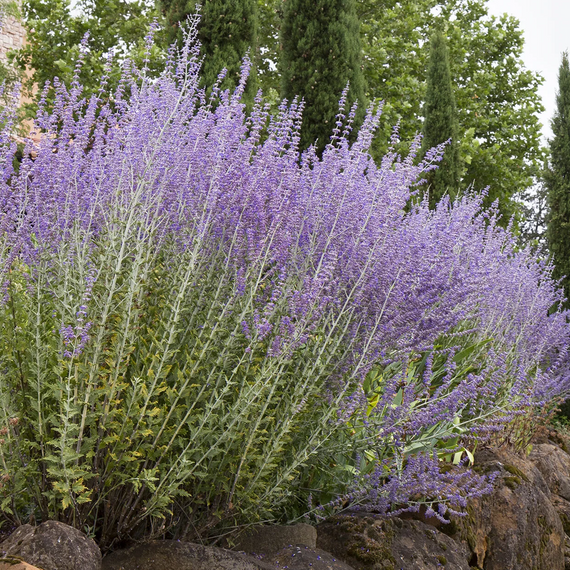
Russian Sage (Salvia yangii, formerly Perovskia atriplicifolia) is a showstopping, drought-tolerant perennial sub-shrub that delivers extraordinary ornamental value with minimal effort, making it one of the most popular and versatile plants for sunny, water-wise gardens across a wide range of climates. Native to the rugged, arid landscapes of central Asia and Tibet, this tough-as-nails perennial produces tall, airy spires of small but abundant lavender-blue to violet flowers that bloom from mid-summer well into fall, creating a dreamy haze of cool color that beautifully complements bold warm-toned perennials, ornamental grasses, and landscape roses. The finely textured, deeply lobed gray-green leaves are carried on distinctive whitish-silver stems and release a pleasant sage-like fragrance when brushed or crushed, adding a sensory dimension to the garden that few other perennials can match. Thriving in full sun and well-drained to lean soils, Russian Sage is remarkably adaptable, tolerating poor soils, heat, and extended dry periods with ease once established. Hardy in USDA Zones 4-9, it grows 3 to 5 feet tall and 2 to 4 feet wide, forming an open, graceful mounding habit that works beautifully as a mid-border filler, a low informal hedge, a slope stabilizer, or a stunning mass planting. Its long bloom season, exceptional pest and disease resistance, deer and rabbit resistance, and near-zero fertilizer requirements make Russian Sage an outstanding choice for beginner and experienced gardeners alike throughout Southern Oregon and Northern California.
Plant Description
Russian Sage (Salvia yangii, syn. Perovskia atriplicifolia) is a woody-based herbaceous perennial and member of the Lamiaceae (mint) family. Despite its common name, it is not native to Russia but originates from the steppe regions and rocky slopes of central Asia and Tibet, where it thrives at elevations up to 8,000 feet. The plant produces upright to slightly arching stems covered in small, deeply serrated, aromatic gray-green leaves. The upper third of each stem erupts into long, branching panicles of tiny tubular lavender-blue to violet flowers, each emerging from a silvery calyx that contributes to the overall hazy, luminous appearance of the plant. Both the foliage and flowers are aromatic, releasing a pungent, menthol-like sage scent when touched or crushed. The whitish-silver stems provide attractive winter structure and four-season interest even after the foliage dies back. Russian Sage is widely celebrated for its long bloom period, its airy texture, its silvery-blue color palette, and its remarkable resilience in challenging growing conditions.
Mature Size
| Attribute | Typical Range |
|---|---|
| Mature Height | 3 to 5 feet |
| Mature Spread | 2 to 4 feet |
| Growth Rate | Moderate to fast once established |
| Plant Form | Upright, open, mounding sub-shrub |
Most standard cultivars reach 3 to 4 feet in height and spread, while some taller varieties such as 'Longin' can approach 5 feet. Compact cultivars like 'Little Spire' and 'Crazy Blue' stay closer to 18 to 24 inches tall, making them better suited for smaller garden spaces or container use. Rich, overly fertile soil can cause plants to flop open and spread wider than desired; lean to average soils produce the most upright and self-supporting growth habit.
Hardiness Zones and Climate Tolerance
Russian Sage is reliably hardy in USDA Hardiness Zones 4 through 9, with some sources noting successful growth in Zone 3 with additional winter mulching in well-draining soils. It is exceptionally well-suited to the climate of Southern Oregon and Northern California, thriving in the region's hot, dry summers and mild-to-cool winters. The plant tolerates a wide temperature range, from winter lows of around -30°F (-34°C) up to summer highs well above 95°F (35°C). It performs best in low-humidity environments but adapts reasonably well to average summer humidity as long as the soil drainage is excellent. In areas with wet winters, ensuring sharp drainage is the single most important factor for successful overwintering.
Sunlight Requirements
Russian Sage demands full sun and performs best with a minimum of 6 to 8 hours of direct sunlight per day. Adequate sun exposure is critical not only for abundant flowering but also for maintaining an upright, sturdy growth habit. Plants grown in partial shade or low-light conditions tend to produce fewer flowers, develop weak, leggy stems that flop over, and become more susceptible to disease. For the best ornamental performance, choose a planting site with open, unobstructed exposure to full sun throughout the day. It is one of the most sun-loving and heat-tolerant perennials available for the home landscape.
Soil and pH Preferences
Russian Sage is notably unfussy about soil quality and actually performs better in lean to average soils rather than rich, fertile ones. Excessively fertile or amended soils encourage overly lush, floppy growth that may require staking. The single non-negotiable requirement is excellent drainage — Russian Sage will not tolerate consistently wet or waterlogged conditions, which quickly lead to root rot and plant decline.
- Soil type: Sandy, gravelly, loamy, or average garden soils are all acceptable. Heavy clay soils should be amended with coarse sand, perlite, or fine gravel to improve drainage.
- Soil pH: Prefers a neutral to slightly alkaline pH, ideally between 6.5 and 8.0. It tolerates slightly acidic to highly alkaline soils better than most perennials.
- Soil fertility: Low to medium fertility is ideal. Avoid adding heavy applications of compost or high-nitrogen fertilizers at planting time.
- Container mix: Use a quality all-purpose potting mix amended with perlite or pumice (20-30% by volume) to ensure rapid drainage.
Watering Guide
Once established, Russian Sage is one of the most drought-tolerant perennials available for the home garden. However, proper watering during the establishment phase is essential for long-term plant health and vigor.
- At planting: Water thoroughly at planting time and keep the soil evenly moist (but not saturated) during the first 4 to 6 weeks as the root system develops.
- First growing season: Water regularly during the first season, allowing the soil to dry out moderately between waterings. Deep, infrequent watering encourages a deep, drought-resistant root system.
- Established plants: After the first full growing season, Russian Sage requires very little supplemental irrigation. In the Southern Oregon and Northern California climate, established plants typically need watering only during prolonged dry spells of 3 or more weeks with no rainfall.
- Overwatering warning: Overwatering is the most common cause of plant failure. Soggy or consistently moist soil causes stem and root rot. Always allow the top several inches of soil to dry between waterings.
- Containers: Water container plants when the top 2 inches of potting mix are dry, and always empty saucers after watering to prevent roots from sitting in standing water.
Fertilizing
Russian Sage requires little to no supplemental fertilization and is one of the easiest perennials to maintain in this regard. In fact, over-fertilizing — particularly with high-nitrogen products — is counterproductive, encouraging weak, floppy stems and excessive vegetative growth at the expense of flowers. For most garden soils, no routine fertilizing is needed at all. If desired, a light top-dressing of compost applied around the base of the plant in early spring as new growth emerges is the safest and most beneficial approach. Avoid applying granular synthetic fertilizers directly against the crown or stems. In containers, where nutrients leach out more quickly, a single light application of a balanced slow-release granular fertilizer in spring is sufficient for the entire growing season.
Pruning and Maintenance
Pruning is the most important routine maintenance task for Russian Sage and is key to keeping plants vigorous, bushy, and floriferous year after year. Following these guidelines will ensure the best results:
- Fall: Do not cut plants back in the fall. The silvery stems and dried seed heads provide attractive winter structure and help protect the crown from cold. Leave them standing through winter.
- Early spring (primary pruning): Wait until you see new growth beginning to emerge from the base or lower portions of the stems, then cut the old woody stems back to approximately 6 to 12 inches above the ground, just above the lowest set of new leaves or buds. Cutting back before new growth is visible risks removing viable growth points.
- Mid-season shaping: If plants begin to sprawl or flop open in late spring or early summer, shear off the top one-third of the stems to encourage a more compact, upright habit.
- Summer re-bloom boost: If blooming slows or stops in midsummer, cut stems back by about half to encourage a fresh flush of flowers in late summer and fall.
- Staking: Taller varieties or plants grown in slightly shaded or overly rich conditions may need support. Insert stakes or grow-through supports in early spring before stems become tall. Planting in masses allows neighboring stems to support each other naturally.
- Division: Divide clumps every 4 to 6 years in early spring to rejuvenate the plant and control spread.
Planting Instructions
- Select a planting site with full sun (6-8 hours minimum per day) and well-drained soil. Avoid low-lying areas where water pools after rain.
- If the native soil is heavy clay, amend the planting area by working coarse sand, perlite, or fine gravel into the top 12 inches of soil across a wide area, not just in the planting hole.
- Dig a planting hole slightly wider than the root ball and no deeper than the height of the root ball, so the crown of the plant sits at or just slightly above the surrounding soil grade.
- Gently remove the plant from its nursery container and loosen any circling or densely matted roots before placing it in the hole.
- Backfill with the native or amended soil, tamping gently to eliminate large air pockets. Avoid burying the crown.
- Water thoroughly at planting. Create a slight watering basin around the plant to direct water to the root zone during the establishment period.
- Space multiple plants 2 to 3 feet apart for a mass planting or informal hedge effect. Closer spacing (18 inches) is acceptable for smaller cultivars.
- Apply a 1 to 2-inch layer of gravel mulch (preferred) or light organic mulch around the plant, keeping mulch several inches away from the crown to prevent rot. Gravel mulch is preferred because it allows better moisture evaporation and keeps the crown dry.
- Water regularly during the first growing season as the root system establishes, then transition to an infrequent, deep-watering schedule.
Seasonal Interest
| Season | Ornamental Features |
|---|---|
| Spring | Fresh silver-gray new foliage emerges from the base; attractive low mounding growth begins to fill out |
| Early Summer | Tall flowering stems elongate; silvery foliage creates striking textural contrast in the border; early flower buds form |
| Mid to Late Summer | Peak bloom period; abundant lavender-blue to violet flower spires cover the upper stems; strong pollinator activity from bees, butterflies, and hummingbirds |
| Fall | Continued bloom through frost; foliage begins to take on warm tones; seed heads develop and add textural interest |
| Winter | Upright whitish-silver dried stems and seed heads provide architectural structure and winter garden interest; stems help protect the crown |
Landscape Uses
Russian Sage is one of the most versatile perennials available for sunny, low-water landscapes. Its fine texture, soft color palette, and long season of interest make it highly useful in a wide range of design contexts:
- Mixed perennial borders: Use in the middle or back of a border to provide a soft, hazy blue backdrop that makes bold warm-colored flowers pop. It pairs especially well with yellows, oranges, and deep purples.
- Mass plantings: Plant in drifts of 3 or more for a dramatic, meadow-like effect. Mass plantings also help stems support one another, reducing flopping.
- Informal hedging: Effective as a low, soft hedge along pathways, driveways, or to divide garden areas. Taller cultivars work especially well for this purpose.
- Xeriscape and water-wise gardens: An outstanding candidate for dry, low-irrigation landscapes, curbside strips, and water conservation planting schemes.
- Slope stabilization: The deep, spreading root system makes Russian Sage an excellent choice for stabilizing dry, sunny slopes where erosion control is needed.
- Pollinator and wildlife gardens: A top-rated pollinator plant, attracting bees, butterflies, and hummingbirds throughout the long bloom season.
- Cut and dried flower arrangements: Freshly cut stems add fragrance and airy texture to floral arrangements; dried stems retain their form and subtle color for use in dried arrangements and potpourri.
- Containers: Compact cultivars are well-suited to large containers on sunny patios and decks, adding height, texture, and long-season color.
Companion Plants
Russian Sage thrives alongside plants that share its preference for full sun, well-drained soil, and relatively dry conditions. Its cool lavender-blue tones create striking combinations with warm-colored and bold-textured companions:
- Landscape roses: A classic pairing — the soft blue spires of Russian Sage complement the bold blooms of shrub and landscape roses beautifully while both share the same low-water needs.
- Ornamental grasses: Fountain grass, switch grass, and blue oat grass provide contrasting texture and movement while thriving in the same dry, sunny conditions.
- Coneflowers (Echinacea): The warm pinks and purples of coneflowers contrast vibrantly with the cool blue of Russian Sage and share the same cultural requirements.
- Black-eyed Susan (Rudbeckia): Bright golden-yellow blooms create a high-contrast, eye-catching combination with the lavender-blue spires.
- Lavender (Lavandula): Similar in appearance and cultural needs, lavender makes a harmonious companion, though Russian Sage blooms later and grows larger.
- Catmint (Nepeta): Another close look-alike with complementary bloom times; catmint starts flowering earlier in the season while Russian Sage carries color into fall.
- Daylilies (Hemerocallis): The bold, colorful blooms and strap-like foliage of daylilies contrast attractively with the fine, airy texture of Russian Sage.
- Yarrow (Achillea): Flat-topped yellow or warm-toned yarrow flowers provide striking color and textural contrast alongside Russian Sage in hot, dry plantings.
- Smokebush (Cotinus): The deep burgundy or smoke-colored foliage of smokebush makes a dramatic foil for the silver and blue tones of Russian Sage.
Pests and Diseases
Russian Sage is one of the most pest- and disease-resistant perennials available, and problems are rare when the plant is sited correctly. Its strongly aromatic foliage naturally repels most common garden insects and larger pests.
- Deer and rabbit resistance: Highly resistant. The pungent scent of the foliage is strongly off-putting to deer and rabbits, making this an excellent choice for gardens where these animals are a problem.
- Aphids: Occasionally appear on new growth in early season. Treat with a strong blast of water or an application of insecticidal soap or neem oil if populations are significant.
- Spider mites: Can appear during hot, dry weather. Increase air circulation and treat with neem oil or insecticidal soap if needed.
- Whiteflies and leafhoppers: Occasional, minor pests. Rarely cause serious damage; treat with insecticidal soap if infestations are heavy.
- Root rot and stem rot: The most serious and common disease issue, caused entirely by poorly draining or consistently wet soils. Prevent by ensuring excellent drainage, avoiding overwatering, and not mulching heavily against the crown. There is no effective treatment once advanced rot has set in; prevent it through proper site selection and watering practices.
- Powdery mildew: Uncommon but can occur in overly humid conditions with poor air circulation. Maintain adequate plant spacing and plant in open, breezy locations to minimize risk.
Container Growing
Russian Sage can be grown successfully in containers, making it a versatile option for patios, decks, and entryways where garden space is limited. Compact cultivars such as 'Little Spire', 'Crazy Blue', and 'Denim 'n Lace' are the best choices for container culture due to their smaller stature and more restrained habit.
- Container size: Choose a large container — at least 12 to 16 inches in diameter and depth — to accommodate the root system and provide stability for the tall flower stems.
- Drainage: Containers must have adequate drainage holes. Never allow pots to sit in standing water. Elevate containers on pot feet if needed to ensure free drainage.
- Potting mix: Use a quality all-purpose potting mix amended with 20-30% perlite or coarse pumice to ensure rapid drainage and prevent the soggy conditions that cause root rot.
- Watering in containers: Containers dry out more quickly than garden beds. Check soil moisture regularly and water when the top 2 inches of the mix feel dry. Always water thoroughly until it drains freely from the bottom.
- Fertilizing in containers: Apply a single light application of balanced slow-release granular fertilizer in spring. Avoid over-fertilizing, which promotes floppy growth.
- Overwintering containers: In Zone 6 and colder, move containers to an unheated garage or shed for winter, or bury the pot in a garden bed and mulch heavily. In Zones 7-9 (applicable to most of Southern Oregon and Northern California), containers can typically be left outdoors in a sheltered location with minimal protection.
Wildlife Value
Russian Sage is an outstanding plant for supporting pollinators and beneficial wildlife throughout its exceptionally long bloom season from mid-summer through fall — a period when many other garden plants have finished flowering and nectar sources become scarcer.
- Bees: A premier bee plant. Honey bees, native bumble bees, and a wide variety of solitary native bees are strongly attracted to the abundant tubular flowers, which are rich in nectar and easily accessible. In peak bloom, plants can be alive with bee activity.
- Butterflies: Attracts a wide range of butterfly species including swallowtails, skippers, monarchs, and painted ladies. The long bloom period provides a sustained nectar source throughout late summer and early fall migration periods.
- Hummingbirds: The tubular flower form is well-suited to hummingbird feeding. Ruby-throated and other hummingbird species visit Russian Sage regularly throughout the blooming season.
- Pest deterrent: The strongly aromatic foliage naturally deters deer, rabbits, and most browsing animals. Most insect pests also avoid the plant, reducing the need for pesticide use and helping maintain a healthy garden ecosystem.
- Winter seed heads: The dried seed heads that remain through winter provide food for seed-eating birds such as finches.
- Stunning lavender-blue flower spires bloom from mid-summer through fall, delivering months of continuous color in sunny borders and landscapes.
- Exceptionally drought-tolerant and heat-hardy once established, making it an ideal low-water, xeriscape-friendly perennial for hot, dry climates.
- Aromatic silver-green foliage on white-silver stems adds striking textural contrast all season long while naturally deterring deer, rabbits, and most garden pests.
- A powerful pollinator magnet that draws bees, butterflies, and hummingbirds, supporting a healthy and vibrant garden ecosystem.
Russian Sage (Salvia yangii, formerly Perovskia atriplicifolia) is a showstopping, drought-tolerant perennial sub-shrub that delivers extraordinary ornamental value with minimal effort, making it one of the most popular and versatile plants for sunny, water-wise gardens across a wide range of climates. Native to the rugged, arid landscapes of central Asia and Tibet, this tough-as-nails perennial produces tall, airy spires of small but abundant lavender-blue to violet flowers that bloom from mid-summer well into fall, creating a dreamy haze of cool color that beautifully complements bold warm-toned perennials, ornamental grasses, and landscape roses. The finely textured, deeply lobed gray-green leaves are carried on distinctive whitish-silver stems and release a pleasant sage-like fragrance when brushed or crushed, adding a sensory dimension to the garden that few other perennials can match. Thriving in full sun and well-drained to lean soils, Russian Sage is remarkably adaptable, tolerating poor soils, heat, and extended dry periods with ease once established. Hardy in USDA Zones 4-9, it grows 3 to 5 feet tall and 2 to 4 feet wide, forming an open, graceful mounding habit that works beautifully as a mid-border filler, a low informal hedge, a slope stabilizer, or a stunning mass planting. Its long bloom season, exceptional pest and disease resistance, deer and rabbit resistance, and near-zero fertilizer requirements make Russian Sage an outstanding choice for beginner and experienced gardeners alike throughout Southern Oregon and Northern California.
Plant Description
Russian Sage (Salvia yangii, syn. Perovskia atriplicifolia) is a woody-based herbaceous perennial and member of the Lamiaceae (mint) family. Despite its common name, it is not native to Russia but originates from the steppe regions and rocky slopes of central Asia and Tibet, where it thrives at elevations up to 8,000 feet. The plant produces upright to slightly arching stems covered in small, deeply serrated, aromatic gray-green leaves. The upper third of each stem erupts into long, branching panicles of tiny tubular lavender-blue to violet flowers, each emerging from a silvery calyx that contributes to the overall hazy, luminous appearance of the plant. Both the foliage and flowers are aromatic, releasing a pungent, menthol-like sage scent when touched or crushed. The whitish-silver stems provide attractive winter structure and four-season interest even after the foliage dies back. Russian Sage is widely celebrated for its long bloom period, its airy texture, its silvery-blue color palette, and its remarkable resilience in challenging growing conditions.
Mature Size
| Attribute | Typical Range |
|---|---|
| Mature Height | 3 to 5 feet |
| Mature Spread | 2 to 4 feet |
| Growth Rate | Moderate to fast once established |
| Plant Form | Upright, open, mounding sub-shrub |
Most standard cultivars reach 3 to 4 feet in height and spread, while some taller varieties such as 'Longin' can approach 5 feet. Compact cultivars like 'Little Spire' and 'Crazy Blue' stay closer to 18 to 24 inches tall, making them better suited for smaller garden spaces or container use. Rich, overly fertile soil can cause plants to flop open and spread wider than desired; lean to average soils produce the most upright and self-supporting growth habit.
Hardiness Zones and Climate Tolerance
Russian Sage is reliably hardy in USDA Hardiness Zones 4 through 9, with some sources noting successful growth in Zone 3 with additional winter mulching in well-draining soils. It is exceptionally well-suited to the climate of Southern Oregon and Northern California, thriving in the region's hot, dry summers and mild-to-cool winters. The plant tolerates a wide temperature range, from winter lows of around -30°F (-34°C) up to summer highs well above 95°F (35°C). It performs best in low-humidity environments but adapts reasonably well to average summer humidity as long as the soil drainage is excellent. In areas with wet winters, ensuring sharp drainage is the single most important factor for successful overwintering.
Sunlight Requirements
Russian Sage demands full sun and performs best with a minimum of 6 to 8 hours of direct sunlight per day. Adequate sun exposure is critical not only for abundant flowering but also for maintaining an upright, sturdy growth habit. Plants grown in partial shade or low-light conditions tend to produce fewer flowers, develop weak, leggy stems that flop over, and become more susceptible to disease. For the best ornamental performance, choose a planting site with open, unobstructed exposure to full sun throughout the day. It is one of the most sun-loving and heat-tolerant perennials available for the home landscape.
Soil and pH Preferences
Russian Sage is notably unfussy about soil quality and actually performs better in lean to average soils rather than rich, fertile ones. Excessively fertile or amended soils encourage overly lush, floppy growth that may require staking. The single non-negotiable requirement is excellent drainage — Russian Sage will not tolerate consistently wet or waterlogged conditions, which quickly lead to root rot and plant decline.
- Soil type: Sandy, gravelly, loamy, or average garden soils are all acceptable. Heavy clay soils should be amended with coarse sand, perlite, or fine gravel to improve drainage.
- Soil pH: Prefers a neutral to slightly alkaline pH, ideally between 6.5 and 8.0. It tolerates slightly acidic to highly alkaline soils better than most perennials.
- Soil fertility: Low to medium fertility is ideal. Avoid adding heavy applications of compost or high-nitrogen fertilizers at planting time.
- Container mix: Use a quality all-purpose potting mix amended with perlite or pumice (20-30% by volume) to ensure rapid drainage.
Watering Guide
Once established, Russian Sage is one of the most drought-tolerant perennials available for the home garden. However, proper watering during the establishment phase is essential for long-term plant health and vigor.
- At planting: Water thoroughly at planting time and keep the soil evenly moist (but not saturated) during the first 4 to 6 weeks as the root system develops.
- First growing season: Water regularly during the first season, allowing the soil to dry out moderately between waterings. Deep, infrequent watering encourages a deep, drought-resistant root system.
- Established plants: After the first full growing season, Russian Sage requires very little supplemental irrigation. In the Southern Oregon and Northern California climate, established plants typically need watering only during prolonged dry spells of 3 or more weeks with no rainfall.
- Overwatering warning: Overwatering is the most common cause of plant failure. Soggy or consistently moist soil causes stem and root rot. Always allow the top several inches of soil to dry between waterings.
- Containers: Water container plants when the top 2 inches of potting mix are dry, and always empty saucers after watering to prevent roots from sitting in standing water.
Fertilizing
Russian Sage requires little to no supplemental fertilization and is one of the easiest perennials to maintain in this regard. In fact, over-fertilizing — particularly with high-nitrogen products — is counterproductive, encouraging weak, floppy stems and excessive vegetative growth at the expense of flowers. For most garden soils, no routine fertilizing is needed at all. If desired, a light top-dressing of compost applied around the base of the plant in early spring as new growth emerges is the safest and most beneficial approach. Avoid applying granular synthetic fertilizers directly against the crown or stems. In containers, where nutrients leach out more quickly, a single light application of a balanced slow-release granular fertilizer in spring is sufficient for the entire growing season.
Pruning and Maintenance
Pruning is the most important routine maintenance task for Russian Sage and is key to keeping plants vigorous, bushy, and floriferous year after year. Following these guidelines will ensure the best results:
- Fall: Do not cut plants back in the fall. The silvery stems and dried seed heads provide attractive winter structure and help protect the crown from cold. Leave them standing through winter.
- Early spring (primary pruning): Wait until you see new growth beginning to emerge from the base or lower portions of the stems, then cut the old woody stems back to approximately 6 to 12 inches above the ground, just above the lowest set of new leaves or buds. Cutting back before new growth is visible risks removing viable growth points.
- Mid-season shaping: If plants begin to sprawl or flop open in late spring or early summer, shear off the top one-third of the stems to encourage a more compact, upright habit.
- Summer re-bloom boost: If blooming slows or stops in midsummer, cut stems back by about half to encourage a fresh flush of flowers in late summer and fall.
- Staking: Taller varieties or plants grown in slightly shaded or overly rich conditions may need support. Insert stakes or grow-through supports in early spring before stems become tall. Planting in masses allows neighboring stems to support each other naturally.
- Division: Divide clumps every 4 to 6 years in early spring to rejuvenate the plant and control spread.
Planting Instructions
- Select a planting site with full sun (6-8 hours minimum per day) and well-drained soil. Avoid low-lying areas where water pools after rain.
- If the native soil is heavy clay, amend the planting area by working coarse sand, perlite, or fine gravel into the top 12 inches of soil across a wide area, not just in the planting hole.
- Dig a planting hole slightly wider than the root ball and no deeper than the height of the root ball, so the crown of the plant sits at or just slightly above the surrounding soil grade.
- Gently remove the plant from its nursery container and loosen any circling or densely matted roots before placing it in the hole.
- Backfill with the native or amended soil, tamping gently to eliminate large air pockets. Avoid burying the crown.
- Water thoroughly at planting. Create a slight watering basin around the plant to direct water to the root zone during the establishment period.
- Space multiple plants 2 to 3 feet apart for a mass planting or informal hedge effect. Closer spacing (18 inches) is acceptable for smaller cultivars.
- Apply a 1 to 2-inch layer of gravel mulch (preferred) or light organic mulch around the plant, keeping mulch several inches away from the crown to prevent rot. Gravel mulch is preferred because it allows better moisture evaporation and keeps the crown dry.
- Water regularly during the first growing season as the root system establishes, then transition to an infrequent, deep-watering schedule.
Seasonal Interest
| Season | Ornamental Features |
|---|---|
| Spring | Fresh silver-gray new foliage emerges from the base; attractive low mounding growth begins to fill out |
| Early Summer | Tall flowering stems elongate; silvery foliage creates striking textural contrast in the border; early flower buds form |
| Mid to Late Summer | Peak bloom period; abundant lavender-blue to violet flower spires cover the upper stems; strong pollinator activity from bees, butterflies, and hummingbirds |
| Fall | Continued bloom through frost; foliage begins to take on warm tones; seed heads develop and add textural interest |
| Winter | Upright whitish-silver dried stems and seed heads provide architectural structure and winter garden interest; stems help protect the crown |
Landscape Uses
Russian Sage is one of the most versatile perennials available for sunny, low-water landscapes. Its fine texture, soft color palette, and long season of interest make it highly useful in a wide range of design contexts:
- Mixed perennial borders: Use in the middle or back of a border to provide a soft, hazy blue backdrop that makes bold warm-colored flowers pop. It pairs especially well with yellows, oranges, and deep purples.
- Mass plantings: Plant in drifts of 3 or more for a dramatic, meadow-like effect. Mass plantings also help stems support one another, reducing flopping.
- Informal hedging: Effective as a low, soft hedge along pathways, driveways, or to divide garden areas. Taller cultivars work especially well for this purpose.
- Xeriscape and water-wise gardens: An outstanding candidate for dry, low-irrigation landscapes, curbside strips, and water conservation planting schemes.
- Slope stabilization: The deep, spreading root system makes Russian Sage an excellent choice for stabilizing dry, sunny slopes where erosion control is needed.
- Pollinator and wildlife gardens: A top-rated pollinator plant, attracting bees, butterflies, and hummingbirds throughout the long bloom season.
- Cut and dried flower arrangements: Freshly cut stems add fragrance and airy texture to floral arrangements; dried stems retain their form and subtle color for use in dried arrangements and potpourri.
- Containers: Compact cultivars are well-suited to large containers on sunny patios and decks, adding height, texture, and long-season color.
Companion Plants
Russian Sage thrives alongside plants that share its preference for full sun, well-drained soil, and relatively dry conditions. Its cool lavender-blue tones create striking combinations with warm-colored and bold-textured companions:
- Landscape roses: A classic pairing — the soft blue spires of Russian Sage complement the bold blooms of shrub and landscape roses beautifully while both share the same low-water needs.
- Ornamental grasses: Fountain grass, switch grass, and blue oat grass provide contrasting texture and movement while thriving in the same dry, sunny conditions.
- Coneflowers (Echinacea): The warm pinks and purples of coneflowers contrast vibrantly with the cool blue of Russian Sage and share the same cultural requirements.
- Black-eyed Susan (Rudbeckia): Bright golden-yellow blooms create a high-contrast, eye-catching combination with the lavender-blue spires.
- Lavender (Lavandula): Similar in appearance and cultural needs, lavender makes a harmonious companion, though Russian Sage blooms later and grows larger.
- Catmint (Nepeta): Another close look-alike with complementary bloom times; catmint starts flowering earlier in the season while Russian Sage carries color into fall.
- Daylilies (Hemerocallis): The bold, colorful blooms and strap-like foliage of daylilies contrast attractively with the fine, airy texture of Russian Sage.
- Yarrow (Achillea): Flat-topped yellow or warm-toned yarrow flowers provide striking color and textural contrast alongside Russian Sage in hot, dry plantings.
- Smokebush (Cotinus): The deep burgundy or smoke-colored foliage of smokebush makes a dramatic foil for the silver and blue tones of Russian Sage.
Pests and Diseases
Russian Sage is one of the most pest- and disease-resistant perennials available, and problems are rare when the plant is sited correctly. Its strongly aromatic foliage naturally repels most common garden insects and larger pests.
- Deer and rabbit resistance: Highly resistant. The pungent scent of the foliage is strongly off-putting to deer and rabbits, making this an excellent choice for gardens where these animals are a problem.
- Aphids: Occasionally appear on new growth in early season. Treat with a strong blast of water or an application of insecticidal soap or neem oil if populations are significant.
- Spider mites: Can appear during hot, dry weather. Increase air circulation and treat with neem oil or insecticidal soap if needed.
- Whiteflies and leafhoppers: Occasional, minor pests. Rarely cause serious damage; treat with insecticidal soap if infestations are heavy.
- Root rot and stem rot: The most serious and common disease issue, caused entirely by poorly draining or consistently wet soils. Prevent by ensuring excellent drainage, avoiding overwatering, and not mulching heavily against the crown. There is no effective treatment once advanced rot has set in; prevent it through proper site selection and watering practices.
- Powdery mildew: Uncommon but can occur in overly humid conditions with poor air circulation. Maintain adequate plant spacing and plant in open, breezy locations to minimize risk.
Container Growing
Russian Sage can be grown successfully in containers, making it a versatile option for patios, decks, and entryways where garden space is limited. Compact cultivars such as 'Little Spire', 'Crazy Blue', and 'Denim 'n Lace' are the best choices for container culture due to their smaller stature and more restrained habit.
- Container size: Choose a large container — at least 12 to 16 inches in diameter and depth — to accommodate the root system and provide stability for the tall flower stems.
- Drainage: Containers must have adequate drainage holes. Never allow pots to sit in standing water. Elevate containers on pot feet if needed to ensure free drainage.
- Potting mix: Use a quality all-purpose potting mix amended with 20-30% perlite or coarse pumice to ensure rapid drainage and prevent the soggy conditions that cause root rot.
- Watering in containers: Containers dry out more quickly than garden beds. Check soil moisture regularly and water when the top 2 inches of the mix feel dry. Always water thoroughly until it drains freely from the bottom.
- Fertilizing in containers: Apply a single light application of balanced slow-release granular fertilizer in spring. Avoid over-fertilizing, which promotes floppy growth.
- Overwintering containers: In Zone 6 and colder, move containers to an unheated garage or shed for winter, or bury the pot in a garden bed and mulch heavily. In Zones 7-9 (applicable to most of Southern Oregon and Northern California), containers can typically be left outdoors in a sheltered location with minimal protection.
Wildlife Value
Russian Sage is an outstanding plant for supporting pollinators and beneficial wildlife throughout its exceptionally long bloom season from mid-summer through fall — a period when many other garden plants have finished flowering and nectar sources become scarcer.
- Bees: A premier bee plant. Honey bees, native bumble bees, and a wide variety of solitary native bees are strongly attracted to the abundant tubular flowers, which are rich in nectar and easily accessible. In peak bloom, plants can be alive with bee activity.
- Butterflies: Attracts a wide range of butterfly species including swallowtails, skippers, monarchs, and painted ladies. The long bloom period provides a sustained nectar source throughout late summer and early fall migration periods.
- Hummingbirds: The tubular flower form is well-suited to hummingbird feeding. Ruby-throated and other hummingbird species visit Russian Sage regularly throughout the blooming season.
- Pest deterrent: The strongly aromatic foliage naturally deters deer, rabbits, and most browsing animals. Most insect pests also avoid the plant, reducing the need for pesticide use and helping maintain a healthy garden ecosystem.
- Winter seed heads: The dried seed heads that remain through winter provide food for seed-eating birds such as finches.
Related Products