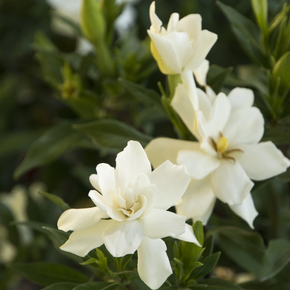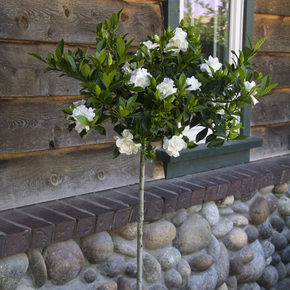


The Miniature Gardenia Patio Tree (Gardenia jasminoides 'Radicans') is a showstopping grafted standard that elevates the classic gardenia to a whole new level of elegance. Trained into a tidy, lollipop-form tree, this dwarf cultivar produces an abundance of petite, intensely fragrant double white flowers — each measuring about 1 to 2 inches across — against a dense, rounded crown of glossy, lance-shaped, deep green evergreen leaves. Flowering begins in late spring and continues sporadically through summer, perfuming every corner of an outdoor living space, courtyard, or entryway. The superior grafted rootstock provides outstanding resistance to soil nematodes and gives the plant a remarkable ability to absorb nutrients and thrive in challenging or less-than-ideal soils. In fall, small ornamental orange berry-like fruits add unexpected seasonal color and attract songbirds. Heat and drought tolerant once established, and naturally deer resistant, this refined patio tree is equally at home growing in a decorative container on a sunny deck or planted as a fragrant focal point in a warm-climate garden border. Its dwarf, compact character and low-spreading natural habit make the grafted tree standard form especially practical for smaller spaces, raised planters, and container gardens in Southern Oregon and Northern California landscapes.
Gardenia jasminoides 'Radicans' is a true dwarf, broadleaf evergreen shrub in the Rubiaceae (coffee) family, native to southern China, Taiwan, and Japan. In its natural form it is a low, spreading, creeping plant, but when grafted onto an upright rootstock and trained as a standard patio tree, it forms a refined, lollipop-shaped specimen with a clean single trunk topped by a dense, rounded canopy. The leaves are lustrous, lance-shaped to elliptical, deep glossy green above and lighter beneath, reaching up to 3 inches long and about 1 inch wide, arranged in opposite pairs or whorls of three along the stems. Flower buds display a distinctive spiral "barber pole" appearance before opening into richly fragrant, waxy, double white to cream blooms roughly 1 to 2 inches across. The flowers can carry anywhere from 7 to 20 petals, ranging from a loose daisy-like form to a densely petaled, rose-resembling blossom. In fall, small ornamental orange berries with longitudinal ribs follow the flowers and provide additional wildlife interest.
| Attribute | Measurement |
|---|---|
| Overall Tree Height (standard form) | Typically 2 to 4 ft. tall, depending on trunk length at grafting |
| Crown Spread | 2 to 3 ft. wide |
| Natural Shrub Height (ungrafted 'Radicans') | 6 in. to 2 ft. tall |
| Natural Shrub Spread | 2 to 4 ft. wide |
| Growth Rate | Medium |
| Leaf Length | 1 to 3 inches |
| Flower Diameter | 1 to 2 inches |
Miniature Gardenia 'Radicans' is hardy in USDA Zones 7b through 11, with best performance in Zones 8 through 10. It tolerates temperatures down to approximately 10-15 degrees Fahrenheit when established in the ground, though the roots are more sensitive to frost than the top growth and should be protected. In Zone 7b, a thick layer of organic mulch over the root zone and protection from harsh winter winds is strongly recommended. In the coldest portions of the hardiness range, growing in a container that can be moved indoors during freezing weather is an ideal strategy. This plant is well-suited to the mild winters and warm summers of Southern Oregon and Northern California, performing beautifully in Sunset Climate Zones 7, 8, 9, 12-16, 18-24, H1, and H2. It is not frost-tender once fully established but should be protected from hard freezes, especially as a patio tree standard where the graft union and trunk are more exposed than in ground-planted specimens.
Miniature Gardenia thrives in full sun to partial shade, requiring a minimum of 4 to 6 hours of direct sunlight daily for the best bloom production. In cooler coastal climates like those found in parts of Southern Oregon and Northern California, a location in full sun is ideal. In hotter inland valleys, where summer temperatures regularly exceed 90 degrees Fahrenheit, protection from intense afternoon sun helps prevent leaf scorch and bud drop. The ideal exposure in hot climates is morning sun with light dappled or partial shade from mid-afternoon onward. Avoid deep, heavy shade, as this significantly reduces flowering. When grown as a patio tree in a container, it can be repositioned seasonally to ensure it receives optimal light. Insufficient light is one of the most common reasons gardenias fail to bloom, so prioritize a bright, sunny location whenever possible.
Gardenia 'Radicans' is an acid-loving plant that performs best in moist, organically rich, well-drained soil with a pH of 5.0 to 6.0. Alkaline soils cause chlorosis (yellowing leaves), poor growth, and bud drop. Before planting in the ground, test your soil pH and amend with elemental sulfur, acidic compost, or peat moss to lower it into the preferred range if needed. The grafted rootstock on this patio tree form offers improved adaptability to a wider range of soil types — including sandy and clay soils — compared to gardenias growing on their own roots. However, regardless of the rootstock advantage, consistently good drainage is non-negotiable; waterlogged roots will lead to root rot and rapid decline. Incorporate generous amounts of compost or aged pine bark into the planting hole to improve both drainage and organic matter. For container culture, use a high-quality, well-draining acidic potting mix formulated for camellias, azaleas, or acid-loving plants.
Consistent moisture is essential for healthy growth and reliable blooming. Water deeply and thoroughly, then allow the top 1 to 2 inches of soil to dry out slightly before watering again — never allow the soil to dry out completely, but also avoid waterlogged conditions. In the ground, aim for approximately 1 inch of water per week during the growing season, increasing frequency during hot, dry spells. Container-grown patio trees dry out more quickly than in-ground plants and may need watering every 2 to 3 days in summer heat. Whenever possible, use rainwater or distilled water, as tap water with high mineral content or alkalinity can raise soil pH over time and cause yellowing foliage. Reduce watering frequency in fall and winter as the plant enters a slower growth period, but never allow the root ball to go completely dry. Applying a 2 to 3 inch layer of organic mulch around the base of in-ground plants helps retain soil moisture, moderate root temperature, and gradually add organic matter as it breaks down.
Feed your Miniature Gardenia Patio Tree regularly during the active growing season to support lush foliage and abundant blooming. Use a fertilizer formulated for acid-loving plants (such as an azalea, camellia, or gardenia formula) that supplies nitrogen, iron, and magnesium — nutrients that gardenias frequently demand. Apply a water-soluble acidic fertilizer every 3 to 4 weeks from early spring through late summer (approximately April through August or September). Alternatively, a slow-release granular fertilizer for acid-lovers can be applied once in early spring as the plant breaks dormancy, supplemented with a liquid feed mid-summer. Always water the plant thoroughly before and after applying fertilizer to prevent root burn. Do not fertilize in fall or winter, as stimulating new growth during cooling temperatures can result in cold damage to tender new shoots. If foliage yellows between the veins (interveinal chlorosis) despite proper pH management, a supplemental application of chelated iron or a soil drench of iron sulfate can correct the deficiency quickly.
Maintaining the elegant patio tree form of this grafted gardenia requires a modest but consistent approach to pruning. Deadhead spent blooms by removing them just below the leaf node to encourage reblooming and keep the crown looking tidy. After the main flush of flowers in early to mid-summer, lightly prune the crown to shape, remove any crossing or crowded branches, and improve air circulation within the canopy — good airflow helps prevent fungal issues. Avoid heavy pruning in late summer or fall, as gardenia sets next season's flower buds in late summer and pruning too late will reduce the following year's bloom. Remove any suckers or shoots that emerge from below the graft union promptly, as these come from the rootstock and will not produce the same ornamental flowers as the grafted 'Radicans' top. For in-ground plants, a light cleanup pruning in early spring before new growth begins is also appropriate. Always use clean, sharp pruning shears to make precise cuts and minimize stress on the plant.
Miniature Gardenia 'Radicans' delivers ornamental appeal across multiple seasons. In late spring, the first flush of fragrant double white blooms transforms the rounded crown into a breathtaking display, filling the surrounding air with that unmistakable, heady gardenia scent. Blooming continues on and off through early and mid-summer, with deadheading encouraging continued flower production. The glossy, dark evergreen foliage provides year-round structure and deep green color, making the patio tree an attractive specimen even when not in bloom. In fall, small ornamental orange to golden-orange berries develop, adding a warm pop of color and providing a food source for songbirds. Through winter, the evergreen canopy retains its glossy, lustrous appeal, maintaining the architectural elegance of the tree standard form even during the off-season. In the mild winters of Southern Oregon and Northern California, this tree can remain a handsome outdoor focal point year-round in the appropriate zones.
The grafted patio tree form of Miniature Gardenia is tailor-made for container culture and outdoor living spaces. Its upright standard form provides vertical interest without consuming significant horizontal space, making it ideal for flanking entryways, framing a front door, adorning a deck or patio corner, or anchoring a container garden arrangement. Use a sturdy, well-weighted container — terracotta or glazed ceramic pots work best for stability — with a diameter approximately 6 inches larger than the root ball, and ensure generous drainage holes. Fill with a premium acidic potting mix formulated for camellias or azaleas. Container plants require more frequent watering and feeding than in-ground specimens. In regions where winter temperatures drop below 15 to 20 degrees Fahrenheit, the container can be moved to a sheltered porch, unheated garage, or bright indoor space to protect it from freeze damage. When overwintering indoors, place near a south- or east-facing window, reduce watering slightly, and resume regular fertilization in early spring as growth resumes. Avoid placing containers near heating vents or air conditioners, as temperature fluctuations and dry air can trigger bud drop.
This Miniature Gardenia is propagated by grafting the ornamental 'Radicans' cultivar onto a specially selected, vigorous rootstock — a key feature that sets it apart from gardenias grown on their own roots. The rootstock provides exceptional resistance to soil-dwelling nematodes, which are microscopic roundworms that can devastate gardenia roots in warmer, sandy soils common in California and the broader South. Beyond nematode resistance, the superior rootstock enables the plant to more efficiently take up water and soil nutrients, including iron and other micronutrients that gardenias frequently struggle to absorb in less-than-ideal soils. The result is a more vigorous, longer-lived plant with improved adaptability to a wider range of soil types and conditions. Gardeners in areas with known nematode pressure, poor soil structure, or less-than-perfect growing conditions will find grafted gardenias far more reliable performers than their own-root counterparts. Always ensure that any shoots emerging from below the graft union (from the rootstock) are promptly removed to preserve the integrity of the ornamental top growth.
The Miniature Gardenia Patio Tree standard is extraordinarily versatile in the landscape. Consider these excellent uses:
Pair Miniature Gardenia Patio Tree with plants that share its preference for acidic, organically rich, well-drained soil and complement its glossy dark foliage and pure white blooms:
Miniature Gardenia is generally resilient once established but is susceptible to some common pests and diseases, particularly when grown under stress or in poorly suited conditions.
The grafted rootstock on this variety provides an important defense against soil nematodes, which are among the most damaging soilborne threats to gardenias in warmer climates.
Miniature Gardenia 'Radicans' offers meaningful wildlife benefits beyond its beauty. The heavily fragrant flowers are highly attractive to pollinators, including bees and butterflies, which visit them readily throughout the blooming season. The intense scent is also known to attract hummingbird moths (sphinx moths) at dusk, adding to the plant's wildlife appeal in evening garden settings. In fall, the small ornamental orange berries that develop after flowering are a favored food source for songbirds, including thrushes, robins, and mockingbirds, making this gardenia a worthy inclusion in a bird-friendly garden. While it is deer resistant — a meaningful advantage in the deer-pressure-prone landscapes of Southern Oregon and Northern California — it is important to note that the plant is toxic to dogs, cats, and horses if ingested, so placement should be considered in pet-accessible areas.
Gardenia jasminoides 'Radicans' is considered mildly toxic to dogs, cats, and horses. If plant material is ingested by pets, symptoms may include mild gastrointestinal upset such as vomiting, diarrhea, or hives. The level of toxicity is generally considered low and rarely life-threatening, but pet owners are advised to keep animals away from the plant or choose a placement in a part of the landscape that is not freely accessible to pets. The plant is not considered toxic to humans and is generally safe for use in gardens where children play, though as a general precaution, young children should be discouraged from putting plant material in their mouths. If you suspect your pet has ingested gardenia plant material and is showing symptoms, consult a veterinarian promptly.
The Miniature Gardenia Patio Tree (Gardenia jasminoides 'Radicans') is a showstopping grafted standard that elevates the classic gardenia to a whole new level of elegance. Trained into a tidy, lollipop-form tree, this dwarf cultivar produces an abundance of petite, intensely fragrant double white flowers — each measuring about 1 to 2 inches across — against a dense, rounded crown of glossy, lance-shaped, deep green evergreen leaves. Flowering begins in late spring and continues sporadically through summer, perfuming every corner of an outdoor living space, courtyard, or entryway. The superior grafted rootstock provides outstanding resistance to soil nematodes and gives the plant a remarkable ability to absorb nutrients and thrive in challenging or less-than-ideal soils. In fall, small ornamental orange berry-like fruits add unexpected seasonal color and attract songbirds. Heat and drought tolerant once established, and naturally deer resistant, this refined patio tree is equally at home growing in a decorative container on a sunny deck or planted as a fragrant focal point in a warm-climate garden border. Its dwarf, compact character and low-spreading natural habit make the grafted tree standard form especially practical for smaller spaces, raised planters, and container gardens in Southern Oregon and Northern California landscapes.
Gardenia jasminoides 'Radicans' is a true dwarf, broadleaf evergreen shrub in the Rubiaceae (coffee) family, native to southern China, Taiwan, and Japan. In its natural form it is a low, spreading, creeping plant, but when grafted onto an upright rootstock and trained as a standard patio tree, it forms a refined, lollipop-shaped specimen with a clean single trunk topped by a dense, rounded canopy. The leaves are lustrous, lance-shaped to elliptical, deep glossy green above and lighter beneath, reaching up to 3 inches long and about 1 inch wide, arranged in opposite pairs or whorls of three along the stems. Flower buds display a distinctive spiral "barber pole" appearance before opening into richly fragrant, waxy, double white to cream blooms roughly 1 to 2 inches across. The flowers can carry anywhere from 7 to 20 petals, ranging from a loose daisy-like form to a densely petaled, rose-resembling blossom. In fall, small ornamental orange berries with longitudinal ribs follow the flowers and provide additional wildlife interest.
| Attribute | Measurement |
|---|---|
| Overall Tree Height (standard form) | Typically 2 to 4 ft. tall, depending on trunk length at grafting |
| Crown Spread | 2 to 3 ft. wide |
| Natural Shrub Height (ungrafted 'Radicans') | 6 in. to 2 ft. tall |
| Natural Shrub Spread | 2 to 4 ft. wide |
| Growth Rate | Medium |
| Leaf Length | 1 to 3 inches |
| Flower Diameter | 1 to 2 inches |
Miniature Gardenia 'Radicans' is hardy in USDA Zones 7b through 11, with best performance in Zones 8 through 10. It tolerates temperatures down to approximately 10-15 degrees Fahrenheit when established in the ground, though the roots are more sensitive to frost than the top growth and should be protected. In Zone 7b, a thick layer of organic mulch over the root zone and protection from harsh winter winds is strongly recommended. In the coldest portions of the hardiness range, growing in a container that can be moved indoors during freezing weather is an ideal strategy. This plant is well-suited to the mild winters and warm summers of Southern Oregon and Northern California, performing beautifully in Sunset Climate Zones 7, 8, 9, 12-16, 18-24, H1, and H2. It is not frost-tender once fully established but should be protected from hard freezes, especially as a patio tree standard where the graft union and trunk are more exposed than in ground-planted specimens.
Miniature Gardenia thrives in full sun to partial shade, requiring a minimum of 4 to 6 hours of direct sunlight daily for the best bloom production. In cooler coastal climates like those found in parts of Southern Oregon and Northern California, a location in full sun is ideal. In hotter inland valleys, where summer temperatures regularly exceed 90 degrees Fahrenheit, protection from intense afternoon sun helps prevent leaf scorch and bud drop. The ideal exposure in hot climates is morning sun with light dappled or partial shade from mid-afternoon onward. Avoid deep, heavy shade, as this significantly reduces flowering. When grown as a patio tree in a container, it can be repositioned seasonally to ensure it receives optimal light. Insufficient light is one of the most common reasons gardenias fail to bloom, so prioritize a bright, sunny location whenever possible.
Gardenia 'Radicans' is an acid-loving plant that performs best in moist, organically rich, well-drained soil with a pH of 5.0 to 6.0. Alkaline soils cause chlorosis (yellowing leaves), poor growth, and bud drop. Before planting in the ground, test your soil pH and amend with elemental sulfur, acidic compost, or peat moss to lower it into the preferred range if needed. The grafted rootstock on this patio tree form offers improved adaptability to a wider range of soil types — including sandy and clay soils — compared to gardenias growing on their own roots. However, regardless of the rootstock advantage, consistently good drainage is non-negotiable; waterlogged roots will lead to root rot and rapid decline. Incorporate generous amounts of compost or aged pine bark into the planting hole to improve both drainage and organic matter. For container culture, use a high-quality, well-draining acidic potting mix formulated for camellias, azaleas, or acid-loving plants.
Consistent moisture is essential for healthy growth and reliable blooming. Water deeply and thoroughly, then allow the top 1 to 2 inches of soil to dry out slightly before watering again — never allow the soil to dry out completely, but also avoid waterlogged conditions. In the ground, aim for approximately 1 inch of water per week during the growing season, increasing frequency during hot, dry spells. Container-grown patio trees dry out more quickly than in-ground plants and may need watering every 2 to 3 days in summer heat. Whenever possible, use rainwater or distilled water, as tap water with high mineral content or alkalinity can raise soil pH over time and cause yellowing foliage. Reduce watering frequency in fall and winter as the plant enters a slower growth period, but never allow the root ball to go completely dry. Applying a 2 to 3 inch layer of organic mulch around the base of in-ground plants helps retain soil moisture, moderate root temperature, and gradually add organic matter as it breaks down.
Feed your Miniature Gardenia Patio Tree regularly during the active growing season to support lush foliage and abundant blooming. Use a fertilizer formulated for acid-loving plants (such as an azalea, camellia, or gardenia formula) that supplies nitrogen, iron, and magnesium — nutrients that gardenias frequently demand. Apply a water-soluble acidic fertilizer every 3 to 4 weeks from early spring through late summer (approximately April through August or September). Alternatively, a slow-release granular fertilizer for acid-lovers can be applied once in early spring as the plant breaks dormancy, supplemented with a liquid feed mid-summer. Always water the plant thoroughly before and after applying fertilizer to prevent root burn. Do not fertilize in fall or winter, as stimulating new growth during cooling temperatures can result in cold damage to tender new shoots. If foliage yellows between the veins (interveinal chlorosis) despite proper pH management, a supplemental application of chelated iron or a soil drench of iron sulfate can correct the deficiency quickly.
Maintaining the elegant patio tree form of this grafted gardenia requires a modest but consistent approach to pruning. Deadhead spent blooms by removing them just below the leaf node to encourage reblooming and keep the crown looking tidy. After the main flush of flowers in early to mid-summer, lightly prune the crown to shape, remove any crossing or crowded branches, and improve air circulation within the canopy — good airflow helps prevent fungal issues. Avoid heavy pruning in late summer or fall, as gardenia sets next season's flower buds in late summer and pruning too late will reduce the following year's bloom. Remove any suckers or shoots that emerge from below the graft union promptly, as these come from the rootstock and will not produce the same ornamental flowers as the grafted 'Radicans' top. For in-ground plants, a light cleanup pruning in early spring before new growth begins is also appropriate. Always use clean, sharp pruning shears to make precise cuts and minimize stress on the plant.
Miniature Gardenia 'Radicans' delivers ornamental appeal across multiple seasons. In late spring, the first flush of fragrant double white blooms transforms the rounded crown into a breathtaking display, filling the surrounding air with that unmistakable, heady gardenia scent. Blooming continues on and off through early and mid-summer, with deadheading encouraging continued flower production. The glossy, dark evergreen foliage provides year-round structure and deep green color, making the patio tree an attractive specimen even when not in bloom. In fall, small ornamental orange to golden-orange berries develop, adding a warm pop of color and providing a food source for songbirds. Through winter, the evergreen canopy retains its glossy, lustrous appeal, maintaining the architectural elegance of the tree standard form even during the off-season. In the mild winters of Southern Oregon and Northern California, this tree can remain a handsome outdoor focal point year-round in the appropriate zones.
The grafted patio tree form of Miniature Gardenia is tailor-made for container culture and outdoor living spaces. Its upright standard form provides vertical interest without consuming significant horizontal space, making it ideal for flanking entryways, framing a front door, adorning a deck or patio corner, or anchoring a container garden arrangement. Use a sturdy, well-weighted container — terracotta or glazed ceramic pots work best for stability — with a diameter approximately 6 inches larger than the root ball, and ensure generous drainage holes. Fill with a premium acidic potting mix formulated for camellias or azaleas. Container plants require more frequent watering and feeding than in-ground specimens. In regions where winter temperatures drop below 15 to 20 degrees Fahrenheit, the container can be moved to a sheltered porch, unheated garage, or bright indoor space to protect it from freeze damage. When overwintering indoors, place near a south- or east-facing window, reduce watering slightly, and resume regular fertilization in early spring as growth resumes. Avoid placing containers near heating vents or air conditioners, as temperature fluctuations and dry air can trigger bud drop.
This Miniature Gardenia is propagated by grafting the ornamental 'Radicans' cultivar onto a specially selected, vigorous rootstock — a key feature that sets it apart from gardenias grown on their own roots. The rootstock provides exceptional resistance to soil-dwelling nematodes, which are microscopic roundworms that can devastate gardenia roots in warmer, sandy soils common in California and the broader South. Beyond nematode resistance, the superior rootstock enables the plant to more efficiently take up water and soil nutrients, including iron and other micronutrients that gardenias frequently struggle to absorb in less-than-ideal soils. The result is a more vigorous, longer-lived plant with improved adaptability to a wider range of soil types and conditions. Gardeners in areas with known nematode pressure, poor soil structure, or less-than-perfect growing conditions will find grafted gardenias far more reliable performers than their own-root counterparts. Always ensure that any shoots emerging from below the graft union (from the rootstock) are promptly removed to preserve the integrity of the ornamental top growth.
The Miniature Gardenia Patio Tree standard is extraordinarily versatile in the landscape. Consider these excellent uses:
Pair Miniature Gardenia Patio Tree with plants that share its preference for acidic, organically rich, well-drained soil and complement its glossy dark foliage and pure white blooms:
Miniature Gardenia is generally resilient once established but is susceptible to some common pests and diseases, particularly when grown under stress or in poorly suited conditions.
The grafted rootstock on this variety provides an important defense against soil nematodes, which are among the most damaging soilborne threats to gardenias in warmer climates.
Miniature Gardenia 'Radicans' offers meaningful wildlife benefits beyond its beauty. The heavily fragrant flowers are highly attractive to pollinators, including bees and butterflies, which visit them readily throughout the blooming season. The intense scent is also known to attract hummingbird moths (sphinx moths) at dusk, adding to the plant's wildlife appeal in evening garden settings. In fall, the small ornamental orange berries that develop after flowering are a favored food source for songbirds, including thrushes, robins, and mockingbirds, making this gardenia a worthy inclusion in a bird-friendly garden. While it is deer resistant — a meaningful advantage in the deer-pressure-prone landscapes of Southern Oregon and Northern California — it is important to note that the plant is toxic to dogs, cats, and horses if ingested, so placement should be considered in pet-accessible areas.
Gardenia jasminoides 'Radicans' is considered mildly toxic to dogs, cats, and horses. If plant material is ingested by pets, symptoms may include mild gastrointestinal upset such as vomiting, diarrhea, or hives. The level of toxicity is generally considered low and rarely life-threatening, but pet owners are advised to keep animals away from the plant or choose a placement in a part of the landscape that is not freely accessible to pets. The plant is not considered toxic to humans and is generally safe for use in gardens where children play, though as a general precaution, young children should be discouraged from putting plant material in their mouths. If you suspect your pet has ingested gardenia plant material and is showing symptoms, consult a veterinarian promptly.