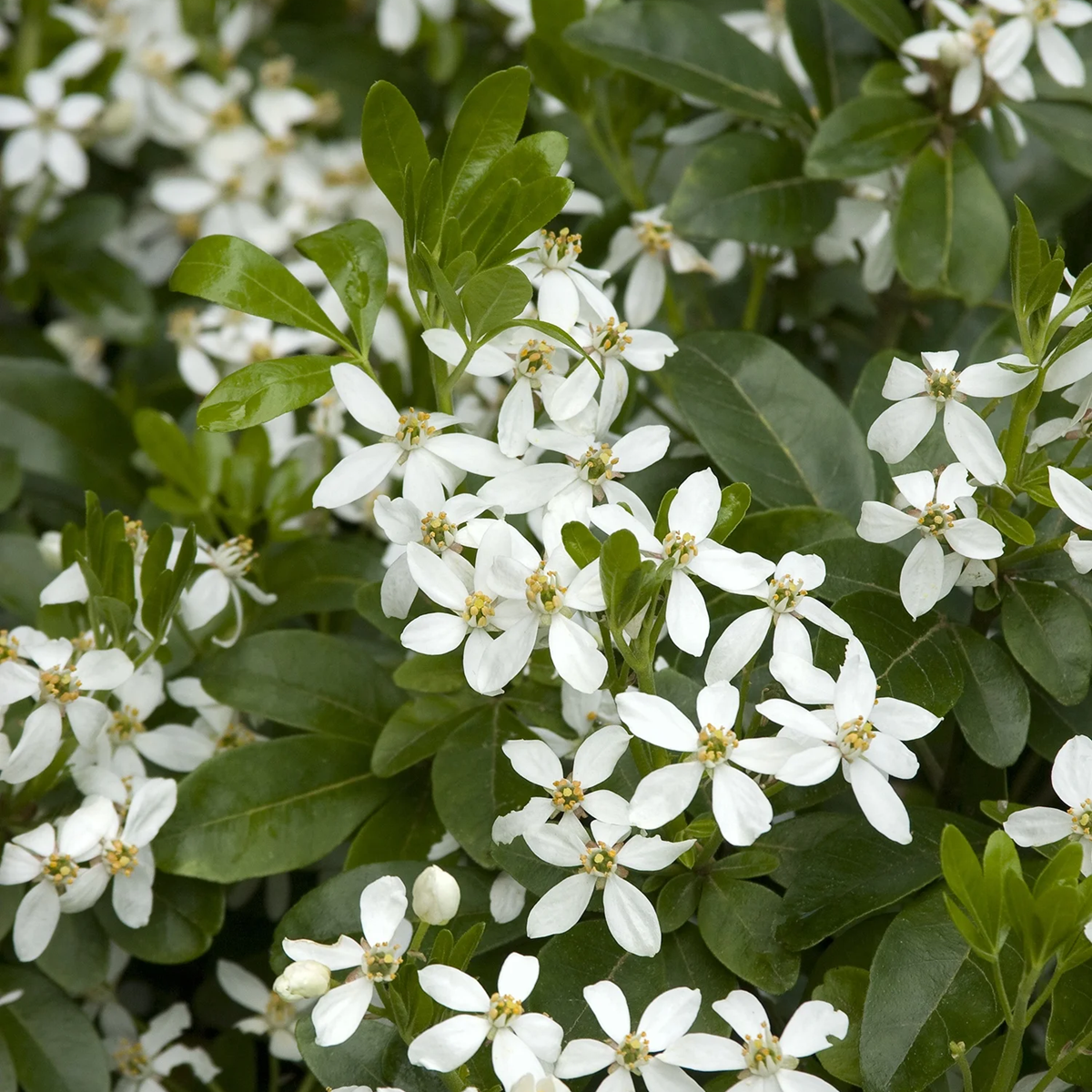
Choisya ternata, commonly known as Mexican Orange Blossom, is a standout broadleaf evergreen shrub that brings year-round beauty, fragrance, and structure to warm-climate gardens across Southern Oregon and Northern California. Naturally forming a full, rounded mound 4 to 8 feet tall and wide, this member of the Rutaceae (citrus) family earns its common name from the clusters of pure white, five-petaled, star-shaped flowers that saturate the shrub each late spring and often reappear in late summer or early fall. Each delicate blossom carries the same heady, sweet orange-blossom fragrance associated with true citrus trees, making it a sensory highlight when planted near paths, patios, entryways, or windows. The opposite, palmately compound leaves are composed of three glossy, medium-green, leathery leaflets that hold their rich color through every season and release a bright citrusy scent when crushed or brushed. Hardy in USDA Zones 7 through 10, Mexican Orange Blossom is native to the sunny, rocky hillsides and well-drained slopes of the southwestern United States and Mexico, giving it an innate tolerance for the long, dry summers characteristic of the Pacific Coast region. Once established in fertile, well-drained soil, it requires minimal supplemental water and is resistant to rabbits, tolerant of urban pollution, and notably resistant to honey fungus. Its dense, naturally tidy form rarely demands heavy pruning, and its nectar-rich blooms are a reliable magnet for bees and butterflies, lending ecological value alongside its exceptional ornamental appeal. Whether used as a fragrant informal hedge, an evergreen anchor in mixed borders, or a specimen shrub in a Mediterranean-style garden, Choisya ternata delivers outstanding performance with effortless grace.
Choisya ternata is a dense, rounded, broadleaf evergreen shrub belonging to the Rutaceae (citrus) family. Its common name, Mexican Orange Blossom, reflects the intensely sweet, orange-like fragrance produced by both the flowers and the aromatic foliage. The genus name Choisya honors Swiss botanist Jacques Denis Choisy, while ternata refers to the trifoliate leaf arrangement, with each leaf composed of three glossy leaflets. The shrub naturally forms a full, dome-shaped mound with dense branching and a fine to medium texture that remains attractive throughout every season. New foliage emerges with a fresh yellow-green hue before maturing to a rich, lustrous medium green. In late spring, masses of pure white, star-shaped flowers with five petals appear in clusters (corymbs) at the tips of the shoots, often smothering the shrub in bloom. With favorable conditions and light post-bloom pruning, a second lighter flush of flowers frequently occurs in late summer or fall. Small, brown to copper-toned seed capsules may follow the flowers but are not considered a significant ornamental feature.
| Attribute | Detail |
|---|---|
| Mature Height | 4 to 8 feet |
| Mature Spread | 4 to 8 feet |
| Growth Habit | Dense, rounded, naturally mounded |
| Growth Rate | Moderate to fast when young; slows to moderate as the plant matures |
| Plant Type | Broadleaf evergreen shrub |
Young plants establish and fill out quickly, making them effective for hedging and screening in just a few seasons. As the plant matures, growth slows to a moderate pace and the naturally tidy, rounded outline requires little corrective pruning to maintain its attractive form.
Mexican Orange Blossom is hardy in USDA Zones 7 through 10, making it well suited to the mild-winter, dry-summer climates of Southern Oregon and Northern California. In Zone 7, plants perform best when sited in a sheltered location protected from harsh winter winds and prolonged hard freezes. Temperatures below 14 degrees Fahrenheit can damage stems and foliage, and prolonged exposure near 5 degrees Fahrenheit may cause significant defoliation, though healthy established plants often resprout from undamaged wood when conditions improve. In Zones 8 through 10, this shrub thrives with minimal cold-weather concern and can be treated as a reliable, permanent landscape plant. Its native origin on sunny, rocky hillsides and sheltered canyons of the southwestern United States and Mexico gives it a natural affinity for the warm, dry-summer conditions characteristic of the Pacific Coast region.
Choisya ternata performs best in full sun to partial shade. In cooler coastal and inland valley climates, full sun (6 or more hours of direct sunlight daily) encourages the densest growth and most prolific flowering. In hotter inland locations where summer temperatures frequently climb into the upper 90s or above, a position that receives morning sun with protection from intense afternoon sun helps prevent foliage scorch and keeps the shrub looking its best. A warm, south- or west-facing wall or fence is an ideal placement in cooler parts of its range, as reflected heat provides additional warmth and can enhance bloom performance. Deep shade is not suitable and will result in sparse, leggy growth and dramatically reduced flowering.
Mexican Orange Blossom thrives in fertile, humus-rich, well-drained soil and is intolerant of standing water or poorly drained conditions, which promote the root rot and crown rot that are its most common health threats. It is naturally adaptable to a range of soil textures including loam, sandy loam, and even moderately chalky or slightly clay-based soils, provided drainage is adequate. In terms of pH, it prefers slightly acidic to slightly alkaline conditions and performs well across a broad range, roughly pH 6.0 to 8.0. Amending heavy clay soils with compost and coarse grit before planting significantly improves drainage and long-term plant health. Avoid low-lying planting sites or areas where water pools after rain.
Mexican Orange Blossom is not a heavy feeder but benefits from a light annual application of fertilizer to maintain glossy foliage and support abundant flowering. Apply a balanced, slow-release shrub fertilizer or a generous 2- to 3-inch layer of compost around the root zone each spring as new growth begins. Avoid excessive nitrogen, which promotes lush foliage at the expense of flowers. If leaves appear pale or yellowish and drainage is confirmed to be adequate, applying an acid-based or balanced fertilizer can help correct minor nutrient deficiencies. Container-grown plants should be fed more regularly during the active growing season, approximately every four to six weeks with a balanced liquid fertilizer, since nutrients leach from potting mix more quickly with regular irrigation.
One of the great advantages of Choisya ternata is its naturally tidy, rounded habit that requires very little pruning under normal circumstances. Follow these guidelines to keep your plant healthy and floriferous:
| Season | Ornamental Interest |
|---|---|
| Spring | Main flowering season: the shrub is smothered in fragrant, star-shaped white blossoms from late spring into early summer. New foliage emerges with a fresh yellow-green flush. |
| Summer | Glossy, aromatic medium-green foliage provides a lush, dense backdrop. A repeat bloom flush often occurs in late summer, especially after light post-spring pruning. |
| Fall | Additional flowers may continue into fall in mild climates. Small copper-brown seed capsules develop. Evergreen foliage remains attractive and fragrant when brushed. |
| Winter | Dense, glossy evergreen foliage provides year-round structure, screening, and garden backbone when many other plants are dormant. Fragrant leaves are present throughout. |
Choisya ternata is one of the most versatile fragrant evergreen shrubs available for mild-climate gardens. Consider these landscape applications:
Mexican Orange Blossom pairs beautifully with other sun-loving, drought-tolerant, and Mediterranean-style plants that share its preference for well-drained soil and warm, sheltered positions. Consider these complementary companions:
Choisya ternata is considered virtually trouble-free in the landscape and is not prone to serious pest or disease problems. Here is what to watch for:
Mexican Orange Blossom is a valuable pollinator plant, particularly during its spring blooming season and fall rebloom. Its nectar-rich, fragrant white flowers attract a wide variety of beneficial insects, including bees and butterflies, making it a welcome addition to any wildlife-friendly or pollinator garden. The dense evergreen foliage can also provide shelter and nesting cover for small birds. On the resistance side, Choisya ternata is reliably rabbit resistant, likely due to the pungent aromatic compounds in its foliage, making it a smart choice for gardens where rabbit browsing is a persistent challenge. Deer may occasionally sample young growth, but the strongly scented foliage is generally not a preferred food source and deer damage is typically light.
Choisya ternata grows well in large containers, making it an excellent choice for patios, decks, courtyard gardens, and entryways. Container culture also allows gardeners in the cooler edges of its hardiness range to move the plant to a sheltered or frost-free location during winter. Follow these tips for success in containers:
Few shrubs rival Choisya ternata in terms of olfactory impact in the garden. Its sensory appeal operates on two distinct levels throughout the year. During the main spring bloom and the fall rebloom, the clusters of white flowers release a rich, sweet, orange-blossom fragrance that perfumes the surrounding air and is especially concentrated in enclosed courtyard and patio settings on warm evenings. Even when the plant is not in flower, the trifoliate, leathery leaves emit a pleasant, bright citrusy scent whenever they are brushed, touched, or lightly crushed. This dual source of fragrance - blooms in season and aromatic foliage year-round - makes Mexican Orange Blossom a top recommendation for planting adjacent to paths, gates, doorways, seating areas, and open windows where the fragrance can be appreciated as part of everyday garden life.
Choisya ternata, commonly known as Mexican Orange Blossom, is a standout broadleaf evergreen shrub that brings year-round beauty, fragrance, and structure to warm-climate gardens across Southern Oregon and Northern California. Naturally forming a full, rounded mound 4 to 8 feet tall and wide, this member of the Rutaceae (citrus) family earns its common name from the clusters of pure white, five-petaled, star-shaped flowers that saturate the shrub each late spring and often reappear in late summer or early fall. Each delicate blossom carries the same heady, sweet orange-blossom fragrance associated with true citrus trees, making it a sensory highlight when planted near paths, patios, entryways, or windows. The opposite, palmately compound leaves are composed of three glossy, medium-green, leathery leaflets that hold their rich color through every season and release a bright citrusy scent when crushed or brushed. Hardy in USDA Zones 7 through 10, Mexican Orange Blossom is native to the sunny, rocky hillsides and well-drained slopes of the southwestern United States and Mexico, giving it an innate tolerance for the long, dry summers characteristic of the Pacific Coast region. Once established in fertile, well-drained soil, it requires minimal supplemental water and is resistant to rabbits, tolerant of urban pollution, and notably resistant to honey fungus. Its dense, naturally tidy form rarely demands heavy pruning, and its nectar-rich blooms are a reliable magnet for bees and butterflies, lending ecological value alongside its exceptional ornamental appeal. Whether used as a fragrant informal hedge, an evergreen anchor in mixed borders, or a specimen shrub in a Mediterranean-style garden, Choisya ternata delivers outstanding performance with effortless grace.
Choisya ternata is a dense, rounded, broadleaf evergreen shrub belonging to the Rutaceae (citrus) family. Its common name, Mexican Orange Blossom, reflects the intensely sweet, orange-like fragrance produced by both the flowers and the aromatic foliage. The genus name Choisya honors Swiss botanist Jacques Denis Choisy, while ternata refers to the trifoliate leaf arrangement, with each leaf composed of three glossy leaflets. The shrub naturally forms a full, dome-shaped mound with dense branching and a fine to medium texture that remains attractive throughout every season. New foliage emerges with a fresh yellow-green hue before maturing to a rich, lustrous medium green. In late spring, masses of pure white, star-shaped flowers with five petals appear in clusters (corymbs) at the tips of the shoots, often smothering the shrub in bloom. With favorable conditions and light post-bloom pruning, a second lighter flush of flowers frequently occurs in late summer or fall. Small, brown to copper-toned seed capsules may follow the flowers but are not considered a significant ornamental feature.
| Attribute | Detail |
|---|---|
| Mature Height | 4 to 8 feet |
| Mature Spread | 4 to 8 feet |
| Growth Habit | Dense, rounded, naturally mounded |
| Growth Rate | Moderate to fast when young; slows to moderate as the plant matures |
| Plant Type | Broadleaf evergreen shrub |
Young plants establish and fill out quickly, making them effective for hedging and screening in just a few seasons. As the plant matures, growth slows to a moderate pace and the naturally tidy, rounded outline requires little corrective pruning to maintain its attractive form.
Mexican Orange Blossom is hardy in USDA Zones 7 through 10, making it well suited to the mild-winter, dry-summer climates of Southern Oregon and Northern California. In Zone 7, plants perform best when sited in a sheltered location protected from harsh winter winds and prolonged hard freezes. Temperatures below 14 degrees Fahrenheit can damage stems and foliage, and prolonged exposure near 5 degrees Fahrenheit may cause significant defoliation, though healthy established plants often resprout from undamaged wood when conditions improve. In Zones 8 through 10, this shrub thrives with minimal cold-weather concern and can be treated as a reliable, permanent landscape plant. Its native origin on sunny, rocky hillsides and sheltered canyons of the southwestern United States and Mexico gives it a natural affinity for the warm, dry-summer conditions characteristic of the Pacific Coast region.
Choisya ternata performs best in full sun to partial shade. In cooler coastal and inland valley climates, full sun (6 or more hours of direct sunlight daily) encourages the densest growth and most prolific flowering. In hotter inland locations where summer temperatures frequently climb into the upper 90s or above, a position that receives morning sun with protection from intense afternoon sun helps prevent foliage scorch and keeps the shrub looking its best. A warm, south- or west-facing wall or fence is an ideal placement in cooler parts of its range, as reflected heat provides additional warmth and can enhance bloom performance. Deep shade is not suitable and will result in sparse, leggy growth and dramatically reduced flowering.
Mexican Orange Blossom thrives in fertile, humus-rich, well-drained soil and is intolerant of standing water or poorly drained conditions, which promote the root rot and crown rot that are its most common health threats. It is naturally adaptable to a range of soil textures including loam, sandy loam, and even moderately chalky or slightly clay-based soils, provided drainage is adequate. In terms of pH, it prefers slightly acidic to slightly alkaline conditions and performs well across a broad range, roughly pH 6.0 to 8.0. Amending heavy clay soils with compost and coarse grit before planting significantly improves drainage and long-term plant health. Avoid low-lying planting sites or areas where water pools after rain.
Mexican Orange Blossom is not a heavy feeder but benefits from a light annual application of fertilizer to maintain glossy foliage and support abundant flowering. Apply a balanced, slow-release shrub fertilizer or a generous 2- to 3-inch layer of compost around the root zone each spring as new growth begins. Avoid excessive nitrogen, which promotes lush foliage at the expense of flowers. If leaves appear pale or yellowish and drainage is confirmed to be adequate, applying an acid-based or balanced fertilizer can help correct minor nutrient deficiencies. Container-grown plants should be fed more regularly during the active growing season, approximately every four to six weeks with a balanced liquid fertilizer, since nutrients leach from potting mix more quickly with regular irrigation.
One of the great advantages of Choisya ternata is its naturally tidy, rounded habit that requires very little pruning under normal circumstances. Follow these guidelines to keep your plant healthy and floriferous:
| Season | Ornamental Interest |
|---|---|
| Spring | Main flowering season: the shrub is smothered in fragrant, star-shaped white blossoms from late spring into early summer. New foliage emerges with a fresh yellow-green flush. |
| Summer | Glossy, aromatic medium-green foliage provides a lush, dense backdrop. A repeat bloom flush often occurs in late summer, especially after light post-spring pruning. |
| Fall | Additional flowers may continue into fall in mild climates. Small copper-brown seed capsules develop. Evergreen foliage remains attractive and fragrant when brushed. |
| Winter | Dense, glossy evergreen foliage provides year-round structure, screening, and garden backbone when many other plants are dormant. Fragrant leaves are present throughout. |
Choisya ternata is one of the most versatile fragrant evergreen shrubs available for mild-climate gardens. Consider these landscape applications:
Mexican Orange Blossom pairs beautifully with other sun-loving, drought-tolerant, and Mediterranean-style plants that share its preference for well-drained soil and warm, sheltered positions. Consider these complementary companions:
Choisya ternata is considered virtually trouble-free in the landscape and is not prone to serious pest or disease problems. Here is what to watch for:
Mexican Orange Blossom is a valuable pollinator plant, particularly during its spring blooming season and fall rebloom. Its nectar-rich, fragrant white flowers attract a wide variety of beneficial insects, including bees and butterflies, making it a welcome addition to any wildlife-friendly or pollinator garden. The dense evergreen foliage can also provide shelter and nesting cover for small birds. On the resistance side, Choisya ternata is reliably rabbit resistant, likely due to the pungent aromatic compounds in its foliage, making it a smart choice for gardens where rabbit browsing is a persistent challenge. Deer may occasionally sample young growth, but the strongly scented foliage is generally not a preferred food source and deer damage is typically light.
Choisya ternata grows well in large containers, making it an excellent choice for patios, decks, courtyard gardens, and entryways. Container culture also allows gardeners in the cooler edges of its hardiness range to move the plant to a sheltered or frost-free location during winter. Follow these tips for success in containers:
Few shrubs rival Choisya ternata in terms of olfactory impact in the garden. Its sensory appeal operates on two distinct levels throughout the year. During the main spring bloom and the fall rebloom, the clusters of white flowers release a rich, sweet, orange-blossom fragrance that perfumes the surrounding air and is especially concentrated in enclosed courtyard and patio settings on warm evenings. Even when the plant is not in flower, the trifoliate, leathery leaves emit a pleasant, bright citrusy scent whenever they are brushed, touched, or lightly crushed. This dual source of fragrance - blooms in season and aromatic foliage year-round - makes Mexican Orange Blossom a top recommendation for planting adjacent to paths, gates, doorways, seating areas, and open windows where the fragrance can be appreciated as part of everyday garden life.