Zoom the image with the mouse
Madinia Deep Red Mandevilla - 1 Gallon
SKU:
2015975
UPC:
014949488010
$19.99
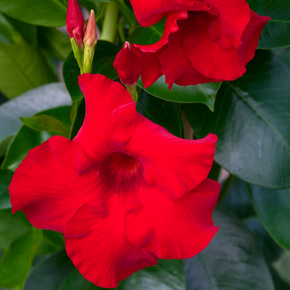
- Blazing velvety deep red trumpet flowers bloom continuously from late spring through first frost, delivering months of nonstop tropical color on patios, balconies, and in garden borders.
- Naturally compact and bushy with limited vining -- reaching just 18-20 inches tall -- this well-behaved Mandevilla thrives in containers, hanging baskets, and landscape borders without constant pruning or staking.
- A magnet for hummingbirds and butterflies, the rich crimson blooms pop against glossy, dark green evergreen foliage for stunning ornamental impact all season long.
- Bred for exceptional heat tolerance, Madinia Deep Red shrugs off summer's hottest days while staying lush, floriferous, and nearly pest-resistant in full sun plantings.
Madinia Deep Red Mandevilla (Mandevilla 'Madinia Deep Red') is a showstopping tropical flowering plant that brings intense, saturated crimson color to any sunny outdoor space from late spring through the first frost of fall. Part of the elite Madinia series, this compact interspecific hybrid was developed for its naturally mounded, shrubby growth habit -- a welcome departure from larger vining Mandevillas that demand heavy support structures. Growing just 18 to 20 inches tall and 18 to 20 inches wide, it fits beautifully in patio containers, hanging baskets, window boxes, and mixed borders, acting as a bold thriller or graceful spiller in combination plantings. The tubular, deep red blooms with golden yellow throats emerge in clusters along the branches from mid-spring through late summer and into fall, set off brilliantly by dense, glossy dark green foliage. A true heat-lover, Madinia Deep Red thrives in full sun and warm temperatures, making it an outstanding performer in the long, hot summers of Southern Oregon and Northern California. It is frost-tender and treated as a summer annual in most regions, though gardeners in USDA Zones 10-11 can enjoy it as a perennial, and dedicated growers in cooler zones can overwinter it indoors with moderate care. Whether you are dressing up an entry, filling a hanging basket, or adding a tropical flair to a mixed container, Madinia Deep Red Mandevilla delivers unmatched color, reliability, and refined elegance season after season.
Plant Description
Madinia Deep Red Mandevilla is a vigorous, multi-stemmed tropical evergreen grown for its spectacular deep red, trumpet-shaped flowers with bright yellow throats. Blooms appear in clusters along the branches from mid-spring through late summer, and often well into fall, providing an exceptionally long season of vivid color. The foliage is equally attractive -- dense, glossy, and dark green with slightly leathery, pointed elliptical leaves featuring prominent midribs. Unlike traditional vining Mandevillas, this cultivar exhibits a naturally compact, mounded, and semi-upright habit that requires no trellis or heavy staking. It belongs to the family Apocynaceae and is botanically classified under the genus Mandevilla, though it is commonly marketed under the Dipladenia trade name due to its compact, shrubby form. The plant is an interspecific hybrid sterile cultivar, meaning it produces no viable seed and all energy is directed toward prolific, continuous flowering.
Mature Size
| Characteristic | Measurement |
|---|---|
| Mature Height | 18 to 20 inches |
| Mature Spread | 18 to 20 inches |
| Growth Rate | Medium |
| Growth Habit | Compact, mounded, semi-upright, limited vining |
| Plant Type | Tropical evergreen perennial; grown as a summer annual in most climates |
Hardiness Zones and Temperature
Madinia Deep Red Mandevilla is rated for USDA Hardiness Zones 9-11 as a perennial and can be grown in Zones 8 and below as a summer annual or overwintered container plant. It thrives in daytime temperatures between 70 and 90 degrees F and prefers nighttime temperatures no lower than 60 to 65 degrees F. Temperatures below 50 degrees F will cause bud drop and leaf yellowing. Sustained exposure to temperatures below 45 degrees F triggers leaf damage, and any frost or freeze will cause irreversible stem dieback. In Southern Oregon and Northern California, it performs as a warm-season annual in most inland areas and as a perennial or near-perennial in the mildest coastal and low-elevation regions. It is highly tolerant of summer heat and will not flag or stop blooming during periods of high temperatures as long as consistent moisture and adequate sunlight are provided.
Sunlight Requirements
Madinia Deep Red Mandevilla performs best in full sun, receiving at least 6 to 8 hours of direct sunlight per day. More sunlight directly correlates with more vigorous growth and a heavier bloom load. In areas where summer temperatures regularly exceed 90 degrees F, light afternoon shade is beneficial to prevent excessive leaf surface temperatures and petal bleaching -- morning sun with filtered afternoon light is an ideal exposure in hot inland climates. Partial shade is tolerable but will reduce flowering by 20 to 30 percent and may cause slightly longer internodes, giving the plant a leggier appearance. Deep shade or north-facing locations are not suitable; plants in insufficient light become etiolated, produce sparse foliage, and rarely bloom well. For container growing, position pots where they capture maximum morning and midday sun for the best possible floral display.
Watering Guide
Consistent but careful watering is essential for success with Madinia Deep Red Mandevilla. The plant has fibrous, shallow roots that are adapted to quick-draining tropical soils and cannot tolerate prolonged waterlogging. Water deeply when the top 1 to 2 inches of soil have dried out, then allow the soil to partially dry between waterings. Always water until moisture drains freely from the bottom of the container, and never allow pots to sit in standing water in saucers. Empty saucers within 15 to 20 minutes of watering. In midsummer heat, containers may need watering every 2 to 4 days depending on pot size, material, and temperature -- check soil moisture regularly rather than following a fixed schedule. In the ground, established plants are moderately drought-tolerant once settled, though consistent moisture during active flowering is important. Overwatering is the single most common cause of plant failure: early signs include uniform yellowing of lower leaves and bud drop before blooms open, followed by soft, mushy stems at the base. Underwatering presents as crisp, upward-curling leaf margins and rapid flower fading; recovery is quick with a thorough, deep watering.
Soil and pH Preferences
Madinia Deep Red Mandevilla is adaptable to a range of soil types but absolutely requires excellent drainage. It will not tolerate heavy, clay-like soils or any planting situation where water pools around the roots. For in-ground planting, amend heavy soils generously with compost, aged bark fines, and coarse perlite to improve drainage and aeration. For containers, use a high-quality, well-draining potting mix -- avoid dense, peat-heavy mixes that compact over time and retain too much moisture. An ideal container blend incorporates coarse bark fines, horticultural perlite, and a small amount of worm castings for gentle nutrient supplementation. Soil pH of 5.8 to 6.5 (slightly acidic to neutral) is preferred and supports optimal uptake of iron, manganese, and other micronutrients. In hard water areas, periodic supplementation with chelated iron can prevent chlorosis. Enrich the planting hole with a layer of compost or aged manure before planting in the landscape to give roots a nutrient-rich start.
Fertilizing
Madinia Deep Red Mandevilla is a moderate to heavy feeder during its active growing and flowering season and benefits significantly from regular fertilization. Use a liquid fertilizer with a balanced or slightly low-nitrogen, high-phosphorus and potassium formulation -- an N-P-K ratio such as 5-10-10 or similar bloom-booster formula is ideal to promote prolific flowering without excessive leafy growth. Apply at half the recommended label strength every 10 to 14 days from when nighttime temperatures are consistently above 55 degrees F through late summer. Taper feedings to once monthly in early spring and early fall. Discontinue fertilizing entirely once temperatures drop below 65 degrees F for several consecutive days, as the plant is not actively growing and cannot use additional nutrients. Never apply concentrated granular fertilizer directly against stems or roots. For in-ground plants in fertile native soils, a slow-release granular fertilizer worked into the soil at planting, supplemented with occasional liquid feedings, may be sufficient. Avoid high-nitrogen fertilizers, which favor lush foliage at the expense of flowers.
Pruning and Maintenance
One of the great advantages of Madinia Deep Red Mandevilla over traditional vining Mandevillas is its minimal pruning requirement. Its naturally compact, bushy habit largely maintains itself throughout the growing season. Light pinching of stem tips when stems reach 6 to 8 inches long will encourage branching and maximize the number of flowering sites -- remove just the terminal half-inch including the growing tip. Repeat pinching every 3 to 4 weeks through early July. Deadheading spent blooms, while not strictly necessary since the plant is a prolific self-renewer, can tidy up appearance and may slightly encourage additional blooms. Remove any dead, damaged, or crossing stems at any time during the growing season. If overwintering indoors, a light pruning back to a manageable size in early fall before bringing the plant inside is beneficial. A more significant rejuvenation pruning can be performed in early spring before new growth resumes, cutting back leggy or winter-damaged stems by up to one-third. Avoid heavy pruning after midsummer in cooler climates, as new growth stimulated late in the season is vulnerable to frost damage.
Planting Instructions
- Plant outdoors only after all danger of frost has passed and nighttime temperatures are consistently above 55 degrees F.
- Choose a site with full sun and well-draining soil. For in-ground planting, dig a hole slightly larger and deeper than the root ball.
- Amend the planting hole with compost or aged organic matter to improve fertility and drainage in heavy soils.
- Gently remove the plant from its container, loosen any circling roots, and place it in the hole at the same depth it was growing in the nursery container.
- Backfill with amended soil and tamp lightly to eliminate air pockets around the roots.
- Water thoroughly and deeply immediately after planting to settle the soil and establish root-to-soil contact.
- Apply a 2 to 3 inch layer of mulch around the base of the plant (keeping it a few inches away from the stem) to conserve soil moisture and moderate root temperatures.
- For container planting, select a pot with ample drainage holes and fill with a well-draining tropical potting mix. Plant at the same depth as in the nursery container, water thoroughly, and position in a full-sun location.
Container Growing
Madinia Deep Red Mandevilla is exceptionally well-suited to container culture and is arguably at its most impressive when grown in pots, hanging baskets, and mixed planter combinations on patios, decks, and balconies. Its naturally spreading, mounded habit makes it an outstanding "spiller" plant along container edges and in hanging baskets, where stems cascade gracefully over the sides. In mixed containers, it serves as a bold focal point or thriller when positioned at the center or back. Choose a container at least 10 to 12 inches in diameter with generous drainage holes. Use a well-draining, coarse potting mix -- avoid dense, moisture-retentive mixes. Container plants will require more frequent watering than in-ground plantings, especially during hot weather. Fertilize container-grown plants consistently throughout the growing season with a bloom-promoting liquid fertilizer. In climates with freezing winters, containers can be moved indoors before the first frost to overwinter the plant and then returned outdoors the following spring once temperatures warm. Fabric grow bags are an excellent container option as they promote superior drainage, air-root pruning, and evaporative cooling.
Overwintering Indoors
In climates cooler than USDA Zone 9, Madinia Deep Red Mandevilla can be successfully overwintered indoors as a potted plant, allowing gardeners to preserve the plant from year to year. Move the plant inside before the first forecasted night below 45 degrees F. Place it in the brightest available location, ideally a south-facing window, and maintain daytime temperatures between 60 and 70 degrees F. Reduce watering significantly during winter -- water only when the top 3 inches of soil are fully dry, roughly every 10 to 14 days. Do not fertilize during dormancy. Some leaf drop is normal as the plant adjusts to lower light levels and reduced temperatures; this is not cause for alarm. Keep the plant away from heating vents, which cause excessive desiccation, and avoid humid bathrooms, which can promote fungal issues. Maintain indoor relative humidity around 40 to 50 percent -- a pebble tray with water beneath the pot can help boost humidity without wetting foliage. Inspect plants regularly for spider mites and mealybugs, which are common on indoor-overwintered tropicals. In early spring, resume regular watering and fertilizing, and return the plant outdoors after all frost danger has passed.
Seasonal Interest
Madinia Deep Red Mandevilla delivers an extraordinarily long season of ornamental interest that few other plants can match. Flowering begins in mid to late spring as temperatures rise and continues uninterrupted through summer and well into fall, stopping only when cold temperatures arrive. In the mild climates of Southern Oregon and Northern California, this bloom window can span five to seven months or more. The deep, velvety crimson blooms -- each a bold trumpet shape with a contrasting golden yellow throat -- create a striking visual presence throughout the warm season. The dense, glossy dark green foliage remains attractive even between flushes of bloom, providing a rich backdrop that enhances the impact of the flowers. In frost-free or near-frost-free climates, the plant may retain its foliage year-round, maintaining evergreen interest through winter. The combination of vivid flower color, attractive foliage, and an exceptionally long bloom period makes this one of the most rewarding warm-season plants for sunny gardens and outdoor living spaces.
Wildlife Value
Madinia Deep Red Mandevilla is a highly attractive plant for beneficial wildlife, particularly pollinators. The deep, trumpet-shaped blooms with rich nectar are especially appealing to hummingbirds, which are drawn to the vivid red coloration and tubular flower form ideally suited to their long bills. Hummingbirds are among the most reliable and frequent visitors throughout the blooming season. Butterflies, including swallowtails and other long-tongued species, also visit the flowers regularly for nectar. The plant is generally deer-resistant, as deer tend to avoid it in favor of more palatable landscape plants -- though browsing may occur in areas of very high deer pressure. Note that while Madinia Deep Red Mandevilla supports pollinators and provides wildlife value, all parts of the plant are toxic if ingested. Systemic pesticide applications should be avoided on or near this plant to protect visiting hummingbirds and pollinators.
Pests and Diseases
Madinia Deep Red Mandevilla is relatively pest- and disease-resistant compared to many tropical ornamentals, particularly when grown in proper conditions with good air circulation. The most common pest concerns include:
- Spider Mites: Most prevalent in hot, dry conditions or on plants overwintered indoors. Look for fine webbing and stippled, bronzed foliage on leaf undersides. Treat with insecticidal soap or neem oil applied at dawn or dusk, repeating every 5 days for three applications.
- Aphids: May cluster on tender new spring growth. Dislodge with a strong water spray or treat with insecticidal soap.
- Mealybugs: Appear as white cottony masses at stem joints and leaf undersides. Treat with 70 percent isopropyl alcohol applied directly with a cotton swab, or use insecticidal soap spray.
- Whiteflies: Can cause yellowing and wilting; use sticky yellow traps and insecticidal soap for control.
- Root Rot (Phytophthora spp.): Caused by overwatering or poor drainage. Prevention through proper soil and watering practices is the only reliable control -- infected plants should be discarded and containers sterilized.
- Botrytis Blight: Gray fuzzy mold on spent flowers in humid conditions. Remove decaying blooms promptly and improve air circulation around the plant.
- Powdery Mildew: White powdery coating on foliage; more common in humid, crowded plantings. Improve air circulation and treat with an appropriate fungicide if needed.
- Iron Chlorosis: Yellow leaves with green veins, often caused by pH imbalance or hard water. Correct with chelated iron and adjust soil or water pH as needed.
Landscape Uses
The compact, well-mannered habit of Madinia Deep Red Mandevilla makes it one of the most versatile warm-season tropical plants for a wide range of landscape and container applications. Its naturally mounded form and limited vining behavior allow it to fit into spaces where larger, more aggressive Mandevillas would be impractical. Recommended uses include:
- Patio and deck containers as a bold, long-blooming focal point or thriller plant in mixed combinations
- Hanging baskets where stems can spill gracefully over the sides
- Window boxes and balcony planters for concentrated tropical color in small spaces
- Garden border accents and seasonal bedding plants in full-sun areas
- Entryway plantings flanking doors or gates for a dramatic seasonal welcome
- Low informal hedging or screening in warm-climate gardens where it grows as a perennial
- Pool surrounds and outdoor living areas where its heat tolerance and continuous blooming shine
- Mixed container "spiller-thriller-filler" designs positioned near pot edges to cascade outward
Companion Plants
Madinia Deep Red Mandevilla pairs best with plants that share its preference for full sun, warm temperatures, moderate to regular water, and well-draining soil. Choose companions that complement its bold crimson color and tropical character without competing aggressively for moisture or nutrients. Excellent companions include:
- Lantana (Lantana camara): Shares identical heat and sun requirements; provides vibrant complementary or contrasting color tones and attracts the same butterfly and hummingbird pollinators.
- Calibrachoa (Million Bells): Trailing habit fills container edges beautifully; responds well to the same fertilizer regimen and blooms concurrently throughout the season.
- Angelonia (Summer Snapdragon): Upright, heat-tolerant, long-blooming companion that pairs well in mixed beds and containers; similar water and sun needs.
- Pentas (Pentas lanceolata): Equally heat-loving, hummingbird-attracting bloomer with a complementary rounded form and available in red, pink, or white to harmonize or contrast.
- Vinca (Catharanthus roseus): Low-maintenance, heat-tolerant companion for borders and mixed beds; shares well-draining soil requirements.
- Sweet Potato Vine (Ipomoea batatas): Bold trailing foliage in chartreuse or deep purple provides dramatic textural contrast in container combinations.
- Salvia (Salvia splendens or S. guaranitica): Shares the same pollinator appeal and sun requirements; blue and red salvias create particularly striking color combinations.
Toxicity and Safety
Madinia Deep Red Mandevilla is considered toxic to humans, dogs, cats, and horses. As a member of the Apocynaceae family, the plant contains toxic compounds including cardiac glycosides and saponins throughout all of its parts -- leaves, stems, flowers, and sap. Ingestion can cause gastrointestinal upset, vomiting, diarrhea, and in larger quantities, irregular heartbeat. The milky sap can also cause skin irritation and allergic reactions in sensitive individuals. Wear gloves when pruning or handling the plant, and wash hands thoroughly afterward. Plant in locations where children and pets cannot readily access or chew on the foliage or stems. If ingestion is suspected in a person, contact Poison Control immediately. If ingestion is suspected in a pet, contact a veterinarian or animal poison control hotline promptly. Despite its toxicity concerns, the plant is safe to grow in the landscape when reasonable precautions are observed.
- Blazing velvety deep red trumpet flowers bloom continuously from late spring through first frost, delivering months of nonstop tropical color on patios, balconies, and in garden borders.
- Naturally compact and bushy with limited vining -- reaching just 18-20 inches tall -- this well-behaved Mandevilla thrives in containers, hanging baskets, and landscape borders without constant pruning or staking.
- A magnet for hummingbirds and butterflies, the rich crimson blooms pop against glossy, dark green evergreen foliage for stunning ornamental impact all season long.
- Bred for exceptional heat tolerance, Madinia Deep Red shrugs off summer's hottest days while staying lush, floriferous, and nearly pest-resistant in full sun plantings.
Madinia Deep Red Mandevilla (Mandevilla 'Madinia Deep Red') is a showstopping tropical flowering plant that brings intense, saturated crimson color to any sunny outdoor space from late spring through the first frost of fall. Part of the elite Madinia series, this compact interspecific hybrid was developed for its naturally mounded, shrubby growth habit -- a welcome departure from larger vining Mandevillas that demand heavy support structures. Growing just 18 to 20 inches tall and 18 to 20 inches wide, it fits beautifully in patio containers, hanging baskets, window boxes, and mixed borders, acting as a bold thriller or graceful spiller in combination plantings. The tubular, deep red blooms with golden yellow throats emerge in clusters along the branches from mid-spring through late summer and into fall, set off brilliantly by dense, glossy dark green foliage. A true heat-lover, Madinia Deep Red thrives in full sun and warm temperatures, making it an outstanding performer in the long, hot summers of Southern Oregon and Northern California. It is frost-tender and treated as a summer annual in most regions, though gardeners in USDA Zones 10-11 can enjoy it as a perennial, and dedicated growers in cooler zones can overwinter it indoors with moderate care. Whether you are dressing up an entry, filling a hanging basket, or adding a tropical flair to a mixed container, Madinia Deep Red Mandevilla delivers unmatched color, reliability, and refined elegance season after season.
Plant Description
Madinia Deep Red Mandevilla is a vigorous, multi-stemmed tropical evergreen grown for its spectacular deep red, trumpet-shaped flowers with bright yellow throats. Blooms appear in clusters along the branches from mid-spring through late summer, and often well into fall, providing an exceptionally long season of vivid color. The foliage is equally attractive -- dense, glossy, and dark green with slightly leathery, pointed elliptical leaves featuring prominent midribs. Unlike traditional vining Mandevillas, this cultivar exhibits a naturally compact, mounded, and semi-upright habit that requires no trellis or heavy staking. It belongs to the family Apocynaceae and is botanically classified under the genus Mandevilla, though it is commonly marketed under the Dipladenia trade name due to its compact, shrubby form. The plant is an interspecific hybrid sterile cultivar, meaning it produces no viable seed and all energy is directed toward prolific, continuous flowering.
Mature Size
| Characteristic | Measurement |
|---|---|
| Mature Height | 18 to 20 inches |
| Mature Spread | 18 to 20 inches |
| Growth Rate | Medium |
| Growth Habit | Compact, mounded, semi-upright, limited vining |
| Plant Type | Tropical evergreen perennial; grown as a summer annual in most climates |
Hardiness Zones and Temperature
Madinia Deep Red Mandevilla is rated for USDA Hardiness Zones 9-11 as a perennial and can be grown in Zones 8 and below as a summer annual or overwintered container plant. It thrives in daytime temperatures between 70 and 90 degrees F and prefers nighttime temperatures no lower than 60 to 65 degrees F. Temperatures below 50 degrees F will cause bud drop and leaf yellowing. Sustained exposure to temperatures below 45 degrees F triggers leaf damage, and any frost or freeze will cause irreversible stem dieback. In Southern Oregon and Northern California, it performs as a warm-season annual in most inland areas and as a perennial or near-perennial in the mildest coastal and low-elevation regions. It is highly tolerant of summer heat and will not flag or stop blooming during periods of high temperatures as long as consistent moisture and adequate sunlight are provided.
Sunlight Requirements
Madinia Deep Red Mandevilla performs best in full sun, receiving at least 6 to 8 hours of direct sunlight per day. More sunlight directly correlates with more vigorous growth and a heavier bloom load. In areas where summer temperatures regularly exceed 90 degrees F, light afternoon shade is beneficial to prevent excessive leaf surface temperatures and petal bleaching -- morning sun with filtered afternoon light is an ideal exposure in hot inland climates. Partial shade is tolerable but will reduce flowering by 20 to 30 percent and may cause slightly longer internodes, giving the plant a leggier appearance. Deep shade or north-facing locations are not suitable; plants in insufficient light become etiolated, produce sparse foliage, and rarely bloom well. For container growing, position pots where they capture maximum morning and midday sun for the best possible floral display.
Watering Guide
Consistent but careful watering is essential for success with Madinia Deep Red Mandevilla. The plant has fibrous, shallow roots that are adapted to quick-draining tropical soils and cannot tolerate prolonged waterlogging. Water deeply when the top 1 to 2 inches of soil have dried out, then allow the soil to partially dry between waterings. Always water until moisture drains freely from the bottom of the container, and never allow pots to sit in standing water in saucers. Empty saucers within 15 to 20 minutes of watering. In midsummer heat, containers may need watering every 2 to 4 days depending on pot size, material, and temperature -- check soil moisture regularly rather than following a fixed schedule. In the ground, established plants are moderately drought-tolerant once settled, though consistent moisture during active flowering is important. Overwatering is the single most common cause of plant failure: early signs include uniform yellowing of lower leaves and bud drop before blooms open, followed by soft, mushy stems at the base. Underwatering presents as crisp, upward-curling leaf margins and rapid flower fading; recovery is quick with a thorough, deep watering.
Soil and pH Preferences
Madinia Deep Red Mandevilla is adaptable to a range of soil types but absolutely requires excellent drainage. It will not tolerate heavy, clay-like soils or any planting situation where water pools around the roots. For in-ground planting, amend heavy soils generously with compost, aged bark fines, and coarse perlite to improve drainage and aeration. For containers, use a high-quality, well-draining potting mix -- avoid dense, peat-heavy mixes that compact over time and retain too much moisture. An ideal container blend incorporates coarse bark fines, horticultural perlite, and a small amount of worm castings for gentle nutrient supplementation. Soil pH of 5.8 to 6.5 (slightly acidic to neutral) is preferred and supports optimal uptake of iron, manganese, and other micronutrients. In hard water areas, periodic supplementation with chelated iron can prevent chlorosis. Enrich the planting hole with a layer of compost or aged manure before planting in the landscape to give roots a nutrient-rich start.
Fertilizing
Madinia Deep Red Mandevilla is a moderate to heavy feeder during its active growing and flowering season and benefits significantly from regular fertilization. Use a liquid fertilizer with a balanced or slightly low-nitrogen, high-phosphorus and potassium formulation -- an N-P-K ratio such as 5-10-10 or similar bloom-booster formula is ideal to promote prolific flowering without excessive leafy growth. Apply at half the recommended label strength every 10 to 14 days from when nighttime temperatures are consistently above 55 degrees F through late summer. Taper feedings to once monthly in early spring and early fall. Discontinue fertilizing entirely once temperatures drop below 65 degrees F for several consecutive days, as the plant is not actively growing and cannot use additional nutrients. Never apply concentrated granular fertilizer directly against stems or roots. For in-ground plants in fertile native soils, a slow-release granular fertilizer worked into the soil at planting, supplemented with occasional liquid feedings, may be sufficient. Avoid high-nitrogen fertilizers, which favor lush foliage at the expense of flowers.
Pruning and Maintenance
One of the great advantages of Madinia Deep Red Mandevilla over traditional vining Mandevillas is its minimal pruning requirement. Its naturally compact, bushy habit largely maintains itself throughout the growing season. Light pinching of stem tips when stems reach 6 to 8 inches long will encourage branching and maximize the number of flowering sites -- remove just the terminal half-inch including the growing tip. Repeat pinching every 3 to 4 weeks through early July. Deadheading spent blooms, while not strictly necessary since the plant is a prolific self-renewer, can tidy up appearance and may slightly encourage additional blooms. Remove any dead, damaged, or crossing stems at any time during the growing season. If overwintering indoors, a light pruning back to a manageable size in early fall before bringing the plant inside is beneficial. A more significant rejuvenation pruning can be performed in early spring before new growth resumes, cutting back leggy or winter-damaged stems by up to one-third. Avoid heavy pruning after midsummer in cooler climates, as new growth stimulated late in the season is vulnerable to frost damage.
Planting Instructions
- Plant outdoors only after all danger of frost has passed and nighttime temperatures are consistently above 55 degrees F.
- Choose a site with full sun and well-draining soil. For in-ground planting, dig a hole slightly larger and deeper than the root ball.
- Amend the planting hole with compost or aged organic matter to improve fertility and drainage in heavy soils.
- Gently remove the plant from its container, loosen any circling roots, and place it in the hole at the same depth it was growing in the nursery container.
- Backfill with amended soil and tamp lightly to eliminate air pockets around the roots.
- Water thoroughly and deeply immediately after planting to settle the soil and establish root-to-soil contact.
- Apply a 2 to 3 inch layer of mulch around the base of the plant (keeping it a few inches away from the stem) to conserve soil moisture and moderate root temperatures.
- For container planting, select a pot with ample drainage holes and fill with a well-draining tropical potting mix. Plant at the same depth as in the nursery container, water thoroughly, and position in a full-sun location.
Container Growing
Madinia Deep Red Mandevilla is exceptionally well-suited to container culture and is arguably at its most impressive when grown in pots, hanging baskets, and mixed planter combinations on patios, decks, and balconies. Its naturally spreading, mounded habit makes it an outstanding "spiller" plant along container edges and in hanging baskets, where stems cascade gracefully over the sides. In mixed containers, it serves as a bold focal point or thriller when positioned at the center or back. Choose a container at least 10 to 12 inches in diameter with generous drainage holes. Use a well-draining, coarse potting mix -- avoid dense, moisture-retentive mixes. Container plants will require more frequent watering than in-ground plantings, especially during hot weather. Fertilize container-grown plants consistently throughout the growing season with a bloom-promoting liquid fertilizer. In climates with freezing winters, containers can be moved indoors before the first frost to overwinter the plant and then returned outdoors the following spring once temperatures warm. Fabric grow bags are an excellent container option as they promote superior drainage, air-root pruning, and evaporative cooling.
Overwintering Indoors
In climates cooler than USDA Zone 9, Madinia Deep Red Mandevilla can be successfully overwintered indoors as a potted plant, allowing gardeners to preserve the plant from year to year. Move the plant inside before the first forecasted night below 45 degrees F. Place it in the brightest available location, ideally a south-facing window, and maintain daytime temperatures between 60 and 70 degrees F. Reduce watering significantly during winter -- water only when the top 3 inches of soil are fully dry, roughly every 10 to 14 days. Do not fertilize during dormancy. Some leaf drop is normal as the plant adjusts to lower light levels and reduced temperatures; this is not cause for alarm. Keep the plant away from heating vents, which cause excessive desiccation, and avoid humid bathrooms, which can promote fungal issues. Maintain indoor relative humidity around 40 to 50 percent -- a pebble tray with water beneath the pot can help boost humidity without wetting foliage. Inspect plants regularly for spider mites and mealybugs, which are common on indoor-overwintered tropicals. In early spring, resume regular watering and fertilizing, and return the plant outdoors after all frost danger has passed.
Seasonal Interest
Madinia Deep Red Mandevilla delivers an extraordinarily long season of ornamental interest that few other plants can match. Flowering begins in mid to late spring as temperatures rise and continues uninterrupted through summer and well into fall, stopping only when cold temperatures arrive. In the mild climates of Southern Oregon and Northern California, this bloom window can span five to seven months or more. The deep, velvety crimson blooms -- each a bold trumpet shape with a contrasting golden yellow throat -- create a striking visual presence throughout the warm season. The dense, glossy dark green foliage remains attractive even between flushes of bloom, providing a rich backdrop that enhances the impact of the flowers. In frost-free or near-frost-free climates, the plant may retain its foliage year-round, maintaining evergreen interest through winter. The combination of vivid flower color, attractive foliage, and an exceptionally long bloom period makes this one of the most rewarding warm-season plants for sunny gardens and outdoor living spaces.
Wildlife Value
Madinia Deep Red Mandevilla is a highly attractive plant for beneficial wildlife, particularly pollinators. The deep, trumpet-shaped blooms with rich nectar are especially appealing to hummingbirds, which are drawn to the vivid red coloration and tubular flower form ideally suited to their long bills. Hummingbirds are among the most reliable and frequent visitors throughout the blooming season. Butterflies, including swallowtails and other long-tongued species, also visit the flowers regularly for nectar. The plant is generally deer-resistant, as deer tend to avoid it in favor of more palatable landscape plants -- though browsing may occur in areas of very high deer pressure. Note that while Madinia Deep Red Mandevilla supports pollinators and provides wildlife value, all parts of the plant are toxic if ingested. Systemic pesticide applications should be avoided on or near this plant to protect visiting hummingbirds and pollinators.
Pests and Diseases
Madinia Deep Red Mandevilla is relatively pest- and disease-resistant compared to many tropical ornamentals, particularly when grown in proper conditions with good air circulation. The most common pest concerns include:
- Spider Mites: Most prevalent in hot, dry conditions or on plants overwintered indoors. Look for fine webbing and stippled, bronzed foliage on leaf undersides. Treat with insecticidal soap or neem oil applied at dawn or dusk, repeating every 5 days for three applications.
- Aphids: May cluster on tender new spring growth. Dislodge with a strong water spray or treat with insecticidal soap.
- Mealybugs: Appear as white cottony masses at stem joints and leaf undersides. Treat with 70 percent isopropyl alcohol applied directly with a cotton swab, or use insecticidal soap spray.
- Whiteflies: Can cause yellowing and wilting; use sticky yellow traps and insecticidal soap for control.
- Root Rot (Phytophthora spp.): Caused by overwatering or poor drainage. Prevention through proper soil and watering practices is the only reliable control -- infected plants should be discarded and containers sterilized.
- Botrytis Blight: Gray fuzzy mold on spent flowers in humid conditions. Remove decaying blooms promptly and improve air circulation around the plant.
- Powdery Mildew: White powdery coating on foliage; more common in humid, crowded plantings. Improve air circulation and treat with an appropriate fungicide if needed.
- Iron Chlorosis: Yellow leaves with green veins, often caused by pH imbalance or hard water. Correct with chelated iron and adjust soil or water pH as needed.
Landscape Uses
The compact, well-mannered habit of Madinia Deep Red Mandevilla makes it one of the most versatile warm-season tropical plants for a wide range of landscape and container applications. Its naturally mounded form and limited vining behavior allow it to fit into spaces where larger, more aggressive Mandevillas would be impractical. Recommended uses include:
- Patio and deck containers as a bold, long-blooming focal point or thriller plant in mixed combinations
- Hanging baskets where stems can spill gracefully over the sides
- Window boxes and balcony planters for concentrated tropical color in small spaces
- Garden border accents and seasonal bedding plants in full-sun areas
- Entryway plantings flanking doors or gates for a dramatic seasonal welcome
- Low informal hedging or screening in warm-climate gardens where it grows as a perennial
- Pool surrounds and outdoor living areas where its heat tolerance and continuous blooming shine
- Mixed container "spiller-thriller-filler" designs positioned near pot edges to cascade outward
Companion Plants
Madinia Deep Red Mandevilla pairs best with plants that share its preference for full sun, warm temperatures, moderate to regular water, and well-draining soil. Choose companions that complement its bold crimson color and tropical character without competing aggressively for moisture or nutrients. Excellent companions include:
- Lantana (Lantana camara): Shares identical heat and sun requirements; provides vibrant complementary or contrasting color tones and attracts the same butterfly and hummingbird pollinators.
- Calibrachoa (Million Bells): Trailing habit fills container edges beautifully; responds well to the same fertilizer regimen and blooms concurrently throughout the season.
- Angelonia (Summer Snapdragon): Upright, heat-tolerant, long-blooming companion that pairs well in mixed beds and containers; similar water and sun needs.
- Pentas (Pentas lanceolata): Equally heat-loving, hummingbird-attracting bloomer with a complementary rounded form and available in red, pink, or white to harmonize or contrast.
- Vinca (Catharanthus roseus): Low-maintenance, heat-tolerant companion for borders and mixed beds; shares well-draining soil requirements.
- Sweet Potato Vine (Ipomoea batatas): Bold trailing foliage in chartreuse or deep purple provides dramatic textural contrast in container combinations.
- Salvia (Salvia splendens or S. guaranitica): Shares the same pollinator appeal and sun requirements; blue and red salvias create particularly striking color combinations.
Toxicity and Safety
Madinia Deep Red Mandevilla is considered toxic to humans, dogs, cats, and horses. As a member of the Apocynaceae family, the plant contains toxic compounds including cardiac glycosides and saponins throughout all of its parts -- leaves, stems, flowers, and sap. Ingestion can cause gastrointestinal upset, vomiting, diarrhea, and in larger quantities, irregular heartbeat. The milky sap can also cause skin irritation and allergic reactions in sensitive individuals. Wear gloves when pruning or handling the plant, and wash hands thoroughly afterward. Plant in locations where children and pets cannot readily access or chew on the foliage or stems. If ingestion is suspected in a person, contact Poison Control immediately. If ingestion is suspected in a pet, contact a veterinarian or animal poison control hotline promptly. Despite its toxicity concerns, the plant is safe to grow in the landscape when reasonable precautions are observed.