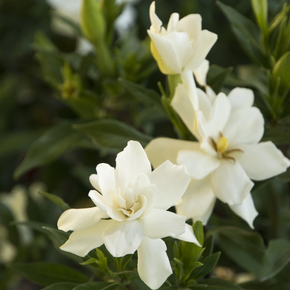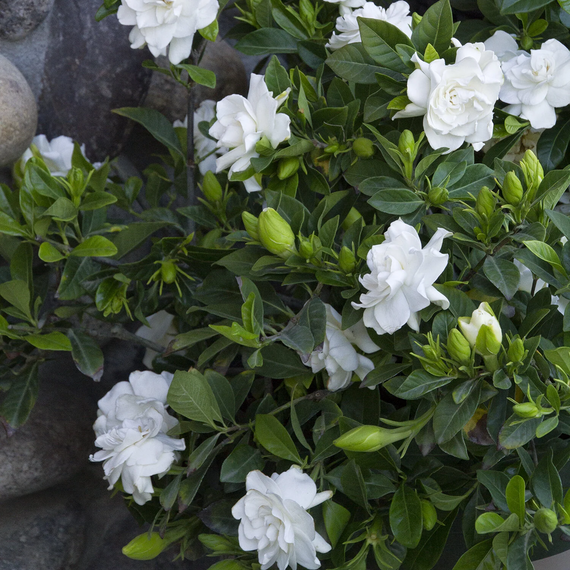
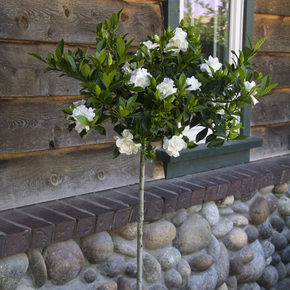


Gardenia jasminoides 'Veitchii', commonly known as the Everblooming Gardenia or Veitchii Gardenia, is one of the most celebrated and enduring cultivars in American horticulture, cherished for its exceptional perfume and remarkably extended bloom period. This broadleaf evergreen shrub produces a profusion of waxy, fully double white blossoms — each measuring 2 to 3 inches across — that emerge from elegantly spiraled buds beginning in late spring and continue to grace the garden sporadically through summer and into fall, far outlasting many of its sister cultivars. The rich, exotic fragrance is legendary, making 'Veitchii' an essential selection for fragrance gardens, nighttime gardens, sensory gardens, and any planting where scent is a priority. The foliage is equally impressive: thick, glossy, rugose leaves in a deep emerald green are arranged in whorled or opposite pairs along the branches, providing a handsome, dense framework that remains attractive through all four seasons. Maturing to a tidy, rounded form of 4 to 6 feet tall and 3 to 4 feet wide at a medium growth rate, this shrub fits comfortably into foundation plantings, mixed shrub borders, informal hedges, and large containers placed near entryways, patios, and walkways where its intoxicating fragrance can be enjoyed up close. Originating from the stream banks of southern China, Taiwan, and Japan and belonging to the Rubiaceae (coffee) family, gardenias have been cultivated for over a thousand years, and 'Veitchii' remains a timeless choice that rewards attentive gardeners with unmatched floral elegance throughout the warm growing months.
Gardenia jasminoides 'Veitchii' is a broadleaf evergreen shrub renowned for its intensely fragrant, fully double white flowers and its exceptionally glossy, deep emerald-green foliage. This is one of the oldest and most beloved gardenia cultivars, distinguished from the species by its reliably long bloom period and its compact, rounded growth habit. Each flower is composed of overlapping waxy petals arranged in a classic double rosette form, opening creamy white and aging to a soft, warm ivory-yellow. The flower buds have a distinctive pinwheel or spiral appearance before opening. Leaves are simple, opposite or whorled at the branch tips, lanceolate to ovate in shape, 2 to 4 inches long, with impressed pinnate venation, a leathery texture, and a brilliant gloss on the upper surface. The overall form of the shrub is dense, mounding, and multi-stemmed, giving it excellent presence in the year-round garden. The plant belongs to the Rubiaceae family — the same family as coffee — and was named in honor of the Scottish naturalist Alexander Garden (1730–1791).
| Attribute | Detail |
|---|---|
| Mature Height | 4 to 6 feet |
| Mature Spread | 3 to 4 feet wide |
| Growth Rate | Medium |
| Plant Form | Dense, mounding, rounded, multi-stemmed |
| Foliage Type | Broadleaf evergreen |
| Texture | Medium |
'Veitchii' Gardenia is hardy in USDA Plant Hardiness Zones 7b through 10b. It performs best in the mild-winter climates typical of the Pacific Coast, the Deep South, and other regions without prolonged hard freezes. In Zone 7 and the colder margins of Zone 8, plants may experience some winter dieback of top growth during severe cold snaps, but they often regenerate from the roots come spring. Temperatures below 15°F can cause significant cold damage. In Southern Oregon and Northern California, it thrives in sheltered locations where it is protected from cold, drying winds and hard frosts. Avoid planting in exposed, frost-prone low spots. In hotter inland zones, afternoon shade helps prevent flower and foliage scorch.
Gardenias — including 'Veitchii' — grow best with bright indirect light or a half-day of direct sun. The ideal exposure is morning sun with afternoon shade, which promotes robust flowering while protecting the glossy foliage and delicate blossoms from heat stress. In cooler coastal climates, full sun (6 or more hours) is well tolerated and can encourage even more prolific blooming. In hotter inland gardens, partial shade during the hottest afternoon hours is recommended to prevent leaf scorch and bud drop. Avoid deep, dense shade, which reduces flowering and encourages leggy growth. Dappled light beneath a high canopy can be suitable in warmer regions.
'Veitchii' Gardenia demands acidic, organically rich, moist, and well-drained soil for its best performance. The optimal soil pH range is 5.0 to 6.0 — below neutral. When soil pH rises above 6.5, gardenias are prone to iron-deficiency chlorosis, which causes the newer leaves to yellow while the leaf veins remain green. Soils near concrete foundations, sidewalks, or driveways may become excessively alkaline due to lime leaching and should be avoided or amended. Before planting, work generous amounts of compost, peat moss, or ground pine bark into the planting area to enrich the soil and lower the pH. Gardenias have shallow roots and strongly resent competition from tree roots or soil disturbance after planting.
Consistent soil moisture is essential for gardenias, particularly during the active growing and blooming seasons from spring through summer. Water deeply and regularly, aiming to keep the root zone evenly moist — never waterlogged and never allowed to dry out completely. During drought periods in summer, water at least once per week. Drip irrigation or soaker hoses are the preferred delivery method, as overhead watering can wet the foliage and blossoms, increasing the risk of leaf spot diseases and causing browning of the flowers. A 2- to 3-inch layer of organic mulch (such as pine straw, shredded bark, or compost) spread around — but not directly against — the base of the plant helps retain soil moisture, regulate soil temperature, and suppress weeds. Although gardenias have some drought tolerance once established, prolonged drought stress will reduce flowering and overall plant vigor.
Feed 'Veitchii' Gardenia with an acid-forming fertilizer formulated for acid-loving plants such as azaleas, camellias, and rhododendrons. Look for a balanced, extended-release product with a nutrient ratio of approximately 2-1-1 (nitrogen-phosphorus-potassium). Apply once in early spring after the danger of frost has passed, and again about 6 weeks later in early summer to support continued flowering and robust new growth. A third light application may be made in midsummer if growth appears slow or foliage looks pale. Organic options such as cottonseed meal or holly-tone formulations are excellent gentler alternatives and carry a lower risk of root burn. Never fertilize in late summer or fall — doing so stimulates a flush of soft, frost-tender new growth that can be damaged or killed by winter cold. If new foliage appears yellow with green veins (iron chlorosis), supplement with a chelated iron product or a foliar spray containing iron and micronutrients during the growing season.
Prune 'Veitchii' Gardenia immediately after its main flush of blooming winds down in mid- to late summer, but no later than early fall. Pruning at this time allows the plant to set new growth that will carry next season's flower buds without sacrificing blooms. Avoid pruning in winter or early spring, as this removes the developing flower buds and significantly reduces the season's bloom display. Use clean, sharp bypass pruners to remove straggly, crossing, or dead branches, and lightly shape the plant to maintain its naturally rounded form. Deadhead spent flowers promptly to encourage continued blooming throughout the season. Remove faded or browning blossoms as soon as they appear to keep the plant looking tidy and to redirect energy into new flower bud development. Gardenias are considered high-maintenance shrubs — regular attention to watering, feeding, and pest management is part of their care routine.
'Veitchii' Gardenia delivers multi-season garden interest with something to offer in nearly every month of the year. Its primary bloom season runs from late spring (typically May or June) through summer and into early fall, with fragrant white double flowers appearing repeatedly over an unusually long period for a gardenia. After blooming, the plant occasionally produces small, showy orange-red berry-like fruits in fall that add a warm seasonal accent and attract birds and wildlife. The lush, glossy deep-green evergreen foliage remains an attractive, polished backdrop throughout winter when most other garden shrubs have lost their leaves, providing structure and year-round greenery. In warmer zones, the foliage color intensifies with proper fertilization, maintaining its dark emerald hue even through the cooler months.
'Veitchii' Gardenia is a versatile landscaping shrub that adapts to a wide range of design applications. Its upright-rounded form, dense foliage, and spectacular fragrant flowers make it particularly well suited for the following uses:
For a cohesive, seasonally rich planting, pair 'Veitchii' Gardenia with plants that share its preference for acidic, well-drained soil and partial to full sun conditions. Excellent companions include:
Gardenias are considered high-maintenance plants in part because of their susceptibility to several common pests and some cultural disorders. Awareness of these issues helps gardeners address problems quickly.
'Veitchii' Gardenia adapts well to container culture, making it an excellent choice for patios, covered porches, and entryways — especially in areas at the colder edge of its hardiness range where overwintering indoors may be desired. Use a large container (at least 14 to 18 inches in diameter) with generous drainage holes, and fill it with a high-quality, acidic potting mix formulated for azaleas, camellias, or acid-loving plants. Container-grown gardenias dry out more quickly than those in the ground, so monitor soil moisture closely and water as soon as the top inch of soil begins to dry out. Fertilize more frequently than in-ground plants — approximately every 4 to 6 weeks during the growing season with a liquid or water-soluble acid fertilizer. Position containers in a bright spot with morning sun and afternoon shade. In winter, move container plants to a protected, frost-free location such as a cool greenhouse, enclosed porch, or bright indoor space. Repot every 2 to 3 years into a slightly larger container with fresh acidic potting mix to refresh nutrients and maintain healthy root growth.
'Veitchii' Gardenia offers meaningful value to garden wildlife throughout the seasons. The fragrant flowers attract bees and other pollinating insects, making it a worthwhile addition to pollinator-friendly garden designs. Later in the season, the orange-red, berry-like fruits (technically drupes) ripen in fall and provide a food source for songbirds and other wildlife seeking high-energy sustenance as they prepare for or move through migration. Gardenias are considered deer-resistant shrubs, which is a practical advantage in areas with browsing deer pressure. The dense, evergreen branching habit can also provide nesting cover and shelter for small birds year-round.
Gardenia jasminoides has low-severity toxicity. The toxic compounds — primarily genioposide and gardenoside — can cause mild gastrointestinal upset (mild vomiting and/or diarrhea) and hives if plant material is ingested. This plant is considered problematic for cats, dogs, and horses if consumed. Keep this in mind when siting the plant in households with pets that may chew on garden plants. The plant does not cause contact dermatitis in humans, though individuals with sensitive skin may wish to use gloves when handling cut stems, as the milky sap can occasionally be irritating. As always, wash hands after handling and keep cut flowers out of reach of pets and young children.
Gardenia jasminoides 'Veitchii', commonly known as the Everblooming Gardenia or Veitchii Gardenia, is one of the most celebrated and enduring cultivars in American horticulture, cherished for its exceptional perfume and remarkably extended bloom period. This broadleaf evergreen shrub produces a profusion of waxy, fully double white blossoms — each measuring 2 to 3 inches across — that emerge from elegantly spiraled buds beginning in late spring and continue to grace the garden sporadically through summer and into fall, far outlasting many of its sister cultivars. The rich, exotic fragrance is legendary, making 'Veitchii' an essential selection for fragrance gardens, nighttime gardens, sensory gardens, and any planting where scent is a priority. The foliage is equally impressive: thick, glossy, rugose leaves in a deep emerald green are arranged in whorled or opposite pairs along the branches, providing a handsome, dense framework that remains attractive through all four seasons. Maturing to a tidy, rounded form of 4 to 6 feet tall and 3 to 4 feet wide at a medium growth rate, this shrub fits comfortably into foundation plantings, mixed shrub borders, informal hedges, and large containers placed near entryways, patios, and walkways where its intoxicating fragrance can be enjoyed up close. Originating from the stream banks of southern China, Taiwan, and Japan and belonging to the Rubiaceae (coffee) family, gardenias have been cultivated for over a thousand years, and 'Veitchii' remains a timeless choice that rewards attentive gardeners with unmatched floral elegance throughout the warm growing months.
Gardenia jasminoides 'Veitchii' is a broadleaf evergreen shrub renowned for its intensely fragrant, fully double white flowers and its exceptionally glossy, deep emerald-green foliage. This is one of the oldest and most beloved gardenia cultivars, distinguished from the species by its reliably long bloom period and its compact, rounded growth habit. Each flower is composed of overlapping waxy petals arranged in a classic double rosette form, opening creamy white and aging to a soft, warm ivory-yellow. The flower buds have a distinctive pinwheel or spiral appearance before opening. Leaves are simple, opposite or whorled at the branch tips, lanceolate to ovate in shape, 2 to 4 inches long, with impressed pinnate venation, a leathery texture, and a brilliant gloss on the upper surface. The overall form of the shrub is dense, mounding, and multi-stemmed, giving it excellent presence in the year-round garden. The plant belongs to the Rubiaceae family — the same family as coffee — and was named in honor of the Scottish naturalist Alexander Garden (1730–1791).
| Attribute | Detail |
|---|---|
| Mature Height | 4 to 6 feet |
| Mature Spread | 3 to 4 feet wide |
| Growth Rate | Medium |
| Plant Form | Dense, mounding, rounded, multi-stemmed |
| Foliage Type | Broadleaf evergreen |
| Texture | Medium |
'Veitchii' Gardenia is hardy in USDA Plant Hardiness Zones 7b through 10b. It performs best in the mild-winter climates typical of the Pacific Coast, the Deep South, and other regions without prolonged hard freezes. In Zone 7 and the colder margins of Zone 8, plants may experience some winter dieback of top growth during severe cold snaps, but they often regenerate from the roots come spring. Temperatures below 15°F can cause significant cold damage. In Southern Oregon and Northern California, it thrives in sheltered locations where it is protected from cold, drying winds and hard frosts. Avoid planting in exposed, frost-prone low spots. In hotter inland zones, afternoon shade helps prevent flower and foliage scorch.
Gardenias — including 'Veitchii' — grow best with bright indirect light or a half-day of direct sun. The ideal exposure is morning sun with afternoon shade, which promotes robust flowering while protecting the glossy foliage and delicate blossoms from heat stress. In cooler coastal climates, full sun (6 or more hours) is well tolerated and can encourage even more prolific blooming. In hotter inland gardens, partial shade during the hottest afternoon hours is recommended to prevent leaf scorch and bud drop. Avoid deep, dense shade, which reduces flowering and encourages leggy growth. Dappled light beneath a high canopy can be suitable in warmer regions.
'Veitchii' Gardenia demands acidic, organically rich, moist, and well-drained soil for its best performance. The optimal soil pH range is 5.0 to 6.0 — below neutral. When soil pH rises above 6.5, gardenias are prone to iron-deficiency chlorosis, which causes the newer leaves to yellow while the leaf veins remain green. Soils near concrete foundations, sidewalks, or driveways may become excessively alkaline due to lime leaching and should be avoided or amended. Before planting, work generous amounts of compost, peat moss, or ground pine bark into the planting area to enrich the soil and lower the pH. Gardenias have shallow roots and strongly resent competition from tree roots or soil disturbance after planting.
Consistent soil moisture is essential for gardenias, particularly during the active growing and blooming seasons from spring through summer. Water deeply and regularly, aiming to keep the root zone evenly moist — never waterlogged and never allowed to dry out completely. During drought periods in summer, water at least once per week. Drip irrigation or soaker hoses are the preferred delivery method, as overhead watering can wet the foliage and blossoms, increasing the risk of leaf spot diseases and causing browning of the flowers. A 2- to 3-inch layer of organic mulch (such as pine straw, shredded bark, or compost) spread around — but not directly against — the base of the plant helps retain soil moisture, regulate soil temperature, and suppress weeds. Although gardenias have some drought tolerance once established, prolonged drought stress will reduce flowering and overall plant vigor.
Feed 'Veitchii' Gardenia with an acid-forming fertilizer formulated for acid-loving plants such as azaleas, camellias, and rhododendrons. Look for a balanced, extended-release product with a nutrient ratio of approximately 2-1-1 (nitrogen-phosphorus-potassium). Apply once in early spring after the danger of frost has passed, and again about 6 weeks later in early summer to support continued flowering and robust new growth. A third light application may be made in midsummer if growth appears slow or foliage looks pale. Organic options such as cottonseed meal or holly-tone formulations are excellent gentler alternatives and carry a lower risk of root burn. Never fertilize in late summer or fall — doing so stimulates a flush of soft, frost-tender new growth that can be damaged or killed by winter cold. If new foliage appears yellow with green veins (iron chlorosis), supplement with a chelated iron product or a foliar spray containing iron and micronutrients during the growing season.
Prune 'Veitchii' Gardenia immediately after its main flush of blooming winds down in mid- to late summer, but no later than early fall. Pruning at this time allows the plant to set new growth that will carry next season's flower buds without sacrificing blooms. Avoid pruning in winter or early spring, as this removes the developing flower buds and significantly reduces the season's bloom display. Use clean, sharp bypass pruners to remove straggly, crossing, or dead branches, and lightly shape the plant to maintain its naturally rounded form. Deadhead spent flowers promptly to encourage continued blooming throughout the season. Remove faded or browning blossoms as soon as they appear to keep the plant looking tidy and to redirect energy into new flower bud development. Gardenias are considered high-maintenance shrubs — regular attention to watering, feeding, and pest management is part of their care routine.
'Veitchii' Gardenia delivers multi-season garden interest with something to offer in nearly every month of the year. Its primary bloom season runs from late spring (typically May or June) through summer and into early fall, with fragrant white double flowers appearing repeatedly over an unusually long period for a gardenia. After blooming, the plant occasionally produces small, showy orange-red berry-like fruits in fall that add a warm seasonal accent and attract birds and wildlife. The lush, glossy deep-green evergreen foliage remains an attractive, polished backdrop throughout winter when most other garden shrubs have lost their leaves, providing structure and year-round greenery. In warmer zones, the foliage color intensifies with proper fertilization, maintaining its dark emerald hue even through the cooler months.
'Veitchii' Gardenia is a versatile landscaping shrub that adapts to a wide range of design applications. Its upright-rounded form, dense foliage, and spectacular fragrant flowers make it particularly well suited for the following uses:
For a cohesive, seasonally rich planting, pair 'Veitchii' Gardenia with plants that share its preference for acidic, well-drained soil and partial to full sun conditions. Excellent companions include:
Gardenias are considered high-maintenance plants in part because of their susceptibility to several common pests and some cultural disorders. Awareness of these issues helps gardeners address problems quickly.
'Veitchii' Gardenia adapts well to container culture, making it an excellent choice for patios, covered porches, and entryways — especially in areas at the colder edge of its hardiness range where overwintering indoors may be desired. Use a large container (at least 14 to 18 inches in diameter) with generous drainage holes, and fill it with a high-quality, acidic potting mix formulated for azaleas, camellias, or acid-loving plants. Container-grown gardenias dry out more quickly than those in the ground, so monitor soil moisture closely and water as soon as the top inch of soil begins to dry out. Fertilize more frequently than in-ground plants — approximately every 4 to 6 weeks during the growing season with a liquid or water-soluble acid fertilizer. Position containers in a bright spot with morning sun and afternoon shade. In winter, move container plants to a protected, frost-free location such as a cool greenhouse, enclosed porch, or bright indoor space. Repot every 2 to 3 years into a slightly larger container with fresh acidic potting mix to refresh nutrients and maintain healthy root growth.
'Veitchii' Gardenia offers meaningful value to garden wildlife throughout the seasons. The fragrant flowers attract bees and other pollinating insects, making it a worthwhile addition to pollinator-friendly garden designs. Later in the season, the orange-red, berry-like fruits (technically drupes) ripen in fall and provide a food source for songbirds and other wildlife seeking high-energy sustenance as they prepare for or move through migration. Gardenias are considered deer-resistant shrubs, which is a practical advantage in areas with browsing deer pressure. The dense, evergreen branching habit can also provide nesting cover and shelter for small birds year-round.
Gardenia jasminoides has low-severity toxicity. The toxic compounds — primarily genioposide and gardenoside — can cause mild gastrointestinal upset (mild vomiting and/or diarrhea) and hives if plant material is ingested. This plant is considered problematic for cats, dogs, and horses if consumed. Keep this in mind when siting the plant in households with pets that may chew on garden plants. The plant does not cause contact dermatitis in humans, though individuals with sensitive skin may wish to use gloves when handling cut stems, as the milky sap can occasionally be irritating. As always, wash hands after handling and keep cut flowers out of reach of pets and young children.