Zoom the image with the mouse
Madison Star Jasmine - 5 Gallon
SKU:
2094485
UPC:
014949025437
$69.99
- Exceptionally cold-hardy cultivar of classic star jasmine, reliably evergreen through USDA Zones 7-10 with improved frost tolerance compared to the standard species
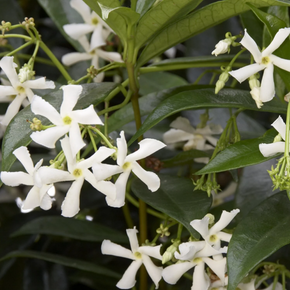
- Intensely sweet, orange-blossom-like fragrance from masses of creamy-white, pinwheel-shaped flowers in late spring with repeat flushes into summer
- Incredibly versatile habit — train it as a climbing vine on trellises, fences, and arbors, or let it sprawl as a dense, lush evergreen groundcover
- Low-maintenance and adaptable, thriving in full sun to partial shade with drought tolerance once established, and naturally resistant to deer and most pests
Madison Star Jasmine (Trachelospermum jasminoides 'Madison') is the gold-standard selection of star jasmine for gardeners who want long-season fragrance, glossy year-round foliage, and remarkable landscape flexibility all in one plant. Developed from a notably cold-tolerant individual discovered in Madison, Georgia — where it survived temperatures that killed other cultivars — this superior clone extends the reach of beloved star jasmine into USDA Zone 7 and even marginal Zone 6 microclimates. Its twining stems clothe trellises, arbors, pergolas, and fences with a dense curtain of lustrous, deep-green foliage that remains attractive through every season, then erupts in late spring with clusters of five-petaled, creamy-white blossoms whose heady, jasmine-like scent is irresistible near patios, walkways, and entryways. Blooming continues intermittently into summer for an extended season of color and perfume. When left unsupported, Madison Star Jasmine spreads into a beautiful, weed-suppressing groundcover just 1 to 2 feet tall, making it equally at home cascading down slopes, carpeting shaded beds under open canopies, or spilling gracefully from large containers. Adaptable to full sun through partial shade and tolerant of a wide range of well-drained soils, this vigorous yet refined evergreen vine earns its place as one of the most rewarding long-term landscape plants available for the Pacific Coast and mild-winter West.
Plant Description
Madison Star Jasmine is a broadleaf evergreen vine and groundcover belonging to the dogbane family (Apocynaceae), native to western and southern Japan through Vietnam. The 'Madison' cultivar is a selected clone prized for superior cold hardiness and an exceptionally sweet, long-lasting fragrance. Its wiry, twining stems carry opposite, simple leaves that are elliptic to oval-lanceolate in shape, measuring 3 to 6 inches long with a smooth, leathery texture and a high-gloss finish. Mature foliage is a rich, lustrous dark green, while juvenile leaves often emerge with attractive bronze-purple tints that add seasonal contrast. Stems exude a milky latex sap when cut — a characteristic trait of the Apocynaceae family. The overall effect is a refined, lush plant with year-round ornamental value that goes far beyond its spectacular bloom season.
Mature Size and Growth Rate
| Characteristic | Detail |
|---|---|
| Growth Habit | Twining vine or spreading groundcover |
| Height as a Vine | 10 to 12 feet with support (can reach up to 20 feet on tall structures) |
| Height as a Groundcover | 1 to 2 feet tall |
| Spread | 6 to 12 feet wide |
| Growth Rate | Moderate to fast once established |
| Groundcover Spacing | Space plants 2 to 3 feet apart for a full, dense mat |
Hardiness Zones
Madison Star Jasmine is reliably hardy in USDA Zones 7 through 10, making it one of the most cold-tolerant forms of star jasmine available. While the standard species is typically rated for Zone 8 and warmer, the 'Madison' selection has demonstrated the ability to survive temperatures well into the teens (Fahrenheit) and may even survive brief dips into the upper reaches of Zone 6 in sheltered microclimates. Its evergreen foliage holds through mild winters and it will typically rebound vigorously from the roots if top growth is damaged by an unusually hard freeze. For gardeners in Southern Oregon and Northern California, Madison Star Jasmine is an outstanding year-round performer well within its hardiness comfort zone.
Sunlight Requirements
Madison Star Jasmine performs well across a wide range of light conditions, from full sun (6 or more hours of direct sunlight per day) through partial shade (2 to 6 hours) and even dappled or light full shade. For the heaviest and most reliable bloom production, a location with at least 6 hours of sun is ideal. In warmer inland climates, some afternoon shade can help protect foliage from heat stress during the hottest part of summer. Plants grown in deeper shade will still produce healthy, lush foliage and some flowers, but blooming will be less prolific. Its light adaptability makes it one of the more versatile flowering vines for mixed garden situations.
Soil and pH Preferences
Madison Star Jasmine is adaptable to a wide range of soil types and thrives in average to organically rich, well-drained soil. Good drainage is the most critical soil requirement — standing water or consistently waterlogged conditions can cause root problems. It tolerates loam, sandy loam, and even somewhat lean soils, and it has shown adaptability to both slightly acidic and slightly alkaline conditions. For best results, aim for a soil pH in the range of 6.0 to 7.5. Amending planting beds with compost or other organic matter at planting time will encourage faster establishment and more vigorous growth. This plant also has noted salt tolerance, making it suitable for coastal gardens and roadside plantings where salt exposure can be an issue.
Watering Guide
During the first growing season, water Madison Star Jasmine deeply and consistently to encourage strong root development. Newly planted vines typically benefit from watering once or twice a week, depending on temperature, soil type, and rainfall. Deep, infrequent watering is preferable to frequent shallow watering, as it encourages roots to grow deeper into the soil. Once established — usually after the first full growing season — Madison Star Jasmine becomes notably drought tolerant and requires much less supplemental irrigation. During extended heat waves or prolonged dry spells, even established plants will benefit from a deep soaking to maintain peak foliage quality and bloom performance. Avoid overwatering in heavy clay soils, as this can lead to root rot.
Fertilizing
Madison Star Jasmine is not a heavy feeder, but a light fertilizing program supports vigorous growth and prolific flowering. Apply a balanced, slow-release granular fertilizer formulated for flowering shrubs or vines in early spring as new growth begins to emerge. A second light application in mid-summer can help sustain lush foliage through the growing season, particularly in sandy or lean soils. Avoid high-nitrogen fertilizers that favor leafy growth over flower production. Fertilizing after late summer or early fall is not recommended, as it can stimulate tender new growth that may be susceptible to cold damage. Top-dressing the root zone with compost each spring also provides slow, steady nutrition while improving soil structure over time.
Pruning and Maintenance
Madison Star Jasmine blooms on the previous year's wood, so the best time to prune is shortly after the main bloom period concludes in late spring to early summer. This timing allows the plant to put on new growth that will carry next season's flowers. Begin by removing any dead, damaged, or frost-tipped stems, then trim back overly long or wayward growth to maintain the desired shape and size. When grown on a trellis or fence, periodically thin out the oldest, woodiest stems from the base to encourage fresh, productive growth from the bottom up. For groundcover use, shear or trim the tips of spreading stems to encourage a thicker, denser mat. Note that the stems produce a milky latex sap when cut — clean your pruning tools after use to prevent the sap from gumming up the blades.
Planting Instructions
- Choose a planting location in full sun to partial shade with well-drained soil. Avoid low spots prone to standing water.
- Dig a planting hole approximately twice as wide and equal in depth to the root ball.
- If growing as a climbing vine, install a trellis, fence, arbor, or other support structure at planting time before the roots are disturbed.
- Mix compost or other organic matter into the removed soil at a ratio of roughly 1 part amendment to 2 parts native soil.
- Set the plant so that the top of the root ball is level with the surrounding soil grade. Avoid planting too deeply.
- Backfill with the amended soil, firming gently around the roots to eliminate air pockets.
- Water deeply immediately after planting to settle the soil and hydrate the root zone.
- Apply a 2 to 3 inch layer of mulch around the base, keeping it a few inches away from the main stem, to retain moisture and moderate soil temperature.
- For groundcover plantings, space individual plants 2 to 3 feet apart to allow them to fill in over 1 to 2 seasons.
Flowering and Fragrance
The blooms of Madison Star Jasmine are among its most celebrated features. Flowers are creamy-white with a subtle yellowish tinge at the throat, five-petaled, and arranged in a distinctive pinwheel or windmill shape that gives the plant its common name. Clusters of blossoms appear along the length of the stems, creating a breathtaking floral display in late spring. The 'Madison' cultivar is particularly noted for producing a sweeter, more intense fragrance than the standard species — a rich, warm, orange-blossom-like perfume that can scent an entire outdoor living space when in full bloom. After the main flush, flowers continue to appear intermittently through summer and sometimes into fall, extending the season of fragrance well beyond what most flowering vines offer. Planting near a patio, seating area, doorway, or along a frequently traveled walkway maximizes the impact of its extraordinary scent.
Landscape Uses
Madison Star Jasmine is one of the most versatile landscape plants available for mild-climate gardeners, offering a genuinely wide range of functional and ornamental applications:
- Climbing vine: Train on trellises, arbors, pergolas, garden fences, chain-link fencing, and wire espaliers for vertical interest and privacy screening
- Wall cover: Guide stems against walls and structures to create a living green facade with seasonal fragrance
- Evergreen groundcover: Allow to spread freely as a weed-suppressing, fragrant groundcover on slopes, banks, and flat beds
- Patio and poolside planting: Position near seating areas to enjoy the intoxicating fragrance up close
- Entryway and walkway accent: Plant along paths or flanking doorways where the scent greets visitors
- Retaining wall softener: Let stems cascade over the face of retaining walls and raised beds
- Container specimen: Grow in large pots on patios, balconies, or decks with a support frame
- Screening and privacy: Densely planted along a fence or trellis, it creates a year-round evergreen screen
Container Growing
Madison Star Jasmine is well suited to container culture and makes a stunning patio or balcony plant. Choose a large pot — at least 15 to 18 inches in diameter — with ample drainage holes. Use a high-quality, well-draining potting mix and incorporate a slow-release fertilizer at planting time. Insert a trellis, obelisk, or stake into the container at planting to give the twining stems something to climb. Position the container in a full sun to part shade location. Container-grown plants dry out more rapidly than those in the ground, so check soil moisture frequently during warm weather and water thoroughly when the top inch of soil feels dry. Feed with a balanced liquid fertilizer every 4 to 6 weeks during the active growing season. In Zone 7, containers can be moved to a sheltered, frost-free location during the coldest winter months for added protection.
Wildlife Value and Pollinator Appeal
The nectar-rich flowers of Madison Star Jasmine are highly attractive to bees, including honeybees and native bumblebees, making it a valuable addition to pollinator gardens. The sweet fragrance acts as a powerful attractant during its peak bloom in late spring, and the sporadic summer rebloom provides a continued nectar source through the season. The plant has also been noted as attractive to other beneficial pollinators visiting the garden. As an added bonus, Madison Star Jasmine is consistently listed as deer resistant and rabbit resistant — a significant practical advantage in landscapes where browsing pressure is a concern. The dense evergreen coverage also provides habitat structure and shelter for small birds and beneficial insects throughout the year.
Pests and Diseases
Madison Star Jasmine is notably pest- and disease-resistant, requiring little intervention under normal growing conditions. It is generally free of serious problems, which contributes to its reputation as a low-maintenance landscape plant. The following occasional issues are worth monitoring:
- Japanese Beetles: The most commonly noted insect pest; adults can skeletonize leaves during their summer feeding period. Hand-pick adults in the morning and use Japanese beetle traps away from the plant if populations are high.
- Scale Insects: Occasional infestations of soft scale can appear on stems, particularly in crowded or stressed plants. Treat with horticultural oil applied in late winter or spring before new growth emerges.
- Aphids: Soft-bodied aphids may cluster on tender new growth in spring. A strong spray of water or application of insecticidal soap is usually sufficient control.
- Root Rot: Not a pathogen-specific disease, but overwatering or poor drainage can lead to root decline. Always plant in well-drained soil and avoid waterlogged conditions.
Overall, Madison Star Jasmine is considered a tough, resilient plant with no serious, recurring disease problems under appropriate growing conditions.
Companion Plants
Madison Star Jasmine pairs beautifully with a wide range of garden plants that complement its glossy evergreen foliage, white flowers, and fragrant character. Consider these companion plant combinations:
- Clematis: Layer purple or blue clematis vines through the jasmine for a stunning color contrast in spring and early summer
- Roses: Classic pairing — climbing roses on adjacent structures provide complementary fragrance and color
- Plumbago (Ceratostigma): The cobalt-blue flowers of plumbago make a striking contrast against white jasmine blooms
- Lavender: Plant lavender at the base of a jasmine-covered fence for a layered, fragrant border that attracts pollinators
- Phormium (New Zealand Flax): Bold, sword-like foliage provides dramatic textural contrast to the jasmine's fine-textured leaves
- Salvia: Blue and purple salvias planted beneath or beside the jasmine extend bloom season and enhance pollinator appeal
- Ornamental Grasses: Fine-textured grasses such as Blue Oat Grass or Feather Reed Grass complement the jasmine's glossy leaves with movement and contrast
- Pittosporum or Loropetalum: Evergreen shrubs with contrasting foliage colors (burgundy or gold) create a rich, year-round tapestry alongside the jasmine
Seasonal Interest
| Season | Ornamental Interest |
|---|---|
| Spring | Peak bloom — masses of intensely fragrant, creamy-white pinwheel flowers smother the vine; new growth may emerge with attractive bronze-purple tints |
| Summer | Sporadic rebloom with continued fragrance; lush, deep-green foliage at its most vibrant; excellent structure and screening value |
| Fall | Occasional late blooms; glossy evergreen foliage holds color well; pairs of slender seed follicles may form and add subtle interest |
| Winter | Evergreen foliage remains attractive and provides year-round structure, green color, and coverage on fences and trellises even in cold months |
Training and Support
Madison Star Jasmine climbs by twining its flexible stems around any available support — it does not have adhesive pads or aerial roots, so a physical structure such as a trellis, wire grid, lattice panel, fence rail, or arbor post is needed. When planting against a wall or fence, install horizontal wires or a trellis panel spaced 4 to 6 inches from the surface to allow air circulation behind the foliage. In the early stages of establishment, loosely tie new stems to the support with soft plant ties or garden twine to guide growth in the desired direction. Once the framework of stems is established and twined securely, the plant largely takes care of itself. For covering a large structure such as a pergola or garden arch, train the main stems in the direction you want them to grow and allow secondary stems to branch freely from there. Periodic light tying of new growth during the growing season keeps the display neat and prevents stems from flopping outward.
- Exceptionally cold-hardy cultivar of classic star jasmine, reliably evergreen through USDA Zones 7-10 with improved frost tolerance compared to the standard species
- Intensely sweet, orange-blossom-like fragrance from masses of creamy-white, pinwheel-shaped flowers in late spring with repeat flushes into summer
- Incredibly versatile habit — train it as a climbing vine on trellises, fences, and arbors, or let it sprawl as a dense, lush evergreen groundcover
- Low-maintenance and adaptable, thriving in full sun to partial shade with drought tolerance once established, and naturally resistant to deer and most pests
Madison Star Jasmine (Trachelospermum jasminoides 'Madison') is the gold-standard selection of star jasmine for gardeners who want long-season fragrance, glossy year-round foliage, and remarkable landscape flexibility all in one plant. Developed from a notably cold-tolerant individual discovered in Madison, Georgia — where it survived temperatures that killed other cultivars — this superior clone extends the reach of beloved star jasmine into USDA Zone 7 and even marginal Zone 6 microclimates. Its twining stems clothe trellises, arbors, pergolas, and fences with a dense curtain of lustrous, deep-green foliage that remains attractive through every season, then erupts in late spring with clusters of five-petaled, creamy-white blossoms whose heady, jasmine-like scent is irresistible near patios, walkways, and entryways. Blooming continues intermittently into summer for an extended season of color and perfume. When left unsupported, Madison Star Jasmine spreads into a beautiful, weed-suppressing groundcover just 1 to 2 feet tall, making it equally at home cascading down slopes, carpeting shaded beds under open canopies, or spilling gracefully from large containers. Adaptable to full sun through partial shade and tolerant of a wide range of well-drained soils, this vigorous yet refined evergreen vine earns its place as one of the most rewarding long-term landscape plants available for the Pacific Coast and mild-winter West.
Plant Description
Madison Star Jasmine is a broadleaf evergreen vine and groundcover belonging to the dogbane family (Apocynaceae), native to western and southern Japan through Vietnam. The 'Madison' cultivar is a selected clone prized for superior cold hardiness and an exceptionally sweet, long-lasting fragrance. Its wiry, twining stems carry opposite, simple leaves that are elliptic to oval-lanceolate in shape, measuring 3 to 6 inches long with a smooth, leathery texture and a high-gloss finish. Mature foliage is a rich, lustrous dark green, while juvenile leaves often emerge with attractive bronze-purple tints that add seasonal contrast. Stems exude a milky latex sap when cut — a characteristic trait of the Apocynaceae family. The overall effect is a refined, lush plant with year-round ornamental value that goes far beyond its spectacular bloom season.
Mature Size and Growth Rate
| Characteristic | Detail |
|---|---|
| Growth Habit | Twining vine or spreading groundcover |
| Height as a Vine | 10 to 12 feet with support (can reach up to 20 feet on tall structures) |
| Height as a Groundcover | 1 to 2 feet tall |
| Spread | 6 to 12 feet wide |
| Growth Rate | Moderate to fast once established |
| Groundcover Spacing | Space plants 2 to 3 feet apart for a full, dense mat |
Hardiness Zones
Madison Star Jasmine is reliably hardy in USDA Zones 7 through 10, making it one of the most cold-tolerant forms of star jasmine available. While the standard species is typically rated for Zone 8 and warmer, the 'Madison' selection has demonstrated the ability to survive temperatures well into the teens (Fahrenheit) and may even survive brief dips into the upper reaches of Zone 6 in sheltered microclimates. Its evergreen foliage holds through mild winters and it will typically rebound vigorously from the roots if top growth is damaged by an unusually hard freeze. For gardeners in Southern Oregon and Northern California, Madison Star Jasmine is an outstanding year-round performer well within its hardiness comfort zone.
Sunlight Requirements
Madison Star Jasmine performs well across a wide range of light conditions, from full sun (6 or more hours of direct sunlight per day) through partial shade (2 to 6 hours) and even dappled or light full shade. For the heaviest and most reliable bloom production, a location with at least 6 hours of sun is ideal. In warmer inland climates, some afternoon shade can help protect foliage from heat stress during the hottest part of summer. Plants grown in deeper shade will still produce healthy, lush foliage and some flowers, but blooming will be less prolific. Its light adaptability makes it one of the more versatile flowering vines for mixed garden situations.
Soil and pH Preferences
Madison Star Jasmine is adaptable to a wide range of soil types and thrives in average to organically rich, well-drained soil. Good drainage is the most critical soil requirement — standing water or consistently waterlogged conditions can cause root problems. It tolerates loam, sandy loam, and even somewhat lean soils, and it has shown adaptability to both slightly acidic and slightly alkaline conditions. For best results, aim for a soil pH in the range of 6.0 to 7.5. Amending planting beds with compost or other organic matter at planting time will encourage faster establishment and more vigorous growth. This plant also has noted salt tolerance, making it suitable for coastal gardens and roadside plantings where salt exposure can be an issue.
Watering Guide
During the first growing season, water Madison Star Jasmine deeply and consistently to encourage strong root development. Newly planted vines typically benefit from watering once or twice a week, depending on temperature, soil type, and rainfall. Deep, infrequent watering is preferable to frequent shallow watering, as it encourages roots to grow deeper into the soil. Once established — usually after the first full growing season — Madison Star Jasmine becomes notably drought tolerant and requires much less supplemental irrigation. During extended heat waves or prolonged dry spells, even established plants will benefit from a deep soaking to maintain peak foliage quality and bloom performance. Avoid overwatering in heavy clay soils, as this can lead to root rot.
Fertilizing
Madison Star Jasmine is not a heavy feeder, but a light fertilizing program supports vigorous growth and prolific flowering. Apply a balanced, slow-release granular fertilizer formulated for flowering shrubs or vines in early spring as new growth begins to emerge. A second light application in mid-summer can help sustain lush foliage through the growing season, particularly in sandy or lean soils. Avoid high-nitrogen fertilizers that favor leafy growth over flower production. Fertilizing after late summer or early fall is not recommended, as it can stimulate tender new growth that may be susceptible to cold damage. Top-dressing the root zone with compost each spring also provides slow, steady nutrition while improving soil structure over time.
Pruning and Maintenance
Madison Star Jasmine blooms on the previous year's wood, so the best time to prune is shortly after the main bloom period concludes in late spring to early summer. This timing allows the plant to put on new growth that will carry next season's flowers. Begin by removing any dead, damaged, or frost-tipped stems, then trim back overly long or wayward growth to maintain the desired shape and size. When grown on a trellis or fence, periodically thin out the oldest, woodiest stems from the base to encourage fresh, productive growth from the bottom up. For groundcover use, shear or trim the tips of spreading stems to encourage a thicker, denser mat. Note that the stems produce a milky latex sap when cut — clean your pruning tools after use to prevent the sap from gumming up the blades.
Planting Instructions
- Choose a planting location in full sun to partial shade with well-drained soil. Avoid low spots prone to standing water.
- Dig a planting hole approximately twice as wide and equal in depth to the root ball.
- If growing as a climbing vine, install a trellis, fence, arbor, or other support structure at planting time before the roots are disturbed.
- Mix compost or other organic matter into the removed soil at a ratio of roughly 1 part amendment to 2 parts native soil.
- Set the plant so that the top of the root ball is level with the surrounding soil grade. Avoid planting too deeply.
- Backfill with the amended soil, firming gently around the roots to eliminate air pockets.
- Water deeply immediately after planting to settle the soil and hydrate the root zone.
- Apply a 2 to 3 inch layer of mulch around the base, keeping it a few inches away from the main stem, to retain moisture and moderate soil temperature.
- For groundcover plantings, space individual plants 2 to 3 feet apart to allow them to fill in over 1 to 2 seasons.
Flowering and Fragrance
The blooms of Madison Star Jasmine are among its most celebrated features. Flowers are creamy-white with a subtle yellowish tinge at the throat, five-petaled, and arranged in a distinctive pinwheel or windmill shape that gives the plant its common name. Clusters of blossoms appear along the length of the stems, creating a breathtaking floral display in late spring. The 'Madison' cultivar is particularly noted for producing a sweeter, more intense fragrance than the standard species — a rich, warm, orange-blossom-like perfume that can scent an entire outdoor living space when in full bloom. After the main flush, flowers continue to appear intermittently through summer and sometimes into fall, extending the season of fragrance well beyond what most flowering vines offer. Planting near a patio, seating area, doorway, or along a frequently traveled walkway maximizes the impact of its extraordinary scent.
Landscape Uses
Madison Star Jasmine is one of the most versatile landscape plants available for mild-climate gardeners, offering a genuinely wide range of functional and ornamental applications:
- Climbing vine: Train on trellises, arbors, pergolas, garden fences, chain-link fencing, and wire espaliers for vertical interest and privacy screening
- Wall cover: Guide stems against walls and structures to create a living green facade with seasonal fragrance
- Evergreen groundcover: Allow to spread freely as a weed-suppressing, fragrant groundcover on slopes, banks, and flat beds
- Patio and poolside planting: Position near seating areas to enjoy the intoxicating fragrance up close
- Entryway and walkway accent: Plant along paths or flanking doorways where the scent greets visitors
- Retaining wall softener: Let stems cascade over the face of retaining walls and raised beds
- Container specimen: Grow in large pots on patios, balconies, or decks with a support frame
- Screening and privacy: Densely planted along a fence or trellis, it creates a year-round evergreen screen
Container Growing
Madison Star Jasmine is well suited to container culture and makes a stunning patio or balcony plant. Choose a large pot — at least 15 to 18 inches in diameter — with ample drainage holes. Use a high-quality, well-draining potting mix and incorporate a slow-release fertilizer at planting time. Insert a trellis, obelisk, or stake into the container at planting to give the twining stems something to climb. Position the container in a full sun to part shade location. Container-grown plants dry out more rapidly than those in the ground, so check soil moisture frequently during warm weather and water thoroughly when the top inch of soil feels dry. Feed with a balanced liquid fertilizer every 4 to 6 weeks during the active growing season. In Zone 7, containers can be moved to a sheltered, frost-free location during the coldest winter months for added protection.
Wildlife Value and Pollinator Appeal
The nectar-rich flowers of Madison Star Jasmine are highly attractive to bees, including honeybees and native bumblebees, making it a valuable addition to pollinator gardens. The sweet fragrance acts as a powerful attractant during its peak bloom in late spring, and the sporadic summer rebloom provides a continued nectar source through the season. The plant has also been noted as attractive to other beneficial pollinators visiting the garden. As an added bonus, Madison Star Jasmine is consistently listed as deer resistant and rabbit resistant — a significant practical advantage in landscapes where browsing pressure is a concern. The dense evergreen coverage also provides habitat structure and shelter for small birds and beneficial insects throughout the year.
Pests and Diseases
Madison Star Jasmine is notably pest- and disease-resistant, requiring little intervention under normal growing conditions. It is generally free of serious problems, which contributes to its reputation as a low-maintenance landscape plant. The following occasional issues are worth monitoring:
- Japanese Beetles: The most commonly noted insect pest; adults can skeletonize leaves during their summer feeding period. Hand-pick adults in the morning and use Japanese beetle traps away from the plant if populations are high.
- Scale Insects: Occasional infestations of soft scale can appear on stems, particularly in crowded or stressed plants. Treat with horticultural oil applied in late winter or spring before new growth emerges.
- Aphids: Soft-bodied aphids may cluster on tender new growth in spring. A strong spray of water or application of insecticidal soap is usually sufficient control.
- Root Rot: Not a pathogen-specific disease, but overwatering or poor drainage can lead to root decline. Always plant in well-drained soil and avoid waterlogged conditions.
Overall, Madison Star Jasmine is considered a tough, resilient plant with no serious, recurring disease problems under appropriate growing conditions.
Companion Plants
Madison Star Jasmine pairs beautifully with a wide range of garden plants that complement its glossy evergreen foliage, white flowers, and fragrant character. Consider these companion plant combinations:
- Clematis: Layer purple or blue clematis vines through the jasmine for a stunning color contrast in spring and early summer
- Roses: Classic pairing — climbing roses on adjacent structures provide complementary fragrance and color
- Plumbago (Ceratostigma): The cobalt-blue flowers of plumbago make a striking contrast against white jasmine blooms
- Lavender: Plant lavender at the base of a jasmine-covered fence for a layered, fragrant border that attracts pollinators
- Phormium (New Zealand Flax): Bold, sword-like foliage provides dramatic textural contrast to the jasmine's fine-textured leaves
- Salvia: Blue and purple salvias planted beneath or beside the jasmine extend bloom season and enhance pollinator appeal
- Ornamental Grasses: Fine-textured grasses such as Blue Oat Grass or Feather Reed Grass complement the jasmine's glossy leaves with movement and contrast
- Pittosporum or Loropetalum: Evergreen shrubs with contrasting foliage colors (burgundy or gold) create a rich, year-round tapestry alongside the jasmine
Seasonal Interest
| Season | Ornamental Interest |
|---|---|
| Spring | Peak bloom — masses of intensely fragrant, creamy-white pinwheel flowers smother the vine; new growth may emerge with attractive bronze-purple tints |
| Summer | Sporadic rebloom with continued fragrance; lush, deep-green foliage at its most vibrant; excellent structure and screening value |
| Fall | Occasional late blooms; glossy evergreen foliage holds color well; pairs of slender seed follicles may form and add subtle interest |
| Winter | Evergreen foliage remains attractive and provides year-round structure, green color, and coverage on fences and trellises even in cold months |
Training and Support
Madison Star Jasmine climbs by twining its flexible stems around any available support — it does not have adhesive pads or aerial roots, so a physical structure such as a trellis, wire grid, lattice panel, fence rail, or arbor post is needed. When planting against a wall or fence, install horizontal wires or a trellis panel spaced 4 to 6 inches from the surface to allow air circulation behind the foliage. In the early stages of establishment, loosely tie new stems to the support with soft plant ties or garden twine to guide growth in the desired direction. Once the framework of stems is established and twined securely, the plant largely takes care of itself. For covering a large structure such as a pergola or garden arch, train the main stems in the direction you want them to grow and allow secondary stems to branch freely from there. Periodic light tying of new growth during the growing season keeps the display neat and prevents stems from flopping outward.
Related Products