
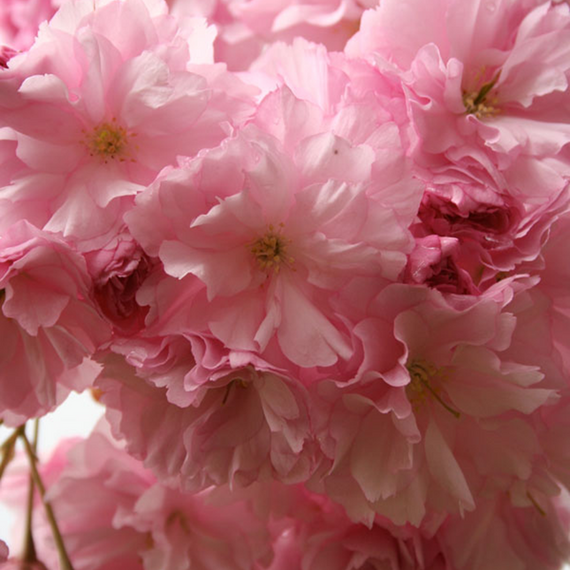



The Kwanzan Cherry (Prunus serrulata 'Kwanzan') is widely regarded as the showiest of all ornamental flowering cherries, and it is easy to see why. Each spring this iconic deciduous tree erupts in a breathtaking profusion of large, fully double, deep rosy-pink blossoms arranged in pendulous clusters of two to five flowers, appearing just before or alongside the emerging bronze-tinged new foliage for a layered, jewel-like effect. Native to Japan, China, and Korea and celebrated for centuries in East Asian culture, Kwanzan cherry was introduced to the United States in 1912 and has since become a beloved feature of landscapes from neighborhood streets to grand public parks. Its graceful broad vase silhouette matures to roughly 25-30 feet in height with a 20-foot spread, growing at a moderate rate of 13-24 inches per year. Through summer, the dark green serrated foliage provides a handsome, dense canopy, and in autumn the leaves transition through warm tones of yellow, bronze-orange, and orange-red before drop. Because Kwanzan cherry is sterile and produces no fruit, it eliminates the cleanup hassle associated with fruiting cherries, making it an excellent choice for lawns, patios, driveways, and parkways. Hardy in USDA Zones 5-9, this low-maintenance ornamental tree asks for little more than a sunny site, well-drained soil, and consistent moisture while young, rewarding those conditions with decades of extraordinary seasonal beauty.
Kwanzan Cherry (Prunus serrulata 'Kwanzan'), also known as Kanzan or Japanese Flowering Cherry, is a deciduous ornamental tree prized above all others in its genus for the extravagance of its spring bloom. The flowers are fully double — each blossom packed with up to 30 petals — and a rich, deep rosy pink, forming pendant clusters that smother every branch before the leaves fully emerge. The tree grows in an elegant broad vase shape, branching upward and outward from a relatively low, stout trunk. Leaves are dark green, lance-shaped to oval, and serrated along the edges, reaching approximately 4-5 inches in length. Young spring foliage emerges with a distinctive reddish-bronze hue that gradually deepens to glossy dark green through summer. In autumn, foliage transitions through shades of yellow, bronze, and orange-red. The tree is completely sterile, setting no fruit or viable seed. Kwanzan cherry has a long cultural history in Japan, dating to the Edo period (1603-1867), and is one of the original cherry tree varieties gifted to Washington, D.C. in 1912, where it remains a celebrated feature of the National Cherry Blossom Festival.
| Characteristic | Detail |
|---|---|
| Mature Height | 25-30 feet |
| Mature Spread | 20 feet |
| Growth Rate | Moderate — 13 to 24 inches per year |
| Tree Form | Broad vase shape |
| Trunk Character | Short, stout, low-branching with attractive bark |
| Lifespan | Approximately 15-25 years |
| Tree Type | Deciduous |
Kwanzan cherry typically reaches a visually impressive size within 10-15 years. The root system tends to be shallow and spreading, so plant at least 10-15 feet away from structures, pavement, and underground utilities. Its vase shape and moderate size make it well suited to residential yards that can accommodate a mid-sized tree without crowding.
Kwanzan Cherry is hardy in USDA Plant Hardiness Zones 5 through 9, tolerating winter temperatures as low as -10 degrees Fahrenheit. It performs best where winters are cool and springs are mild, conditions well matched to the climate of Southern Oregon and Northern California. Within this range it adapts to a variety of regional climates and can handle summer heat and humidity reasonably well. In Zone 5 and cooler parts of Zone 6, young trees benefit from a 3-4 inch layer of organic mulch over the root zone to protect against hard freezes. Avoid planting in areas where road salts or de-icing products may reach the root zone, as salt damage can cause significant leaf scorch and root injury in spring.
Kwanzan cherry thrives in full sun and requires a minimum of 6 hours of direct, unfiltered sunlight per day for the best bloom production and overall health. While the tree can tolerate partial shade, flowering will be noticeably reduced and the canopy less vigorous in lower-light conditions. Shaded trees are also more susceptible to fungal diseases due to reduced air circulation and slower drying of foliage. For the most spectacular spring display, choose the sunniest available planting location. South- or west-facing exposures typically deliver the most consistent light throughout the growing season.
Kwanzan cherry is adaptable to a fairly wide range of soil types, including loamy, sandy, and clay-based soils, provided drainage is adequate. It will not tolerate waterlogged or chronically wet conditions, which quickly lead to root rot and decline. The ideal soil is moist, well-draining, and slightly acidic to neutral, with a pH in the range of 6.0-7.0. In heavy clay soils, amend generously with compost before planting and consider raising the planting bed 12-18 inches above the surrounding grade to ensure drainage. In sandy soils, incorporate compost to improve water retention and fertility. A light soil test every few years is a practical way to monitor pH and catch nutrient deficiencies early.
Consistent moisture is especially important during the first two growing seasons while the root system is becoming established. During this period, water deeply once or twice per week, allowing the top 2-3 inches of soil to dry slightly between waterings. Deep, infrequent irrigation encourages deep root development and is far more beneficial than frequent shallow watering. Once established, Kwanzan cherry is moderately drought tolerant but will benefit from supplemental watering during extended dry spells, particularly in summer. Check soil moisture by inserting a finger 2 inches into the soil — if it feels moist, hold off; if dry, water deeply. Avoid overwatering at all times, as soggy soil is the leading cause of root rot in this species. Applying a 2-4 inch layer of organic mulch around the base of the tree helps conserve soil moisture between waterings and reduces the frequency of irrigation needed.
Kwanzan cherry does not require fertilizing in its first year or two in the ground. Once established, apply a balanced slow-release fertilizer — such as a 10-10-10 formulation — once in early spring, just as new growth begins to emerge. This timing provides a nutrient boost that supports vigorous flowering and healthy foliage through the growing season. Avoid over-fertilizing, especially with high-nitrogen products, as excess nitrogen pushes soft, leafy growth that is structurally weaker and more attractive to pests and diseases. In reasonably fertile soils, a well-established tree may need little to no supplemental fertilizer after the first few years. If the tree shows signs of yellowing leaves or poor growth, conduct a soil test before amending to identify the specific deficiency.
Kwanzan cherry requires minimal pruning under normal circumstances. The primary goal of pruning is to remove dead, damaged, or crossing branches, improve air circulation through the canopy, and maintain the tree's naturally graceful vase shape. The best time to prune is in late summer to early autumn, after the tree has flowered and put on a full season of new growth. Avoid pruning in winter or early spring, as fresh cuts during these periods are more vulnerable to fungal and bacterial infection. Always use clean, sharp bypass pruners with the blade facing toward the living wood to leave the cleanest possible cut. Disinfect tools between cuts, especially if any disease is present. Never remove more than one-third of the tree's canopy in a single year. Do not apply wound sealants to pruning cuts — current horticultural research shows they are not beneficial and may actually trap moisture and interfere with the tree's natural healing. Promptly remove any branches showing signs of canker, black knot, or other disease, cutting well below the visible damage and disposing of the material rather than composting it.
Kwanzan cherry is one of the most versatile and impactful ornamental trees available for residential and commercial landscapes. Its broad vase shape and moderate size make it well suited to a wide range of applications:
Kwanzan cherry is susceptible to several pests and diseases. Vigilance and prompt action are the most effective management strategies.
Kwanzan cherry combines beautifully with other spring-blooming and foliage plants that complement its rich pink blossoms and warm bronze-orange fall color. Consider pairing it with:
While Kwanzan cherry is sterile and produces no fruit for wildlife consumption, it still offers meaningful value to the local ecosystem. The spring blossoms, though fully double and not as accessible as single-flowered cherries, can attract early-season butterflies, native bees, and other pollinators that feed on available nectar and pollen. The dense summer canopy provides nesting habitat and cover for songbirds and other small wildlife. The tree's bark and branch structure attract woodpeckers and other cavity-nesting birds, especially as the tree ages. Note that, like all plants in the Prunus genus, the leaves, bark, and stems contain cyanogenic compounds and are considered toxic to horses, cattle, and other livestock if ingested in quantity. Keep this in mind when situating the tree near pastures or areas accessed by livestock or pets.
The Kwanzan Cherry (Prunus serrulata 'Kwanzan') is widely regarded as the showiest of all ornamental flowering cherries, and it is easy to see why. Each spring this iconic deciduous tree erupts in a breathtaking profusion of large, fully double, deep rosy-pink blossoms arranged in pendulous clusters of two to five flowers, appearing just before or alongside the emerging bronze-tinged new foliage for a layered, jewel-like effect. Native to Japan, China, and Korea and celebrated for centuries in East Asian culture, Kwanzan cherry was introduced to the United States in 1912 and has since become a beloved feature of landscapes from neighborhood streets to grand public parks. Its graceful broad vase silhouette matures to roughly 25-30 feet in height with a 20-foot spread, growing at a moderate rate of 13-24 inches per year. Through summer, the dark green serrated foliage provides a handsome, dense canopy, and in autumn the leaves transition through warm tones of yellow, bronze-orange, and orange-red before drop. Because Kwanzan cherry is sterile and produces no fruit, it eliminates the cleanup hassle associated with fruiting cherries, making it an excellent choice for lawns, patios, driveways, and parkways. Hardy in USDA Zones 5-9, this low-maintenance ornamental tree asks for little more than a sunny site, well-drained soil, and consistent moisture while young, rewarding those conditions with decades of extraordinary seasonal beauty.
Kwanzan Cherry (Prunus serrulata 'Kwanzan'), also known as Kanzan or Japanese Flowering Cherry, is a deciduous ornamental tree prized above all others in its genus for the extravagance of its spring bloom. The flowers are fully double — each blossom packed with up to 30 petals — and a rich, deep rosy pink, forming pendant clusters that smother every branch before the leaves fully emerge. The tree grows in an elegant broad vase shape, branching upward and outward from a relatively low, stout trunk. Leaves are dark green, lance-shaped to oval, and serrated along the edges, reaching approximately 4-5 inches in length. Young spring foliage emerges with a distinctive reddish-bronze hue that gradually deepens to glossy dark green through summer. In autumn, foliage transitions through shades of yellow, bronze, and orange-red. The tree is completely sterile, setting no fruit or viable seed. Kwanzan cherry has a long cultural history in Japan, dating to the Edo period (1603-1867), and is one of the original cherry tree varieties gifted to Washington, D.C. in 1912, where it remains a celebrated feature of the National Cherry Blossom Festival.
| Characteristic | Detail |
|---|---|
| Mature Height | 25-30 feet |
| Mature Spread | 20 feet |
| Growth Rate | Moderate — 13 to 24 inches per year |
| Tree Form | Broad vase shape |
| Trunk Character | Short, stout, low-branching with attractive bark |
| Lifespan | Approximately 15-25 years |
| Tree Type | Deciduous |
Kwanzan cherry typically reaches a visually impressive size within 10-15 years. The root system tends to be shallow and spreading, so plant at least 10-15 feet away from structures, pavement, and underground utilities. Its vase shape and moderate size make it well suited to residential yards that can accommodate a mid-sized tree without crowding.
Kwanzan Cherry is hardy in USDA Plant Hardiness Zones 5 through 9, tolerating winter temperatures as low as -10 degrees Fahrenheit. It performs best where winters are cool and springs are mild, conditions well matched to the climate of Southern Oregon and Northern California. Within this range it adapts to a variety of regional climates and can handle summer heat and humidity reasonably well. In Zone 5 and cooler parts of Zone 6, young trees benefit from a 3-4 inch layer of organic mulch over the root zone to protect against hard freezes. Avoid planting in areas where road salts or de-icing products may reach the root zone, as salt damage can cause significant leaf scorch and root injury in spring.
Kwanzan cherry thrives in full sun and requires a minimum of 6 hours of direct, unfiltered sunlight per day for the best bloom production and overall health. While the tree can tolerate partial shade, flowering will be noticeably reduced and the canopy less vigorous in lower-light conditions. Shaded trees are also more susceptible to fungal diseases due to reduced air circulation and slower drying of foliage. For the most spectacular spring display, choose the sunniest available planting location. South- or west-facing exposures typically deliver the most consistent light throughout the growing season.
Kwanzan cherry is adaptable to a fairly wide range of soil types, including loamy, sandy, and clay-based soils, provided drainage is adequate. It will not tolerate waterlogged or chronically wet conditions, which quickly lead to root rot and decline. The ideal soil is moist, well-draining, and slightly acidic to neutral, with a pH in the range of 6.0-7.0. In heavy clay soils, amend generously with compost before planting and consider raising the planting bed 12-18 inches above the surrounding grade to ensure drainage. In sandy soils, incorporate compost to improve water retention and fertility. A light soil test every few years is a practical way to monitor pH and catch nutrient deficiencies early.
Consistent moisture is especially important during the first two growing seasons while the root system is becoming established. During this period, water deeply once or twice per week, allowing the top 2-3 inches of soil to dry slightly between waterings. Deep, infrequent irrigation encourages deep root development and is far more beneficial than frequent shallow watering. Once established, Kwanzan cherry is moderately drought tolerant but will benefit from supplemental watering during extended dry spells, particularly in summer. Check soil moisture by inserting a finger 2 inches into the soil — if it feels moist, hold off; if dry, water deeply. Avoid overwatering at all times, as soggy soil is the leading cause of root rot in this species. Applying a 2-4 inch layer of organic mulch around the base of the tree helps conserve soil moisture between waterings and reduces the frequency of irrigation needed.
Kwanzan cherry does not require fertilizing in its first year or two in the ground. Once established, apply a balanced slow-release fertilizer — such as a 10-10-10 formulation — once in early spring, just as new growth begins to emerge. This timing provides a nutrient boost that supports vigorous flowering and healthy foliage through the growing season. Avoid over-fertilizing, especially with high-nitrogen products, as excess nitrogen pushes soft, leafy growth that is structurally weaker and more attractive to pests and diseases. In reasonably fertile soils, a well-established tree may need little to no supplemental fertilizer after the first few years. If the tree shows signs of yellowing leaves or poor growth, conduct a soil test before amending to identify the specific deficiency.
Kwanzan cherry requires minimal pruning under normal circumstances. The primary goal of pruning is to remove dead, damaged, or crossing branches, improve air circulation through the canopy, and maintain the tree's naturally graceful vase shape. The best time to prune is in late summer to early autumn, after the tree has flowered and put on a full season of new growth. Avoid pruning in winter or early spring, as fresh cuts during these periods are more vulnerable to fungal and bacterial infection. Always use clean, sharp bypass pruners with the blade facing toward the living wood to leave the cleanest possible cut. Disinfect tools between cuts, especially if any disease is present. Never remove more than one-third of the tree's canopy in a single year. Do not apply wound sealants to pruning cuts — current horticultural research shows they are not beneficial and may actually trap moisture and interfere with the tree's natural healing. Promptly remove any branches showing signs of canker, black knot, or other disease, cutting well below the visible damage and disposing of the material rather than composting it.
Kwanzan cherry is one of the most versatile and impactful ornamental trees available for residential and commercial landscapes. Its broad vase shape and moderate size make it well suited to a wide range of applications:
Kwanzan cherry is susceptible to several pests and diseases. Vigilance and prompt action are the most effective management strategies.
Kwanzan cherry combines beautifully with other spring-blooming and foliage plants that complement its rich pink blossoms and warm bronze-orange fall color. Consider pairing it with:
While Kwanzan cherry is sterile and produces no fruit for wildlife consumption, it still offers meaningful value to the local ecosystem. The spring blossoms, though fully double and not as accessible as single-flowered cherries, can attract early-season butterflies, native bees, and other pollinators that feed on available nectar and pollen. The dense summer canopy provides nesting habitat and cover for songbirds and other small wildlife. The tree's bark and branch structure attract woodpeckers and other cavity-nesting birds, especially as the tree ages. Note that, like all plants in the Prunus genus, the leaves, bark, and stems contain cyanogenic compounds and are considered toxic to horses, cattle, and other livestock if ingested in quantity. Keep this in mind when situating the tree near pastures or areas accessed by livestock or pets.


