


Zoom the image with the mouse
Scarlet Trumpet Vine - 1 Gallon
SKU:
2094425
UPC:
014949124512
$19.99
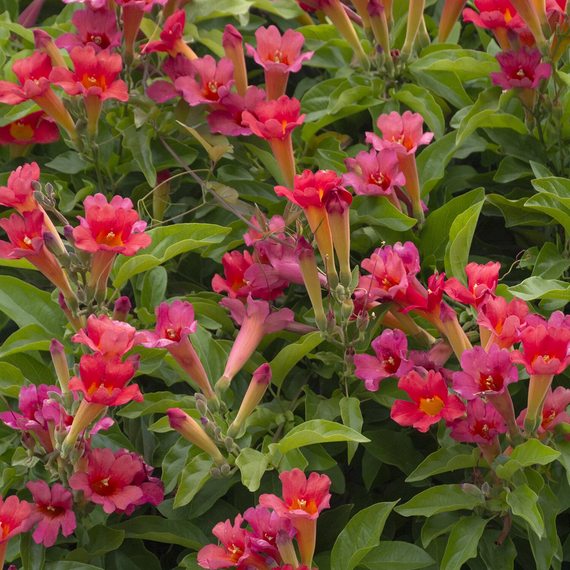
- Spectacular blood-red, trumpet-shaped blooms with bright yellow throats burst forth in abundant clusters from spring through the warmer months, creating a breathtaking season-long color show.
- A powerful, fast-growing evergreen climber that reaches up to 40 feet, quickly cloaking fences, arbors, trellises, pergolas, and walls in lush, deep-green glossy foliage year-round.
- A proven hummingbird and butterfly magnet — the vivid scarlet blooms serve as a reliable nectar source, bringing vibrant wildlife activity right to your garden.
- Impressively heat and drought tolerant once established, and the most cold-hardy species in its genus, capable of withstanding brief dips below 25 degrees F.
Scarlet Trumpet Vine (Distictis buccinatoria) is a vigorous, showstopping evergreen climber native to Mexico that delivers season after season of brilliant color and lush, tropical-looking greenery to warm-climate gardens. Belonging to the Bignoniaceae family, this fast-growing vine produces large, showy clusters of blood-red, trumpet-shaped flowers with striking yellow throats that emerge in abundance from spring through summer and often continue well into fall in warmer settings. Its rich, deep-green glossy foliage provides year-round screening and textural interest, making it equally appealing even when not in bloom. Climbing vigorously by tendrils, Scarlet Trumpet Vine quickly covers fences, high walls, pergolas, arbors, and large trellises, making it an ideal choice for dramatic vertical landscaping, privacy screening, or cascading over slopes. Tolerant of heat, coastal conditions, and a range of well-draining soil types, it requires only moderate water once established and rewards even minimal care with spectacular performance. As the most cold-tolerant species in the Distictis genus, it is well-suited to gardens across Southern Oregon and Northern California, where its fiery blooms and wildlife-friendly flowers make it a standout addition to any warm, sunny landscape.
Plant Description
Scarlet Trumpet Vine is a bold, fast-growing evergreen vine prized for its vivid floral display and lush, tropical appearance. Its stems climb by means of strong tendrils, attaching to and scaling vertical surfaces with impressive speed. The glossy, deep-green compound leaves are made up of pairs of ovate leaflets, providing a dense, attractive backdrop that looks beautiful throughout the entire year. The flowers are the undeniable stars of the show: large, tubular trumpets measuring up to 4 inches long, colored in rich blood-red to orange-scarlet tones with a bold yellow throat. Blooms emerge in eye-catching clusters and are produced prolifically during the warm season. This vine belongs to the Bignoniaceae family, the same plant family as the well-known Trumpet Creeper (Campsis), and shares many of that family's signature traits including its hummingbird-attracting tubular flowers and vigorous climbing habit. It is native to Mexico and thrives in warm, sunny climates with mild winters.
Mature Size
| Attribute | Detail |
|---|---|
| Mature Vine Length | 30 to 40 feet (can reach up to 50 feet in ideal conditions over time) |
| Spread | Wide-spreading; can cover 30 feet or more horizontally |
| Growth Rate | Fast |
| Growth Habit | Climbing and spreading via tendrils |
| Plant Type | Evergreen vine |
This is a large-scale vine best suited to expansive spaces where it has room to spread and climb. It is not recommended for small trellises or confined spaces, but it is ideal for swallowing a full fence line, covering a large pergola, or cascading dramatically over a slope or retaining wall. Over many years, the base of the vine develops a substantial woody trunk, so care should be taken to ensure supports and structures are robust enough to hold the mature plant.
Hardiness Zones and Cold Tolerance
Scarlet Trumpet Vine performs best in USDA Hardiness Zones 9 through 11, making it an excellent choice for the warm, Mediterranean-influenced climates of Southern Oregon and Northern California. It thrives in Sunset Garden Zones 8, 9, and 14 through 24. Among the cultivated species in the Distictis genus, D. buccinatoria is notably the most cold-tolerant, capable of surviving brief freezes down to approximately 25 degrees F. Young plants and tender new growth may be damaged by frost, and it is advisable to avoid heavy pruning in late fall, as the resulting flush of new growth can be vulnerable to cold snaps. In the event of a light freeze causing dieback of the above-ground growth, established plants will typically regenerate vigorously from the root system in spring.
Sunlight Requirements
For the most abundant flowering and most vigorous growth, plant Scarlet Trumpet Vine in a full sun location receiving a minimum of 6 hours of direct sunlight per day. South-facing or west-facing exposures are ideal in most regions. The plant will also tolerate partial shade, but flowering may be somewhat reduced in shadier conditions. It is well-adapted to heat and thrives against warm walls and in open, exposed garden situations that would stress many other ornamental plants. Full sun is especially important in cooler inland valley settings to ensure reliable and prolific bloom production.
Soil and pH Preferences
| Attribute | Preference |
|---|---|
| Soil Type | Sandy loam, loam, or clay loam; well-draining is essential |
| Drainage | Fast-draining; does not tolerate waterlogged or boggy conditions |
| Soil pH | 5.5 to 6.5 (slightly acidic to neutral) |
| Organic Matter | Benefits from incorporation of compost at planting |
| Adaptability | Tolerates a range of soil types provided drainage is adequate |
Scarlet Trumpet Vine is adaptable to a variety of common garden soils but demands good drainage above all else. Heavy clay soils that remain waterlogged can cause root problems and should be amended with organic matter and coarse grit to improve drainage before planting. Enriching the planting area with 2 to 4 inches of aged compost worked deep into the soil will promote vigorous establishment and long-term plant health. Loamy soil provides the ideal growing medium for the fastest growth and most prolific blooming.
Watering Guide
Regular, consistent watering is important during the establishment period — typically the first one to two years after planting. Water deeply once or twice per week during the growing season, ensuring moisture penetrates at least 6 to 7 inches into the soil. Once fully established, Scarlet Trumpet Vine becomes notably drought tolerant and requires significantly less supplemental irrigation, though more robust growth and heavier blooming are achieved with moderate, regular water during the warm months. A general seasonal guide for established plants is as follows:
- Spring (March to May): Water deeply once per week; soil should dry somewhat between waterings.
- Summer (June to August): Water deeply once per week; increase depth and frequency during prolonged heat waves.
- Fall (September to October): Reduce watering frequency; deep water approximately every 7 to 10 days.
- Winter (November to February): Water sparingly; natural rainfall is usually sufficient in most years in Southern Oregon and Northern California.
Applying a 2 to 3 inch layer of organic mulch around the root zone helps retain soil moisture, moderate soil temperature, and reduce watering needs. Always allow the top few inches of soil to dry between waterings to prevent root rot.
Fertilizing
Scarlet Trumpet Vine is not a heavy feeder, but it benefits from appropriate fertilization to support its vigorous growth and prolific blooming. At planting time, incorporate a phosphorus-rich starter fertilizer into the backfill soil to encourage strong root development. For established plants, a balanced slow-release fertilizer applied in early spring as growth resumes is generally sufficient. Avoid excessive nitrogen fertilization, as too much nitrogen will promote lush leafy growth at the expense of flower production. A fertilizer with a balanced or slightly lower nitrogen ratio (such as 5-10-10 or a bloom-boosting formula) is preferable once the vine is established and flowering is the priority. Cease fertilizing by late summer to allow growth to harden off before any potential cold weather.
Pruning and Maintenance
Pruning is not strictly necessary for the health of Scarlet Trumpet Vine, but due to its vigorous, fast-spreading growth habit, regular trimming is strongly recommended to keep the plant at a manageable size and prevent it from overwhelming adjacent structures or plants. Key pruning guidelines include:
- Prune throughout the year as needed to control size and shape, but avoid heavy pruning immediately before or during the coldest winter months, as tender new growth stimulated by pruning can be damaged by frost.
- Avoid pruning during peak bloom periods if you want to preserve the full floral display.
- Remove any dead, damaged, or crossing stems to improve airflow and plant structure.
- Be mindful of the vine's thickening woody trunk over time — do not allow the main trunk to grow through small openings in fences or trellises, as it will expand and can damage or become constricted by the structure.
- Annual rejuvenation pruning after the main bloom flush in summer or early fall helps keep the plant vigorous and encourages fresh, floriferous growth the following season.
Planting Instructions
- Select a planting site in full sun to partial shade with room for the vine to spread 30 to 40 feet or more. Identify and install a sturdy support structure — such as a heavy-duty trellis, fence, arbor, or pergola — before planting.
- Amend the planting area by digging in 2 to 4 inches of aged compost to improve soil fertility and drainage. Check that the site drains freely and does not collect standing water.
- Dig a planting hole twice as wide and equal in depth to the root ball. Place the vine so the top of the root ball is level with the surrounding soil surface.
- Backfill with native soil mixed with compost, firming the soil gently around the roots to eliminate air pockets. Water thoroughly after planting to settle the soil.
- Apply a 2 to 3 inch layer of organic mulch over the root zone, keeping it a few inches away from the base of the stem to prevent rot.
- Water regularly and deeply during the first growing season to establish a deep, strong root system. As soon as the stems are long enough, gently guide the tendrils toward the support structure and loosely tie if needed.
- Avoid planting immediately against a solid wall, which may limit the sunlight and water the vine receives; allow some space for air circulation and root access to rainfall.
Seasonal Interest
Scarlet Trumpet Vine delivers year-round garden appeal, with each season offering its own rewards:
- Spring: The first flush of vivid scarlet and orange-red blooms erupts from the vine, often coinciding with the return of migrating hummingbirds — creating a spectacular combination of color and wildlife activity.
- Summer: Blooming continues in full force through the hottest months of the year, with clusters of trumpet flowers standing out dramatically against the dense, glossy dark-green foliage. The vine is at its most lush and vigorous during this period.
- Fall: Flowering often continues well into fall in warmer locations. The rich evergreen canopy remains attractive and continues to provide privacy and visual interest as temperatures cool.
- Winter: As an evergreen vine, Scarlet Trumpet Vine retains its deep-green foliage through winter, maintaining its role as a screening plant and providing structure to the garden during the dormant season.
Landscape Uses
Scarlet Trumpet Vine is one of the most versatile large-scale vines available for warm-climate gardens. Its many landscape applications include:
- Fence and wall coverage: Rapidly covers chain-link, wood, or masonry fences and blank walls, transforming utilitarian structures into living garden features.
- Arbors and pergolas: Trained over overhead structures, the vine creates a dramatic flowering canopy and provides dappled summer shade.
- Privacy screening: The dense, year-round evergreen foliage creates an effective living privacy screen between properties or to block unwanted views.
- Slope coverage: The vine's spreading habit makes it well-suited for cascading over retaining walls or covering large, hard-to-maintain slopes, helping to stabilize soil.
- Espalier: Can be trained flat against walls in an espalier form for a more architectural appearance.
- Commercial and highway landscapes: Frequently used as a low-maintenance, high-impact planting in commercial settings and along freeway corridors where coverage of large areas is desired.
Companion Plants
Scarlet Trumpet Vine pairs beautifully with other sun-loving, warm-climate plants that share similar water and soil requirements. Consider these companion planting combinations:
- Bougainvillea: A complementary large-scale climber with similarly vibrant flower bracts that creates a bold, tropical color combination alongside the scarlet trumpets.
- Salvia species (particularly red or coral salvias): Low-growing salvias planted at the base of the vine echo the warm color palette and continue to feed hummingbirds at ground level.
- Agapanthus: The soft blue-purple globe flowers of Agapanthus provide a pleasing color contrast at the base of the vine and thrive in similar sun and soil conditions.
- Lantana: Another heat-loving, butterfly-attracting plant whose orange and yellow flower clusters complement the scarlet blooms beautifully.
- Ornamental grasses (such as Pennisetum or Muhlenbergia): Planted at the base of a fence or wall to soften the transition between the vine and the ground plane.
- Rosemary and lavender: Mediterranean herbs that share the same love of full sun and excellent drainage, providing aromatic, silvery-textured contrast at ground level.
Wildlife Value
Scarlet Trumpet Vine is a superb wildlife-friendly plant, particularly valued for its role in supporting pollinators in warm-climate gardens:
- Hummingbirds: The long, tubular scarlet and orange-red flowers are perfectly shaped for hummingbird feeding and are one of the most reliable hummingbird-attracting vines available for Western gardens. The plant is sometimes referred to informally as Hummingbird Vine because of this strong association.
- Butterflies: Numerous butterfly species are attracted to the blooms for nectar, adding further wildlife activity to the garden.
- Other pollinators: Bees and other native pollinators also visit the flowers regularly.
- Songbirds: The dense foliage of the vine provides cover and potential nesting habitat for small songbirds.
Planting Scarlet Trumpet Vine in combination with other nectar-rich plants creates a pollinator corridor that supports a healthy and active garden ecosystem throughout the warm growing season.
Pests and Diseases
Scarlet Trumpet Vine is generally a robust, low-maintenance plant with few serious pest or disease problems. The following occasional issues may be encountered:
- Spider mites: May appear during hot, dry weather, causing leaves to look yellow and stippled. Maintain adequate soil moisture, as stressed plants are more susceptible. Treat with a targeted miticide or knock mites back with a strong jet of water directed at the undersides of leaves.
- Whiteflies: Occasionally infest the foliage, especially in sheltered or congested garden situations. Yellow sticky traps, reflective mulch, and encouraging natural predators such as parasitic wasps can help manage populations. Insecticidal soap sprays are effective for heavy infestations.
- Root rot: The most common cultural problem, almost always caused by poor drainage or overwatering. Ensure the planting site drains freely and avoid waterlogged soil conditions.
- Frost damage: Tender new growth can be damaged or killed by unexpected frosts. While established vines typically recover, protect young plants during the first winter with frost cloth if a hard freeze is forecast.
In general, a plant grown in the right conditions — full sun, well-draining soil, and appropriate water — will be far less susceptible to pest and disease problems. Good air circulation within the vine's canopy, maintained through periodic pruning, further reduces disease risk.
Container Growing
While Scarlet Trumpet Vine is a large-scale plant most at home in the ground, it can be successfully grown in a container for a period of time, particularly in its younger years or in situations where in-ground planting is not possible. Container growing tips include:
- Choose the largest container available — a minimum of a 15-gallon pot or half-barrel planter is recommended to accommodate the root system and support vigorous growth.
- Use a high-quality, well-draining potting mix blended with perlite or coarse grit to ensure excellent drainage. Avoid heavy garden soils that can compact in containers.
- Install a sturdy trellis or obelisk support in the container before planting to give the vine something to climb from the start.
- Container-grown plants dry out more quickly than in-ground plants and will require more frequent watering — check soil moisture regularly during summer.
- Fertilize container plants more frequently than in-ground plantings, as nutrients are flushed from the pot with regular watering. A slow-release balanced fertilizer applied in spring, supplemented with a liquid bloom formula monthly through summer, works well.
- Plan to eventually transition the vine to an in-ground site as it matures, where it can fully express its potential size and vigor.
- Spectacular blood-red, trumpet-shaped blooms with bright yellow throats burst forth in abundant clusters from spring through the warmer months, creating a breathtaking season-long color show.
- A powerful, fast-growing evergreen climber that reaches up to 40 feet, quickly cloaking fences, arbors, trellises, pergolas, and walls in lush, deep-green glossy foliage year-round.
- A proven hummingbird and butterfly magnet — the vivid scarlet blooms serve as a reliable nectar source, bringing vibrant wildlife activity right to your garden.
- Impressively heat and drought tolerant once established, and the most cold-hardy species in its genus, capable of withstanding brief dips below 25 degrees F.
Scarlet Trumpet Vine (Distictis buccinatoria) is a vigorous, showstopping evergreen climber native to Mexico that delivers season after season of brilliant color and lush, tropical-looking greenery to warm-climate gardens. Belonging to the Bignoniaceae family, this fast-growing vine produces large, showy clusters of blood-red, trumpet-shaped flowers with striking yellow throats that emerge in abundance from spring through summer and often continue well into fall in warmer settings. Its rich, deep-green glossy foliage provides year-round screening and textural interest, making it equally appealing even when not in bloom. Climbing vigorously by tendrils, Scarlet Trumpet Vine quickly covers fences, high walls, pergolas, arbors, and large trellises, making it an ideal choice for dramatic vertical landscaping, privacy screening, or cascading over slopes. Tolerant of heat, coastal conditions, and a range of well-draining soil types, it requires only moderate water once established and rewards even minimal care with spectacular performance. As the most cold-tolerant species in the Distictis genus, it is well-suited to gardens across Southern Oregon and Northern California, where its fiery blooms and wildlife-friendly flowers make it a standout addition to any warm, sunny landscape.
Plant Description
Scarlet Trumpet Vine is a bold, fast-growing evergreen vine prized for its vivid floral display and lush, tropical appearance. Its stems climb by means of strong tendrils, attaching to and scaling vertical surfaces with impressive speed. The glossy, deep-green compound leaves are made up of pairs of ovate leaflets, providing a dense, attractive backdrop that looks beautiful throughout the entire year. The flowers are the undeniable stars of the show: large, tubular trumpets measuring up to 4 inches long, colored in rich blood-red to orange-scarlet tones with a bold yellow throat. Blooms emerge in eye-catching clusters and are produced prolifically during the warm season. This vine belongs to the Bignoniaceae family, the same plant family as the well-known Trumpet Creeper (Campsis), and shares many of that family's signature traits including its hummingbird-attracting tubular flowers and vigorous climbing habit. It is native to Mexico and thrives in warm, sunny climates with mild winters.
Mature Size
| Attribute | Detail |
|---|---|
| Mature Vine Length | 30 to 40 feet (can reach up to 50 feet in ideal conditions over time) |
| Spread | Wide-spreading; can cover 30 feet or more horizontally |
| Growth Rate | Fast |
| Growth Habit | Climbing and spreading via tendrils |
| Plant Type | Evergreen vine |
This is a large-scale vine best suited to expansive spaces where it has room to spread and climb. It is not recommended for small trellises or confined spaces, but it is ideal for swallowing a full fence line, covering a large pergola, or cascading dramatically over a slope or retaining wall. Over many years, the base of the vine develops a substantial woody trunk, so care should be taken to ensure supports and structures are robust enough to hold the mature plant.
Hardiness Zones and Cold Tolerance
Scarlet Trumpet Vine performs best in USDA Hardiness Zones 9 through 11, making it an excellent choice for the warm, Mediterranean-influenced climates of Southern Oregon and Northern California. It thrives in Sunset Garden Zones 8, 9, and 14 through 24. Among the cultivated species in the Distictis genus, D. buccinatoria is notably the most cold-tolerant, capable of surviving brief freezes down to approximately 25 degrees F. Young plants and tender new growth may be damaged by frost, and it is advisable to avoid heavy pruning in late fall, as the resulting flush of new growth can be vulnerable to cold snaps. In the event of a light freeze causing dieback of the above-ground growth, established plants will typically regenerate vigorously from the root system in spring.
Sunlight Requirements
For the most abundant flowering and most vigorous growth, plant Scarlet Trumpet Vine in a full sun location receiving a minimum of 6 hours of direct sunlight per day. South-facing or west-facing exposures are ideal in most regions. The plant will also tolerate partial shade, but flowering may be somewhat reduced in shadier conditions. It is well-adapted to heat and thrives against warm walls and in open, exposed garden situations that would stress many other ornamental plants. Full sun is especially important in cooler inland valley settings to ensure reliable and prolific bloom production.
Soil and pH Preferences
| Attribute | Preference |
|---|---|
| Soil Type | Sandy loam, loam, or clay loam; well-draining is essential |
| Drainage | Fast-draining; does not tolerate waterlogged or boggy conditions |
| Soil pH | 5.5 to 6.5 (slightly acidic to neutral) |
| Organic Matter | Benefits from incorporation of compost at planting |
| Adaptability | Tolerates a range of soil types provided drainage is adequate |
Scarlet Trumpet Vine is adaptable to a variety of common garden soils but demands good drainage above all else. Heavy clay soils that remain waterlogged can cause root problems and should be amended with organic matter and coarse grit to improve drainage before planting. Enriching the planting area with 2 to 4 inches of aged compost worked deep into the soil will promote vigorous establishment and long-term plant health. Loamy soil provides the ideal growing medium for the fastest growth and most prolific blooming.
Watering Guide
Regular, consistent watering is important during the establishment period — typically the first one to two years after planting. Water deeply once or twice per week during the growing season, ensuring moisture penetrates at least 6 to 7 inches into the soil. Once fully established, Scarlet Trumpet Vine becomes notably drought tolerant and requires significantly less supplemental irrigation, though more robust growth and heavier blooming are achieved with moderate, regular water during the warm months. A general seasonal guide for established plants is as follows:
- Spring (March to May): Water deeply once per week; soil should dry somewhat between waterings.
- Summer (June to August): Water deeply once per week; increase depth and frequency during prolonged heat waves.
- Fall (September to October): Reduce watering frequency; deep water approximately every 7 to 10 days.
- Winter (November to February): Water sparingly; natural rainfall is usually sufficient in most years in Southern Oregon and Northern California.
Applying a 2 to 3 inch layer of organic mulch around the root zone helps retain soil moisture, moderate soil temperature, and reduce watering needs. Always allow the top few inches of soil to dry between waterings to prevent root rot.
Fertilizing
Scarlet Trumpet Vine is not a heavy feeder, but it benefits from appropriate fertilization to support its vigorous growth and prolific blooming. At planting time, incorporate a phosphorus-rich starter fertilizer into the backfill soil to encourage strong root development. For established plants, a balanced slow-release fertilizer applied in early spring as growth resumes is generally sufficient. Avoid excessive nitrogen fertilization, as too much nitrogen will promote lush leafy growth at the expense of flower production. A fertilizer with a balanced or slightly lower nitrogen ratio (such as 5-10-10 or a bloom-boosting formula) is preferable once the vine is established and flowering is the priority. Cease fertilizing by late summer to allow growth to harden off before any potential cold weather.
Pruning and Maintenance
Pruning is not strictly necessary for the health of Scarlet Trumpet Vine, but due to its vigorous, fast-spreading growth habit, regular trimming is strongly recommended to keep the plant at a manageable size and prevent it from overwhelming adjacent structures or plants. Key pruning guidelines include:
- Prune throughout the year as needed to control size and shape, but avoid heavy pruning immediately before or during the coldest winter months, as tender new growth stimulated by pruning can be damaged by frost.
- Avoid pruning during peak bloom periods if you want to preserve the full floral display.
- Remove any dead, damaged, or crossing stems to improve airflow and plant structure.
- Be mindful of the vine's thickening woody trunk over time — do not allow the main trunk to grow through small openings in fences or trellises, as it will expand and can damage or become constricted by the structure.
- Annual rejuvenation pruning after the main bloom flush in summer or early fall helps keep the plant vigorous and encourages fresh, floriferous growth the following season.
Planting Instructions
- Select a planting site in full sun to partial shade with room for the vine to spread 30 to 40 feet or more. Identify and install a sturdy support structure — such as a heavy-duty trellis, fence, arbor, or pergola — before planting.
- Amend the planting area by digging in 2 to 4 inches of aged compost to improve soil fertility and drainage. Check that the site drains freely and does not collect standing water.
- Dig a planting hole twice as wide and equal in depth to the root ball. Place the vine so the top of the root ball is level with the surrounding soil surface.
- Backfill with native soil mixed with compost, firming the soil gently around the roots to eliminate air pockets. Water thoroughly after planting to settle the soil.
- Apply a 2 to 3 inch layer of organic mulch over the root zone, keeping it a few inches away from the base of the stem to prevent rot.
- Water regularly and deeply during the first growing season to establish a deep, strong root system. As soon as the stems are long enough, gently guide the tendrils toward the support structure and loosely tie if needed.
- Avoid planting immediately against a solid wall, which may limit the sunlight and water the vine receives; allow some space for air circulation and root access to rainfall.
Seasonal Interest
Scarlet Trumpet Vine delivers year-round garden appeal, with each season offering its own rewards:
- Spring: The first flush of vivid scarlet and orange-red blooms erupts from the vine, often coinciding with the return of migrating hummingbirds — creating a spectacular combination of color and wildlife activity.
- Summer: Blooming continues in full force through the hottest months of the year, with clusters of trumpet flowers standing out dramatically against the dense, glossy dark-green foliage. The vine is at its most lush and vigorous during this period.
- Fall: Flowering often continues well into fall in warmer locations. The rich evergreen canopy remains attractive and continues to provide privacy and visual interest as temperatures cool.
- Winter: As an evergreen vine, Scarlet Trumpet Vine retains its deep-green foliage through winter, maintaining its role as a screening plant and providing structure to the garden during the dormant season.
Landscape Uses
Scarlet Trumpet Vine is one of the most versatile large-scale vines available for warm-climate gardens. Its many landscape applications include:
- Fence and wall coverage: Rapidly covers chain-link, wood, or masonry fences and blank walls, transforming utilitarian structures into living garden features.
- Arbors and pergolas: Trained over overhead structures, the vine creates a dramatic flowering canopy and provides dappled summer shade.
- Privacy screening: The dense, year-round evergreen foliage creates an effective living privacy screen between properties or to block unwanted views.
- Slope coverage: The vine's spreading habit makes it well-suited for cascading over retaining walls or covering large, hard-to-maintain slopes, helping to stabilize soil.
- Espalier: Can be trained flat against walls in an espalier form for a more architectural appearance.
- Commercial and highway landscapes: Frequently used as a low-maintenance, high-impact planting in commercial settings and along freeway corridors where coverage of large areas is desired.
Companion Plants
Scarlet Trumpet Vine pairs beautifully with other sun-loving, warm-climate plants that share similar water and soil requirements. Consider these companion planting combinations:
- Bougainvillea: A complementary large-scale climber with similarly vibrant flower bracts that creates a bold, tropical color combination alongside the scarlet trumpets.
- Salvia species (particularly red or coral salvias): Low-growing salvias planted at the base of the vine echo the warm color palette and continue to feed hummingbirds at ground level.
- Agapanthus: The soft blue-purple globe flowers of Agapanthus provide a pleasing color contrast at the base of the vine and thrive in similar sun and soil conditions.
- Lantana: Another heat-loving, butterfly-attracting plant whose orange and yellow flower clusters complement the scarlet blooms beautifully.
- Ornamental grasses (such as Pennisetum or Muhlenbergia): Planted at the base of a fence or wall to soften the transition between the vine and the ground plane.
- Rosemary and lavender: Mediterranean herbs that share the same love of full sun and excellent drainage, providing aromatic, silvery-textured contrast at ground level.
Wildlife Value
Scarlet Trumpet Vine is a superb wildlife-friendly plant, particularly valued for its role in supporting pollinators in warm-climate gardens:
- Hummingbirds: The long, tubular scarlet and orange-red flowers are perfectly shaped for hummingbird feeding and are one of the most reliable hummingbird-attracting vines available for Western gardens. The plant is sometimes referred to informally as Hummingbird Vine because of this strong association.
- Butterflies: Numerous butterfly species are attracted to the blooms for nectar, adding further wildlife activity to the garden.
- Other pollinators: Bees and other native pollinators also visit the flowers regularly.
- Songbirds: The dense foliage of the vine provides cover and potential nesting habitat for small songbirds.
Planting Scarlet Trumpet Vine in combination with other nectar-rich plants creates a pollinator corridor that supports a healthy and active garden ecosystem throughout the warm growing season.
Pests and Diseases
Scarlet Trumpet Vine is generally a robust, low-maintenance plant with few serious pest or disease problems. The following occasional issues may be encountered:
- Spider mites: May appear during hot, dry weather, causing leaves to look yellow and stippled. Maintain adequate soil moisture, as stressed plants are more susceptible. Treat with a targeted miticide or knock mites back with a strong jet of water directed at the undersides of leaves.
- Whiteflies: Occasionally infest the foliage, especially in sheltered or congested garden situations. Yellow sticky traps, reflective mulch, and encouraging natural predators such as parasitic wasps can help manage populations. Insecticidal soap sprays are effective for heavy infestations.
- Root rot: The most common cultural problem, almost always caused by poor drainage or overwatering. Ensure the planting site drains freely and avoid waterlogged soil conditions.
- Frost damage: Tender new growth can be damaged or killed by unexpected frosts. While established vines typically recover, protect young plants during the first winter with frost cloth if a hard freeze is forecast.
In general, a plant grown in the right conditions — full sun, well-draining soil, and appropriate water — will be far less susceptible to pest and disease problems. Good air circulation within the vine's canopy, maintained through periodic pruning, further reduces disease risk.
Container Growing
While Scarlet Trumpet Vine is a large-scale plant most at home in the ground, it can be successfully grown in a container for a period of time, particularly in its younger years or in situations where in-ground planting is not possible. Container growing tips include:
- Choose the largest container available — a minimum of a 15-gallon pot or half-barrel planter is recommended to accommodate the root system and support vigorous growth.
- Use a high-quality, well-draining potting mix blended with perlite or coarse grit to ensure excellent drainage. Avoid heavy garden soils that can compact in containers.
- Install a sturdy trellis or obelisk support in the container before planting to give the vine something to climb from the start.
- Container-grown plants dry out more quickly than in-ground plants and will require more frequent watering — check soil moisture regularly during summer.
- Fertilize container plants more frequently than in-ground plantings, as nutrients are flushed from the pot with regular watering. A slow-release balanced fertilizer applied in spring, supplemented with a liquid bloom formula monthly through summer, works well.
- Plan to eventually transition the vine to an in-ground site as it matures, where it can fully express its potential size and vigor.


