


Zoom the image with the mouse
Holiday Silver Bells Begonia - 1 Gallon
SKU:
2121640
UPC:
014949488454
$12.99
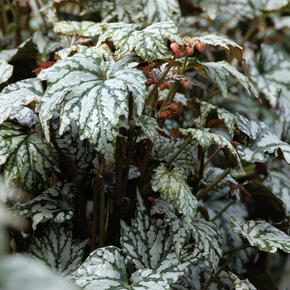
- Striking silver-topped, deeply cut leaves with vivid burgundy undersides create year-round eye-catching foliage display unlike any other shade plant.
- Produces dainty nodding coral-pink, orchid-like flowers with yellow throats from mid-spring through early fall, adding a delicate floral bonus to the outstanding foliage.
- Compact, mounded habit reaches just 9-10 inches tall and spreads up to 16 inches wide, making it an ideal choice for containers, hanging baskets, and shaded border edges.
- Vigorous, easy-care interspecific hybrid from the Holiday Collection — naturally deer-resistant and well suited to the mild climates of Southern Oregon and Northern California.
Begonia Holiday Silver Bells (Begonia HOLIDAY 'Silver Bells' PPAF) is a showstopping interspecific hybrid begonia that earns its place in the garden through both spectacular foliage and season-long bloom. The deeply lobed, narrowly cut leaves emerge light green in spring and mature to a dazzling silver-pewter on top, contrasted dramatically by rich burgundy-red undersides carried on delicate pink stems. From mid-spring through early fall, clusters of small, nodding coral-pink flowers with orchid-like form and soft yellow throats rise above the dense, mounded canopy of foliage, providing a delicate floral accent that complements the flashy leaves. Growing to approximately 9-10 inches tall and spreading up to 16 inches wide, this compact, well-branched plant thrives in partial shade to full shade, making it the perfect solution for difficult low-light spots in the landscape or on the patio. Part of the Terra Nova Nurseries Holiday Collection, Begonia Silver Bells is a vigorous and prolific performer that excels in container gardens, hanging baskets, shaded beds, and border edges. Its fine-textured, ornamental foliage and free-flowering habit make it one of the most distinctive and versatile shade plants available for gardeners throughout USDA Zones 9-11, and it is easily overwintered indoors in cooler climates.
Plant Description
Begonia Holiday Silver Bells is a compact, mounded interspecific hybrid begonia prized primarily for its extraordinary foliage. The deeply cut, lobed leaves have a narrow, elegant silhouette and are carried on slender pink stems. Leaf surfaces shimmer with a luminous silver-pewter coating on top, while the undersides reveal a striking burgundy-red coloration with hints of grayish green. This two-toned foliage effect is ornamental throughout the entire growing season. As a bonus, small clusters of dainty nodding coral-pink blooms with orchid-like petals and soft yellow throats appear reliably from mid-spring through early fall. The plant maintains a dense, fine-textured habit that stays low and full right to the ground, making it as attractive in a container planting as it is in the landscape.
Mature Size
| Characteristic | Measurement |
|---|---|
| Foliage Height | 9-10 inches |
| Spread / Width | Up to 16 inches |
| Recommended Spacing | Approximately 12 inches apart |
| Growth Habit | Compact, mounded, dense |
Hardiness Zones and Climate
Begonia Holiday Silver Bells is rated for USDA Hardiness Zones 9-11, which covers most of Southern Oregon's mild valleys and the majority of Northern California's lower elevations. In these zones it can be grown outdoors as a long-season annual or, in frost-free areas, as a tender perennial. It is not cold hardy and will not survive frost or hard freezes if left outdoors. In regions that experience occasional light frost, it should be treated as an annual or brought indoors before the first frost date to overwinter as a houseplant. It performs beautifully as a warm-season container plant that can be moved inside for protection during cooler months.
Sunlight Requirements
This begonia thrives in partial shade to full shade and should be protected from harsh direct afternoon sunlight, which can scorch the delicate silver foliage and cause leaf edges to brown and curl. It performs best with bright indirect light or gentle morning sun — ideally no more than 2-3 hours of direct sun early in the day. Outdoors, a north- or east-facing exposure, or a spot under a canopy of light-filtering trees, is ideal. When grown as a houseplant or brought indoors, place it within 3 feet of a bright window to ensure adequate light for strong growth and continued flowering. Insufficient light will result in reduced silvering of the foliage and fewer blooms.
Soil and pH Preferences
Begonia Holiday Silver Bells grows best in rich, well-draining soil with a high organic matter content. It will not tolerate standing water or consistently waterlogged conditions, which lead rapidly to root rot. When planting in the ground, amend heavy clay soils generously with compost, perlite, or coarse bark to improve drainage and aeration. For containers, use a high-quality potting mix blended with perlite or vermiculite to ensure excellent drainage while retaining appropriate moisture. This plant is not particularly fussy about soil pH and performs well across a moderately wide range, though it generally prefers a slightly acidic to neutral pH of approximately 5.5-7.0. A rich, loamy, moisture-retentive but well-drained growing medium is the key to success.
Watering Guide
- Keep the soil evenly moist but never waterlogged — consistent moisture is key to healthy, vigorous growth.
- Allow the top inch of soil to dry slightly between waterings; begonias are sensitive to both underwatering and overwatering.
- Water at the base of the plant and avoid wetting the foliage, as wet leaves promote fungal diseases such as powdery mildew and botrytis.
- Container-grown plants dry out more quickly than in-ground plants and will need more frequent watering, especially during warm summer weather.
- Reduce watering frequency in winter if the plant is brought indoors, but do not allow the root ball to dry out completely.
- Applying a layer of organic mulch around the root zone of in-ground plants helps retain soil moisture and moderate soil temperature.
Fertilizing
Begonia Holiday Silver Bells is a moderately vigorous grower that benefits from regular fertilization during the active growing season. Apply a balanced, water-soluble fertilizer with an equal ratio of nitrogen, phosphorus, and potassium (such as a 10-10-10 or 20-20-20 formula) every two to three weeks from spring through early fall. Alternatively, a slow-release granular fertilizer worked into the soil or container mix at the beginning of the growing season provides a steady nutrient supply with less effort. Avoid overfertilizing with high-nitrogen formulas, which can promote excessive leafy growth at the expense of the silver foliage coloration and flower production. For container plants, refresh the potting soil annually to replenish depleted nutrients. Reduce or eliminate fertilization in late fall and winter when the plant's growth naturally slows.
Planting Instructions
- Choose a location with partial to full shade and protection from harsh afternoon sun and strong, drying winds.
- Prepare the planting bed by loosening the soil to a depth of 8-10 inches and incorporating generous amounts of compost or aged organic matter.
- Dig a planting hole approximately twice the width of the root ball and equal in depth.
- Remove the plant from its container, gently loosen any circling roots, and set it in the hole so the top of the root ball is level with or very slightly above the surrounding soil grade.
- Backfill with amended soil, firming it gently around the roots to eliminate air pockets.
- Water thoroughly after planting and apply a 2-inch layer of organic mulch around the base, keeping mulch a few inches away from the stems to discourage rot.
- Space plants approximately 12 inches apart when planting in masses or as a bedding display.
- For container planting, use a well-draining potting mix in a container with drainage holes and ensure adequate space for the plant's 16-inch spread at maturity.
Pruning and Maintenance
Begonia Holiday Silver Bells generally looks its best with minimal pruning — its naturally dense, mounded habit requires little intervention to maintain a tidy appearance. Deadheading spent flower clusters is not strictly necessary, as the plant is a prolific self-cleaning bloomer, but removing faded blooms can encourage continued flower production and keeps the plant looking its neatest. If stems become leggy or the plant loses its compact form, light pinching of stem tips in early summer will encourage branching and a fuller, more vigorous habit. Remove any yellowed, damaged, or diseased leaves promptly to improve air circulation and reduce the risk of fungal problems. When overwintering indoors, cut the plant back by about one-third to reduce stress from the transition and encourage fresh, compact regrowth in spring.
Container Growing
Begonia Holiday Silver Bells is an exceptional container plant and truly shines in pots, window boxes, and hanging baskets on shaded patios, porches, and decks. Its trailing, spreading habit (up to 16 inches wide) and fine-textured silver foliage make it an excellent "filler" plant in combination container arrangements, pairing beautifully with taller thriller plants and cascading spillers. Choose a container with adequate drainage holes and fill it with a rich, well-draining potting mix amended with perlite. Because container plants dry out faster than those planted in the ground, monitor soil moisture more frequently — especially during hot summer weather — and water whenever the top inch of soil feels dry. Container plants also benefit from more regular fertilizing since nutrients leach out with each watering. In cooler climates, container-grown plants can be brought indoors before the first frost to extend their life as a houseplant through the winter months.
Landscape Uses
- Shaded border edging: The compact, low-growing mounded habit makes an elegant, refined edge along shaded walkways and garden beds.
- Mass planting: When grouped in drifts, the silvery foliage creates a luminous, eye-catching ground-level display under trees or along shaded walls.
- Container and patio planting: Thrives in pots, window boxes, and mixed container arrangements on shaded decks and patios.
- Hanging baskets: The spreading habit and cascading stems fill hanging baskets beautifully for shaded porch and pergola displays.
- Woodland and shade garden accent: A natural fit in dappled-shade woodland garden settings where few other ornamentals provide this level of foliage interest.
- Indoor houseplant: Can be grown year-round as a striking, low-light houseplant near a bright window.
Companion Plants
The silvery, deeply cut foliage of Begonia Holiday Silver Bells pairs beautifully with a wide range of shade-loving companions. For a dramatic contrast in texture and color, combine it with the large, deeply veined leaves of hostas in blue-green or gold tones. Coleus varieties with deep burgundy or chartreuse foliage echo and amplify the two-toned coloring of Silver Bells' leaves. Impatiens in soft pink or white tones complement the coral-pink flowers without competing for visual attention. Heucheras (coral bells) with bronze or silver-mottled foliage create a cohesive, layered shade planting. Ferns such as Japanese painted fern add graceful, arching texture alongside the begonia's dense mound. Caladiums with red or pink-veined leaves make bold, tropical-feeling companions. For hanging basket combinations, pair Silver Bells with ivy, trailing bacopa, or creeping Jenny as a contrasting cascading element.
Pests and Diseases
Begonia Holiday Silver Bells is generally a robust, relatively easy-care plant, but there are a few common issues to watch for:
- Powdery mildew: The most common fungal problem for begonias. Appears as a white, powdery coating on leaf surfaces, particularly in humid conditions with poor air circulation. Prevent by spacing plants appropriately, avoiding overhead watering, and ensuring good air movement. Treat affected plants with a neem oil solution or a fungicide labeled for powdery mildew.
- Botrytis (gray mold): A fungal rot that affects stems and leaves in cool, damp, poorly ventilated conditions. Remove affected tissue immediately and improve air circulation.
- Root rot: Caused by overwatering or poor drainage. Ensure the soil or potting mix drains freely and allow the soil surface to dry slightly between waterings.
- Mealybugs and whiteflies: Occasional sap-feeding insect pests. Treat infestations with insecticidal soap or neem oil, targeting the undersides of leaves where pests congregate.
- Thrips and spider mites: More common in hot, dry conditions. Maintain adequate moisture and treat with appropriate insecticides or miticides if detected.
This variety is noted for deer resistance — deer generally avoid it in favor of other garden plants.
Toxicity and Safety
Begonia Holiday Silver Bells, like all begonias, contains soluble calcium oxalates and other compounds that are toxic if ingested. All parts of the plant should be considered potentially harmful to cats, dogs, and children if consumed. The underground portions (roots and tubers) tend to be the most concentrated source of toxic compounds. Ingestion can cause symptoms including oral irritation, excessive drooling, vomiting, and difficulty swallowing in pets. If a pet or person ingests any part of this plant, contact a veterinarian, Poison Control (US: 800-222-1222), or seek medical attention immediately. This plant is best sited out of reach of curious pets and small children, or grown in locations where accidental ingestion is unlikely.
Overwintering and Indoor Care
In USDA Zones 9-11, Begonia Holiday Silver Bells can remain outdoors year-round in sheltered locations, though it may die back in the event of any frost. In cooler climates — including higher-elevation areas of Southern Oregon and Northern California — it should be brought indoors before the first frost to overwinter successfully. Transition the plant gradually by moving it to a sheltered outdoor location for a week or two before bringing it inside completely. Indoors, place it in the brightest available location, ideally within 3 feet of a south- or east-facing window. Reduce watering frequency in winter, allowing the soil to dry slightly more between waterings, and hold off on fertilizing until spring growth resumes. Light pruning at the time of the indoor move helps reduce transplant stress and promotes bushy regrowth. Move the plant back outside once nighttime temperatures consistently remain above 50 degrees Fahrenheit in spring.
- Striking silver-topped, deeply cut leaves with vivid burgundy undersides create year-round eye-catching foliage display unlike any other shade plant.
- Produces dainty nodding coral-pink, orchid-like flowers with yellow throats from mid-spring through early fall, adding a delicate floral bonus to the outstanding foliage.
- Compact, mounded habit reaches just 9-10 inches tall and spreads up to 16 inches wide, making it an ideal choice for containers, hanging baskets, and shaded border edges.
- Vigorous, easy-care interspecific hybrid from the Holiday Collection — naturally deer-resistant and well suited to the mild climates of Southern Oregon and Northern California.
Begonia Holiday Silver Bells (Begonia HOLIDAY 'Silver Bells' PPAF) is a showstopping interspecific hybrid begonia that earns its place in the garden through both spectacular foliage and season-long bloom. The deeply lobed, narrowly cut leaves emerge light green in spring and mature to a dazzling silver-pewter on top, contrasted dramatically by rich burgundy-red undersides carried on delicate pink stems. From mid-spring through early fall, clusters of small, nodding coral-pink flowers with orchid-like form and soft yellow throats rise above the dense, mounded canopy of foliage, providing a delicate floral accent that complements the flashy leaves. Growing to approximately 9-10 inches tall and spreading up to 16 inches wide, this compact, well-branched plant thrives in partial shade to full shade, making it the perfect solution for difficult low-light spots in the landscape or on the patio. Part of the Terra Nova Nurseries Holiday Collection, Begonia Silver Bells is a vigorous and prolific performer that excels in container gardens, hanging baskets, shaded beds, and border edges. Its fine-textured, ornamental foliage and free-flowering habit make it one of the most distinctive and versatile shade plants available for gardeners throughout USDA Zones 9-11, and it is easily overwintered indoors in cooler climates.
Plant Description
Begonia Holiday Silver Bells is a compact, mounded interspecific hybrid begonia prized primarily for its extraordinary foliage. The deeply cut, lobed leaves have a narrow, elegant silhouette and are carried on slender pink stems. Leaf surfaces shimmer with a luminous silver-pewter coating on top, while the undersides reveal a striking burgundy-red coloration with hints of grayish green. This two-toned foliage effect is ornamental throughout the entire growing season. As a bonus, small clusters of dainty nodding coral-pink blooms with orchid-like petals and soft yellow throats appear reliably from mid-spring through early fall. The plant maintains a dense, fine-textured habit that stays low and full right to the ground, making it as attractive in a container planting as it is in the landscape.
Mature Size
| Characteristic | Measurement |
|---|---|
| Foliage Height | 9-10 inches |
| Spread / Width | Up to 16 inches |
| Recommended Spacing | Approximately 12 inches apart |
| Growth Habit | Compact, mounded, dense |
Hardiness Zones and Climate
Begonia Holiday Silver Bells is rated for USDA Hardiness Zones 9-11, which covers most of Southern Oregon's mild valleys and the majority of Northern California's lower elevations. In these zones it can be grown outdoors as a long-season annual or, in frost-free areas, as a tender perennial. It is not cold hardy and will not survive frost or hard freezes if left outdoors. In regions that experience occasional light frost, it should be treated as an annual or brought indoors before the first frost date to overwinter as a houseplant. It performs beautifully as a warm-season container plant that can be moved inside for protection during cooler months.
Sunlight Requirements
This begonia thrives in partial shade to full shade and should be protected from harsh direct afternoon sunlight, which can scorch the delicate silver foliage and cause leaf edges to brown and curl. It performs best with bright indirect light or gentle morning sun — ideally no more than 2-3 hours of direct sun early in the day. Outdoors, a north- or east-facing exposure, or a spot under a canopy of light-filtering trees, is ideal. When grown as a houseplant or brought indoors, place it within 3 feet of a bright window to ensure adequate light for strong growth and continued flowering. Insufficient light will result in reduced silvering of the foliage and fewer blooms.
Soil and pH Preferences
Begonia Holiday Silver Bells grows best in rich, well-draining soil with a high organic matter content. It will not tolerate standing water or consistently waterlogged conditions, which lead rapidly to root rot. When planting in the ground, amend heavy clay soils generously with compost, perlite, or coarse bark to improve drainage and aeration. For containers, use a high-quality potting mix blended with perlite or vermiculite to ensure excellent drainage while retaining appropriate moisture. This plant is not particularly fussy about soil pH and performs well across a moderately wide range, though it generally prefers a slightly acidic to neutral pH of approximately 5.5-7.0. A rich, loamy, moisture-retentive but well-drained growing medium is the key to success.
Watering Guide
- Keep the soil evenly moist but never waterlogged — consistent moisture is key to healthy, vigorous growth.
- Allow the top inch of soil to dry slightly between waterings; begonias are sensitive to both underwatering and overwatering.
- Water at the base of the plant and avoid wetting the foliage, as wet leaves promote fungal diseases such as powdery mildew and botrytis.
- Container-grown plants dry out more quickly than in-ground plants and will need more frequent watering, especially during warm summer weather.
- Reduce watering frequency in winter if the plant is brought indoors, but do not allow the root ball to dry out completely.
- Applying a layer of organic mulch around the root zone of in-ground plants helps retain soil moisture and moderate soil temperature.
Fertilizing
Begonia Holiday Silver Bells is a moderately vigorous grower that benefits from regular fertilization during the active growing season. Apply a balanced, water-soluble fertilizer with an equal ratio of nitrogen, phosphorus, and potassium (such as a 10-10-10 or 20-20-20 formula) every two to three weeks from spring through early fall. Alternatively, a slow-release granular fertilizer worked into the soil or container mix at the beginning of the growing season provides a steady nutrient supply with less effort. Avoid overfertilizing with high-nitrogen formulas, which can promote excessive leafy growth at the expense of the silver foliage coloration and flower production. For container plants, refresh the potting soil annually to replenish depleted nutrients. Reduce or eliminate fertilization in late fall and winter when the plant's growth naturally slows.
Planting Instructions
- Choose a location with partial to full shade and protection from harsh afternoon sun and strong, drying winds.
- Prepare the planting bed by loosening the soil to a depth of 8-10 inches and incorporating generous amounts of compost or aged organic matter.
- Dig a planting hole approximately twice the width of the root ball and equal in depth.
- Remove the plant from its container, gently loosen any circling roots, and set it in the hole so the top of the root ball is level with or very slightly above the surrounding soil grade.
- Backfill with amended soil, firming it gently around the roots to eliminate air pockets.
- Water thoroughly after planting and apply a 2-inch layer of organic mulch around the base, keeping mulch a few inches away from the stems to discourage rot.
- Space plants approximately 12 inches apart when planting in masses or as a bedding display.
- For container planting, use a well-draining potting mix in a container with drainage holes and ensure adequate space for the plant's 16-inch spread at maturity.
Pruning and Maintenance
Begonia Holiday Silver Bells generally looks its best with minimal pruning — its naturally dense, mounded habit requires little intervention to maintain a tidy appearance. Deadheading spent flower clusters is not strictly necessary, as the plant is a prolific self-cleaning bloomer, but removing faded blooms can encourage continued flower production and keeps the plant looking its neatest. If stems become leggy or the plant loses its compact form, light pinching of stem tips in early summer will encourage branching and a fuller, more vigorous habit. Remove any yellowed, damaged, or diseased leaves promptly to improve air circulation and reduce the risk of fungal problems. When overwintering indoors, cut the plant back by about one-third to reduce stress from the transition and encourage fresh, compact regrowth in spring.
Container Growing
Begonia Holiday Silver Bells is an exceptional container plant and truly shines in pots, window boxes, and hanging baskets on shaded patios, porches, and decks. Its trailing, spreading habit (up to 16 inches wide) and fine-textured silver foliage make it an excellent "filler" plant in combination container arrangements, pairing beautifully with taller thriller plants and cascading spillers. Choose a container with adequate drainage holes and fill it with a rich, well-draining potting mix amended with perlite. Because container plants dry out faster than those planted in the ground, monitor soil moisture more frequently — especially during hot summer weather — and water whenever the top inch of soil feels dry. Container plants also benefit from more regular fertilizing since nutrients leach out with each watering. In cooler climates, container-grown plants can be brought indoors before the first frost to extend their life as a houseplant through the winter months.
Landscape Uses
- Shaded border edging: The compact, low-growing mounded habit makes an elegant, refined edge along shaded walkways and garden beds.
- Mass planting: When grouped in drifts, the silvery foliage creates a luminous, eye-catching ground-level display under trees or along shaded walls.
- Container and patio planting: Thrives in pots, window boxes, and mixed container arrangements on shaded decks and patios.
- Hanging baskets: The spreading habit and cascading stems fill hanging baskets beautifully for shaded porch and pergola displays.
- Woodland and shade garden accent: A natural fit in dappled-shade woodland garden settings where few other ornamentals provide this level of foliage interest.
- Indoor houseplant: Can be grown year-round as a striking, low-light houseplant near a bright window.
Companion Plants
The silvery, deeply cut foliage of Begonia Holiday Silver Bells pairs beautifully with a wide range of shade-loving companions. For a dramatic contrast in texture and color, combine it with the large, deeply veined leaves of hostas in blue-green or gold tones. Coleus varieties with deep burgundy or chartreuse foliage echo and amplify the two-toned coloring of Silver Bells' leaves. Impatiens in soft pink or white tones complement the coral-pink flowers without competing for visual attention. Heucheras (coral bells) with bronze or silver-mottled foliage create a cohesive, layered shade planting. Ferns such as Japanese painted fern add graceful, arching texture alongside the begonia's dense mound. Caladiums with red or pink-veined leaves make bold, tropical-feeling companions. For hanging basket combinations, pair Silver Bells with ivy, trailing bacopa, or creeping Jenny as a contrasting cascading element.
Pests and Diseases
Begonia Holiday Silver Bells is generally a robust, relatively easy-care plant, but there are a few common issues to watch for:
- Powdery mildew: The most common fungal problem for begonias. Appears as a white, powdery coating on leaf surfaces, particularly in humid conditions with poor air circulation. Prevent by spacing plants appropriately, avoiding overhead watering, and ensuring good air movement. Treat affected plants with a neem oil solution or a fungicide labeled for powdery mildew.
- Botrytis (gray mold): A fungal rot that affects stems and leaves in cool, damp, poorly ventilated conditions. Remove affected tissue immediately and improve air circulation.
- Root rot: Caused by overwatering or poor drainage. Ensure the soil or potting mix drains freely and allow the soil surface to dry slightly between waterings.
- Mealybugs and whiteflies: Occasional sap-feeding insect pests. Treat infestations with insecticidal soap or neem oil, targeting the undersides of leaves where pests congregate.
- Thrips and spider mites: More common in hot, dry conditions. Maintain adequate moisture and treat with appropriate insecticides or miticides if detected.
This variety is noted for deer resistance — deer generally avoid it in favor of other garden plants.
Toxicity and Safety
Begonia Holiday Silver Bells, like all begonias, contains soluble calcium oxalates and other compounds that are toxic if ingested. All parts of the plant should be considered potentially harmful to cats, dogs, and children if consumed. The underground portions (roots and tubers) tend to be the most concentrated source of toxic compounds. Ingestion can cause symptoms including oral irritation, excessive drooling, vomiting, and difficulty swallowing in pets. If a pet or person ingests any part of this plant, contact a veterinarian, Poison Control (US: 800-222-1222), or seek medical attention immediately. This plant is best sited out of reach of curious pets and small children, or grown in locations where accidental ingestion is unlikely.
Overwintering and Indoor Care
In USDA Zones 9-11, Begonia Holiday Silver Bells can remain outdoors year-round in sheltered locations, though it may die back in the event of any frost. In cooler climates — including higher-elevation areas of Southern Oregon and Northern California — it should be brought indoors before the first frost to overwinter successfully. Transition the plant gradually by moving it to a sheltered outdoor location for a week or two before bringing it inside completely. Indoors, place it in the brightest available location, ideally within 3 feet of a south- or east-facing window. Reduce watering frequency in winter, allowing the soil to dry slightly more between waterings, and hold off on fertilizing until spring growth resumes. Light pruning at the time of the indoor move helps reduce transplant stress and promotes bushy regrowth. Move the plant back outside once nighttime temperatures consistently remain above 50 degrees Fahrenheit in spring.


