
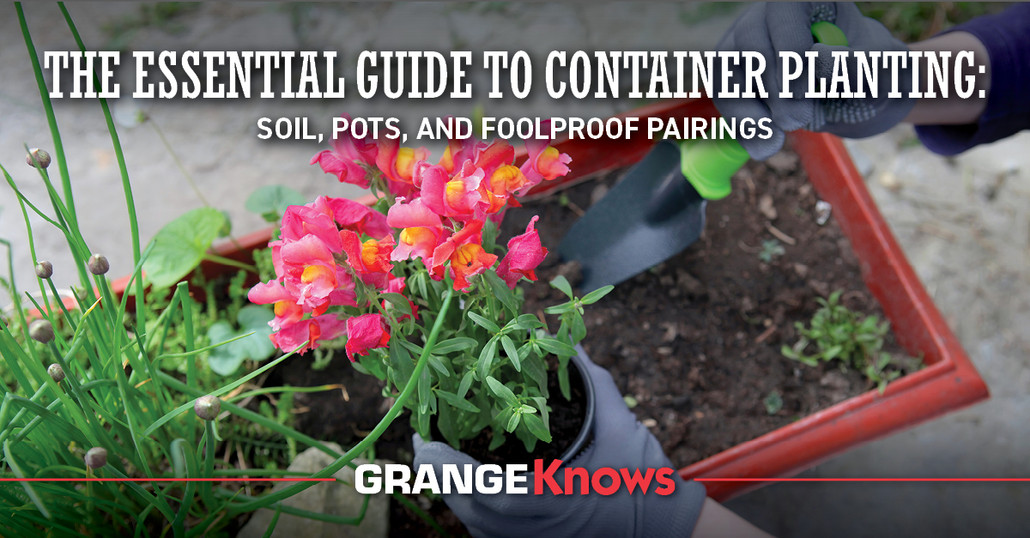
The Essential Guide to Container Planting: Soil, Pots, and Foolproof Pairings
Posted by Grange Co-op on 3rd Mar 2026
Not everyone has a ‘back 40’ to cultivate the garden of their dreams – a lot of us must make do with gardening where we can and when we can! Thankfully, container gardening is a perfectly viable option that can give even the smallest spaces a splash of color and bring us natural joy. If planned right, you can have fresh flowers blooming in your small outdoor spaces all year round!
Successful container gardening starts with the right container – while you can plant in just about anything that will hold soil, some materials will be more practical than others depending on your circumstances.
- Terra cotta pots are a time-tested option – the porous containers help wick away excess moisture and aren’t excessively heavy, but their capacity to hold moisture in the ceramic material makes them susceptible to frost damage.
- Glazed ceramic pots are much tougher, but with that comes additional weight and often a higher price. The glass-like enamel does resist scratching and minor frost cracking, but damage due to exceedingly cold temperatures is still possible.
- Metal pots have made a surge in popularity – they often take on a unique patina as they age in the elements, not unlike terra cotta, and are often much lighter than ceramic alternatives. However, they can also heat up in the summer sun, so would-be gardeners should be thoughtful of what plants are going in these and where, to prevent summer heat stress to tender seedlings.
- Wooden planter boxes are also great planting options; their size and shapes can make them less adjustable than smaller containers but like ceramic material, their porosity can help wick away excess moisture.
For all containers, a drip tray or pot feet (or both!) are recommended to reduce staining or damaging surfaces. And with all containers, drainage hole(s) are preferred. If you don’t have a drainage hole or visible overflow, you’ll never really know how much water is stagnating at the bottom of your containers and possibly rotting away your plant’s roots.
Soil is another key factor to consider. Like any well-designed garden, plants need soil that drains appropriately, provides sufficient nutrients, and contains the right amount of organic matter to maintain healthy moisture levels. Potting soils work great as a basis for all containers, and soils labeled for raised beds are a cost-effective way to fill up particularly large containers where the required volume is more than most annuals at the surface will ever tap into. All of the plants in a single container should have similar preferences for sun and water, so if you are planting up say a group of succulents, then the soil should be particularly well-draining – a base partially amended with grit or even a fully-mixed cactus blend works best.
Now that you have the right soil and your favorite planter, the best part comes next. Container gardening is an artistic exercise in cultivating a canvas of colors and textures. You can be bold, complimentary, daring, or demure. To make the plant selection a little less intimidating, start with plants that like similar growing conditions. Determine if your container will be in full sun, part-sun, or shade. Remember that a few hours of afternoon light is considered a lot more ‘sun’ than a few hours of morning light, which might be fine for plants that otherwise want to be made in the shade such as fuchsias, hostas, begonias, and ferns. Meanwhile, sun-loving annuals such as petunias, marigolds, and snapdragons have no issue being clustered together throughout summer, and will give you many months of brilliant color.
An easy rule of thumb for those needing an inspiring helping hand is the ‘Thriller, Filler, Spiller’ combination. This oft-referenced planting style uses a large plant (the ‘Thriller’) in the rear or center of the planter (think dracaena, salvias, grasses, and big coleus), several ‘Fillers’ around the container (less tall but sometimes branchier plants that group well together and add visual mass, such as lantana, impatiens, fan-flower, and dusty miller), and stunning ‘Spillers’, which are usually asymmetrically placed front-facing or around the sides of the pot, anchoring everything visually. These are some folks’ favorite flowers, such as cascading petunias and calibrachoas, ivy geraniums, bacopa, nasturtium, sweet potato vine, and lotus.)
But rules are meant to be broken! Be audacious and go monoculture – a large pot only planted with one variety of flower, or several colors of the same flower species, makes for an impressive display. Some unique specimen plants, especially perennials, can have their colors, shape, or texture further highlighted by clever container choices. A tall, dwarf conifer will look even more elegant potted up in a narrowly shaped container, lifting both it and your garden’s style sky high!
Don’t be afraid to try new things; the plants only care about having their needs met. How they look in your garden is all up to you. Annuals are one of the easiest things to explore new planting combinations with – if you don’t like it one year, try something new the next year! And remember that with the change in the seasons, you can change your container curb appeal as well. While most of the popular container gardening choices are annuals that thrive in late spring and summer, the fall season brings a bevy of choices such as mums, asters, pansies that will continue to brighten your patio into winter. Fill a pumpkin up with soil and cold-loving flowers for a cute planter that composts itself (maybe save the flowers first though!) Got the room for a small conifer on your balcony? Now you have a living Christmas tree every year. Why not throw some of your favorite bulbs underneath a planter of pansies, so that you have ANOTHER pop of color before next spring! The choices are as endless as your imagination.