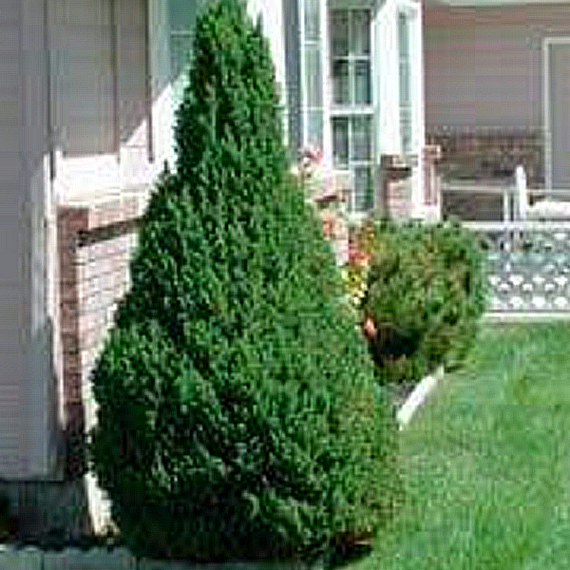
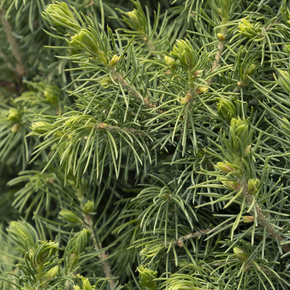


Dwarf Alberta Spruce (Picea glauca 'Conica') is one of the most beloved and instantly recognizable dwarf conifers in cultivation, prized by homeowners and landscape designers alike for its flawless, naturally cone-shaped silhouette and dense, fine-textured blue-green foliage. A spontaneous genetic mutation of the native White Spruce first discovered near Lake Laggan, Alberta, Canada in 1904, this compact cultivar maintains incredibly tight branch internodes that produce its signature miniature Christmas tree appearance without any shearing required. Growing at a leisurely 2–4 inches per year, it reaches a mature height of 8–10 feet with a spread of 3–4 feet over many decades, making it perfectly suited to smaller modern landscapes, formal gardens, and container plantings. The soft, fine needles emerge in a fresh, bright lime-green each spring before deepening into their characteristic rich blue-green for the remainder of the year, providing a striking seasonal color shift and year-round visual interest. Exceptionally cold hardy to USDA Zone 2 and deer resistant, this low-maintenance evergreen thrives in full sun to partial shade in well-drained, slightly acidic soil, and adapts readily to the diverse climates of Southern Oregon and Northern California. Whether used in symmetrical pairs at an entry, as an elegant anchor in a perennial border, or as a living holiday centerpiece on a porch or patio, Dwarf Alberta Spruce delivers timeless, refined beauty with minimal effort for generations to come.
Dwarf Alberta Spruce is a dwarf coniferous evergreen shrub boasting an exceptionally dense, perfectly pyramidal to conical growth habit that it maintains naturally throughout its long life. It is a cultivated selection — technically a spontaneous branch mutation, or "sport" — of the White Spruce (Picea glauca), a large native tree of Canada and the northern United States. While its parent species can exceed 100 feet in height, 'Conica' remains compact and refined due to its extraordinarily short branch internodes, which pack its branches tightly together and prevent the open, layered habit typical of full-size spruces. The needles are soft and fine-textured compared to most spruce species, measuring roughly 1/4 to 3/8 inch in length, and release a pleasant, mild resinous fragrance when gently crushed. Foliage color is a rich blue-green for most of the year, with a particularly attractive flush of bright, soft lime-green new growth emerging each spring. Because 'Conica' is derived from a juvenile branch, it rarely produces cones; when they do appear, they are small and typically hidden within the dense interior foliage. This cultivar was first identified in 1904 by botanists J.G. Jack and Alfred Rehder near Lake Laggan, Alberta, Canada, and has since become one of the most widely planted dwarf conifers in North American horticulture.
| Characteristic | Detail |
|---|---|
| Mature Height | 8–10 feet (can reach up to 12 feet over many decades) |
| Mature Spread | 3–4 feet |
| Growth Rate | Slow — approximately 2–4 inches per year |
| Growth Habit | Upright, densely pyramidal to conical; fills out to the ground |
| Longevity | 50 years or more under ideal conditions |
| Plant Type | Dwarf evergreen coniferous shrub |
Dwarf Alberta Spruce is exceptionally cold hardy, rated for USDA Hardiness Zones 2 through 8, tolerating minimum temperatures as low as -50°F (-46°C). It is native to the cold continental climates of Canada and the northern United States, making it one of the toughest dwarf conifers available. In Southern Oregon and Northern California it generally performs very well through Zones 6–9, though gardeners in the hottest, driest inland valleys of Zone 9 should provide afternoon shade and consistent summer moisture to prevent heat stress. It tolerates strong winds but can be susceptible to winter burn — needle desiccation caused by cold, drying winds when the ground is frozen — in exposed sites. In those situations, a windbreak planting or a loose burlap wrap during the harshest winter months offers effective protection. Somewhat tolerant of urban pollution and air quality challenges, it benefits from a relatively sheltered location wherever possible.
Dwarf Alberta Spruce performs best in full sun to partial shade, ideally receiving a minimum of 4–6 hours of direct sunlight per day. Full sun encourages the densest, most compact growth and maintains the plant's signature tight conical form. In areas with intense summer heat, such as hot inland valleys, morning sun with afternoon shade is the preferred exposure, as prolonged midday and afternoon sun can scorch the fine needles and stress the plant during summer heat waves. Insufficient light causes the branching to loosen and open up, which compromises the plant's naturally refined pyramidal silhouette. Good air circulation around the plant also helps reduce humidity-related problems and spider mite pressure.
Dwarf Alberta Spruce is adaptable to a wide range of soil types — including sandy, loamy, and clay-based soils — as long as drainage is adequate. It will not tolerate standing water or chronically waterlogged conditions, which quickly lead to root rot. The ideal soil pH falls between 6.0 and 7.0 (slightly acidic to neutral); slightly acidic conditions are preferred for optimal nutrient uptake and deep needle color. If your native soil is heavy clay, amend the backfill and the surrounding planting area with compost or coarse sand to improve drainage before planting. Slightly acidic amendments such as peat moss or sulfur can be used to lower pH in alkaline soils. A soil test is always a good first step to understanding your specific site conditions.
Consistent moisture is important for Dwarf Alberta Spruce, particularly during its establishment period and through hot, dry summer weather. Follow these general watering guidelines:
Dwarf Alberta Spruce has modest fertilizer needs. An annual application of a balanced, slow-release evergreen or conifer fertilizer in early spring — just as new growth begins to emerge — is generally all that is needed to maintain healthy, dense, richly colored foliage. Look for fertilizers formulated for acid-loving evergreens, with an N-P-K ratio such as 10-8-6 or similar. Avoid fertilizing after midsummer, as late-season feeding can stimulate soft new growth that is vulnerable to early fall frost damage. Do not over-fertilize; excessive nitrogen promotes the loose, open growth that undermines the plant's naturally compact form. A 2–3 inch layer of organic mulch such as pine bark or shredded leaves applied over the root zone also gradually enriches the soil as it decomposes, reducing the need for supplemental feeding.
One of the most appealing qualities of Dwarf Alberta Spruce is that its naturally perfect conical form requires little to no routine pruning to maintain. However, occasional light maintenance may be desirable:
Dwarf Alberta Spruce provides genuine four-season garden interest, which is one of the key reasons it has remained a landscape staple for over a century:
Few plants offer the design flexibility of Dwarf Alberta Spruce. Its naturally refined, architectural form makes it suitable for a wide array of landscape roles:
Dwarf Alberta Spruce pairs beautifully with a wide variety of plants that complement its fine texture, cool blue-green color, and formal conical form:
Dwarf Alberta Spruce is generally a healthy, long-lived plant but has a few known vulnerabilities that gardeners should watch for:
Dwarf Alberta Spruce is exceptionally well-suited to long-term container culture, making it a popular choice for porch, patio, deck, and balcony gardens. Its slow growth rate means a single container-grown specimen can remain in the same pot for many years before requiring up-sizing. Follow these guidelines for success:
As a juvenile-stage genetic variant of White Spruce, Dwarf Alberta Spruce rarely produces the seed-bearing cones that would typically attract seed-eating birds and small mammals. As a result, its direct food value for wildlife is minimal compared to its full-size parent species. However, it does provide meaningful indirect wildlife benefits:
Dwarf Alberta Spruce (Picea glauca 'Conica') is one of the most beloved and instantly recognizable dwarf conifers in cultivation, prized by homeowners and landscape designers alike for its flawless, naturally cone-shaped silhouette and dense, fine-textured blue-green foliage. A spontaneous genetic mutation of the native White Spruce first discovered near Lake Laggan, Alberta, Canada in 1904, this compact cultivar maintains incredibly tight branch internodes that produce its signature miniature Christmas tree appearance without any shearing required. Growing at a leisurely 2–4 inches per year, it reaches a mature height of 8–10 feet with a spread of 3–4 feet over many decades, making it perfectly suited to smaller modern landscapes, formal gardens, and container plantings. The soft, fine needles emerge in a fresh, bright lime-green each spring before deepening into their characteristic rich blue-green for the remainder of the year, providing a striking seasonal color shift and year-round visual interest. Exceptionally cold hardy to USDA Zone 2 and deer resistant, this low-maintenance evergreen thrives in full sun to partial shade in well-drained, slightly acidic soil, and adapts readily to the diverse climates of Southern Oregon and Northern California. Whether used in symmetrical pairs at an entry, as an elegant anchor in a perennial border, or as a living holiday centerpiece on a porch or patio, Dwarf Alberta Spruce delivers timeless, refined beauty with minimal effort for generations to come.
Dwarf Alberta Spruce is a dwarf coniferous evergreen shrub boasting an exceptionally dense, perfectly pyramidal to conical growth habit that it maintains naturally throughout its long life. It is a cultivated selection — technically a spontaneous branch mutation, or "sport" — of the White Spruce (Picea glauca), a large native tree of Canada and the northern United States. While its parent species can exceed 100 feet in height, 'Conica' remains compact and refined due to its extraordinarily short branch internodes, which pack its branches tightly together and prevent the open, layered habit typical of full-size spruces. The needles are soft and fine-textured compared to most spruce species, measuring roughly 1/4 to 3/8 inch in length, and release a pleasant, mild resinous fragrance when gently crushed. Foliage color is a rich blue-green for most of the year, with a particularly attractive flush of bright, soft lime-green new growth emerging each spring. Because 'Conica' is derived from a juvenile branch, it rarely produces cones; when they do appear, they are small and typically hidden within the dense interior foliage. This cultivar was first identified in 1904 by botanists J.G. Jack and Alfred Rehder near Lake Laggan, Alberta, Canada, and has since become one of the most widely planted dwarf conifers in North American horticulture.
| Characteristic | Detail |
|---|---|
| Mature Height | 8–10 feet (can reach up to 12 feet over many decades) |
| Mature Spread | 3–4 feet |
| Growth Rate | Slow — approximately 2–4 inches per year |
| Growth Habit | Upright, densely pyramidal to conical; fills out to the ground |
| Longevity | 50 years or more under ideal conditions |
| Plant Type | Dwarf evergreen coniferous shrub |
Dwarf Alberta Spruce is exceptionally cold hardy, rated for USDA Hardiness Zones 2 through 8, tolerating minimum temperatures as low as -50°F (-46°C). It is native to the cold continental climates of Canada and the northern United States, making it one of the toughest dwarf conifers available. In Southern Oregon and Northern California it generally performs very well through Zones 6–9, though gardeners in the hottest, driest inland valleys of Zone 9 should provide afternoon shade and consistent summer moisture to prevent heat stress. It tolerates strong winds but can be susceptible to winter burn — needle desiccation caused by cold, drying winds when the ground is frozen — in exposed sites. In those situations, a windbreak planting or a loose burlap wrap during the harshest winter months offers effective protection. Somewhat tolerant of urban pollution and air quality challenges, it benefits from a relatively sheltered location wherever possible.
Dwarf Alberta Spruce performs best in full sun to partial shade, ideally receiving a minimum of 4–6 hours of direct sunlight per day. Full sun encourages the densest, most compact growth and maintains the plant's signature tight conical form. In areas with intense summer heat, such as hot inland valleys, morning sun with afternoon shade is the preferred exposure, as prolonged midday and afternoon sun can scorch the fine needles and stress the plant during summer heat waves. Insufficient light causes the branching to loosen and open up, which compromises the plant's naturally refined pyramidal silhouette. Good air circulation around the plant also helps reduce humidity-related problems and spider mite pressure.
Dwarf Alberta Spruce is adaptable to a wide range of soil types — including sandy, loamy, and clay-based soils — as long as drainage is adequate. It will not tolerate standing water or chronically waterlogged conditions, which quickly lead to root rot. The ideal soil pH falls between 6.0 and 7.0 (slightly acidic to neutral); slightly acidic conditions are preferred for optimal nutrient uptake and deep needle color. If your native soil is heavy clay, amend the backfill and the surrounding planting area with compost or coarse sand to improve drainage before planting. Slightly acidic amendments such as peat moss or sulfur can be used to lower pH in alkaline soils. A soil test is always a good first step to understanding your specific site conditions.
Consistent moisture is important for Dwarf Alberta Spruce, particularly during its establishment period and through hot, dry summer weather. Follow these general watering guidelines:
Dwarf Alberta Spruce has modest fertilizer needs. An annual application of a balanced, slow-release evergreen or conifer fertilizer in early spring — just as new growth begins to emerge — is generally all that is needed to maintain healthy, dense, richly colored foliage. Look for fertilizers formulated for acid-loving evergreens, with an N-P-K ratio such as 10-8-6 or similar. Avoid fertilizing after midsummer, as late-season feeding can stimulate soft new growth that is vulnerable to early fall frost damage. Do not over-fertilize; excessive nitrogen promotes the loose, open growth that undermines the plant's naturally compact form. A 2–3 inch layer of organic mulch such as pine bark or shredded leaves applied over the root zone also gradually enriches the soil as it decomposes, reducing the need for supplemental feeding.
One of the most appealing qualities of Dwarf Alberta Spruce is that its naturally perfect conical form requires little to no routine pruning to maintain. However, occasional light maintenance may be desirable:
Dwarf Alberta Spruce provides genuine four-season garden interest, which is one of the key reasons it has remained a landscape staple for over a century:
Few plants offer the design flexibility of Dwarf Alberta Spruce. Its naturally refined, architectural form makes it suitable for a wide array of landscape roles:
Dwarf Alberta Spruce pairs beautifully with a wide variety of plants that complement its fine texture, cool blue-green color, and formal conical form:
Dwarf Alberta Spruce is generally a healthy, long-lived plant but has a few known vulnerabilities that gardeners should watch for:
Dwarf Alberta Spruce is exceptionally well-suited to long-term container culture, making it a popular choice for porch, patio, deck, and balcony gardens. Its slow growth rate means a single container-grown specimen can remain in the same pot for many years before requiring up-sizing. Follow these guidelines for success:
As a juvenile-stage genetic variant of White Spruce, Dwarf Alberta Spruce rarely produces the seed-bearing cones that would typically attract seed-eating birds and small mammals. As a result, its direct food value for wildlife is minimal compared to its full-size parent species. However, it does provide meaningful indirect wildlife benefits: