

Zoom the image with the mouse
Coco Chill Weigela - 1 Gallon
SKU:
2099695
UPC:
014949488966
$19.99
- Exceptionally cold-hardy compact shrub with striking deep burgundy to near-black foliage that emerges dark red in spring and deepens through summer, offering four-season color impact
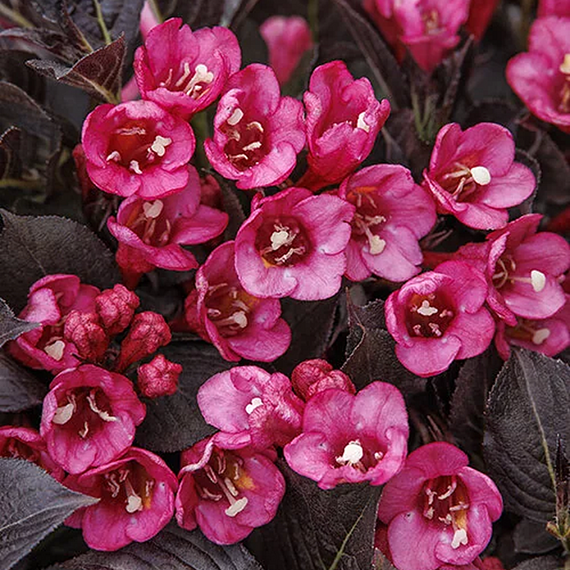
- Showy clusters of pink trumpet-shaped flowers with vivid red throats light up the garden from late spring to early summer, irresistibly drawing hummingbirds to the yard
- Dense, naturally mounded form reaches a tidy 3 feet tall and wide with no need for facer plants, making it a low-maintenance fit for borders, foundation plantings, and containers
- Outstanding urban and climate adaptability — tolerates pollution, is not fussy about soil type, and carries exceptional cold hardiness thanks to its Canadian breeding heritage
Coco Chill Weigela (Weigela florida 'VBL1') is a standout compact deciduous shrub that delivers bold, season-long ornamental interest through its extraordinary combination of dark foliage and vivid blooms. This superior variety develops a neat, symmetrical mound of deep ruby-red to burgundy leaves accented with rich green veins and hints of black — foliage that emerges dark red in spring, intensifies through summer, and transforms to a brilliant dark red again in fall, making it one of the most visually dynamic shrubs in any four-season garden. In late spring to early summer, the branches are blanketed in showy clusters of pink, trumpet-shaped flowers with contrasting red throats that emerge from distinctive crimson buds, creating a vivid display that reliably attracts hummingbirds. Bred with Canadian genetics for exceptional cold hardiness into USDA Zone 4a, Coco Chill Weigela thrives where other dark-foliaged weigelas may struggle, bringing reliable performance to a wide range of climates. Its refined, relatively fine-textured foliage sets it apart from coarser landscape shrubs, while its adaptability to average soils, urban environments, and container culture makes it a versatile choice for mixed borders, mass plantings, foundation settings, and patio container displays throughout Southern Oregon and Northern California gardens.
Plant Description
Coco Chill Weigela is a dense, multi-stemmed deciduous shrub with a naturally mounded, symmetrical form. Its glossy, pointed leaves are among the most ornamental of any compact weigela — emerging a rich dark red in spring, deepening to deep burgundy with green veins and dark undertones through summer, and returning to a stunning dark red in autumn before leaf drop. The dark red stems themselves add winter structure and subtle visual interest when the plant is bare. From late spring into early summer, showy clusters of pink, trumpet-shaped flowers with red throats line the branches, emerging from striking crimson flower buds. Its relatively fine foliage texture creates an elegant contrast to coarser-leaved companion plants in mixed borders. This is a selected cultivar bred with Canadian parentage specifically to combine striking dark foliage with outstanding cold hardiness — a pairing that sets it apart from many other ornamental weigelas.
Mature Size and Growth Rate
Coco Chill Weigela grows to a mature height and spread of approximately 3 feet, forming a compact, well-rounded mound. It grows at a medium rate and tends to fill out right to the ground, eliminating the need for low facer plants in front of it. Under favorable conditions, this shrub can be expected to live for approximately 30 years, making it a reliable long-term investment in the landscape.
Hardiness Zones
Coco Chill Weigela is hardy in USDA Zones 4a through 8. Its exceptional cold hardiness is directly attributed to its Canadian breeding parentage, allowing it to withstand harsh winters that can challenge other dark-foliaged weigela cultivars. In the warmest zones (Zone 8 and above), provide some afternoon shade to reduce heat stress. Late spring frosts after bud break may damage the season's flower buds without harming the plant long term — a lightweight frost cloth can protect blooms during unexpected late freezes.
Sunlight Requirements
Coco Chill Weigela performs best and produces the most abundant blooms in full sun, requiring a minimum of 6 hours of direct sunlight per day. Full sun also intensifies the deep burgundy-to-near-black foliage color for which this cultivar is prized — plants in partial shade tend to produce muddier, less dramatic leaf tones and significantly fewer flowers. In hotter inland climates, light afternoon shade can reduce stress, but morning sun with some afternoon protection should still allow the plant to thrive. Avoid deep shade, which results in sparse flowering and leggy growth.
Soil and pH Preferences
This adaptable shrub is not fussy about soil type and will grow in loam, clay, or sandy ground, provided drainage is adequate. Standing water or consistently waterlogged soil should be avoided, as it can lead to root rot. The ideal soil pH range is 5.5 to 7.0 (slightly acidic to neutral). Outside this range — particularly in highly alkaline soils above pH 7.5 — the plant may develop interveinal chlorosis, where leaves yellow while the veins remain green due to impaired iron and manganese uptake. Coco Chill Weigela is highly tolerant of urban soil conditions and pollution, making it suitable for city and suburban landscapes alike. At planting time, incorporating bonemeal and/or mycorrhizal inoculant into the backfill can support healthy root establishment.
Watering Guide
Newly planted Coco Chill Weigela requires consistent moisture throughout its first growing season — approximately 1 inch of water per week from rainfall or supplemental irrigation. Once established (typically after one full year in the ground), it is reasonably drought tolerant and requires deep watering only during extended dry spells. In hot, dry inland climates, a thorough soak of the root zone every 10 to 14 days during summer is recommended to prevent stress and support flower bud development for the following season. The best watering approach is a slow, deep soak once or twice per week rather than frequent shallow waterings, encouraging deep root development. Avoid overwatering — yellowing leaves, wilting despite wet soil, and failure to thrive can all indicate root rot from saturated conditions. When grown in containers, water more frequently, as pots dry out considerably faster than in-ground plantings.
Fertilizing
Apply a balanced, slow-release granular fertilizer (such as a 10-10-10 formulation) once in early spring as the buds begin to swell. Work it lightly into the soil around the drip line — not directly against the stems — and water it in thoroughly. At planting time, incorporate bonemeal and/or mycorrhizal fertilizer into the backfill to encourage strong root establishment. Avoid high-nitrogen fertilizers or over-fertilization, which promotes excessive leafy growth at the expense of flower production. Plants growing in naturally nutrient-rich soil may require little to no supplemental feeding — use healthy, vigorous growth as your guide. Mulching with several inches of organic material around the base helps retain soil moisture, moderate temperature, suppress weeds, and slowly improve soil fertility over time.
Pruning and Maintenance
Proper pruning timing is the single most critical aspect of Coco Chill Weigela care. This shrub blooms on old wood — the stems produced during the previous growing season. Flower buds for the following spring are set on new summer growth after the current season's blooms fade. Pruning in fall, winter, or early spring removes these buds and results in little to no bloom the following year.
- After flowering (late spring to early summer): Prune lightly to shape the plant immediately after the last flowers fade — ideally within two weeks. Cut stems back to a healthy set of side shoots or a branch junction, never mid-stem. This gives the plant the entire summer to produce new growth that will carry next year's flower buds.
- Early spring cleanup: Remove any dead, damaged, or crossing branches as the plant begins to leaf out. Coco Chill's compact size means this is typically minimal.
- Every 2 to 3 years: For rejuvenation, remove up to one-third of the oldest, thickest stems at the base in early spring to stimulate vigorous new growth. Flowering returns fully within one to two seasons.
Avoid shearing this shrub into formal shapes — this removes most of the flowering wood and destroys its naturally attractive mounded habit. Its compact, self-shaping growth means heavy pruning is rarely needed.
Planting Instructions
For best results, plant Coco Chill Weigela in spring after the last frost date or in early fall at least 6 weeks before the first expected frost. Follow these steps for successful establishment:
- Select a site with full sun and well-draining soil.
- Dig a hole as deep as the root ball and 2 to 3 times as wide.
- If soil drainage is poor, raise the planting area slightly or amend with organic matter to improve structure.
- Mix bonemeal and/or mycorrhizal inoculant into the backfill at the recommended rates.
- If the root ball is rootbound, gently tease out the outer roots or make several shallow vertical cuts before planting.
- Set the plant so the top of the root ball sits at or very slightly above the surrounding soil level — never below.
- Backfill, firm the soil to eliminate air pockets, and water thoroughly and deeply.
- Apply 2 to 3 inches of organic mulch in a ring around the plant, keeping mulch several inches away from the base of the stems to prevent crown rot.
- Water consistently throughout the first growing season until the plant is well established.
Seasonal Interest
| Season | Ornamental Features |
|---|---|
| Spring | Foliage emerges a rich dark red; showy clusters of pink trumpet-shaped flowers with red throats open from crimson buds; hummingbirds arrive |
| Early Summer | Bloom display continues into early summer; foliage deepens to rich burgundy with dark veining and near-black undertones |
| Summer | Dense, deeply colored burgundy-to-near-black foliage provides bold contrast in the landscape; dark red stems begin to show |
| Fall | Glossy leaves turn an outstanding dark red before dropping; dark stems add architectural structure |
| Winter | Dark red stems provide subtle structure and branching interest in the dormant garden |
Landscape Uses
Coco Chill Weigela is a highly versatile landscape shrub suited to a wide range of design applications:
- Mixed shrub borders: The deep burgundy foliage creates dramatic contrast among green-leafed neighbors and acts as a bold anchor in the middle or back of a mixed border.
- Foundation plantings: Its compact, self-contained 3-foot mound is well-scaled for home foundations without obstructing windows or overpowering entryways.
- Mass plantings: Grouped in threes or fives, Coco Chill creates a stunning sweep of dark foliage and spring color that reads beautifully at a landscape scale.
- Border edging: Its naturally tidy mounded habit makes it effective as a repeated edging element along walkways, driveways, or garden bed perimeters.
- Accent specimen: Planted alone against a light-colored wall, fence, or lighter-foliaged backdrop, the dark leaves and vivid pink blooms make a powerful focal point.
- Container planting: Well-suited as a "thriller" in the spiller-thriller-filler container design approach; sizeable enough to anchor a large patio planter on its own.
- Urban and streetside gardens: Excellent tolerance for pollution and a wide range of soil conditions makes it a reliable choice for city gardens and urban landscapes.
Container Growing
Coco Chill Weigela is a strong performer in outdoor pots and containers due to its compact, self-contained habit. Because of its mature height, it works especially well as the "thriller" element in a spiller-thriller-filler container combination — position it near the center of a large pot and surround it with lower, cascading companions. It is also sizeable and ornamental enough to be grown alone as a statement specimen in a decorative container. Key tips for container success:
- Choose a container at least twice the width of the root ball with adequate drainage holes.
- Use a high-quality, well-draining potting mix.
- Water more frequently than in-ground plantings — containers dry out much faster, especially in summer heat; check moisture every few days during hot weather.
- Apply a balanced slow-release fertilizer in spring, as container plants exhaust nutrients more quickly than garden plants.
- In colder winters, move containers to a sheltered, frost-protected location such as an unheated garage or shed, as roots in containers experience colder temperatures than in-ground plants and may not survive hard freezes even within the plant's rated hardiness zone.
Companion Plants
The deep burgundy foliage and pink-and-red blooms of Coco Chill Weigela pair beautifully with a wide range of plants. Consider these proven companions for spectacular combinations:
- Spirea (Spiraea spp.): White-flowered spireas such as 'Snowmound' or Bridal Wreath bloom at the same time and create a stunning contrast against the dark foliage.
- Blue Star Juniper or Golden Charm Cypress: Cool blue or chartreuse-gold conifers pop dramatically against the dark burgundy leaves of Coco Chill.
- Blue-flowered Hydrangea: The bold blue blooms of a bigleaf or panicle hydrangea make a dazzling summer pairing with Coco Chill's deep foliage tones.
- Perennial Salvia: Salvias begin to bloom as weigela finishes, extending the season-long show while sharing a love of full sun and attracting the same pollinators.
- Ornamental Grasses: Fine-textured grasses such as Karl Foerster feather reed grass or blue oat grass provide elegant foliage contrast and movement alongside the mounded weigela form.
- Peonies, Bearded Iris, and Rhododendrons: These classic spring bloomers share the same late-spring flowering window, creating a layered and colorful spring garden display.
- Delphinium and Spikes of Blue or Purple Perennials: Vertical blue and purple blooms create stunning complementary contrast with the rounded dark-foliaged weigela form.
Wildlife Value
Coco Chill Weigela is a reliable wildlife magnet, particularly celebrated for its value to hummingbirds. The trumpet-shaped flowers are perfectly designed for hummingbird feeding, and the spring bloom season — timed to coincide with the northward migration of rufous and other hummingbird species in the Pacific Northwest and Northern California — makes this shrub a prime stopover and garden destination. Bees and butterflies are also attracted to the abundant nectar-rich blooms, supporting pollinator populations through the critical late-spring season. The dense branching structure can provide nesting habitat for small songbirds. Weigela is not considered toxic to pets, livestock, or children, making it a safe and family-friendly landscape plant.
Pests and Diseases
Coco Chill Weigela is generally a robust, low-maintenance shrub with no significant pest or disease vulnerabilities when planted in appropriate conditions. The following issues may occasionally arise:
- Aphids: Cluster on soft new growth in spring and early summer. Look for curled shoot tips, sticky honeydew, or black sooty mold. Treat with a strong jet of water, insecticidal soap, or neem oil applied to leaf undersides.
- Spider Mites: More common in hot, dry conditions. Yellow-bronze stippling on leaf surfaces and fine webbing are telltale signs. Increase humidity and apply neem oil or a registered miticide to leaf undersides.
- Japanese Beetles: Can skeletonize foliage during midsummer. Hand-pick in the morning, or apply neem oil as a deterrent early in the season. Avoid using Japanese beetle traps near the planting — they attract more beetles than they trap.
- Scale Insects: Appear as waxy bumps on stems; cause yellowing and stunted growth. Treat with horticultural oil during dormancy or rubbing alcohol applied directly to small infestations.
- Powdery Mildew / Fungal Leaf Spot: Rare in well-sited plants with adequate air circulation. Improve airflow through selective pruning and avoid overhead watering during bloom.
- Root Rot (Phytophthora, Pythium): Caused by consistently waterlogged soil. Prevent by ensuring excellent drainage at planting. Symptoms include wilting despite wet soil and yellowing leaves.
Weigela is generally considered deer-resistant, though hungry deer in low-food conditions may occasionally browse tips. No significant toxicity concerns exist for humans or pets.
- Exceptionally cold-hardy compact shrub with striking deep burgundy to near-black foliage that emerges dark red in spring and deepens through summer, offering four-season color impact
- Showy clusters of pink trumpet-shaped flowers with vivid red throats light up the garden from late spring to early summer, irresistibly drawing hummingbirds to the yard
- Dense, naturally mounded form reaches a tidy 3 feet tall and wide with no need for facer plants, making it a low-maintenance fit for borders, foundation plantings, and containers
- Outstanding urban and climate adaptability — tolerates pollution, is not fussy about soil type, and carries exceptional cold hardiness thanks to its Canadian breeding heritage
Coco Chill Weigela (Weigela florida 'VBL1') is a standout compact deciduous shrub that delivers bold, season-long ornamental interest through its extraordinary combination of dark foliage and vivid blooms. This superior variety develops a neat, symmetrical mound of deep ruby-red to burgundy leaves accented with rich green veins and hints of black — foliage that emerges dark red in spring, intensifies through summer, and transforms to a brilliant dark red again in fall, making it one of the most visually dynamic shrubs in any four-season garden. In late spring to early summer, the branches are blanketed in showy clusters of pink, trumpet-shaped flowers with contrasting red throats that emerge from distinctive crimson buds, creating a vivid display that reliably attracts hummingbirds. Bred with Canadian genetics for exceptional cold hardiness into USDA Zone 4a, Coco Chill Weigela thrives where other dark-foliaged weigelas may struggle, bringing reliable performance to a wide range of climates. Its refined, relatively fine-textured foliage sets it apart from coarser landscape shrubs, while its adaptability to average soils, urban environments, and container culture makes it a versatile choice for mixed borders, mass plantings, foundation settings, and patio container displays throughout Southern Oregon and Northern California gardens.
Plant Description
Coco Chill Weigela is a dense, multi-stemmed deciduous shrub with a naturally mounded, symmetrical form. Its glossy, pointed leaves are among the most ornamental of any compact weigela — emerging a rich dark red in spring, deepening to deep burgundy with green veins and dark undertones through summer, and returning to a stunning dark red in autumn before leaf drop. The dark red stems themselves add winter structure and subtle visual interest when the plant is bare. From late spring into early summer, showy clusters of pink, trumpet-shaped flowers with red throats line the branches, emerging from striking crimson flower buds. Its relatively fine foliage texture creates an elegant contrast to coarser-leaved companion plants in mixed borders. This is a selected cultivar bred with Canadian parentage specifically to combine striking dark foliage with outstanding cold hardiness — a pairing that sets it apart from many other ornamental weigelas.
Mature Size and Growth Rate
Coco Chill Weigela grows to a mature height and spread of approximately 3 feet, forming a compact, well-rounded mound. It grows at a medium rate and tends to fill out right to the ground, eliminating the need for low facer plants in front of it. Under favorable conditions, this shrub can be expected to live for approximately 30 years, making it a reliable long-term investment in the landscape.
Hardiness Zones
Coco Chill Weigela is hardy in USDA Zones 4a through 8. Its exceptional cold hardiness is directly attributed to its Canadian breeding parentage, allowing it to withstand harsh winters that can challenge other dark-foliaged weigela cultivars. In the warmest zones (Zone 8 and above), provide some afternoon shade to reduce heat stress. Late spring frosts after bud break may damage the season's flower buds without harming the plant long term — a lightweight frost cloth can protect blooms during unexpected late freezes.
Sunlight Requirements
Coco Chill Weigela performs best and produces the most abundant blooms in full sun, requiring a minimum of 6 hours of direct sunlight per day. Full sun also intensifies the deep burgundy-to-near-black foliage color for which this cultivar is prized — plants in partial shade tend to produce muddier, less dramatic leaf tones and significantly fewer flowers. In hotter inland climates, light afternoon shade can reduce stress, but morning sun with some afternoon protection should still allow the plant to thrive. Avoid deep shade, which results in sparse flowering and leggy growth.
Soil and pH Preferences
This adaptable shrub is not fussy about soil type and will grow in loam, clay, or sandy ground, provided drainage is adequate. Standing water or consistently waterlogged soil should be avoided, as it can lead to root rot. The ideal soil pH range is 5.5 to 7.0 (slightly acidic to neutral). Outside this range — particularly in highly alkaline soils above pH 7.5 — the plant may develop interveinal chlorosis, where leaves yellow while the veins remain green due to impaired iron and manganese uptake. Coco Chill Weigela is highly tolerant of urban soil conditions and pollution, making it suitable for city and suburban landscapes alike. At planting time, incorporating bonemeal and/or mycorrhizal inoculant into the backfill can support healthy root establishment.
Watering Guide
Newly planted Coco Chill Weigela requires consistent moisture throughout its first growing season — approximately 1 inch of water per week from rainfall or supplemental irrigation. Once established (typically after one full year in the ground), it is reasonably drought tolerant and requires deep watering only during extended dry spells. In hot, dry inland climates, a thorough soak of the root zone every 10 to 14 days during summer is recommended to prevent stress and support flower bud development for the following season. The best watering approach is a slow, deep soak once or twice per week rather than frequent shallow waterings, encouraging deep root development. Avoid overwatering — yellowing leaves, wilting despite wet soil, and failure to thrive can all indicate root rot from saturated conditions. When grown in containers, water more frequently, as pots dry out considerably faster than in-ground plantings.
Fertilizing
Apply a balanced, slow-release granular fertilizer (such as a 10-10-10 formulation) once in early spring as the buds begin to swell. Work it lightly into the soil around the drip line — not directly against the stems — and water it in thoroughly. At planting time, incorporate bonemeal and/or mycorrhizal fertilizer into the backfill to encourage strong root establishment. Avoid high-nitrogen fertilizers or over-fertilization, which promotes excessive leafy growth at the expense of flower production. Plants growing in naturally nutrient-rich soil may require little to no supplemental feeding — use healthy, vigorous growth as your guide. Mulching with several inches of organic material around the base helps retain soil moisture, moderate temperature, suppress weeds, and slowly improve soil fertility over time.
Pruning and Maintenance
Proper pruning timing is the single most critical aspect of Coco Chill Weigela care. This shrub blooms on old wood — the stems produced during the previous growing season. Flower buds for the following spring are set on new summer growth after the current season's blooms fade. Pruning in fall, winter, or early spring removes these buds and results in little to no bloom the following year.
- After flowering (late spring to early summer): Prune lightly to shape the plant immediately after the last flowers fade — ideally within two weeks. Cut stems back to a healthy set of side shoots or a branch junction, never mid-stem. This gives the plant the entire summer to produce new growth that will carry next year's flower buds.
- Early spring cleanup: Remove any dead, damaged, or crossing branches as the plant begins to leaf out. Coco Chill's compact size means this is typically minimal.
- Every 2 to 3 years: For rejuvenation, remove up to one-third of the oldest, thickest stems at the base in early spring to stimulate vigorous new growth. Flowering returns fully within one to two seasons.
Avoid shearing this shrub into formal shapes — this removes most of the flowering wood and destroys its naturally attractive mounded habit. Its compact, self-shaping growth means heavy pruning is rarely needed.
Planting Instructions
For best results, plant Coco Chill Weigela in spring after the last frost date or in early fall at least 6 weeks before the first expected frost. Follow these steps for successful establishment:
- Select a site with full sun and well-draining soil.
- Dig a hole as deep as the root ball and 2 to 3 times as wide.
- If soil drainage is poor, raise the planting area slightly or amend with organic matter to improve structure.
- Mix bonemeal and/or mycorrhizal inoculant into the backfill at the recommended rates.
- If the root ball is rootbound, gently tease out the outer roots or make several shallow vertical cuts before planting.
- Set the plant so the top of the root ball sits at or very slightly above the surrounding soil level — never below.
- Backfill, firm the soil to eliminate air pockets, and water thoroughly and deeply.
- Apply 2 to 3 inches of organic mulch in a ring around the plant, keeping mulch several inches away from the base of the stems to prevent crown rot.
- Water consistently throughout the first growing season until the plant is well established.
Seasonal Interest
| Season | Ornamental Features |
|---|---|
| Spring | Foliage emerges a rich dark red; showy clusters of pink trumpet-shaped flowers with red throats open from crimson buds; hummingbirds arrive |
| Early Summer | Bloom display continues into early summer; foliage deepens to rich burgundy with dark veining and near-black undertones |
| Summer | Dense, deeply colored burgundy-to-near-black foliage provides bold contrast in the landscape; dark red stems begin to show |
| Fall | Glossy leaves turn an outstanding dark red before dropping; dark stems add architectural structure |
| Winter | Dark red stems provide subtle structure and branching interest in the dormant garden |
Landscape Uses
Coco Chill Weigela is a highly versatile landscape shrub suited to a wide range of design applications:
- Mixed shrub borders: The deep burgundy foliage creates dramatic contrast among green-leafed neighbors and acts as a bold anchor in the middle or back of a mixed border.
- Foundation plantings: Its compact, self-contained 3-foot mound is well-scaled for home foundations without obstructing windows or overpowering entryways.
- Mass plantings: Grouped in threes or fives, Coco Chill creates a stunning sweep of dark foliage and spring color that reads beautifully at a landscape scale.
- Border edging: Its naturally tidy mounded habit makes it effective as a repeated edging element along walkways, driveways, or garden bed perimeters.
- Accent specimen: Planted alone against a light-colored wall, fence, or lighter-foliaged backdrop, the dark leaves and vivid pink blooms make a powerful focal point.
- Container planting: Well-suited as a "thriller" in the spiller-thriller-filler container design approach; sizeable enough to anchor a large patio planter on its own.
- Urban and streetside gardens: Excellent tolerance for pollution and a wide range of soil conditions makes it a reliable choice for city gardens and urban landscapes.
Container Growing
Coco Chill Weigela is a strong performer in outdoor pots and containers due to its compact, self-contained habit. Because of its mature height, it works especially well as the "thriller" element in a spiller-thriller-filler container combination — position it near the center of a large pot and surround it with lower, cascading companions. It is also sizeable and ornamental enough to be grown alone as a statement specimen in a decorative container. Key tips for container success:
- Choose a container at least twice the width of the root ball with adequate drainage holes.
- Use a high-quality, well-draining potting mix.
- Water more frequently than in-ground plantings — containers dry out much faster, especially in summer heat; check moisture every few days during hot weather.
- Apply a balanced slow-release fertilizer in spring, as container plants exhaust nutrients more quickly than garden plants.
- In colder winters, move containers to a sheltered, frost-protected location such as an unheated garage or shed, as roots in containers experience colder temperatures than in-ground plants and may not survive hard freezes even within the plant's rated hardiness zone.
Companion Plants
The deep burgundy foliage and pink-and-red blooms of Coco Chill Weigela pair beautifully with a wide range of plants. Consider these proven companions for spectacular combinations:
- Spirea (Spiraea spp.): White-flowered spireas such as 'Snowmound' or Bridal Wreath bloom at the same time and create a stunning contrast against the dark foliage.
- Blue Star Juniper or Golden Charm Cypress: Cool blue or chartreuse-gold conifers pop dramatically against the dark burgundy leaves of Coco Chill.
- Blue-flowered Hydrangea: The bold blue blooms of a bigleaf or panicle hydrangea make a dazzling summer pairing with Coco Chill's deep foliage tones.
- Perennial Salvia: Salvias begin to bloom as weigela finishes, extending the season-long show while sharing a love of full sun and attracting the same pollinators.
- Ornamental Grasses: Fine-textured grasses such as Karl Foerster feather reed grass or blue oat grass provide elegant foliage contrast and movement alongside the mounded weigela form.
- Peonies, Bearded Iris, and Rhododendrons: These classic spring bloomers share the same late-spring flowering window, creating a layered and colorful spring garden display.
- Delphinium and Spikes of Blue or Purple Perennials: Vertical blue and purple blooms create stunning complementary contrast with the rounded dark-foliaged weigela form.
Wildlife Value
Coco Chill Weigela is a reliable wildlife magnet, particularly celebrated for its value to hummingbirds. The trumpet-shaped flowers are perfectly designed for hummingbird feeding, and the spring bloom season — timed to coincide with the northward migration of rufous and other hummingbird species in the Pacific Northwest and Northern California — makes this shrub a prime stopover and garden destination. Bees and butterflies are also attracted to the abundant nectar-rich blooms, supporting pollinator populations through the critical late-spring season. The dense branching structure can provide nesting habitat for small songbirds. Weigela is not considered toxic to pets, livestock, or children, making it a safe and family-friendly landscape plant.
Pests and Diseases
Coco Chill Weigela is generally a robust, low-maintenance shrub with no significant pest or disease vulnerabilities when planted in appropriate conditions. The following issues may occasionally arise:
- Aphids: Cluster on soft new growth in spring and early summer. Look for curled shoot tips, sticky honeydew, or black sooty mold. Treat with a strong jet of water, insecticidal soap, or neem oil applied to leaf undersides.
- Spider Mites: More common in hot, dry conditions. Yellow-bronze stippling on leaf surfaces and fine webbing are telltale signs. Increase humidity and apply neem oil or a registered miticide to leaf undersides.
- Japanese Beetles: Can skeletonize foliage during midsummer. Hand-pick in the morning, or apply neem oil as a deterrent early in the season. Avoid using Japanese beetle traps near the planting — they attract more beetles than they trap.
- Scale Insects: Appear as waxy bumps on stems; cause yellowing and stunted growth. Treat with horticultural oil during dormancy or rubbing alcohol applied directly to small infestations.
- Powdery Mildew / Fungal Leaf Spot: Rare in well-sited plants with adequate air circulation. Improve airflow through selective pruning and avoid overhead watering during bloom.
- Root Rot (Phytophthora, Pythium): Caused by consistently waterlogged soil. Prevent by ensuring excellent drainage at planting. Symptoms include wilting despite wet soil and yellowing leaves.
Weigela is generally considered deer-resistant, though hungry deer in low-food conditions may occasionally browse tips. No significant toxicity concerns exist for humans or pets.
Related Products