Zoom the image with the mouse
Goldflame Honeysuckle - 2 Gallon
SKU:
2012790
UPC:
753768068019
$39.99
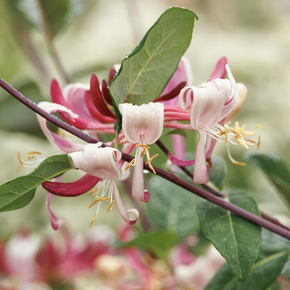
- Stunning two-toned tubular flowers in deep rose-pink with golden-yellow interiors bloom continuously from early summer through fall, filling the garden with a rich, sweet fragrance
- A vigorous, non-invasive twining vine that can be trained on trellises, arbors, fences, and pergolas or pruned into a dense, free-standing shrub
- Irresistible to hummingbirds and butterflies, making it an exceptional choice for pollinator, cottage, and wildlife-friendly gardens
- Low-maintenance, deer-resistant, and adaptable to a wide range of soils, with strong drought tolerance once established
Goldflame Honeysuckle (Lonicera x heckrottii 'Goldflame') is one of the most celebrated and sweetly fragrant climbing vines available to home gardeners, earning recognition as an Award of Garden Merit recipient from the Royal Horticultural Society and praised by renowned horticulturist Michael Dirr as "the most handsome of the climbing honeysuckles." This vigorous hybrid twining vine produces an abundance of elegant, 2-inch tubular flowers that emerge from deep reddish-purple buds and open to reveal rich rose-pink exteriors with glowing orange-yellow to golden throats, blooming in showy terminal whorls from early summer all the way through fall. The intensely fragrant blossoms are a proven magnet for hummingbirds and butterflies, while glossy, oval blue-green leaves on contrasting reddish stems provide lush, attractive foliage throughout the growing season. Semi-evergreen in the mild winters of Southern Oregon and Northern California, Goldflame Honeysuckle is equally at home scrambling up a garden trellis, cloaking a pergola or fence with color, or pruned into a compact, rounded shrub for smaller spaces. Hardy in USDA Zones 5-9, adaptable to a variety of soil types, and notably resistant to deer, drought once established, and most pests and diseases, this exceptional vine delivers season-long beauty and fragrance with minimal care.
Plant Description
Goldflame Honeysuckle is a hybrid twining vine (Lonicera x heckrottii 'Goldflame'), believed to be a cross involving L. americana, L. sempervirens, and possibly L. caprifolium and L. etrusca. It is a woody, perennial vine that twines vigorously around any support structure it can reach. The stems are slender and reddish, giving the plant an ornamental quality even when not in flower. The foliage consists of simple, opposite, oblong to elliptical leaves up to 2 inches long, smooth in texture, and a lustrous blue-green on top with a slightly paler, glaucous underside. Young leaves emerge bright green with a purplish-red tinge and mature to deep blue-green. The uppermost leaves just beneath each flower cluster are connate, meaning they are fused together to form a disk around the stem, a distinctive feature of the species. In the mild winters of Southern Oregon and Northern California, the plant often retains much of its foliage and behaves as a semi-evergreen. In colder portions of its range it drops its leaves in late autumn. The overall texture of the vine is medium and the growth habit is spreading and climbing, giving it an informal, romantic character that suits cottage-style and naturalistic landscapes beautifully.
Flowers and Fragrance
The flowers of Goldflame Honeysuckle are among the most striking and fragrant of any garden vine. The tubular blossoms measure 1.5 to 2 inches in length and are flushed deep rose-pink to carmine on the outside, opening to reveal warm orange-yellow to golden-yellow interiors. Flower buds are a rich reddish-purple, adding to the bicolor drama. Blooms are held in abundant terminal whorls atop the vine's growing tips and are sweetly and richly fragrant, making them especially enjoyable when planted near a patio, entryway, or window where the scent can be savored. The main flush of flowering runs from early to midsummer, with peak bloom typically in June through August, and the vine continues to produce flowers on new growth into fall, making it one of the longest-blooming honeysuckles available. Spent flowers may occasionally give way to small, inedible red berries in autumn, though this hybrid rarely produces fruit in abundance. Planting in full sun maximizes the number and intensity of blooms; flowering is noticeably reduced in shadier conditions.
Mature Size
| Characteristic | Measurement |
|---|---|
| Mature Height (as vine) | 10 to 15 feet |
| Mature Spread | 3 to 6 feet |
| Height (if pruned as shrub) | 4 to 6 feet |
| Growth Rate | Moderate to rapid |
| Plant Type | Woody perennial twining vine or shrub |
Goldflame Honeysuckle is a vigorous grower that can expand its spread significantly within a single growing season once established. It does not cling to smooth walls on its own and requires a trellis, fence, arbor, or other structure with horizontal support elements around which its stems can twine. If left unsupported, it will sprawl as a mounding ground cover. When grown as a vine against a structure, it reaches a manageable 10 to 15 feet in height. It can be kept smaller through regular pruning and shaped into a dense, free-standing rounded shrub in the 4 to 6 foot range — a versatile quality that makes it suitable for a wide range of garden settings.
Hardiness Zones and Climate
Goldflame Honeysuckle is reliably hardy in USDA Hardiness Zones 5 through 9 and performs beautifully throughout Southern Oregon and Northern California, which fall primarily within Zones 7 to 9. It tolerates the warm, dry summers of the region and handles both the cooler inland winters and mild coastal winters without difficulty. In warmer areas of its range (Zones 7-9), the plant is semi-evergreen, often retaining a significant portion of its leaves through the winter months. In Zone 5, plants should be sited in a sheltered location to ensure reliable winter survival. The vine is also notably adaptable to heat, performing well across a broad range of AHS Heat Zones (6 through 9). Research conducted in semi-arid, high-elevation climates has confirmed this honeysuckle's strong adaptability even under conditions of heat stress and reduced irrigation, making it an excellent candidate for water-conscious landscapes in the Pacific Coast states.
Sunlight Requirements
Goldflame Honeysuckle performs best in full sun, defined as 6 or more hours of direct sunlight per day. Full sun exposure produces the most prolific flowering, the most intense flower color, and the healthiest, most vigorous growth. It will also grow in partial shade (2 to 6 hours of direct sun), but flower production will be noticeably reduced and the plant may have a looser, more open form. In the hotter inland valleys of Southern Oregon and Northern California, a site with morning sun and light afternoon shade can help moderate heat stress during the hottest weeks of summer while still delivering excellent bloom. Avoid deep or full shade, as the plant will produce few flowers and may become weak and more susceptible to disease in such conditions. Good air circulation around the planting site is equally important regardless of sun exposure.
Soil and pH Preferences
Goldflame Honeysuckle is adaptable to a range of soil types including clay, loam, and sandy loam, but it thrives best in fertile, organically rich, medium-moisture, well-drained soils. Good drainage is essential — while the plant appreciates consistent moisture, it will not tolerate waterlogged or constantly saturated conditions, which can lead to root rot. In terms of soil pH, this vine prefers slightly acidic to neutral soils in the range of pH 5.5 to 7.0, though it can also tolerate mildly alkaline soils up to approximately pH 8.0 with adequate organic matter. It has demonstrated good performance in the somewhat alkaline soils of the Intermountain West, suggesting it is more adaptable than some references indicate. Amending the planting hole with quality compost improves drainage in heavy clay soils and moisture retention in sandy soils, giving the plant the ideal starting conditions for vigorous establishment. Goldflame Honeysuckle is also notably tolerant of black walnut toxicity (juglone), making it suitable for planting in the vicinity of black walnut trees.
Watering Guide
During the establishment period — typically the first one to two growing seasons — Goldflame Honeysuckle should be watered consistently to encourage strong root development. Keep the soil evenly moist but never waterlogged. Once established, this vine is moderately drought-tolerant and can handle periods of reduced water availability, though it will look and bloom its best with regular moisture during the active growing and flowering season. In the dry summers typical of Southern Oregon and Northern California, deep, infrequent watering is preferred over frequent shallow irrigation, encouraging roots to grow deeper into the soil and improving the plant's long-term drought resilience. Drip irrigation is ideal, as it delivers water directly to the root zone and keeps foliage dry, which is important for preventing powdery mildew and other fungal leaf diseases. Avoid overhead watering whenever possible, particularly in the evening. Research has shown that established plants can maintain vigorous, healthy growth even under low-irrigation conditions in dry, hot summer climates.
Fertilizing
Goldflame Honeysuckle is not a heavy feeder and generally performs well in average garden soils without aggressive fertilization. For best results, apply a balanced, slow-release granular fertilizer with micronutrients in late winter to early spring, just before new growth begins. A fertilizer formulated for flowering shrubs or vines, with a moderate phosphorus content to support bloom, is a good choice. Avoid over-fertilizing with high-nitrogen products, as this can stimulate excessive leafy growth at the expense of flowers. Top-dressing the root zone annually with a 1 to 2 inch layer of quality compost is an excellent way to gradually improve soil fertility and structure while providing steady, gentle nutrition. Always follow soil test results or product label recommendations for application rates. Do not fertilize in late summer or fall, as this can encourage tender new growth that is susceptible to cold damage going into winter.
Pruning and Maintenance
Goldflame Honeysuckle is considered a low-maintenance plant that requires minimal intervention to thrive. Pruning, when needed, is best performed in early spring before new growth emerges or in late fall after the plant has gone dormant. Light annual pruning to remove dead, damaged, or crossing stems keeps the plant tidy and encourages vigorous new growth. Because this honeysuckle blooms most prolifically on new growth produced each season, cutting back some of the older stems in early spring can help rejuvenate older plants and improve the flower display. If you wish to maintain the plant as a compact, rounded free-standing shrub rather than a climbing vine, more aggressive shaping can be done at the same time. Avoid hard pruning during the active growing season, as the young, tender new shoots are fragile and can snap easily. This vine does not self-cling to smooth surfaces and will need to be gently trained and tied onto its support when young, though it will twine naturally once it finds horizontal elements to wrap around. Overall, the vine is not aggressive or weedy — it is non-invasive and will not spread by underground runners or self-sow in the manner of some other honeysuckle species.
Planting Instructions
- Choose a planting location that receives at least 6 hours of direct sun per day and has well-drained soil. Ensure good air circulation around the site to minimize fungal disease risk.
- Install your trellis, arbor, fence panel, or other support structure before or at the time of planting to avoid disturbing roots later.
- Dig a planting hole two to three times as wide as the root ball and approximately equal in depth. Loosen the soil at the bottom and sides of the hole to encourage root spread.
- If the plant is root-bound in its container, gently loosen and tease apart the outer roots before planting to encourage outward growth into the surrounding soil.
- Amend the backfill soil with compost (up to 25-30% by volume) if working with very heavy clay or very sandy soils. In average garden soil, amendment is optional.
- Set the plant so the top of the root ball is level with or slightly above the surrounding soil grade. Planting too deep can lead to crown rot.
- Backfill with soil, firming gently around the roots to eliminate air pockets. Do not compact the soil heavily.
- Water thoroughly at planting to settle the soil and ensure good root-to-soil contact.
- Apply a 2 to 3 inch layer of mulch (such as wood chips or bark) over the root zone, keeping it a few inches away from the base of the stems, to retain soil moisture and moderate temperature.
- Space multiple plants 5 to 6 feet apart for general landscape use. Water regularly during the establishment period.
Landscape Uses
Goldflame Honeysuckle is one of the most versatile flowering vines for the home landscape. Its most popular use is as a twining vine trained up a trellis, arbor, pergola, fence, or garden obelisk, where it provides a long season of fragrant, colorful blooms and attractive foliage. It is especially valued when planted near outdoor living spaces such as patios, decks, and entryways, where the exceptional fragrance can be enjoyed up close. The vine can also be grown along a split-rail or wire fence to provide a softer, flowering screen — though the growth habit is not typically dense enough to serve as a full privacy barrier. When trained against a wall-side border or espalier, it adds vertical color and structure to a flat surface. Alternatively, Goldflame Honeysuckle can be pruned and maintained as a compact, mounding shrub for use in mixed borders, foundation plantings, or as a specimen plant in small garden beds. It fits naturally into cottage gardens, pollinator gardens, butterfly gardens, and children's gardens. It also grows well in rock wall crevices, along walkways, and beside patios where trailing stems can drape gracefully.
Wildlife Value
Goldflame Honeysuckle is a standout wildlife plant that delivers exceptional value for pollinators and birds throughout the long blooming season. The tubular, nectar-rich flowers are perfectly shaped for hummingbird feeding and are reliably visited by both Anna's Hummingbirds and Rufous Hummingbirds, species common throughout Southern Oregon and Northern California. Butterflies of many species, including swallowtails and skippers, are strongly attracted to the blooms, and the flowers also draw bees and moths, making this vine a multi-season hub of pollinator activity. The fragrant, extended bloom window from early summer through fall provides a sustained nectar resource when many other garden plants are past their peak. On the rare occasions when the plant produces small red berries in autumn, these are readily consumed by songbirds. The vine's twining stems and dense summer foliage can also provide light shelter or nesting cover for small birds. Its deer resistance makes it a dependable choice in gardens that experience regular deer browsing, and it has also demonstrated tolerance to rabbit grazing.
Pests and Diseases
Goldflame Honeysuckle is considered a highly disease-resistant hybrid with no serious pest or disease problems under normal growing conditions. The most common issue to watch for is powdery mildew, a fungal disease that produces a white, powdery coating on leaf surfaces. Powdery mildew is most likely to occur in hot, humid conditions or in locations with poor air circulation and overcrowded planting. Prevent it by choosing a site with good air movement, avoiding overhead irrigation, and spacing plants adequately. Leaf spot and leaf blight can occasionally appear, particularly when foliage stays wet for extended periods; drip irrigation and good cultural practices minimize the risk. Root rot may develop if the plant is grown in poorly drained or waterlogged soil. Aphids are the most common insect pest and may cluster on tender new growth tips in spring; they are typically managed by strong jets of water, beneficial insects such as ladybugs, or a light application of insecticidal soap if populations are heavy. Regular scouting of the foliage, especially at the growing tips, allows for early detection and prompt treatment before problems escalate. Overall, Goldflame Honeysuckle is far less prone to disease than many garden plants, making it an excellent, trouble-free choice for low-maintenance landscapes.
Seasonal Interest
Goldflame Honeysuckle delivers reliable ornamental interest from spring through late fall, with something attractive to offer in nearly every season.
- Spring: Fresh new growth emerges with young leaves that display attractive purplish-green tones on reddish stems. The vine begins to wake up and grow rapidly as temperatures warm.
- Early to Midsummer: The peak flowering season begins, with clusters of deep reddish-purple buds opening to brilliant rose-pink and golden-yellow tubular flowers. Fragrance is at its strongest. Hummingbirds and butterflies are frequent visitors.
- Late Summer: Flowering continues on new growth, maintaining a colorful and fragrant display even as many garden plants begin to wind down. Foliage is a rich, deep blue-green.
- Fall: Flowering tapers off but may continue sporadically into early fall. Small red berries occasionally appear and attract songbirds. Foliage may take on golden tones before dropping in deciduous climates.
- Winter: In the mild climates of Southern Oregon and Northern California, much of the foliage often persists through winter, keeping the vine looking green and presentable. The reddish stems provide subtle structure during the dormant period.
Companion Plants
Goldflame Honeysuckle pairs beautifully with a wide range of garden plants, particularly those that share its preference for full sun, well-drained soil, and informal cottage-garden aesthetics. Consider these companion planting ideas for Southern Oregon and Northern California gardens:
- Climbing Roses: Classic companions that complement the rose-pink and golden tones of the honeysuckle flowers; plant together on a shared trellis or arbor for a romantic effect.
- Clematis: Many clematis cultivars in purple, blue, or white make stunning vertical companions on a shared fence or trellis, blooming in coordination with the honeysuckle's summer flush.
- Salvia (Sage): Ornamental salvias in blue, purple, or red tones provide excellent border contrast at the base of the vine and share the same attraction for hummingbirds.
- Lavender: Planted at the feet of the vine, lavender echoes the fragrant garden theme and thrives in the same full-sun, well-drained conditions.
- Echinacea (Coneflower): The bold daisy-like blooms in pink, orange, and yellow create a lively pollinator-garden pairing in the adjacent border.
- Trumpet Honeysuckle (Lonicera sempervirens): A native species that pairs naturally with Goldflame, offering complementary red and orange tubular flowers and native wildlife value.
- Ornamental Grasses: Feather reed grass or blue oat grass planted nearby provide graceful textural contrast against the vine's broad foliage and lush blooms.
- Agastache (Hyssop): A drought-tolerant hummingbird and butterfly favorite that thrives in the same sunny, dry-summer conditions of the Pacific Northwest and Northern California.
Container Growing
Goldflame Honeysuckle can be grown successfully in large containers, making it a flexible option for patios, decks, and entryways where in-ground planting is not possible. Choose a container that is at least 15 to 20 inches in diameter and of substantial depth to accommodate the vine's vigorous root system. Ensure the container has adequate drainage holes. Use a high-quality, well-draining potting mix amended with perlite or coarse sand to improve aeration and drainage. A sturdy trellis, obelisk, or stake inserted into the container at planting will give the vine the support it needs to twine and climb. Container-grown plants will require more frequent watering than in-ground plants, as pots dry out rapidly during warm weather; check soil moisture every one to two days in summer and water whenever the top inch of soil feels dry. Fertilize container plants monthly during the growing season with a balanced liquid fertilizer to compensate for nutrients lost through frequent watering. Container plants may benefit from being moved to a sheltered, frost-protected location during the coldest winter months, especially in Zone 7 and below. Repot every two to three years or when the plant becomes visibly root-bound, stepping up to the next container size to sustain vigorous growth and abundant flowering.
- Stunning two-toned tubular flowers in deep rose-pink with golden-yellow interiors bloom continuously from early summer through fall, filling the garden with a rich, sweet fragrance
- A vigorous, non-invasive twining vine that can be trained on trellises, arbors, fences, and pergolas or pruned into a dense, free-standing shrub
- Irresistible to hummingbirds and butterflies, making it an exceptional choice for pollinator, cottage, and wildlife-friendly gardens
- Low-maintenance, deer-resistant, and adaptable to a wide range of soils, with strong drought tolerance once established
Goldflame Honeysuckle (Lonicera x heckrottii 'Goldflame') is one of the most celebrated and sweetly fragrant climbing vines available to home gardeners, earning recognition as an Award of Garden Merit recipient from the Royal Horticultural Society and praised by renowned horticulturist Michael Dirr as "the most handsome of the climbing honeysuckles." This vigorous hybrid twining vine produces an abundance of elegant, 2-inch tubular flowers that emerge from deep reddish-purple buds and open to reveal rich rose-pink exteriors with glowing orange-yellow to golden throats, blooming in showy terminal whorls from early summer all the way through fall. The intensely fragrant blossoms are a proven magnet for hummingbirds and butterflies, while glossy, oval blue-green leaves on contrasting reddish stems provide lush, attractive foliage throughout the growing season. Semi-evergreen in the mild winters of Southern Oregon and Northern California, Goldflame Honeysuckle is equally at home scrambling up a garden trellis, cloaking a pergola or fence with color, or pruned into a compact, rounded shrub for smaller spaces. Hardy in USDA Zones 5-9, adaptable to a variety of soil types, and notably resistant to deer, drought once established, and most pests and diseases, this exceptional vine delivers season-long beauty and fragrance with minimal care.
Plant Description
Goldflame Honeysuckle is a hybrid twining vine (Lonicera x heckrottii 'Goldflame'), believed to be a cross involving L. americana, L. sempervirens, and possibly L. caprifolium and L. etrusca. It is a woody, perennial vine that twines vigorously around any support structure it can reach. The stems are slender and reddish, giving the plant an ornamental quality even when not in flower. The foliage consists of simple, opposite, oblong to elliptical leaves up to 2 inches long, smooth in texture, and a lustrous blue-green on top with a slightly paler, glaucous underside. Young leaves emerge bright green with a purplish-red tinge and mature to deep blue-green. The uppermost leaves just beneath each flower cluster are connate, meaning they are fused together to form a disk around the stem, a distinctive feature of the species. In the mild winters of Southern Oregon and Northern California, the plant often retains much of its foliage and behaves as a semi-evergreen. In colder portions of its range it drops its leaves in late autumn. The overall texture of the vine is medium and the growth habit is spreading and climbing, giving it an informal, romantic character that suits cottage-style and naturalistic landscapes beautifully.
Flowers and Fragrance
The flowers of Goldflame Honeysuckle are among the most striking and fragrant of any garden vine. The tubular blossoms measure 1.5 to 2 inches in length and are flushed deep rose-pink to carmine on the outside, opening to reveal warm orange-yellow to golden-yellow interiors. Flower buds are a rich reddish-purple, adding to the bicolor drama. Blooms are held in abundant terminal whorls atop the vine's growing tips and are sweetly and richly fragrant, making them especially enjoyable when planted near a patio, entryway, or window where the scent can be savored. The main flush of flowering runs from early to midsummer, with peak bloom typically in June through August, and the vine continues to produce flowers on new growth into fall, making it one of the longest-blooming honeysuckles available. Spent flowers may occasionally give way to small, inedible red berries in autumn, though this hybrid rarely produces fruit in abundance. Planting in full sun maximizes the number and intensity of blooms; flowering is noticeably reduced in shadier conditions.
Mature Size
| Characteristic | Measurement |
|---|---|
| Mature Height (as vine) | 10 to 15 feet |
| Mature Spread | 3 to 6 feet |
| Height (if pruned as shrub) | 4 to 6 feet |
| Growth Rate | Moderate to rapid |
| Plant Type | Woody perennial twining vine or shrub |
Goldflame Honeysuckle is a vigorous grower that can expand its spread significantly within a single growing season once established. It does not cling to smooth walls on its own and requires a trellis, fence, arbor, or other structure with horizontal support elements around which its stems can twine. If left unsupported, it will sprawl as a mounding ground cover. When grown as a vine against a structure, it reaches a manageable 10 to 15 feet in height. It can be kept smaller through regular pruning and shaped into a dense, free-standing rounded shrub in the 4 to 6 foot range — a versatile quality that makes it suitable for a wide range of garden settings.
Hardiness Zones and Climate
Goldflame Honeysuckle is reliably hardy in USDA Hardiness Zones 5 through 9 and performs beautifully throughout Southern Oregon and Northern California, which fall primarily within Zones 7 to 9. It tolerates the warm, dry summers of the region and handles both the cooler inland winters and mild coastal winters without difficulty. In warmer areas of its range (Zones 7-9), the plant is semi-evergreen, often retaining a significant portion of its leaves through the winter months. In Zone 5, plants should be sited in a sheltered location to ensure reliable winter survival. The vine is also notably adaptable to heat, performing well across a broad range of AHS Heat Zones (6 through 9). Research conducted in semi-arid, high-elevation climates has confirmed this honeysuckle's strong adaptability even under conditions of heat stress and reduced irrigation, making it an excellent candidate for water-conscious landscapes in the Pacific Coast states.
Sunlight Requirements
Goldflame Honeysuckle performs best in full sun, defined as 6 or more hours of direct sunlight per day. Full sun exposure produces the most prolific flowering, the most intense flower color, and the healthiest, most vigorous growth. It will also grow in partial shade (2 to 6 hours of direct sun), but flower production will be noticeably reduced and the plant may have a looser, more open form. In the hotter inland valleys of Southern Oregon and Northern California, a site with morning sun and light afternoon shade can help moderate heat stress during the hottest weeks of summer while still delivering excellent bloom. Avoid deep or full shade, as the plant will produce few flowers and may become weak and more susceptible to disease in such conditions. Good air circulation around the planting site is equally important regardless of sun exposure.
Soil and pH Preferences
Goldflame Honeysuckle is adaptable to a range of soil types including clay, loam, and sandy loam, but it thrives best in fertile, organically rich, medium-moisture, well-drained soils. Good drainage is essential — while the plant appreciates consistent moisture, it will not tolerate waterlogged or constantly saturated conditions, which can lead to root rot. In terms of soil pH, this vine prefers slightly acidic to neutral soils in the range of pH 5.5 to 7.0, though it can also tolerate mildly alkaline soils up to approximately pH 8.0 with adequate organic matter. It has demonstrated good performance in the somewhat alkaline soils of the Intermountain West, suggesting it is more adaptable than some references indicate. Amending the planting hole with quality compost improves drainage in heavy clay soils and moisture retention in sandy soils, giving the plant the ideal starting conditions for vigorous establishment. Goldflame Honeysuckle is also notably tolerant of black walnut toxicity (juglone), making it suitable for planting in the vicinity of black walnut trees.
Watering Guide
During the establishment period — typically the first one to two growing seasons — Goldflame Honeysuckle should be watered consistently to encourage strong root development. Keep the soil evenly moist but never waterlogged. Once established, this vine is moderately drought-tolerant and can handle periods of reduced water availability, though it will look and bloom its best with regular moisture during the active growing and flowering season. In the dry summers typical of Southern Oregon and Northern California, deep, infrequent watering is preferred over frequent shallow irrigation, encouraging roots to grow deeper into the soil and improving the plant's long-term drought resilience. Drip irrigation is ideal, as it delivers water directly to the root zone and keeps foliage dry, which is important for preventing powdery mildew and other fungal leaf diseases. Avoid overhead watering whenever possible, particularly in the evening. Research has shown that established plants can maintain vigorous, healthy growth even under low-irrigation conditions in dry, hot summer climates.
Fertilizing
Goldflame Honeysuckle is not a heavy feeder and generally performs well in average garden soils without aggressive fertilization. For best results, apply a balanced, slow-release granular fertilizer with micronutrients in late winter to early spring, just before new growth begins. A fertilizer formulated for flowering shrubs or vines, with a moderate phosphorus content to support bloom, is a good choice. Avoid over-fertilizing with high-nitrogen products, as this can stimulate excessive leafy growth at the expense of flowers. Top-dressing the root zone annually with a 1 to 2 inch layer of quality compost is an excellent way to gradually improve soil fertility and structure while providing steady, gentle nutrition. Always follow soil test results or product label recommendations for application rates. Do not fertilize in late summer or fall, as this can encourage tender new growth that is susceptible to cold damage going into winter.
Pruning and Maintenance
Goldflame Honeysuckle is considered a low-maintenance plant that requires minimal intervention to thrive. Pruning, when needed, is best performed in early spring before new growth emerges or in late fall after the plant has gone dormant. Light annual pruning to remove dead, damaged, or crossing stems keeps the plant tidy and encourages vigorous new growth. Because this honeysuckle blooms most prolifically on new growth produced each season, cutting back some of the older stems in early spring can help rejuvenate older plants and improve the flower display. If you wish to maintain the plant as a compact, rounded free-standing shrub rather than a climbing vine, more aggressive shaping can be done at the same time. Avoid hard pruning during the active growing season, as the young, tender new shoots are fragile and can snap easily. This vine does not self-cling to smooth surfaces and will need to be gently trained and tied onto its support when young, though it will twine naturally once it finds horizontal elements to wrap around. Overall, the vine is not aggressive or weedy — it is non-invasive and will not spread by underground runners or self-sow in the manner of some other honeysuckle species.
Planting Instructions
- Choose a planting location that receives at least 6 hours of direct sun per day and has well-drained soil. Ensure good air circulation around the site to minimize fungal disease risk.
- Install your trellis, arbor, fence panel, or other support structure before or at the time of planting to avoid disturbing roots later.
- Dig a planting hole two to three times as wide as the root ball and approximately equal in depth. Loosen the soil at the bottom and sides of the hole to encourage root spread.
- If the plant is root-bound in its container, gently loosen and tease apart the outer roots before planting to encourage outward growth into the surrounding soil.
- Amend the backfill soil with compost (up to 25-30% by volume) if working with very heavy clay or very sandy soils. In average garden soil, amendment is optional.
- Set the plant so the top of the root ball is level with or slightly above the surrounding soil grade. Planting too deep can lead to crown rot.
- Backfill with soil, firming gently around the roots to eliminate air pockets. Do not compact the soil heavily.
- Water thoroughly at planting to settle the soil and ensure good root-to-soil contact.
- Apply a 2 to 3 inch layer of mulch (such as wood chips or bark) over the root zone, keeping it a few inches away from the base of the stems, to retain soil moisture and moderate temperature.
- Space multiple plants 5 to 6 feet apart for general landscape use. Water regularly during the establishment period.
Landscape Uses
Goldflame Honeysuckle is one of the most versatile flowering vines for the home landscape. Its most popular use is as a twining vine trained up a trellis, arbor, pergola, fence, or garden obelisk, where it provides a long season of fragrant, colorful blooms and attractive foliage. It is especially valued when planted near outdoor living spaces such as patios, decks, and entryways, where the exceptional fragrance can be enjoyed up close. The vine can also be grown along a split-rail or wire fence to provide a softer, flowering screen — though the growth habit is not typically dense enough to serve as a full privacy barrier. When trained against a wall-side border or espalier, it adds vertical color and structure to a flat surface. Alternatively, Goldflame Honeysuckle can be pruned and maintained as a compact, mounding shrub for use in mixed borders, foundation plantings, or as a specimen plant in small garden beds. It fits naturally into cottage gardens, pollinator gardens, butterfly gardens, and children's gardens. It also grows well in rock wall crevices, along walkways, and beside patios where trailing stems can drape gracefully.
Wildlife Value
Goldflame Honeysuckle is a standout wildlife plant that delivers exceptional value for pollinators and birds throughout the long blooming season. The tubular, nectar-rich flowers are perfectly shaped for hummingbird feeding and are reliably visited by both Anna's Hummingbirds and Rufous Hummingbirds, species common throughout Southern Oregon and Northern California. Butterflies of many species, including swallowtails and skippers, are strongly attracted to the blooms, and the flowers also draw bees and moths, making this vine a multi-season hub of pollinator activity. The fragrant, extended bloom window from early summer through fall provides a sustained nectar resource when many other garden plants are past their peak. On the rare occasions when the plant produces small red berries in autumn, these are readily consumed by songbirds. The vine's twining stems and dense summer foliage can also provide light shelter or nesting cover for small birds. Its deer resistance makes it a dependable choice in gardens that experience regular deer browsing, and it has also demonstrated tolerance to rabbit grazing.
Pests and Diseases
Goldflame Honeysuckle is considered a highly disease-resistant hybrid with no serious pest or disease problems under normal growing conditions. The most common issue to watch for is powdery mildew, a fungal disease that produces a white, powdery coating on leaf surfaces. Powdery mildew is most likely to occur in hot, humid conditions or in locations with poor air circulation and overcrowded planting. Prevent it by choosing a site with good air movement, avoiding overhead irrigation, and spacing plants adequately. Leaf spot and leaf blight can occasionally appear, particularly when foliage stays wet for extended periods; drip irrigation and good cultural practices minimize the risk. Root rot may develop if the plant is grown in poorly drained or waterlogged soil. Aphids are the most common insect pest and may cluster on tender new growth tips in spring; they are typically managed by strong jets of water, beneficial insects such as ladybugs, or a light application of insecticidal soap if populations are heavy. Regular scouting of the foliage, especially at the growing tips, allows for early detection and prompt treatment before problems escalate. Overall, Goldflame Honeysuckle is far less prone to disease than many garden plants, making it an excellent, trouble-free choice for low-maintenance landscapes.
Seasonal Interest
Goldflame Honeysuckle delivers reliable ornamental interest from spring through late fall, with something attractive to offer in nearly every season.
- Spring: Fresh new growth emerges with young leaves that display attractive purplish-green tones on reddish stems. The vine begins to wake up and grow rapidly as temperatures warm.
- Early to Midsummer: The peak flowering season begins, with clusters of deep reddish-purple buds opening to brilliant rose-pink and golden-yellow tubular flowers. Fragrance is at its strongest. Hummingbirds and butterflies are frequent visitors.
- Late Summer: Flowering continues on new growth, maintaining a colorful and fragrant display even as many garden plants begin to wind down. Foliage is a rich, deep blue-green.
- Fall: Flowering tapers off but may continue sporadically into early fall. Small red berries occasionally appear and attract songbirds. Foliage may take on golden tones before dropping in deciduous climates.
- Winter: In the mild climates of Southern Oregon and Northern California, much of the foliage often persists through winter, keeping the vine looking green and presentable. The reddish stems provide subtle structure during the dormant period.
Companion Plants
Goldflame Honeysuckle pairs beautifully with a wide range of garden plants, particularly those that share its preference for full sun, well-drained soil, and informal cottage-garden aesthetics. Consider these companion planting ideas for Southern Oregon and Northern California gardens:
- Climbing Roses: Classic companions that complement the rose-pink and golden tones of the honeysuckle flowers; plant together on a shared trellis or arbor for a romantic effect.
- Clematis: Many clematis cultivars in purple, blue, or white make stunning vertical companions on a shared fence or trellis, blooming in coordination with the honeysuckle's summer flush.
- Salvia (Sage): Ornamental salvias in blue, purple, or red tones provide excellent border contrast at the base of the vine and share the same attraction for hummingbirds.
- Lavender: Planted at the feet of the vine, lavender echoes the fragrant garden theme and thrives in the same full-sun, well-drained conditions.
- Echinacea (Coneflower): The bold daisy-like blooms in pink, orange, and yellow create a lively pollinator-garden pairing in the adjacent border.
- Trumpet Honeysuckle (Lonicera sempervirens): A native species that pairs naturally with Goldflame, offering complementary red and orange tubular flowers and native wildlife value.
- Ornamental Grasses: Feather reed grass or blue oat grass planted nearby provide graceful textural contrast against the vine's broad foliage and lush blooms.
- Agastache (Hyssop): A drought-tolerant hummingbird and butterfly favorite that thrives in the same sunny, dry-summer conditions of the Pacific Northwest and Northern California.
Container Growing
Goldflame Honeysuckle can be grown successfully in large containers, making it a flexible option for patios, decks, and entryways where in-ground planting is not possible. Choose a container that is at least 15 to 20 inches in diameter and of substantial depth to accommodate the vine's vigorous root system. Ensure the container has adequate drainage holes. Use a high-quality, well-draining potting mix amended with perlite or coarse sand to improve aeration and drainage. A sturdy trellis, obelisk, or stake inserted into the container at planting will give the vine the support it needs to twine and climb. Container-grown plants will require more frequent watering than in-ground plants, as pots dry out rapidly during warm weather; check soil moisture every one to two days in summer and water whenever the top inch of soil feels dry. Fertilize container plants monthly during the growing season with a balanced liquid fertilizer to compensate for nutrients lost through frequent watering. Container plants may benefit from being moved to a sheltered, frost-protected location during the coldest winter months, especially in Zone 7 and below. Repot every two to three years or when the plant becomes visibly root-bound, stepping up to the next container size to sustain vigorous growth and abundant flowering.