

Camellia sasanqua 'Yuletide' is a standout winter-blooming evergreen shrub that earns its festive name by lighting up the garden with large, vivid crimson-red single flowers — each one highlighted by a bold cluster of bright yellow stamens — right in time for the holiday season. Introduced in 1970 as a chance seedling of the heirloom sasanqua hybrid 'Hiryu,' 'Yuletide' has become one of the most beloved and widely planted winter-flowering camellias in American gardens, prized for its upright, compact form, exceptional cold hardiness for the species, and virtually unmatched floral color in the December-to-January garden. The dense, leathery, dark olive-green foliage remains attractive all year, making this evergreen shrub a reliable structural backbone in any mixed border, woodland edge planting, or formal hedge. Unlike many camellias, C. sasanqua tolerates more sun, is more drought tolerant once established, and shows greater resistance to Phytophthora root rot than C. japonica, making 'Yuletide' a remarkably versatile and forgiving landscape performer. Growing to approximately 8 to 10 feet tall and 6 to 8 feet wide at maturity, this slow-to-moderate grower fits beautifully into foundation plantings, privacy screens, and large containers, offering gardeners in Southern Oregon and Northern California a dazzling, deer-resistant shrub that delivers color, wildlife value, and four-season beauty with minimal care.
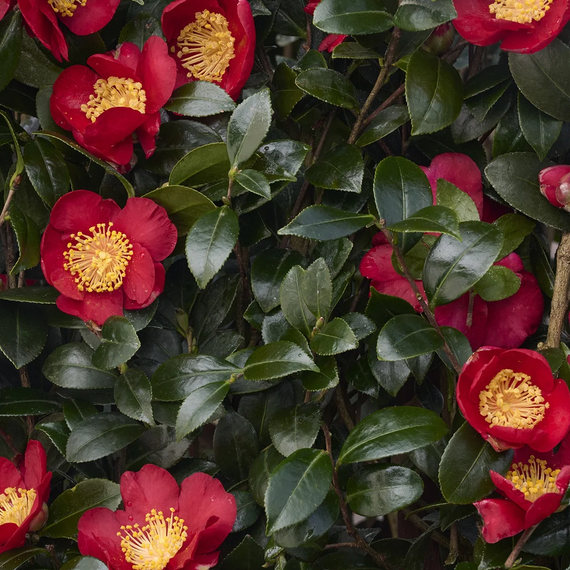
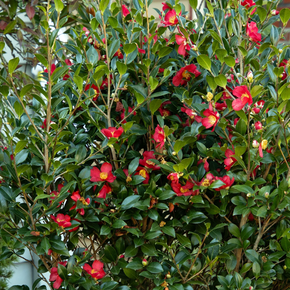
Camellia sasanqua 'Yuletide' is a broadleaf evergreen shrub celebrated for its spectacular winter floral display. Its large single blooms feature slightly cupped, waxy crimson-red petals surrounding a showy center of bright golden-yellow stamens, creating a vivid contrast that is rare in the winter landscape. Each individual flower lasts a few days before dropping cleanly in its entirety, but a steady succession of buds ensures a bloom period that extends four to six weeks, typically from December through January. The flowers carry a light, pleasant fragrance. The foliage is equally handsome — narrow, thick, leathery leaves with a deep olive-green luster and finely toothed margins clothe the plant year-round. 'Yuletide' grows with a loose, open form supported by dense branching and a naturally tight, slender, upright habit that gives it the elegant presence of a small tree over time. It is considered one of the only true-red flowering camellias among fall-to-winter bloomers and remains a benchmark cultivar in the genus.
| Attribute | Detail |
|---|---|
| Mature Height | 8 to 10 feet |
| Mature Width | 6 to 8 feet |
| Growth Rate | Slow to moderate; reaches full size over approximately a decade |
| Growth Habit | Upright, compact, densely branched with a slightly rounded top |
| Plant Type | Broadleaf evergreen shrub |
'Yuletide' camellia is hardy in USDA Zones 7 through 10, tolerating temperatures down to approximately 0 to 10 degrees F. In the lower end of Zone 7, it benefits from a sheltered planting location protected from drying winter winds. On the coldest nights, a layer of frost cloth provides extra protection. It is well suited to the mild winters and moderate summers of Southern Oregon and Northern California's coastal and inland valleys. In the hottest inland areas, afternoon shade helps prevent leaf scorch and eases heat stress. A 2- to 3-inch layer of mulch provides valuable insulation in winter and helps keep root temperatures stable and moisture consistent in summer.
'Yuletide' performs best in partial shade, particularly dappled light beneath a high tree canopy or with protection from intense afternoon sun. As a sasanqua camellia, it is more sun tolerant than Camellia japonica and can handle a half-day of direct morning sun followed by filtered afternoon shade. Four to six hours of morning or early afternoon sunlight is ideal in most climates. In cooler coastal environments it can tolerate more sun exposure, while in hotter inland gardens afternoon shade is strongly recommended to prevent leaf scorch and protect delicate blooms. Avoid planting in deep, dense shade, which will significantly reduce flowering.
'Yuletide' thrives in moist, well-draining soil that is rich in organic matter. It is adaptable to a range of soil textures including clay, sand, and loamy silt, provided drainage is adequate. The ideal soil pH is 6.0 to 6.5 — slightly acidic. If your soil is alkaline, yellowing leaves with green veins (chlorosis) may appear. To correct this, apply iron chelate to the soil and incorporate well-composted organic matter to help lower the pH. A soil test is the best way to determine whether additional amendments such as aluminum sulfate are needed. At planting time, working leaf mold or compost into native soil improves organic richness and aeration, giving new plants the best possible start.
During the first growing season, 'Yuletide' camellia requires regular, deep watering to establish a strong root system. Water deeply approximately once per week, or whenever the top 3 inches of soil feel dry. Once established over subsequent seasons, the plant becomes more drought tolerant and watering frequency can be reduced. Consistent soil moisture during the summer and fall bud-development period is important — underwatering can cause bud drop. While 'Yuletide' can tolerate brief periods of flooding from heavy rainfall, it will not thrive in chronically waterlogged conditions. Always water at the base of the plant rather than overhead to minimize the risk of fungal issues.
Feed 'Yuletide' camellia with a fertilizer formulated for acid-loving plants, such as a camellia, azalea, or holly formula. Look for a product that includes minor and micronutrients such as magnesium, calcium, sulfur, manganese, and iron, as these are important for camellia health and vigor. For young, developing plants, apply in early spring (around March), late spring (around May), and midsummer (around July) to encourage healthy root and foliage development. For established, mature plants, switch to a lower-nitrogen formulation such as a 4-8-8 ratio to maintain nutrition without pushing excessive new growth. Avoid over-fertilizing, which can cause burned leaf edges and premature leaf drop. Do not fertilize after late summer, as tender new growth stimulated by late-season feeding can be damaged by cold.
'Yuletide' camellia is a naturally low-maintenance shrub that rarely requires heavy pruning. If shaping or size reduction is desired, prune immediately after flowering concludes in late winter — a February to March window is ideal. Because flower buds are set on old wood, pruning before bud set in late summer or fall will reduce next season's bloom. Focus on selectively removing long, wayward stems that disrupt the plant's naturally elegant form, and thin out any overly dense interior branching to improve airflow and reduce disease risk. Dead or diseased branches can be removed at any time of year. Maintain a 2- to 3-inch layer of organic mulch (bark chips, straw, or leaf litter) around the base of the plant, keeping it a few inches away from the trunk to discourage rot and pests.
'Yuletide' camellia offers something beautiful in every season. In December and January it steals the show with its vivid crimson-red blooms against the deep green foliage — a holiday-season spectacle that few other shrubs can match. After flowering, small shiny seed capsules develop and persist into late winter, providing a cold-season food source for songbirds and small mammals. Through spring, summer, and fall the glossy, dark olive-green evergreen foliage provides a rich, lush backdrop in the landscape and a reliable year-round structure. As an evergreen, it maintains its presence and foliage color even through winter frost, making it one of the most dependable four-season shrubs available for gardens in the Pacific Northwest and Northern California.
'Yuletide' camellia pairs beautifully with other acid-loving and woodland-edge plants that share its preference for partial shade and moist, well-draining soil. Ideal companions include:
'Yuletide' is a vigorous, resilient camellia with notably better resistance to Phytophthora root rot than Camellia japonica. Common issues to watch for include:
Good cultural practices — adequate spacing for airflow, proper planting depth, consistent watering, and clean mulching away from the trunk — prevent most problems before they start.
'Yuletide' camellia grows beautifully in a large container and is an excellent choice for patios, courtyards, and covered porches where its winter blooms can be enjoyed up close. Choose a container at least 18 inches in diameter with good drainage holes. Use a well-draining potting mix formulated for camellias, azaleas, or hollies — or blend a standard potting mix with coarse sand and bark to increase aeration. Water container-grown plants more frequently than in-ground specimens, as pots dry out faster. Fertilize in spring with an acid-loving plant formula. In the hottest summer months, move containers to a spot with afternoon shade to prevent heat stress. In borderline-cold areas, move containers to a bright, cool, sheltered space during hard freezes, reducing watering until the plant is returned outdoors in spring.
'Yuletide' camellia provides meaningful wildlife benefits, particularly during the quieter winter months when food and forage resources are scarce. The single-form blooms with their open, accessible centers of bright yellow stamens are especially valuable to bees and other beneficial pollinating insects that remain active on mild winter days, providing pollen and nectar at a time of year when very few other plants are in flower. After blooming, small shiny seed capsules develop and persist through late winter, offering a food source for foraging songbirds and small mammals. The dense, evergreen branching also provides shelter and nesting habitat for birds year-round. 'Yuletide' is generally considered deer resistant, though hungry deer may browse in areas with high deer pressure.
Camellia sasanqua 'Yuletide' is a standout winter-blooming evergreen shrub that earns its festive name by lighting up the garden with large, vivid crimson-red single flowers — each one highlighted by a bold cluster of bright yellow stamens — right in time for the holiday season. Introduced in 1970 as a chance seedling of the heirloom sasanqua hybrid 'Hiryu,' 'Yuletide' has become one of the most beloved and widely planted winter-flowering camellias in American gardens, prized for its upright, compact form, exceptional cold hardiness for the species, and virtually unmatched floral color in the December-to-January garden. The dense, leathery, dark olive-green foliage remains attractive all year, making this evergreen shrub a reliable structural backbone in any mixed border, woodland edge planting, or formal hedge. Unlike many camellias, C. sasanqua tolerates more sun, is more drought tolerant once established, and shows greater resistance to Phytophthora root rot than C. japonica, making 'Yuletide' a remarkably versatile and forgiving landscape performer. Growing to approximately 8 to 10 feet tall and 6 to 8 feet wide at maturity, this slow-to-moderate grower fits beautifully into foundation plantings, privacy screens, and large containers, offering gardeners in Southern Oregon and Northern California a dazzling, deer-resistant shrub that delivers color, wildlife value, and four-season beauty with minimal care.
Camellia sasanqua 'Yuletide' is a broadleaf evergreen shrub celebrated for its spectacular winter floral display. Its large single blooms feature slightly cupped, waxy crimson-red petals surrounding a showy center of bright golden-yellow stamens, creating a vivid contrast that is rare in the winter landscape. Each individual flower lasts a few days before dropping cleanly in its entirety, but a steady succession of buds ensures a bloom period that extends four to six weeks, typically from December through January. The flowers carry a light, pleasant fragrance. The foliage is equally handsome — narrow, thick, leathery leaves with a deep olive-green luster and finely toothed margins clothe the plant year-round. 'Yuletide' grows with a loose, open form supported by dense branching and a naturally tight, slender, upright habit that gives it the elegant presence of a small tree over time. It is considered one of the only true-red flowering camellias among fall-to-winter bloomers and remains a benchmark cultivar in the genus.
| Attribute | Detail |
|---|---|
| Mature Height | 8 to 10 feet |
| Mature Width | 6 to 8 feet |
| Growth Rate | Slow to moderate; reaches full size over approximately a decade |
| Growth Habit | Upright, compact, densely branched with a slightly rounded top |
| Plant Type | Broadleaf evergreen shrub |
'Yuletide' camellia is hardy in USDA Zones 7 through 10, tolerating temperatures down to approximately 0 to 10 degrees F. In the lower end of Zone 7, it benefits from a sheltered planting location protected from drying winter winds. On the coldest nights, a layer of frost cloth provides extra protection. It is well suited to the mild winters and moderate summers of Southern Oregon and Northern California's coastal and inland valleys. In the hottest inland areas, afternoon shade helps prevent leaf scorch and eases heat stress. A 2- to 3-inch layer of mulch provides valuable insulation in winter and helps keep root temperatures stable and moisture consistent in summer.
'Yuletide' performs best in partial shade, particularly dappled light beneath a high tree canopy or with protection from intense afternoon sun. As a sasanqua camellia, it is more sun tolerant than Camellia japonica and can handle a half-day of direct morning sun followed by filtered afternoon shade. Four to six hours of morning or early afternoon sunlight is ideal in most climates. In cooler coastal environments it can tolerate more sun exposure, while in hotter inland gardens afternoon shade is strongly recommended to prevent leaf scorch and protect delicate blooms. Avoid planting in deep, dense shade, which will significantly reduce flowering.
'Yuletide' thrives in moist, well-draining soil that is rich in organic matter. It is adaptable to a range of soil textures including clay, sand, and loamy silt, provided drainage is adequate. The ideal soil pH is 6.0 to 6.5 — slightly acidic. If your soil is alkaline, yellowing leaves with green veins (chlorosis) may appear. To correct this, apply iron chelate to the soil and incorporate well-composted organic matter to help lower the pH. A soil test is the best way to determine whether additional amendments such as aluminum sulfate are needed. At planting time, working leaf mold or compost into native soil improves organic richness and aeration, giving new plants the best possible start.
During the first growing season, 'Yuletide' camellia requires regular, deep watering to establish a strong root system. Water deeply approximately once per week, or whenever the top 3 inches of soil feel dry. Once established over subsequent seasons, the plant becomes more drought tolerant and watering frequency can be reduced. Consistent soil moisture during the summer and fall bud-development period is important — underwatering can cause bud drop. While 'Yuletide' can tolerate brief periods of flooding from heavy rainfall, it will not thrive in chronically waterlogged conditions. Always water at the base of the plant rather than overhead to minimize the risk of fungal issues.
Feed 'Yuletide' camellia with a fertilizer formulated for acid-loving plants, such as a camellia, azalea, or holly formula. Look for a product that includes minor and micronutrients such as magnesium, calcium, sulfur, manganese, and iron, as these are important for camellia health and vigor. For young, developing plants, apply in early spring (around March), late spring (around May), and midsummer (around July) to encourage healthy root and foliage development. For established, mature plants, switch to a lower-nitrogen formulation such as a 4-8-8 ratio to maintain nutrition without pushing excessive new growth. Avoid over-fertilizing, which can cause burned leaf edges and premature leaf drop. Do not fertilize after late summer, as tender new growth stimulated by late-season feeding can be damaged by cold.
'Yuletide' camellia is a naturally low-maintenance shrub that rarely requires heavy pruning. If shaping or size reduction is desired, prune immediately after flowering concludes in late winter — a February to March window is ideal. Because flower buds are set on old wood, pruning before bud set in late summer or fall will reduce next season's bloom. Focus on selectively removing long, wayward stems that disrupt the plant's naturally elegant form, and thin out any overly dense interior branching to improve airflow and reduce disease risk. Dead or diseased branches can be removed at any time of year. Maintain a 2- to 3-inch layer of organic mulch (bark chips, straw, or leaf litter) around the base of the plant, keeping it a few inches away from the trunk to discourage rot and pests.
'Yuletide' camellia offers something beautiful in every season. In December and January it steals the show with its vivid crimson-red blooms against the deep green foliage — a holiday-season spectacle that few other shrubs can match. After flowering, small shiny seed capsules develop and persist into late winter, providing a cold-season food source for songbirds and small mammals. Through spring, summer, and fall the glossy, dark olive-green evergreen foliage provides a rich, lush backdrop in the landscape and a reliable year-round structure. As an evergreen, it maintains its presence and foliage color even through winter frost, making it one of the most dependable four-season shrubs available for gardens in the Pacific Northwest and Northern California.
'Yuletide' camellia pairs beautifully with other acid-loving and woodland-edge plants that share its preference for partial shade and moist, well-draining soil. Ideal companions include:
'Yuletide' is a vigorous, resilient camellia with notably better resistance to Phytophthora root rot than Camellia japonica. Common issues to watch for include:
Good cultural practices — adequate spacing for airflow, proper planting depth, consistent watering, and clean mulching away from the trunk — prevent most problems before they start.
'Yuletide' camellia grows beautifully in a large container and is an excellent choice for patios, courtyards, and covered porches where its winter blooms can be enjoyed up close. Choose a container at least 18 inches in diameter with good drainage holes. Use a well-draining potting mix formulated for camellias, azaleas, or hollies — or blend a standard potting mix with coarse sand and bark to increase aeration. Water container-grown plants more frequently than in-ground specimens, as pots dry out faster. Fertilize in spring with an acid-loving plant formula. In the hottest summer months, move containers to a spot with afternoon shade to prevent heat stress. In borderline-cold areas, move containers to a bright, cool, sheltered space during hard freezes, reducing watering until the plant is returned outdoors in spring.
'Yuletide' camellia provides meaningful wildlife benefits, particularly during the quieter winter months when food and forage resources are scarce. The single-form blooms with their open, accessible centers of bright yellow stamens are especially valuable to bees and other beneficial pollinating insects that remain active on mild winter days, providing pollen and nectar at a time of year when very few other plants are in flower. After blooming, small shiny seed capsules develop and persist through late winter, offering a food source for foraging songbirds and small mammals. The dense, evergreen branching also provides shelter and nesting habitat for birds year-round. 'Yuletide' is generally considered deer resistant, though hungry deer may browse in areas with high deer pressure.