

Zoom the image with the mouse
Rock & Roll Peruvian Lily - 2 Gallon
SKU:
1929715
$29.99
- Award-winning herbaceous perennial featuring bold, cream-and-green variegated foliage that delivers stunning visual interest even when the plant is not in bloom
- Produces vivid scarlet-orange, trumpet-shaped blooms in continuous waves from late spring all the way through early fall — perfect for garden borders and cutting gardens alike
- Exceptional cut flower with blooms that last two weeks or more in a vase, making it a showstopper in fresh floral arrangements
- Compact and versatile — equally at home in landscape beds, mixed borders, or decorative containers, and irresistible to hummingbirds, butterflies, and pollinators
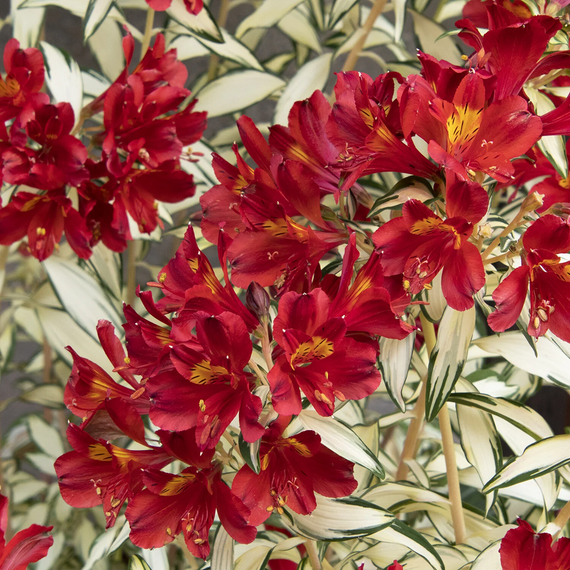
Rock & Roll Peruvian Lily (Alstroemeria x 'AlsDun01') is an award-winning, patented herbaceous perennial that delivers a rare double act of spectacular foliage and long-season floral brilliance. Its lance-shaped leaves emerge in creamy white with rich green margins, creating a bold variegated effect that lights up garden beds and container arrangements from the moment new growth appears each spring. From late spring through early fall, clusters of vivid scarlet-orange, trumpet-shaped blooms rise above the foliage — each petal accented with golden yellow throats and fine burgundy flecking — making a fiery, season-long statement in the landscape. A compact, tidy habit reaching approximately 2 feet tall and 2 feet wide makes Rock & Roll well-suited to mixed perennial borders, massed plantings, patio containers, and dedicated cutting gardens. Florists and home gardeners prize this variety equally, as harvested stems hold their color and form in a vase for two weeks or more. Continuous deadheading encourages an unbroken parade of blooms, while deer resistance, moderate growth, and attraction to hummingbirds and butterflies further cement its status as one of the most rewarding and versatile perennials available for gardens in Southern Oregon and Northern California.
Plant Description
Rock & Roll Peruvian Lily is a tuberous-rooted, herbaceous perennial belonging to the family Alstroemeriaceae — not the true lily family (Liliaceae). Its stems carry lance-shaped leaves that undergo a natural 180-degree twist as they unfurl, a botanical trait called resupination that is unique to the Alstroemeria genus. The foliage of this particular cultivar is exceptionally ornamental, displaying creamy white centers edged in deep green that create a vivid variegated effect throughout the growing season. Atop sturdy, upright stems, clusters of trumpet-shaped scarlet-orange flowers appear with golden yellow throats and delicate burgundy spots and streaks on the inner petals. Each flower measures approximately 2 inches across, and multiple blooms are carried per stem, creating full, lush flower clusters. Unlike many perennials with a brief window of interest, Rock & Roll delivers beauty in both its foliage and its flowers across nearly the entire growing season.
Mature Size
| Characteristic | Measurement |
|---|---|
| Mature Height | 2 feet |
| Mature Width | 2 feet |
| Growth Rate | Medium |
| Growth Habit | Compact, upright, and bushy |
| Root Type | Fleshy, tuberous rhizomes |
Rock & Roll maintains a naturally tidy, compact footprint that requires no staking. Its moderate spread makes it easy to incorporate into smaller spaces and container plantings without concern about overcrowding neighboring plants. Clumps will gradually expand outward over time and benefit from division every 2 to 3 years to maintain vigor.
Hardiness Zones & Climate
Rock & Roll Peruvian Lily is reliably hardy in USDA Hardiness Zones 7 to 10. In Zone 7, the crown should be protected with a generous layer of mulch before winter temperatures arrive. In Zones 8 through 10 — which includes most of Southern Oregon and Northern California — plants are well-adapted to the local climate and typically perform as robust, long-lived perennials. In areas with exceptionally hot summers, some afternoon shade will help protect the foliage and extend the blooming period. In colder zones (5 and 6), tuberous roots can be dug and stored indoors over winter, then replanted in spring. This cultivar shows good heat tolerance compared to older Alstroemeria varieties, maintaining strong flowering even when summer temperatures climb.
Sunlight Requirements
Rock & Roll Peruvian Lily thrives in full sun to partial shade. For the best flowering performance, provide a minimum of 6 hours of direct sunlight per day. In the warmer inland valleys of Southern Oregon and Northern California, a location that receives full morning sun with light afternoon shade is ideal — this protects the foliage from scorching and keeps blooms looking their best during the hottest weeks of summer. In cooler coastal or higher-elevation climates, full sun exposure encourages the most prolific flower production. Avoid dense, full shade, which will significantly reduce bloom counts and cause stems to stretch and lean toward available light.
Soil and pH Preferences
This Peruvian lily performs best in fertile, well-drained soil with a slightly acidic to neutral pH in the range of 6.0 to 7.0. Good drainage is absolutely essential — fleshy tuberous roots are highly susceptible to rot in compacted or poorly drained soils. Before planting, amend heavy clay soils generously with compost, aged bark, or other organic matter to improve drainage and root aeration. In sandy or fast-draining soils, incorporate compost to improve moisture retention and nutrient availability. Avoid low-lying areas where water pools after rain. Raised beds are an excellent option where native drainage is a concern. For container planting, use a high-quality potting mix blended with perlite or coarse sand to ensure excellent aeration and drainage.
Watering Guide
Consistent moisture is the key to keeping Rock & Roll blooming at its best. Water deeply and regularly, providing approximately 1 inch of water per week during the growing season, adjusting upward to about 1.5 inches per week during prolonged heat or drought. The goal is to keep soil evenly moist — like a well-wrung sponge — never waterlogged or bone dry. Always water at the base of the plant rather than overhead to minimize the risk of foliar diseases. Container-grown plants dry out more quickly and may need watering every day during summer heat waves; check the top inch of potting mix and water whenever it feels dry to the touch. During fall, gradually reduce watering frequency as temperatures drop and growth slows. Cease supplemental irrigation after the first frost. Drip irrigation or soaker hoses are ideal delivery methods for in-ground plants.
Fertilizing
Feed Rock & Roll Peruvian Lily to support its long bloom season without overstimulating excessive leafy growth. A balanced, slow-release granular fertilizer applied in early spring as new growth emerges provides a strong nutritional foundation for the season. Once flowering begins in late spring, switch to a fertilizer with slightly higher phosphorus and potassium (such as a bloom-booster formula) to encourage continuous flower bud formation and strong stem development. Apply a second feeding in midsummer to sustain the plant through late-season blooming. Stop all fertilization by mid-August — late-season feeding can delay dormancy and increase vulnerability to early frost damage. Container-grown plants benefit from monthly applications of a balanced liquid fertilizer throughout the active growing season, as nutrients leach more quickly from pots. Avoid excessive nitrogen fertilizers, which promote lush foliage at the expense of flowers and can increase susceptibility to pest problems.
Pruning and Deadheading
Prompt and proper deadheading is the single most effective way to keep Rock & Roll blooming continuously from spring through fall. Rather than cutting spent flower stems with pruners, grasp each spent stem near its base and pull it cleanly upward and free from the crown. This technique — which mimics how the plant naturally sheds stems — stimulates the underground rhizomes to send up fresh flowering shoots and produces a significantly better rebloom response than simply snipping stems. Repeat this process every few days during peak flowering. In late winter or early spring, before new growth emerges, remove any remaining old stems and tidy dead or tatty foliage by pulling it cleanly from the crown. Minimal hard cutting is needed, as the plant's natural growth cycle renews it each season. Dividing congested clumps every 2 to 3 years in early spring also serves as a form of rejuvenative maintenance that restores vigor and bloom density.
Planting Instructions
- Choose a site with full sun to partial shade and excellent soil drainage.
- Amend the planting area with compost or organic matter to a depth of 10 to 12 inches, and confirm the soil pH is between 6.0 and 7.0.
- Dig a planting hole slightly wider than the root ball and deep enough so that the top of the root ball sits level with the surrounding soil surface.
- Remove the plant carefully from its nursery container, taking care not to disturb or break the fragile tuberous roots — do not tease or spread the roots apart.
- Set the plant in the hole at the correct depth, backfill with the amended soil, and firm gently to eliminate air pockets.
- Water thoroughly after planting to settle the soil and eliminate air gaps around the root ball.
- Apply 2 to 3 inches of organic mulch around the base of the plant, keeping mulch a few inches away from the crown to prevent rot.
- Space multiple plants approximately 18 to 24 inches apart to allow for good air circulation and mature spread.
- Water deeply and regularly throughout the first growing season to help establish a strong root system.
Seasonal Interest
| Season | What to Expect |
|---|---|
| Spring | Fresh green-and-cream variegated foliage emerges; first flower buds and early blooms appear by late spring |
| Summer | Peak bloom season with continuous waves of scarlet-orange flowers; bold variegated foliage remains ornamental throughout |
| Early Fall | Continued flowering into early fall; flowers may slow temporarily during extreme heat then rebound as temperatures moderate |
| Late Fall / Winter | Tops die back after frost; plant enters dormancy with roots surviving underground; in mild climates foliage may persist |
Landscape Uses
Rock & Roll Peruvian Lily is one of the most versatile perennials for the garden, offering multiple landscape applications thanks to its compact habit, season-long color, and dual ornamental value from both foliage and flowers.
- Mixed Perennial Borders: The cream-and-green variegated foliage provides beautiful contrast and texture among green-leaved companions, while the scarlet-orange flowers add vibrant color from late spring through fall.
- Massed Plantings: Groupings of three, five, or more plants create a dramatic, unified sweep of color and foliage texture in larger landscape beds.
- Cutting Gardens: An outstanding performer in the cutting garden, producing abundant, long-stemmed blooms with a vase life of two weeks or more.
- Container Gardening: The compact habit and ornamental foliage make Rock & Roll an excellent choice for patio containers, urns, and window boxes, either as a standalone specimen or combined with complementary annuals and perennials.
- Pollinator Gardens: A magnet for hummingbirds, butterflies, and bees, making it a valuable addition to any wildlife-friendly planting.
- Cottage and Tropical-Style Gardens: The bold foliage and fiery flower color integrate beautifully into cottage garden borders and lend a tropical flair to mixed plantings.
Companion Plants
Rock & Roll's cream-and-green variegated foliage and vivid scarlet-orange flowers pair beautifully with a wide range of garden companions. Consider the following pairings for complementary color, texture, and seasonal interest:
- Salvia (Salvia nemorosa or S. guaranitica): Deep blue or purple salvia spikes provide a striking color contrast to the warm scarlet-orange blooms and echo the long bloom season.
- Agapanthus: The cool blue-purple globes of agapanthus complement the fiery tones of Rock & Roll and share similar sun and water preferences.
- Lavender (Lavandula spp.): Silvery foliage and purple flower spikes create a classic cool-warm color pairing alongside the variegated leaves and orange-red blooms.
- Ornamental Grasses (e.g., Pennisetum or Miscanthus): Fine-textured, arching grass foliage provides a soft, natural backdrop that highlights the bold variegation of Rock & Roll's leaves.
- Daylilies (Hemerocallis): Complementary trumpet-shaped flowers in golden yellow or bronze tones harmonize with the warm color palette while extending overall garden bloom time.
- Coreopsis or Rudbeckia: Golden yellow daisy-type flowers in the same warm color family create cheerful, sun-loving combinations in full-sun beds.
Container Growing
Rock & Roll Peruvian Lily is an excellent candidate for container growing, thanks to its compact size, ornamental foliage, and long bloom season. Select a container that is at least 12 inches in diameter and 12 inches deep with multiple drainage holes — good drainage is non-negotiable. Fill with a high-quality potting mix blended with perlite (approximately 25% by volume) to ensure excellent aeration and prevent waterlogging. Plant so the top of the root ball sits approximately 1 inch below the rim of the pot. Place containers in a location receiving at least 6 hours of direct sunlight daily. Container plants dry out faster than in-ground plantings, so check soil moisture frequently and water when the top inch of potting mix feels dry. Feed monthly with a balanced liquid fertilizer during the growing season. In Southern Oregon and Northern California, containers can typically remain outdoors year-round in most areas, but move them to a sheltered location if hard freezes are expected. Repot or divide root-bound plants every 2 to 3 years in early spring.
Pests and Diseases
Rock & Roll Peruvian Lily is a relatively tough and resilient perennial, but a few pests and disease conditions are worth watching for:
- Aphids: Soft-bodied insects that cluster on tender new growth. Treat with a strong spray of water to dislodge them or apply insecticidal soap for larger infestations.
- Spider Mites: More common during hot, dry weather. Look for fine webbing and stippled, dusty-looking leaves. Treat with insecticidal soap; avoid conditions of prolonged heat stress and drought that invite outbreaks.
- Thrips: Tiny insects that damage flower petals, causing silvery streaking or distortion. Treat with neem oil or insecticidal soap at first sign.
- Slugs and Snails: Can damage tender new shoots and foliage, particularly in cool, moist spring conditions. Use iron phosphate-based slug bait or hand-pick at night.
- Crown and Root Rot (Phytophthora, Pythium): Almost always caused by waterlogged soil. Prevention through excellent drainage is the only reliable control — once established, root rot is typically fatal. Remove and dispose of affected plants; do not compost.
- Botrytis (Gray Mold): A fungal disease that develops in cool, wet, humid conditions with poor air circulation. Prevent by spacing plants adequately, watering at the base, and removing spent plant material promptly.
- Leaf Spot (Alternaria): Appears as brown, concentric rings on older leaves. Improve air circulation and avoid overhead watering to minimize risk.
Wildlife Value
Rock & Roll Peruvian Lily is a valuable addition to pollinator and wildlife-friendly gardens. Its vivid scarlet-orange, trumpet-shaped flowers are particularly attractive to hummingbirds, which are drawn to warm red and orange tones and appreciate the accessible flower shape. Butterflies and native bumblebees also visit the blooms regularly, making this plant a multi-season resource for beneficial insects. Unlike many showy ornamentals, Alstroemeria blooms feature inner petal markings that act as guides for visiting pollinators, enhancing its ecological value. The plant is also noted for good deer resistance, making it a reliable choice for gardens in areas where deer browsing is a common challenge — a significant advantage for many gardens in Southern Oregon and Northern California.
Toxicity and Safe Handling
All parts of Alstroemeria plants contain compounds called tuliposides, which can cause contact dermatitis in sensitive individuals. When handling plants during planting, pruning, or harvesting for cut flowers, wearing gloves is recommended — particularly for those with sensitive skin. The sap can cause mild skin irritation or redness upon contact. Keep this plant out of reach of small children who may be tempted to handle or mouth plant material. Note that toxicity classifications for pets may vary by source; consult your veterinarian if you have concerns about exposure by household pets. As a precaution, plant Rock & Roll in areas where accidental ingestion by children or pets is unlikely.
- Award-winning herbaceous perennial featuring bold, cream-and-green variegated foliage that delivers stunning visual interest even when the plant is not in bloom
- Produces vivid scarlet-orange, trumpet-shaped blooms in continuous waves from late spring all the way through early fall — perfect for garden borders and cutting gardens alike
- Exceptional cut flower with blooms that last two weeks or more in a vase, making it a showstopper in fresh floral arrangements
- Compact and versatile — equally at home in landscape beds, mixed borders, or decorative containers, and irresistible to hummingbirds, butterflies, and pollinators
Rock & Roll Peruvian Lily (Alstroemeria x 'AlsDun01') is an award-winning, patented herbaceous perennial that delivers a rare double act of spectacular foliage and long-season floral brilliance. Its lance-shaped leaves emerge in creamy white with rich green margins, creating a bold variegated effect that lights up garden beds and container arrangements from the moment new growth appears each spring. From late spring through early fall, clusters of vivid scarlet-orange, trumpet-shaped blooms rise above the foliage — each petal accented with golden yellow throats and fine burgundy flecking — making a fiery, season-long statement in the landscape. A compact, tidy habit reaching approximately 2 feet tall and 2 feet wide makes Rock & Roll well-suited to mixed perennial borders, massed plantings, patio containers, and dedicated cutting gardens. Florists and home gardeners prize this variety equally, as harvested stems hold their color and form in a vase for two weeks or more. Continuous deadheading encourages an unbroken parade of blooms, while deer resistance, moderate growth, and attraction to hummingbirds and butterflies further cement its status as one of the most rewarding and versatile perennials available for gardens in Southern Oregon and Northern California.
Plant Description
Rock & Roll Peruvian Lily is a tuberous-rooted, herbaceous perennial belonging to the family Alstroemeriaceae — not the true lily family (Liliaceae). Its stems carry lance-shaped leaves that undergo a natural 180-degree twist as they unfurl, a botanical trait called resupination that is unique to the Alstroemeria genus. The foliage of this particular cultivar is exceptionally ornamental, displaying creamy white centers edged in deep green that create a vivid variegated effect throughout the growing season. Atop sturdy, upright stems, clusters of trumpet-shaped scarlet-orange flowers appear with golden yellow throats and delicate burgundy spots and streaks on the inner petals. Each flower measures approximately 2 inches across, and multiple blooms are carried per stem, creating full, lush flower clusters. Unlike many perennials with a brief window of interest, Rock & Roll delivers beauty in both its foliage and its flowers across nearly the entire growing season.
Mature Size
| Characteristic | Measurement |
|---|---|
| Mature Height | 2 feet |
| Mature Width | 2 feet |
| Growth Rate | Medium |
| Growth Habit | Compact, upright, and bushy |
| Root Type | Fleshy, tuberous rhizomes |
Rock & Roll maintains a naturally tidy, compact footprint that requires no staking. Its moderate spread makes it easy to incorporate into smaller spaces and container plantings without concern about overcrowding neighboring plants. Clumps will gradually expand outward over time and benefit from division every 2 to 3 years to maintain vigor.
Hardiness Zones & Climate
Rock & Roll Peruvian Lily is reliably hardy in USDA Hardiness Zones 7 to 10. In Zone 7, the crown should be protected with a generous layer of mulch before winter temperatures arrive. In Zones 8 through 10 — which includes most of Southern Oregon and Northern California — plants are well-adapted to the local climate and typically perform as robust, long-lived perennials. In areas with exceptionally hot summers, some afternoon shade will help protect the foliage and extend the blooming period. In colder zones (5 and 6), tuberous roots can be dug and stored indoors over winter, then replanted in spring. This cultivar shows good heat tolerance compared to older Alstroemeria varieties, maintaining strong flowering even when summer temperatures climb.
Sunlight Requirements
Rock & Roll Peruvian Lily thrives in full sun to partial shade. For the best flowering performance, provide a minimum of 6 hours of direct sunlight per day. In the warmer inland valleys of Southern Oregon and Northern California, a location that receives full morning sun with light afternoon shade is ideal — this protects the foliage from scorching and keeps blooms looking their best during the hottest weeks of summer. In cooler coastal or higher-elevation climates, full sun exposure encourages the most prolific flower production. Avoid dense, full shade, which will significantly reduce bloom counts and cause stems to stretch and lean toward available light.
Soil and pH Preferences
This Peruvian lily performs best in fertile, well-drained soil with a slightly acidic to neutral pH in the range of 6.0 to 7.0. Good drainage is absolutely essential — fleshy tuberous roots are highly susceptible to rot in compacted or poorly drained soils. Before planting, amend heavy clay soils generously with compost, aged bark, or other organic matter to improve drainage and root aeration. In sandy or fast-draining soils, incorporate compost to improve moisture retention and nutrient availability. Avoid low-lying areas where water pools after rain. Raised beds are an excellent option where native drainage is a concern. For container planting, use a high-quality potting mix blended with perlite or coarse sand to ensure excellent aeration and drainage.
Watering Guide
Consistent moisture is the key to keeping Rock & Roll blooming at its best. Water deeply and regularly, providing approximately 1 inch of water per week during the growing season, adjusting upward to about 1.5 inches per week during prolonged heat or drought. The goal is to keep soil evenly moist — like a well-wrung sponge — never waterlogged or bone dry. Always water at the base of the plant rather than overhead to minimize the risk of foliar diseases. Container-grown plants dry out more quickly and may need watering every day during summer heat waves; check the top inch of potting mix and water whenever it feels dry to the touch. During fall, gradually reduce watering frequency as temperatures drop and growth slows. Cease supplemental irrigation after the first frost. Drip irrigation or soaker hoses are ideal delivery methods for in-ground plants.
Fertilizing
Feed Rock & Roll Peruvian Lily to support its long bloom season without overstimulating excessive leafy growth. A balanced, slow-release granular fertilizer applied in early spring as new growth emerges provides a strong nutritional foundation for the season. Once flowering begins in late spring, switch to a fertilizer with slightly higher phosphorus and potassium (such as a bloom-booster formula) to encourage continuous flower bud formation and strong stem development. Apply a second feeding in midsummer to sustain the plant through late-season blooming. Stop all fertilization by mid-August — late-season feeding can delay dormancy and increase vulnerability to early frost damage. Container-grown plants benefit from monthly applications of a balanced liquid fertilizer throughout the active growing season, as nutrients leach more quickly from pots. Avoid excessive nitrogen fertilizers, which promote lush foliage at the expense of flowers and can increase susceptibility to pest problems.
Pruning and Deadheading
Prompt and proper deadheading is the single most effective way to keep Rock & Roll blooming continuously from spring through fall. Rather than cutting spent flower stems with pruners, grasp each spent stem near its base and pull it cleanly upward and free from the crown. This technique — which mimics how the plant naturally sheds stems — stimulates the underground rhizomes to send up fresh flowering shoots and produces a significantly better rebloom response than simply snipping stems. Repeat this process every few days during peak flowering. In late winter or early spring, before new growth emerges, remove any remaining old stems and tidy dead or tatty foliage by pulling it cleanly from the crown. Minimal hard cutting is needed, as the plant's natural growth cycle renews it each season. Dividing congested clumps every 2 to 3 years in early spring also serves as a form of rejuvenative maintenance that restores vigor and bloom density.
Planting Instructions
- Choose a site with full sun to partial shade and excellent soil drainage.
- Amend the planting area with compost or organic matter to a depth of 10 to 12 inches, and confirm the soil pH is between 6.0 and 7.0.
- Dig a planting hole slightly wider than the root ball and deep enough so that the top of the root ball sits level with the surrounding soil surface.
- Remove the plant carefully from its nursery container, taking care not to disturb or break the fragile tuberous roots — do not tease or spread the roots apart.
- Set the plant in the hole at the correct depth, backfill with the amended soil, and firm gently to eliminate air pockets.
- Water thoroughly after planting to settle the soil and eliminate air gaps around the root ball.
- Apply 2 to 3 inches of organic mulch around the base of the plant, keeping mulch a few inches away from the crown to prevent rot.
- Space multiple plants approximately 18 to 24 inches apart to allow for good air circulation and mature spread.
- Water deeply and regularly throughout the first growing season to help establish a strong root system.
Seasonal Interest
| Season | What to Expect |
|---|---|
| Spring | Fresh green-and-cream variegated foliage emerges; first flower buds and early blooms appear by late spring |
| Summer | Peak bloom season with continuous waves of scarlet-orange flowers; bold variegated foliage remains ornamental throughout |
| Early Fall | Continued flowering into early fall; flowers may slow temporarily during extreme heat then rebound as temperatures moderate |
| Late Fall / Winter | Tops die back after frost; plant enters dormancy with roots surviving underground; in mild climates foliage may persist |
Landscape Uses
Rock & Roll Peruvian Lily is one of the most versatile perennials for the garden, offering multiple landscape applications thanks to its compact habit, season-long color, and dual ornamental value from both foliage and flowers.
- Mixed Perennial Borders: The cream-and-green variegated foliage provides beautiful contrast and texture among green-leaved companions, while the scarlet-orange flowers add vibrant color from late spring through fall.
- Massed Plantings: Groupings of three, five, or more plants create a dramatic, unified sweep of color and foliage texture in larger landscape beds.
- Cutting Gardens: An outstanding performer in the cutting garden, producing abundant, long-stemmed blooms with a vase life of two weeks or more.
- Container Gardening: The compact habit and ornamental foliage make Rock & Roll an excellent choice for patio containers, urns, and window boxes, either as a standalone specimen or combined with complementary annuals and perennials.
- Pollinator Gardens: A magnet for hummingbirds, butterflies, and bees, making it a valuable addition to any wildlife-friendly planting.
- Cottage and Tropical-Style Gardens: The bold foliage and fiery flower color integrate beautifully into cottage garden borders and lend a tropical flair to mixed plantings.
Companion Plants
Rock & Roll's cream-and-green variegated foliage and vivid scarlet-orange flowers pair beautifully with a wide range of garden companions. Consider the following pairings for complementary color, texture, and seasonal interest:
- Salvia (Salvia nemorosa or S. guaranitica): Deep blue or purple salvia spikes provide a striking color contrast to the warm scarlet-orange blooms and echo the long bloom season.
- Agapanthus: The cool blue-purple globes of agapanthus complement the fiery tones of Rock & Roll and share similar sun and water preferences.
- Lavender (Lavandula spp.): Silvery foliage and purple flower spikes create a classic cool-warm color pairing alongside the variegated leaves and orange-red blooms.
- Ornamental Grasses (e.g., Pennisetum or Miscanthus): Fine-textured, arching grass foliage provides a soft, natural backdrop that highlights the bold variegation of Rock & Roll's leaves.
- Daylilies (Hemerocallis): Complementary trumpet-shaped flowers in golden yellow or bronze tones harmonize with the warm color palette while extending overall garden bloom time.
- Coreopsis or Rudbeckia: Golden yellow daisy-type flowers in the same warm color family create cheerful, sun-loving combinations in full-sun beds.
Container Growing
Rock & Roll Peruvian Lily is an excellent candidate for container growing, thanks to its compact size, ornamental foliage, and long bloom season. Select a container that is at least 12 inches in diameter and 12 inches deep with multiple drainage holes — good drainage is non-negotiable. Fill with a high-quality potting mix blended with perlite (approximately 25% by volume) to ensure excellent aeration and prevent waterlogging. Plant so the top of the root ball sits approximately 1 inch below the rim of the pot. Place containers in a location receiving at least 6 hours of direct sunlight daily. Container plants dry out faster than in-ground plantings, so check soil moisture frequently and water when the top inch of potting mix feels dry. Feed monthly with a balanced liquid fertilizer during the growing season. In Southern Oregon and Northern California, containers can typically remain outdoors year-round in most areas, but move them to a sheltered location if hard freezes are expected. Repot or divide root-bound plants every 2 to 3 years in early spring.
Pests and Diseases
Rock & Roll Peruvian Lily is a relatively tough and resilient perennial, but a few pests and disease conditions are worth watching for:
- Aphids: Soft-bodied insects that cluster on tender new growth. Treat with a strong spray of water to dislodge them or apply insecticidal soap for larger infestations.
- Spider Mites: More common during hot, dry weather. Look for fine webbing and stippled, dusty-looking leaves. Treat with insecticidal soap; avoid conditions of prolonged heat stress and drought that invite outbreaks.
- Thrips: Tiny insects that damage flower petals, causing silvery streaking or distortion. Treat with neem oil or insecticidal soap at first sign.
- Slugs and Snails: Can damage tender new shoots and foliage, particularly in cool, moist spring conditions. Use iron phosphate-based slug bait or hand-pick at night.
- Crown and Root Rot (Phytophthora, Pythium): Almost always caused by waterlogged soil. Prevention through excellent drainage is the only reliable control — once established, root rot is typically fatal. Remove and dispose of affected plants; do not compost.
- Botrytis (Gray Mold): A fungal disease that develops in cool, wet, humid conditions with poor air circulation. Prevent by spacing plants adequately, watering at the base, and removing spent plant material promptly.
- Leaf Spot (Alternaria): Appears as brown, concentric rings on older leaves. Improve air circulation and avoid overhead watering to minimize risk.
Wildlife Value
Rock & Roll Peruvian Lily is a valuable addition to pollinator and wildlife-friendly gardens. Its vivid scarlet-orange, trumpet-shaped flowers are particularly attractive to hummingbirds, which are drawn to warm red and orange tones and appreciate the accessible flower shape. Butterflies and native bumblebees also visit the blooms regularly, making this plant a multi-season resource for beneficial insects. Unlike many showy ornamentals, Alstroemeria blooms feature inner petal markings that act as guides for visiting pollinators, enhancing its ecological value. The plant is also noted for good deer resistance, making it a reliable choice for gardens in areas where deer browsing is a common challenge — a significant advantage for many gardens in Southern Oregon and Northern California.
Toxicity and Safe Handling
All parts of Alstroemeria plants contain compounds called tuliposides, which can cause contact dermatitis in sensitive individuals. When handling plants during planting, pruning, or harvesting for cut flowers, wearing gloves is recommended — particularly for those with sensitive skin. The sap can cause mild skin irritation or redness upon contact. Keep this plant out of reach of small children who may be tempted to handle or mouth plant material. Note that toxicity classifications for pets may vary by source; consult your veterinarian if you have concerns about exposure by household pets. As a precaution, plant Rock & Roll in areas where accidental ingestion by children or pets is unlikely.