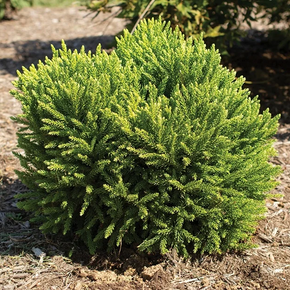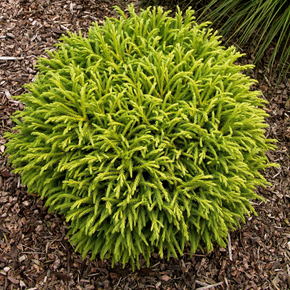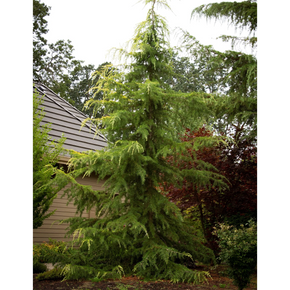

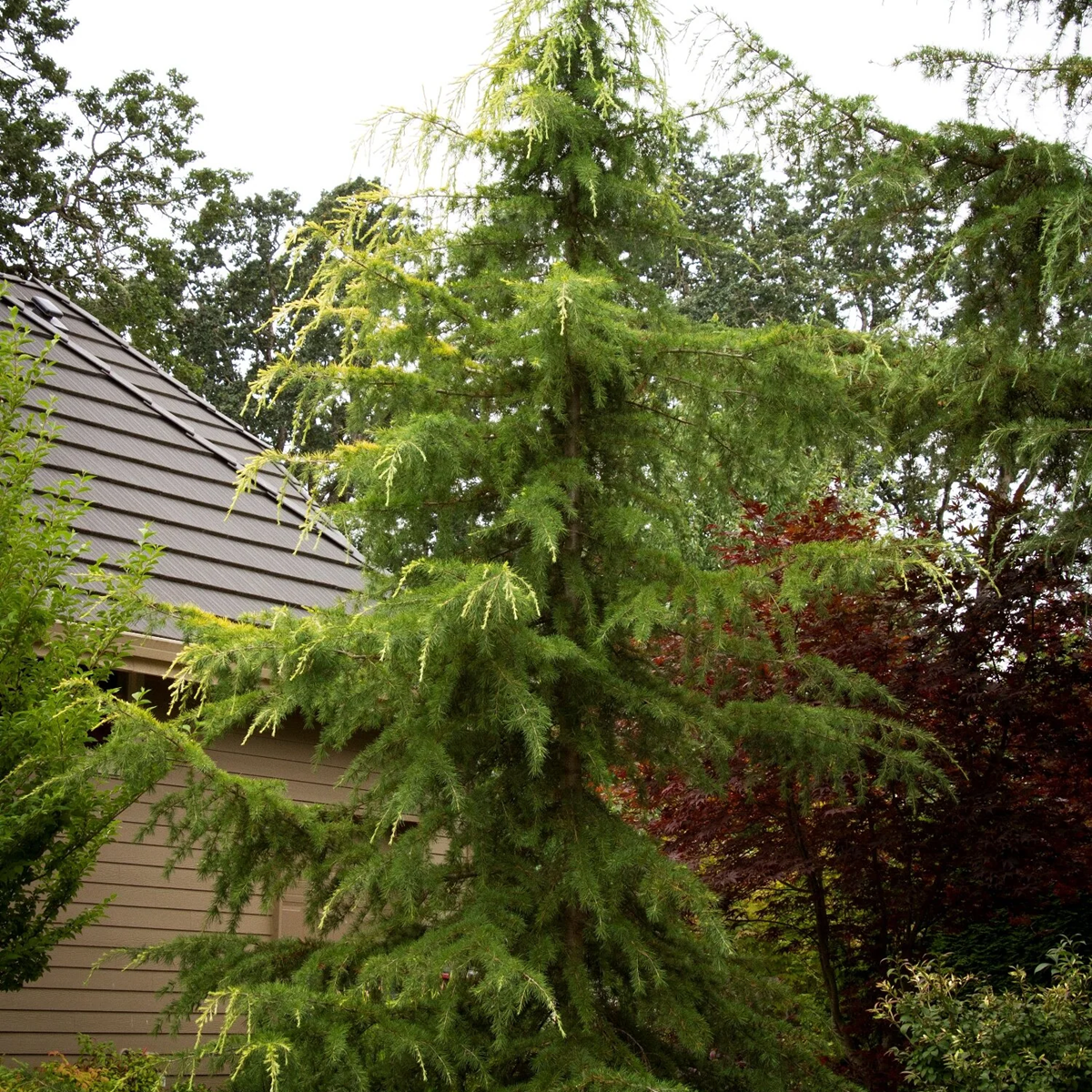
Golden Deodar Cedar (Cedrus deodara 'Aurea') is a breathtaking large evergreen conifer prized for its soft, golden-yellow needles and the graceful, weeping-tipped silhouette that makes Himalayan cedars among the most elegant trees in cultivation. A centuries-old cultivar first described in botanical literature in 1866, 'Aurea' opens each spring with luminous creamy yellow new growth that matures to a rich, warm gold, lighting up the landscape throughout all four seasons. Its broadly conical to pyramidal form is adorned with wide-spreading horizontal branches whose drooping tips and long, soft needles lend the tree an unmistakably refined, sculptural quality. Growing at a vigorous rate of more than 12 inches per year, Golden Deodar Cedar ultimately reaches 25 to 40 feet tall and 15 to 30 feet wide at maturity, making it an ideal specimen tree, large-scale screen, or commanding anchor for spacious landscape compositions. Native to the western Himalayan mountain range from Afghanistan through northwest India and Nepal — where the species name devadaru translates from Sanskrit as "wood of the gods" — it adapts beautifully to the warm, dry summers and mild winters of Southern Oregon and Northern California, thriving in full sun with well-drained soil and rewarding gardeners with exceptional drought tolerance once established. Adaptable to chalk, clay, loam, or sand and tolerant of a broad pH range, this low-maintenance conifer asks very little while delivering extraordinary year-round beauty, deer resistance, and wildlife value that few ornamental trees can match.
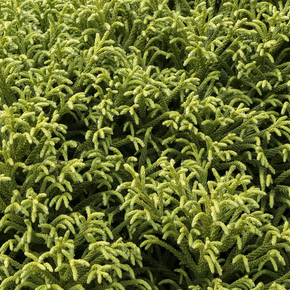
Golden Deodar Cedar is a large, broadly pyramidal evergreen conifer belonging to the pine family (Pinaceae). Its most distinctive feature is its long, soft, needle-like foliage arranged in whorls of 15 to 30 needles on spur-like short shoots. The needles measure approximately 1 to 2.5 inches long, are sharply pointed, and display a striking golden-yellow color that emerges as creamy yellow with each flush of new spring growth before deepening to warm gold through summer and fall. Unlike many golden conifers that fade to yellow-green in shade, 'Aurea' requires full sun to express its full color potential. The tree's form is distinctly conical in youth, broadening and becoming more pyramidal with age, with massive, wide-spreading horizontal primary branches. Secondary branches and shoot tips droop gracefully, giving the tree the characteristically pendulous, flowing profile associated with Himalayan cedars. Bark on young trees is smooth and gray, gradually cracking into dark gray plates and fissuring to dark brown to nearly black on mature specimens. Cones are barrel-shaped and erect, sitting upright on the branches — 3 to 4 inches long on male trees, and 3 to 4 inches of bluish-green on female trees — and the tree naturally produces an aromatic oil in its foliage that is known to deter insects. This cultivar received the prestigious Award of Garden Merit from the Royal Horticultural Society, recognizing its outstanding ornamental qualities and reliable garden performance.
| Attribute | Details |
|---|---|
| Mature Height | 25 to 40 feet |
| Mature Spread | 15 to 30 feet |
| Growth Rate | Fast — over 12 inches per year |
| Size at 10 Years | Approximately 12 to 15 feet tall and 7 to 8 feet wide |
| Growth Habit | Broadly upright, conical to pyramidal; spreading with age |
| Branch Habit | Wide horizontal branches with gracefully nodding, pendulous tips |
Golden Deodar Cedar is reliably hardy in USDA Hardiness Zones 6 through 9, making it an excellent choice for Southern Oregon and Northern California landscapes. It performs particularly well in the warm, dry-summer Mediterranean-type climate of these regions. The tree is somewhat frost-sensitive compared to other true cedars, and established plants show the best cold tolerance when sited in a location with some protection from harsh, desiccating winter winds. It is well-suited to the Pacific Coast climate zones including Sunset zones 3B, 4, 5, 6, 7, 8, 9, 10, 14-24. In climates at the colder edge of its range (Zone 6), siting in a sheltered south- or west-facing location and avoiding low frost pockets will improve performance. Its native habitat spans a dramatic altitudinal and climatic range across the western Himalaya, which accounts for its adaptability to the varied conditions encountered across the Pacific Coast states.
Golden Deodar Cedar performs best and displays its most vivid golden-yellow foliage color in full sun, defined as 6 or more hours of direct sunlight per day. This is a critical requirement for 'Aurea' specifically: plants placed in partial shade will lose their golden color and produce foliage that is essentially green, diminishing the primary ornamental appeal of the cultivar. For the most intense and consistent golden coloration throughout the seasons, select a planting site with unobstructed southern or western sun exposure. While the species as a whole can tolerate partial shade, doing so with this cultivar represents a significant compromise in its visual impact and is generally not recommended.
Golden Deodar Cedar is adaptable to a wide range of soil types, including chalk, clay, loam, and sand, provided drainage is adequate. It grows best in moderately fertile, well-drained soils and is notably intolerant of consistently wet, poorly drained, or waterlogged conditions, which can lead to root rot and significant decline. Regarding soil pH, this cedar is highly flexible and performs well in acid, neutral, and alkaline soils alike. In its Himalayan homeland the tree grows across a broad range of geologic substrates, which helps explain its adaptability in cultivation. For best establishment, work organic matter into heavy clay soils to improve drainage before planting, and avoid low-lying areas where water pools after rain. Once established, the tree has excellent drought tolerance, making it well-suited to the dry-summer conditions typical of Southern Oregon and Northern California.
Newly planted Golden Deodar Cedars require consistent, deep watering during the first two to three growing seasons to support the development of a robust root system. Water deeply at the root zone once or twice per week during the first season, adjusting for rainfall. During hot, dry periods in summer, increase irrigation frequency to prevent stress. As the tree becomes established, its water needs decrease substantially. Mature specimens are notably drought tolerant and typically require supplemental irrigation only during extended dry spells in summer. When watering, apply moisture slowly and deeply at the drip line rather than near the trunk to encourage wide root development. Avoid overwatering and ensure the soil drains freely between waterings — consistently soggy soil is one of the most common causes of decline in this species. A 3- to 4-inch layer of organic mulch spread over the root zone (kept away from the trunk) will help conserve soil moisture and regulate soil temperature.
Golden Deodar Cedar is a relatively low-fertility tree and does not require heavy fertilization. In most established landscapes with reasonably fertile soil, no regular fertilizing is necessary. If new growth appears pale, sparse, or sluggish, apply a balanced slow-release granular fertilizer formulated for conifers or trees (such as a 10-10-10 or similar analysis) in early spring before growth begins. Follow package directions for application rates based on tree size. Avoid applying high-nitrogen fertilizers in late summer or fall, as this can stimulate tender new growth that is more susceptible to frost damage. Young trees in their first few years may benefit from a single annual spring application of a balanced fertilizer to support establishment. Always water thoroughly after fertilizing to move nutrients into the root zone and prevent fertilizer burn.
One of the great virtues of Golden Deodar Cedar is that it requires virtually no pruning to maintain its naturally beautiful form. The tree's conical habit is self-shaping, and routine shearing or heading back is not recommended, as it disrupts the graceful, layered branch structure that defines the tree's ornamental appeal. Pruning should generally be limited to the removal of dead, damaged, or crossing branches, which can be done at any time of year. If a lower branch must be removed for clearance, make a clean cut flush with the branch collar in late winter or early spring before new growth begins. As with most conifers, cutting back into bare, old wood should be avoided because leafless stems on cedars will not reliably re-sprout. If the tree develops co-dominant leaders as a young plant, select and maintain a single dominant central leader early in the tree's life to promote the best long-term form. Beyond occasional cleanup, the annual task is simply to clear any fallen needles and cones from around the base.
Golden Deodar Cedar is a genuine four-season ornamental, providing constant structure and color in the landscape year-round. In early spring, the flush of bright creamy yellow new needles is especially striking, creating a luminous golden haze across the canopy. Through summer, the foliage settles into a rich, warm gold that contrasts beautifully with the deep green of neighboring conifers and the bright colors of flowering perennials and shrubs. In fall and winter, when most of the garden has gone dormant, the tree's warm golden tones and elegant, sweeping silhouette become one of the most valuable assets in the landscape. The upright, barrel-shaped cones — glaucous green maturing to brown — add additional textural interest on mature trees. The gracefully drooping branch tips are particularly dramatic when dusted with frost or light snow, emphasizing the tree's distinctive flowing profile in the winter garden.
The bold color and elegant form of Golden Deodar Cedar lend themselves to a wide variety of landscape applications:
Golden Deodar Cedar's warm golden tone and bold conical form pair well with plants that complement or contrast its color and texture:
Golden Deodar Cedar is generally a robust, low-maintenance tree but can occasionally be affected by the following:
Golden Deodar Cedar provides meaningful wildlife habitat and food resources throughout the year. Its dense, layered evergreen canopy offers excellent cover and nesting sites for a variety of birds, including woodpeckers and songbirds, as well as small mammals such as squirrels, which actively forage on the tree's cones. The substantial evergreen canopy provides valuable thermal cover for birds and other wildlife during cold winter weather. The tree's aromatic foliage naturally produces oils that deter many insect pests, though it does support populations of native insects that in turn support insectivorous birds. Pollen released in autumn from the large male cones can provide a late-season resource. In the garden context, the tree's year-round screening and habitat value are particularly appreciated in suburban and rural landscapes where wildlife corridors benefit from dense, persistent evergreen cover.
Cedrus deodara, the Deodar or Himalayan Cedar, is native to the western Himalayan mountain range, occurring from southeast Afghanistan and Pakistan through northwest India to extreme western Nepal, at elevations of approximately 4,000 to 11,500 feet above sea level. Its name derives from the Sanskrit word devadaru, meaning "wood of the gods," reflecting the sacred status the tree has held in Hindu culture for thousands of years. The tree was introduced to Western cultivation in the United Kingdom around 1831 and quickly became enormously popular during the Victorian-era craze for exotic conifers, valued for its graceful, weeping habit. So well did it adapt to the Pacific Coast of North America that it earned the informal nickname "California Christmas tree" and is still grown for the holiday tree trade in the western states. The golden cultivar 'Aurea' was first described in botanical literature by British botanist J. Nelson in 1866, making it one of the oldest named cultivars of this species still in widespread cultivation. It is considered an "established" and "published" cultivar by the American Conifer Society and has received the prestigious Award of Garden Merit from the Royal Horticultural Society, one of horticulture's most respected accolades for plants of outstanding garden performance. In the Latin language, "aurea" translates to "gold" or "golden," a fitting name for a tree that has been lighting up gardens with its warm, luminous foliage for over 150 years.
Golden Deodar Cedar (Cedrus deodara 'Aurea') is a breathtaking large evergreen conifer prized for its soft, golden-yellow needles and the graceful, weeping-tipped silhouette that makes Himalayan cedars among the most elegant trees in cultivation. A centuries-old cultivar first described in botanical literature in 1866, 'Aurea' opens each spring with luminous creamy yellow new growth that matures to a rich, warm gold, lighting up the landscape throughout all four seasons. Its broadly conical to pyramidal form is adorned with wide-spreading horizontal branches whose drooping tips and long, soft needles lend the tree an unmistakably refined, sculptural quality. Growing at a vigorous rate of more than 12 inches per year, Golden Deodar Cedar ultimately reaches 25 to 40 feet tall and 15 to 30 feet wide at maturity, making it an ideal specimen tree, large-scale screen, or commanding anchor for spacious landscape compositions. Native to the western Himalayan mountain range from Afghanistan through northwest India and Nepal — where the species name devadaru translates from Sanskrit as "wood of the gods" — it adapts beautifully to the warm, dry summers and mild winters of Southern Oregon and Northern California, thriving in full sun with well-drained soil and rewarding gardeners with exceptional drought tolerance once established. Adaptable to chalk, clay, loam, or sand and tolerant of a broad pH range, this low-maintenance conifer asks very little while delivering extraordinary year-round beauty, deer resistance, and wildlife value that few ornamental trees can match.
Golden Deodar Cedar is a large, broadly pyramidal evergreen conifer belonging to the pine family (Pinaceae). Its most distinctive feature is its long, soft, needle-like foliage arranged in whorls of 15 to 30 needles on spur-like short shoots. The needles measure approximately 1 to 2.5 inches long, are sharply pointed, and display a striking golden-yellow color that emerges as creamy yellow with each flush of new spring growth before deepening to warm gold through summer and fall. Unlike many golden conifers that fade to yellow-green in shade, 'Aurea' requires full sun to express its full color potential. The tree's form is distinctly conical in youth, broadening and becoming more pyramidal with age, with massive, wide-spreading horizontal primary branches. Secondary branches and shoot tips droop gracefully, giving the tree the characteristically pendulous, flowing profile associated with Himalayan cedars. Bark on young trees is smooth and gray, gradually cracking into dark gray plates and fissuring to dark brown to nearly black on mature specimens. Cones are barrel-shaped and erect, sitting upright on the branches — 3 to 4 inches long on male trees, and 3 to 4 inches of bluish-green on female trees — and the tree naturally produces an aromatic oil in its foliage that is known to deter insects. This cultivar received the prestigious Award of Garden Merit from the Royal Horticultural Society, recognizing its outstanding ornamental qualities and reliable garden performance.
| Attribute | Details |
|---|---|
| Mature Height | 25 to 40 feet |
| Mature Spread | 15 to 30 feet |
| Growth Rate | Fast — over 12 inches per year |
| Size at 10 Years | Approximately 12 to 15 feet tall and 7 to 8 feet wide |
| Growth Habit | Broadly upright, conical to pyramidal; spreading with age |
| Branch Habit | Wide horizontal branches with gracefully nodding, pendulous tips |
Golden Deodar Cedar is reliably hardy in USDA Hardiness Zones 6 through 9, making it an excellent choice for Southern Oregon and Northern California landscapes. It performs particularly well in the warm, dry-summer Mediterranean-type climate of these regions. The tree is somewhat frost-sensitive compared to other true cedars, and established plants show the best cold tolerance when sited in a location with some protection from harsh, desiccating winter winds. It is well-suited to the Pacific Coast climate zones including Sunset zones 3B, 4, 5, 6, 7, 8, 9, 10, 14-24. In climates at the colder edge of its range (Zone 6), siting in a sheltered south- or west-facing location and avoiding low frost pockets will improve performance. Its native habitat spans a dramatic altitudinal and climatic range across the western Himalaya, which accounts for its adaptability to the varied conditions encountered across the Pacific Coast states.
Golden Deodar Cedar performs best and displays its most vivid golden-yellow foliage color in full sun, defined as 6 or more hours of direct sunlight per day. This is a critical requirement for 'Aurea' specifically: plants placed in partial shade will lose their golden color and produce foliage that is essentially green, diminishing the primary ornamental appeal of the cultivar. For the most intense and consistent golden coloration throughout the seasons, select a planting site with unobstructed southern or western sun exposure. While the species as a whole can tolerate partial shade, doing so with this cultivar represents a significant compromise in its visual impact and is generally not recommended.
Golden Deodar Cedar is adaptable to a wide range of soil types, including chalk, clay, loam, and sand, provided drainage is adequate. It grows best in moderately fertile, well-drained soils and is notably intolerant of consistently wet, poorly drained, or waterlogged conditions, which can lead to root rot and significant decline. Regarding soil pH, this cedar is highly flexible and performs well in acid, neutral, and alkaline soils alike. In its Himalayan homeland the tree grows across a broad range of geologic substrates, which helps explain its adaptability in cultivation. For best establishment, work organic matter into heavy clay soils to improve drainage before planting, and avoid low-lying areas where water pools after rain. Once established, the tree has excellent drought tolerance, making it well-suited to the dry-summer conditions typical of Southern Oregon and Northern California.
Newly planted Golden Deodar Cedars require consistent, deep watering during the first two to three growing seasons to support the development of a robust root system. Water deeply at the root zone once or twice per week during the first season, adjusting for rainfall. During hot, dry periods in summer, increase irrigation frequency to prevent stress. As the tree becomes established, its water needs decrease substantially. Mature specimens are notably drought tolerant and typically require supplemental irrigation only during extended dry spells in summer. When watering, apply moisture slowly and deeply at the drip line rather than near the trunk to encourage wide root development. Avoid overwatering and ensure the soil drains freely between waterings — consistently soggy soil is one of the most common causes of decline in this species. A 3- to 4-inch layer of organic mulch spread over the root zone (kept away from the trunk) will help conserve soil moisture and regulate soil temperature.
Golden Deodar Cedar is a relatively low-fertility tree and does not require heavy fertilization. In most established landscapes with reasonably fertile soil, no regular fertilizing is necessary. If new growth appears pale, sparse, or sluggish, apply a balanced slow-release granular fertilizer formulated for conifers or trees (such as a 10-10-10 or similar analysis) in early spring before growth begins. Follow package directions for application rates based on tree size. Avoid applying high-nitrogen fertilizers in late summer or fall, as this can stimulate tender new growth that is more susceptible to frost damage. Young trees in their first few years may benefit from a single annual spring application of a balanced fertilizer to support establishment. Always water thoroughly after fertilizing to move nutrients into the root zone and prevent fertilizer burn.
One of the great virtues of Golden Deodar Cedar is that it requires virtually no pruning to maintain its naturally beautiful form. The tree's conical habit is self-shaping, and routine shearing or heading back is not recommended, as it disrupts the graceful, layered branch structure that defines the tree's ornamental appeal. Pruning should generally be limited to the removal of dead, damaged, or crossing branches, which can be done at any time of year. If a lower branch must be removed for clearance, make a clean cut flush with the branch collar in late winter or early spring before new growth begins. As with most conifers, cutting back into bare, old wood should be avoided because leafless stems on cedars will not reliably re-sprout. If the tree develops co-dominant leaders as a young plant, select and maintain a single dominant central leader early in the tree's life to promote the best long-term form. Beyond occasional cleanup, the annual task is simply to clear any fallen needles and cones from around the base.
Golden Deodar Cedar is a genuine four-season ornamental, providing constant structure and color in the landscape year-round. In early spring, the flush of bright creamy yellow new needles is especially striking, creating a luminous golden haze across the canopy. Through summer, the foliage settles into a rich, warm gold that contrasts beautifully with the deep green of neighboring conifers and the bright colors of flowering perennials and shrubs. In fall and winter, when most of the garden has gone dormant, the tree's warm golden tones and elegant, sweeping silhouette become one of the most valuable assets in the landscape. The upright, barrel-shaped cones — glaucous green maturing to brown — add additional textural interest on mature trees. The gracefully drooping branch tips are particularly dramatic when dusted with frost or light snow, emphasizing the tree's distinctive flowing profile in the winter garden.
The bold color and elegant form of Golden Deodar Cedar lend themselves to a wide variety of landscape applications:
Golden Deodar Cedar's warm golden tone and bold conical form pair well with plants that complement or contrast its color and texture:
Golden Deodar Cedar is generally a robust, low-maintenance tree but can occasionally be affected by the following:
Golden Deodar Cedar provides meaningful wildlife habitat and food resources throughout the year. Its dense, layered evergreen canopy offers excellent cover and nesting sites for a variety of birds, including woodpeckers and songbirds, as well as small mammals such as squirrels, which actively forage on the tree's cones. The substantial evergreen canopy provides valuable thermal cover for birds and other wildlife during cold winter weather. The tree's aromatic foliage naturally produces oils that deter many insect pests, though it does support populations of native insects that in turn support insectivorous birds. Pollen released in autumn from the large male cones can provide a late-season resource. In the garden context, the tree's year-round screening and habitat value are particularly appreciated in suburban and rural landscapes where wildlife corridors benefit from dense, persistent evergreen cover.
Cedrus deodara, the Deodar or Himalayan Cedar, is native to the western Himalayan mountain range, occurring from southeast Afghanistan and Pakistan through northwest India to extreme western Nepal, at elevations of approximately 4,000 to 11,500 feet above sea level. Its name derives from the Sanskrit word devadaru, meaning "wood of the gods," reflecting the sacred status the tree has held in Hindu culture for thousands of years. The tree was introduced to Western cultivation in the United Kingdom around 1831 and quickly became enormously popular during the Victorian-era craze for exotic conifers, valued for its graceful, weeping habit. So well did it adapt to the Pacific Coast of North America that it earned the informal nickname "California Christmas tree" and is still grown for the holiday tree trade in the western states. The golden cultivar 'Aurea' was first described in botanical literature by British botanist J. Nelson in 1866, making it one of the oldest named cultivars of this species still in widespread cultivation. It is considered an "established" and "published" cultivar by the American Conifer Society and has received the prestigious Award of Garden Merit from the Royal Horticultural Society, one of horticulture's most respected accolades for plants of outstanding garden performance. In the Latin language, "aurea" translates to "gold" or "golden," a fitting name for a tree that has been lighting up gardens with its warm, luminous foliage for over 150 years.