Zoom the image with the mouse
Fat Albert Colorado Blue Spruce - 7 Gallon
SKU:
193155
$139.99
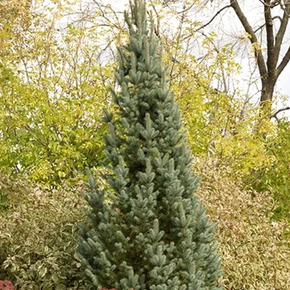
- Striking steel-blue, densely packed needles deliver bold, year-round color that stands out in any landscape setting, all four seasons.
- Naturally forms a broad, symmetrical pyramid without shearing, making it an exceptionally low-maintenance evergreen conifer for home gardens.
- Compact, manageable size of 10-15 ft. tall and 7-10 ft. wide fits foundation plantings, privacy screens, and specimen placements where full-sized spruces would overwhelm.
- Exceptionally cold-hardy down to USDA Zone 3 and notably resistant to deer, rabbits, and air pollution, making it a rugged performer across a wide range of conditions.
Fat Albert Colorado Blue Spruce (Picea pungens 'Fat Albert') is a standout needled evergreen conifer prized for its intensely vivid steel-blue foliage, perfectly symmetrical broad-pyramidal form, and reliably compact, manageable size that outperforms standard Colorado blue spruces in the home landscape. Originally selected as a superior seedling in Oregon, this cultivar of the native Rocky Mountain blue spruce grows at a slow to moderate rate, ultimately reaching 10 to 15 feet tall and 7 to 10 feet wide, with exceptionally dense, closely spaced horizontal branches that give the tree its characteristic full, stocky silhouette - earning it the endearing name it bears. The short, rigid, sharply pointed needles are coated in a waxy bloom that produces one of the most vivid silver-blue colors available in a garden conifer, persisting vibrantly through every season of the year. Hardy from USDA Zones 3 through 7, Fat Albert Colorado Blue Spruce thrives in full sun with well-drained soil and, once established, develops considerable drought tolerance while also shrugging off air pollution, deer, and rabbits. Its versatility in the landscape is unmatched - use it as a striking specimen, a formal or informal anchor in foundation beds, a low-maintenance privacy screen, a mass planting, or a bold focal point in a winter garden where its spectacular blue color truly shines against bare stems and snow.
Plant Description
Fat Albert Colorado Blue Spruce is a cultivar of Picea pungens, the Colorado blue spruce, which is native to the central Rocky Mountain region of North America. It is a needled evergreen conifer in the pine family (Pinaceae) and was originally selected from a seedling grown in Oregon. The cultivar is distinguished by its unusually broad, full pyramidal habit, which is denser and more symmetrical than typical Colorado blue spruce seedlings. The foliage consists of stiff, sharply pointed, four-sided needles arranged radially around the stems, each needle measuring approximately 1 to 1.5 inches in length. A powdery, waxy coating on the needle surfaces creates the characteristic intense silver-blue to steel-blue color that makes this tree one of the most visually striking conifers available to gardeners. The bark on mature trees develops a dark gray, furrowed texture. In spring, inconspicuous oblong cones emerge greenish and mature to a tan-brown color, typically measuring 3 to 6 inches in length.
Mature Size
| Characteristic | Details |
|---|---|
| Mature Height | 10 to 15 feet |
| Mature Width | 7 to 10 feet |
| Growth Rate | Slow to moderate (approximately 6-10 inches per year) |
| Growth Habit | Broad, dense pyramidal form with horizontal branching |
| Plant Type | Needled evergreen conifer |
Hardiness Zones
Fat Albert Colorado Blue Spruce is rated for USDA Plant Hardiness Zones 3 through 7, making it one of the most cold-tolerant ornamental conifers available. It performs exceptionally well across much of the Pacific Northwest, the Rocky Mountain West, the Upper Midwest, and the Northeast. In Southern Oregon and Northern California, it is well-suited to inland valleys and higher-elevation locations where summers are not excessively hot and humid. It may struggle in regions with prolonged high heat and humidity, such as the low-elevation coastal valleys during heat waves, where adequate airflow and well-drained soil become especially critical. Always select a site with good air circulation to support long-term health in warmer growing zones.
Sunlight Requirements
Fat Albert Colorado Blue Spruce performs best in full sun, defined as 6 or more hours of direct sunlight per day. Full sun exposure encourages the densest branch development, the most vivid blue needle color, and the best overall symmetry of the tree's natural pyramidal form. While this cultivar can tolerate some light shade, reduced sun exposure typically results in looser branching, less vibrant needle color, and a less tightly formed crown. For optimal ornamental impact, choose a planting location that receives unobstructed sunlight throughout the majority of the day, particularly during the morning hours. Avoid planting in deep shade or locations overhung by larger trees.
Soil and pH Preferences
This spruce grows best in average to moderately fertile, well-drained soils and will not tolerate poorly drained or waterlogged conditions, which can lead to root rot and rapid decline. While adaptable to a range of soil types including sandy, loamy, and clay soils, it performs best when drainage is reliable. The ideal soil pH range is 6.0 to 7.5 (slightly acidic to neutral), though it demonstrates tolerance for a moderately wide pH range. In heavy clay soils, amend the planting area with organic matter or plant on a slight berm to improve drainage. Fat Albert Colorado Blue Spruce is also notably tolerant of poor, dry, or rocky soils once established, reflecting its native Rocky Mountain heritage.
Watering Guide
Consistent soil moisture is important during the first 1 to 2 growing seasons after planting while the root system establishes. During this period, water deeply and thoroughly once or twice per week, allowing the soil to partially dry between waterings to discourage root rot. Avoid allowing young trees to dry out completely. Once established, Fat Albert Colorado Blue Spruce develops good drought tolerance and requires supplemental watering only during extended dry spells. In Southern Oregon and Northern California, plan to water regularly through the dry summer months, especially during heat events. Deep, infrequent watering that encourages downward root growth is preferable to frequent shallow watering. Established trees in well-drained soils generally need watering every 1 to 2 weeks during hot, dry summer periods.
Fertilizing
Fat Albert Colorado Blue Spruce is a low-fertilizer-demand plant and typically does not require heavy feeding. In average garden soils, a light annual application of a balanced, slow-release granular fertilizer formulated for conifers or evergreens in early spring - just before new growth begins - is sufficient to support healthy development. Look for products with a roughly balanced NPK ratio or slightly higher in nitrogen to encourage steady, healthy growth. Avoid fertilizing in late summer or fall, as this can stimulate tender new growth that may be damaged by early frosts. In very fertile soils, annual fertilization may not be necessary at all. A soil test every few years is the best way to determine whether and what to apply.
Pruning and Maintenance
One of the most appreciated qualities of Fat Albert Colorado Blue Spruce is that it naturally develops its broad pyramidal form without any shearing or pruning, making it a genuinely low-maintenance tree. Pruning is generally unnecessary unless you need to remove dead, damaged, or diseased branches, which should be done in late winter or early spring before new growth emerges. If light shaping is desired to maintain a tidy profile, trim new growth (candles) lightly during the active spring growth period. Avoid cutting back into old wood that lacks green needles, as blue spruce does not reliably bud back from bare, old wood. Never remove more than one-third of the canopy in a single season. Keep the area beneath the canopy free of grass and weeds with a layer of 2 to 3 inches of organic mulch, kept a few inches away from the trunk, to conserve moisture and regulate soil temperature.
Planting Instructions
- Choose a site in full sun with well-drained soil and enough space to accommodate the tree's mature width of 7 to 10 feet.
- Dig a planting hole two to three times as wide as the root ball and no deeper than the height of the root ball - the top of the root ball should sit level with or just slightly above the surrounding soil grade.
- If the soil is heavy clay, amend the backfill with compost or plant on a slight berm to improve drainage.
- Remove the tree from its container carefully, gently loosen any circling roots, and place in the center of the hole.
- Backfill with the native soil, firming gently to remove air pockets, and water thoroughly.
- Apply 2 to 3 inches of organic mulch (wood chips, shredded bark) in a wide ring around the tree, keeping mulch several inches away from the trunk.
- Water deeply at planting and maintain consistent moisture through the first two growing seasons while the root system establishes.
- Space multiple trees at least 8 to 10 feet apart, center to center, to allow for mature spread.
Landscape Uses
Fat Albert Colorado Blue Spruce is an exceptionally versatile conifer for residential and commercial landscapes. Its compact size relative to full-sized blue spruces makes it suitable for a much wider range of applications:
- Specimen or Focal Point: Its bold silver-blue color and perfect pyramidal silhouette make it a natural eye-catching centerpiece in any open lawn or garden bed.
- Foundation Planting: Appropriately sized for planting near homes and buildings without eventually overpowering the structure.
- Privacy Screen or Windbreak: Dense evergreen branching provides effective year-round screening when planted in a row.
- Mass Planting: Multiple plants create a sweeping, uniform landscape effect with dramatic color impact.
- Winter Garden: The vivid blue needle color contrasts beautifully with bare deciduous plants, brown grasses, and snow.
- Walkway and Border Accent: Frames entryways and pathways with structured, formal elegance.
- Slope and Erosion Control: Deep roots anchor well on gentle slopes once established.
Seasonal Interest
Fat Albert Colorado Blue Spruce earns its place in the garden by delivering consistent, bold ornamental interest throughout every month of the year. In spring, bright new growth emerges in an especially vivid silvery-blue, providing a fresh seasonal accent. Through summer, the dense, layered foliage maintains its striking steel-blue to silver-blue color, which intensifies in contrast against lush green neighboring plants. In autumn, as deciduous trees change color and begin to drop leaves, the spruce's blue color becomes an increasingly prominent element in the landscape. Winter is arguably when Fat Albert looks its finest - the persistent steel-blue needles contrast dramatically with snow, bare branches, and dormant surroundings, ensuring the tree remains a standout feature through the coldest months. Small, light-brown cones that develop in late summer and fall add a subtle textural element of additional interest.
Companion Plants
The cool silver-blue tones of Fat Albert Colorado Blue Spruce pair beautifully with a wide variety of plants that complement or contrast with its distinctive color and formal silhouette. Consider these companion plant combinations:
- Gold and Yellow Foliage: Golden false cypress (Chamaecyparis), gold-tipped junipers, or golden barberries create a vibrant warm-cool color contrast.
- Dark Purple Foliage: Smokebush (Cotinus 'Royal Purple'), purple-leaf sand cherry, or dark-leafed barberry varieties make the blue needles pop.
- Ornamental Grasses: Karl Foerster feather reed grass or blue oat grass echo the vertical form and fine texture.
- Flowering Perennials: Purple coneflowers (Echinacea), Russian sage, and lavender provide warm-season color contrast without competing for visual attention.
- Dwarf Conifers: Contrasting forms of globe blue spruce, dwarf mugo pine, or upright junipers create an interesting conifer garden composition.
- Deciduous Shrubs: Red-twig dogwood and native viburnums provide seasonal interest that transitions naturally through the year alongside the evergreen spruce.
Pests and Diseases
Fat Albert Colorado Blue Spruce shares the pest and disease susceptibilities common to Picea pungens cultivars. Being aware of potential issues allows for early detection and prompt management:
- Spruce Spider Mite: The most common pest concern; causes bronzing of needles and fine webbing, especially during hot, dry weather. Inspect regularly in late spring and early summer. Treat with horticultural oil or miticide sprays when populations are detected early.
- Spruce Gall Aphids: Cause pineapple-shaped galls at branch tips. Remove and dispose of galls before they open to interrupt the pest cycle.
- Bagworms: Spindle-shaped bags of silk and plant material hang from branches; hand-pick when small or treat with Bacillus thuringiensis (Bt) in late spring.
- Needle Cast (Rhizosphaera): A fungal disease causing needle browning and drop, usually on inner and lower branches. Improve air circulation, avoid overhead irrigation, and apply copper-based fungicide sprays in spring if needed.
- Cytospora Canker: A fungal canker disease that causes resin-soaked, dying branch sections, especially on stressed trees. There is no fungicide cure; prune out and dispose of infected wood and maintain overall tree vigor with proper watering and soil care.
- Spruce Rust: Occasionally affects needles; maintain good air circulation and remove heavily infected material promptly.
The best defense against most pests and diseases is maintaining a healthy, well-sited, properly watered tree. Avoid over-fertilizing with high-nitrogen products, as this can encourage succulent growth that is more attractive to pest insects.
Wildlife Value
Fat Albert Colorado Blue Spruce provides meaningful wildlife habitat value in home landscapes. The dense, year-round evergreen canopy offers excellent shelter and thermal cover for birds and small mammals during winter storms and cold nights. A variety of songbirds, including chickadees, nuthatches, and finches, use the dense branches for nesting and roosting. The tree's cones, when they develop, provide seeds that are consumed by red crossbills, white-winged crossbills, Clark's nutcrackers, and various other seed-eating birds. The layered horizontal branches create ideal perching and lookout positions for many bird species. Notably, this cultivar is resistant to browsing by deer and rabbits, making it a reliable landscape choice in areas where those animals are a challenge. It does not have significant value as a plant for pollinator insects.
Container Growing
Fat Albert Colorado Blue Spruce can be grown in a large container for use on patios, decks, and entryways, particularly when young. For successful container culture, select a large, sturdy pot with generous drainage holes - a minimum of 24 to 30 inches in diameter is recommended. Use a high-quality, well-draining potting mix blended with perlite or coarse grit to ensure excellent drainage. Container-grown specimens require more frequent watering than in-ground trees, as pots dry out more quickly, especially during warm weather. Fertilize lightly in spring with a slow-release evergreen fertilizer. Because containers expose roots to greater temperature extremes, position container plants where roots are protected from severe freezing in winter - moving to an unheated garage or sheltered area is advisable in climates with harsh winters. Keep in mind that Fat Albert will eventually outgrow most containers as it matures, and long-term planting in the ground will allow it to reach its full ornamental potential.
- Striking steel-blue, densely packed needles deliver bold, year-round color that stands out in any landscape setting, all four seasons.
- Naturally forms a broad, symmetrical pyramid without shearing, making it an exceptionally low-maintenance evergreen conifer for home gardens.
- Compact, manageable size of 10-15 ft. tall and 7-10 ft. wide fits foundation plantings, privacy screens, and specimen placements where full-sized spruces would overwhelm.
- Exceptionally cold-hardy down to USDA Zone 3 and notably resistant to deer, rabbits, and air pollution, making it a rugged performer across a wide range of conditions.
Fat Albert Colorado Blue Spruce (Picea pungens 'Fat Albert') is a standout needled evergreen conifer prized for its intensely vivid steel-blue foliage, perfectly symmetrical broad-pyramidal form, and reliably compact, manageable size that outperforms standard Colorado blue spruces in the home landscape. Originally selected as a superior seedling in Oregon, this cultivar of the native Rocky Mountain blue spruce grows at a slow to moderate rate, ultimately reaching 10 to 15 feet tall and 7 to 10 feet wide, with exceptionally dense, closely spaced horizontal branches that give the tree its characteristic full, stocky silhouette - earning it the endearing name it bears. The short, rigid, sharply pointed needles are coated in a waxy bloom that produces one of the most vivid silver-blue colors available in a garden conifer, persisting vibrantly through every season of the year. Hardy from USDA Zones 3 through 7, Fat Albert Colorado Blue Spruce thrives in full sun with well-drained soil and, once established, develops considerable drought tolerance while also shrugging off air pollution, deer, and rabbits. Its versatility in the landscape is unmatched - use it as a striking specimen, a formal or informal anchor in foundation beds, a low-maintenance privacy screen, a mass planting, or a bold focal point in a winter garden where its spectacular blue color truly shines against bare stems and snow.
Plant Description
Fat Albert Colorado Blue Spruce is a cultivar of Picea pungens, the Colorado blue spruce, which is native to the central Rocky Mountain region of North America. It is a needled evergreen conifer in the pine family (Pinaceae) and was originally selected from a seedling grown in Oregon. The cultivar is distinguished by its unusually broad, full pyramidal habit, which is denser and more symmetrical than typical Colorado blue spruce seedlings. The foliage consists of stiff, sharply pointed, four-sided needles arranged radially around the stems, each needle measuring approximately 1 to 1.5 inches in length. A powdery, waxy coating on the needle surfaces creates the characteristic intense silver-blue to steel-blue color that makes this tree one of the most visually striking conifers available to gardeners. The bark on mature trees develops a dark gray, furrowed texture. In spring, inconspicuous oblong cones emerge greenish and mature to a tan-brown color, typically measuring 3 to 6 inches in length.
Mature Size
| Characteristic | Details |
|---|---|
| Mature Height | 10 to 15 feet |
| Mature Width | 7 to 10 feet |
| Growth Rate | Slow to moderate (approximately 6-10 inches per year) |
| Growth Habit | Broad, dense pyramidal form with horizontal branching |
| Plant Type | Needled evergreen conifer |
Hardiness Zones
Fat Albert Colorado Blue Spruce is rated for USDA Plant Hardiness Zones 3 through 7, making it one of the most cold-tolerant ornamental conifers available. It performs exceptionally well across much of the Pacific Northwest, the Rocky Mountain West, the Upper Midwest, and the Northeast. In Southern Oregon and Northern California, it is well-suited to inland valleys and higher-elevation locations where summers are not excessively hot and humid. It may struggle in regions with prolonged high heat and humidity, such as the low-elevation coastal valleys during heat waves, where adequate airflow and well-drained soil become especially critical. Always select a site with good air circulation to support long-term health in warmer growing zones.
Sunlight Requirements
Fat Albert Colorado Blue Spruce performs best in full sun, defined as 6 or more hours of direct sunlight per day. Full sun exposure encourages the densest branch development, the most vivid blue needle color, and the best overall symmetry of the tree's natural pyramidal form. While this cultivar can tolerate some light shade, reduced sun exposure typically results in looser branching, less vibrant needle color, and a less tightly formed crown. For optimal ornamental impact, choose a planting location that receives unobstructed sunlight throughout the majority of the day, particularly during the morning hours. Avoid planting in deep shade or locations overhung by larger trees.
Soil and pH Preferences
This spruce grows best in average to moderately fertile, well-drained soils and will not tolerate poorly drained or waterlogged conditions, which can lead to root rot and rapid decline. While adaptable to a range of soil types including sandy, loamy, and clay soils, it performs best when drainage is reliable. The ideal soil pH range is 6.0 to 7.5 (slightly acidic to neutral), though it demonstrates tolerance for a moderately wide pH range. In heavy clay soils, amend the planting area with organic matter or plant on a slight berm to improve drainage. Fat Albert Colorado Blue Spruce is also notably tolerant of poor, dry, or rocky soils once established, reflecting its native Rocky Mountain heritage.
Watering Guide
Consistent soil moisture is important during the first 1 to 2 growing seasons after planting while the root system establishes. During this period, water deeply and thoroughly once or twice per week, allowing the soil to partially dry between waterings to discourage root rot. Avoid allowing young trees to dry out completely. Once established, Fat Albert Colorado Blue Spruce develops good drought tolerance and requires supplemental watering only during extended dry spells. In Southern Oregon and Northern California, plan to water regularly through the dry summer months, especially during heat events. Deep, infrequent watering that encourages downward root growth is preferable to frequent shallow watering. Established trees in well-drained soils generally need watering every 1 to 2 weeks during hot, dry summer periods.
Fertilizing
Fat Albert Colorado Blue Spruce is a low-fertilizer-demand plant and typically does not require heavy feeding. In average garden soils, a light annual application of a balanced, slow-release granular fertilizer formulated for conifers or evergreens in early spring - just before new growth begins - is sufficient to support healthy development. Look for products with a roughly balanced NPK ratio or slightly higher in nitrogen to encourage steady, healthy growth. Avoid fertilizing in late summer or fall, as this can stimulate tender new growth that may be damaged by early frosts. In very fertile soils, annual fertilization may not be necessary at all. A soil test every few years is the best way to determine whether and what to apply.
Pruning and Maintenance
One of the most appreciated qualities of Fat Albert Colorado Blue Spruce is that it naturally develops its broad pyramidal form without any shearing or pruning, making it a genuinely low-maintenance tree. Pruning is generally unnecessary unless you need to remove dead, damaged, or diseased branches, which should be done in late winter or early spring before new growth emerges. If light shaping is desired to maintain a tidy profile, trim new growth (candles) lightly during the active spring growth period. Avoid cutting back into old wood that lacks green needles, as blue spruce does not reliably bud back from bare, old wood. Never remove more than one-third of the canopy in a single season. Keep the area beneath the canopy free of grass and weeds with a layer of 2 to 3 inches of organic mulch, kept a few inches away from the trunk, to conserve moisture and regulate soil temperature.
Planting Instructions
- Choose a site in full sun with well-drained soil and enough space to accommodate the tree's mature width of 7 to 10 feet.
- Dig a planting hole two to three times as wide as the root ball and no deeper than the height of the root ball - the top of the root ball should sit level with or just slightly above the surrounding soil grade.
- If the soil is heavy clay, amend the backfill with compost or plant on a slight berm to improve drainage.
- Remove the tree from its container carefully, gently loosen any circling roots, and place in the center of the hole.
- Backfill with the native soil, firming gently to remove air pockets, and water thoroughly.
- Apply 2 to 3 inches of organic mulch (wood chips, shredded bark) in a wide ring around the tree, keeping mulch several inches away from the trunk.
- Water deeply at planting and maintain consistent moisture through the first two growing seasons while the root system establishes.
- Space multiple trees at least 8 to 10 feet apart, center to center, to allow for mature spread.
Landscape Uses
Fat Albert Colorado Blue Spruce is an exceptionally versatile conifer for residential and commercial landscapes. Its compact size relative to full-sized blue spruces makes it suitable for a much wider range of applications:
- Specimen or Focal Point: Its bold silver-blue color and perfect pyramidal silhouette make it a natural eye-catching centerpiece in any open lawn or garden bed.
- Foundation Planting: Appropriately sized for planting near homes and buildings without eventually overpowering the structure.
- Privacy Screen or Windbreak: Dense evergreen branching provides effective year-round screening when planted in a row.
- Mass Planting: Multiple plants create a sweeping, uniform landscape effect with dramatic color impact.
- Winter Garden: The vivid blue needle color contrasts beautifully with bare deciduous plants, brown grasses, and snow.
- Walkway and Border Accent: Frames entryways and pathways with structured, formal elegance.
- Slope and Erosion Control: Deep roots anchor well on gentle slopes once established.
Seasonal Interest
Fat Albert Colorado Blue Spruce earns its place in the garden by delivering consistent, bold ornamental interest throughout every month of the year. In spring, bright new growth emerges in an especially vivid silvery-blue, providing a fresh seasonal accent. Through summer, the dense, layered foliage maintains its striking steel-blue to silver-blue color, which intensifies in contrast against lush green neighboring plants. In autumn, as deciduous trees change color and begin to drop leaves, the spruce's blue color becomes an increasingly prominent element in the landscape. Winter is arguably when Fat Albert looks its finest - the persistent steel-blue needles contrast dramatically with snow, bare branches, and dormant surroundings, ensuring the tree remains a standout feature through the coldest months. Small, light-brown cones that develop in late summer and fall add a subtle textural element of additional interest.
Companion Plants
The cool silver-blue tones of Fat Albert Colorado Blue Spruce pair beautifully with a wide variety of plants that complement or contrast with its distinctive color and formal silhouette. Consider these companion plant combinations:
- Gold and Yellow Foliage: Golden false cypress (Chamaecyparis), gold-tipped junipers, or golden barberries create a vibrant warm-cool color contrast.
- Dark Purple Foliage: Smokebush (Cotinus 'Royal Purple'), purple-leaf sand cherry, or dark-leafed barberry varieties make the blue needles pop.
- Ornamental Grasses: Karl Foerster feather reed grass or blue oat grass echo the vertical form and fine texture.
- Flowering Perennials: Purple coneflowers (Echinacea), Russian sage, and lavender provide warm-season color contrast without competing for visual attention.
- Dwarf Conifers: Contrasting forms of globe blue spruce, dwarf mugo pine, or upright junipers create an interesting conifer garden composition.
- Deciduous Shrubs: Red-twig dogwood and native viburnums provide seasonal interest that transitions naturally through the year alongside the evergreen spruce.
Pests and Diseases
Fat Albert Colorado Blue Spruce shares the pest and disease susceptibilities common to Picea pungens cultivars. Being aware of potential issues allows for early detection and prompt management:
- Spruce Spider Mite: The most common pest concern; causes bronzing of needles and fine webbing, especially during hot, dry weather. Inspect regularly in late spring and early summer. Treat with horticultural oil or miticide sprays when populations are detected early.
- Spruce Gall Aphids: Cause pineapple-shaped galls at branch tips. Remove and dispose of galls before they open to interrupt the pest cycle.
- Bagworms: Spindle-shaped bags of silk and plant material hang from branches; hand-pick when small or treat with Bacillus thuringiensis (Bt) in late spring.
- Needle Cast (Rhizosphaera): A fungal disease causing needle browning and drop, usually on inner and lower branches. Improve air circulation, avoid overhead irrigation, and apply copper-based fungicide sprays in spring if needed.
- Cytospora Canker: A fungal canker disease that causes resin-soaked, dying branch sections, especially on stressed trees. There is no fungicide cure; prune out and dispose of infected wood and maintain overall tree vigor with proper watering and soil care.
- Spruce Rust: Occasionally affects needles; maintain good air circulation and remove heavily infected material promptly.
The best defense against most pests and diseases is maintaining a healthy, well-sited, properly watered tree. Avoid over-fertilizing with high-nitrogen products, as this can encourage succulent growth that is more attractive to pest insects.
Wildlife Value
Fat Albert Colorado Blue Spruce provides meaningful wildlife habitat value in home landscapes. The dense, year-round evergreen canopy offers excellent shelter and thermal cover for birds and small mammals during winter storms and cold nights. A variety of songbirds, including chickadees, nuthatches, and finches, use the dense branches for nesting and roosting. The tree's cones, when they develop, provide seeds that are consumed by red crossbills, white-winged crossbills, Clark's nutcrackers, and various other seed-eating birds. The layered horizontal branches create ideal perching and lookout positions for many bird species. Notably, this cultivar is resistant to browsing by deer and rabbits, making it a reliable landscape choice in areas where those animals are a challenge. It does not have significant value as a plant for pollinator insects.
Container Growing
Fat Albert Colorado Blue Spruce can be grown in a large container for use on patios, decks, and entryways, particularly when young. For successful container culture, select a large, sturdy pot with generous drainage holes - a minimum of 24 to 30 inches in diameter is recommended. Use a high-quality, well-draining potting mix blended with perlite or coarse grit to ensure excellent drainage. Container-grown specimens require more frequent watering than in-ground trees, as pots dry out more quickly, especially during warm weather. Fertilize lightly in spring with a slow-release evergreen fertilizer. Because containers expose roots to greater temperature extremes, position container plants where roots are protected from severe freezing in winter - moving to an unheated garage or sheltered area is advisable in climates with harsh winters. Keep in mind that Fat Albert will eventually outgrow most containers as it matures, and long-term planting in the ground will allow it to reach its full ornamental potential.
Related Products