

Zoom the image with the mouse
Eternal Fragrance Daphne
SKU:
575312-P
UPC:
651469520129
$29.99 - $49.99
- Intensely sweet fragrance fills the air from spring through fall with multiple bloom flushes of blush-pink to white flowers — one of the longest-blooming daphnes available.
- Compact, naturally rounded habit grows just 2 to 3 feet tall and wide, making it ideal for small gardens, border fronts, patios, and container plantings where its perfume can be savored up close.
- Semi-evergreen foliage of dark, semi-glossy leaves provides year-round structure, remaining evergreen where temperatures stay above 0°F and returning vigorously in cooler climates.
- Deer and rabbit resistant, drought tolerant once established, and a recipient of the Royal Horticultural Society Award of Garden Merit — a proven, low-maintenance landscape gem.
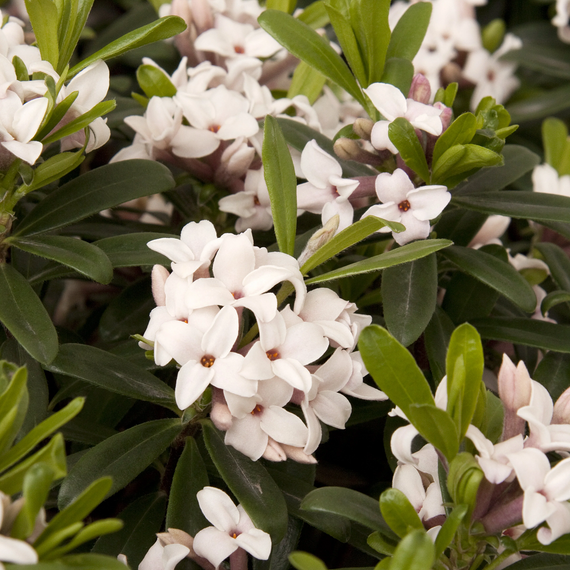
Daphne Eternal Fragrance (Daphne x transatlantica 'Blafra' PP18,361) is a standout semi-evergreen shrub that redefines what gardeners have come to expect from the daphne family. Unlike traditional daphne varieties that offer a single, fleeting burst of bloom, Eternal Fragrance delivers repeated flushes of intensely fragrant, blush-pink to white flower clusters from late spring all the way through autumn, with blooms appearing on new growth so that each season feels fresh and generous. The flowers are small but remarkably powerful — their sweet, complex perfume is detectable from impressive distances and is strong enough to transform an entire patio or entryway into a sensory destination. Bred in the United Kingdom and introduced as a truly next-generation hybrid cross between Daphne caucasica and Daphne collina, this compact shrub forms a tidy, rounded mound of dark green, semi-glossy, narrow elliptic leaves that remain attractive all season long and stay evergreen in mild-winter climates. Hardy in USDA Zones 5 through 9, Eternal Fragrance is adaptable to a wide range of garden conditions, performing beautifully in full sun to partial shade and tolerating a variety of soil types as long as drainage is excellent. Its naturally compact stature of 2 to 3 feet tall and equally wide requires minimal pruning to maintain its attractive form, and its inherent resistance to deer and rabbits, combined with solid drought tolerance once established, makes it a remarkably easy-care choice for Southern Oregon and Northern California gardens. Whether planted as a fragrant specimen in a mixed border, grouped for a hedge effect, tucked into a rock garden, or grown in a decorative container near an outdoor living area, Daphne Eternal Fragrance delivers months of extraordinary floral perfume and four-season foliage interest that few other shrubs can rival.
Plant Description
Daphne Eternal Fragrance is a rounded, open-branched, semi-evergreen shrub that is prized above all else for the extraordinary intensity of its fragrance. It is a hybrid cross (Daphne caucasica x Daphne collina) bred in the United Kingdom and introduced under U.S. Plant Patent PP18,361, issued December 25, 2007. The flowers are borne in tight clusters at the tips of stems and are white with warm orange-yellow anthers at their centers, taking on soft blush-pink to pink-purple hues as temperatures cool in autumn. Foliage consists of narrow, elliptic, semi-glossy dark green leaves up to 2 inches long that clothe the stems densely, giving the shrub a lush, tidy appearance even when not in bloom. Unlike many daphnes that bloom once and finish, Eternal Fragrance produces flowers on new growth, which means the blooming cycle repeats in multiple flushes throughout spring, summer, and into fall. The plant holds the prestigious Royal Horticultural Society Award of Garden Merit, recognizing its outstanding reliability and ornamental value.
Mature Size
| Attribute | Measurement |
|---|---|
| Mature Height | 2 to 3 feet (60 to 90 cm) |
| Mature Spread | 2 to 3 feet (60 to 90 cm) |
| Recommended Spacing | 24 to 36 inches on center |
| Growth Rate | Slow to moderate; naturally compact and self-shaping |
| Growth Habit | Rounded, mounding, densely branched |
Because of its slow, compact growth habit, Eternal Fragrance rarely requires corrective pruning to maintain its attractive rounded form. It is perfectly scaled for smaller urban gardens, raised beds, border foregrounds, and patio containers, and it will not outgrow its space over time the way larger shrubs often do.
Hardiness Zones
Eternal Fragrance Daphne is rated hardy in USDA Hardiness Zones 5 through 9, making it one of the more cold-tolerant daphnes available. It remains semi-evergreen where temperatures stay above approximately 0°F, and while it may drop most of its foliage in colder winters, it typically re-leafs vigorously in spring. In the warmer end of its range (Zones 7 through 9), including much of Southern Oregon and Northern California, it can remain essentially evergreen and may begin its first bloom flush as early as March or April. For best cold-hardiness performance, site the plant in a location sheltered from harsh winter winds, and apply a 2- to 3-inch layer of mulch over the root zone before winter arrives. In the hottest parts of Zone 9, afternoon shade is beneficial to protect the foliage from summer scorch.
Sunlight Requirements
Eternal Fragrance Daphne performs best in full sun to partial shade. In the mild, moderate climates of Southern Oregon and Northern California, it is well-suited to a position that receives at least 4 to 6 hours of direct sun per day, ideally with morning sun and dappled or light afternoon shade. Too much shade — particularly deep, dense shade — will result in sparse, leggy growth and significantly reduced flowering. Conversely, intense full afternoon sun in very hot summers can cause leaf scorch and bud drop. A position along an east-facing wall, under the high canopy of open-branched trees, or on the north or east side of a building often provides the ideal balance of brightness and shelter. Consistent light exposure encourages the most prolific and reliable repeat bloom cycles.
Soil and pH Preferences
Sharp, excellent soil drainage is the single most critical requirement for success with Eternal Fragrance Daphne. It thrives in moist but very well-drained, humus-rich soils and will tolerate chalk, clay, loam, or sandy textures as long as water does not pool at the roots. In areas with heavy clay soils, consider planting in a raised bed or mounding the soil to improve drainage before planting. A soil pH in the slightly acidic to neutral range — approximately 5.8 to 6.5 — is ideal, though the plant can adapt to mildly alkaline conditions. If soil tests reveal a pH above 6.8, top-dressing with elemental sulfur or using an acid-forming fertilizer will help bring it into range. Enriching the planting area with compost or aged leaf mold improves both drainage in clay soils and moisture retention in sandy soils, creating the balanced, humusy root environment where this daphne truly thrives.
Watering Guide
Consistent moisture is especially important during the first one to two growing seasons while Eternal Fragrance Daphne is becoming established. During this establishment period, water deeply every three to four days in the absence of significant rainfall, being careful never to allow the root zone to completely dry out. The finger test is a reliable guide — if the top 2 inches of soil are dry but the soil below remains lightly moist, watering can wait a day; if the soil below is also dry, water immediately. Once established, the plant develops meaningful drought tolerance, though consistent moderate moisture through the blooming months encourages more plentiful and repeat flowering. Extended dry spells can reduce the intensity of summer and fall bloom flushes. In all cases, avoid waterlogged conditions — saturated soil is the leading cause of root rot and plant decline in daphnes. Drip irrigation or soaker hoses that keep water away from the crown and foliage are preferable to overhead irrigation.
Fertilizing
Feed Eternal Fragrance Daphne conservatively, as excessive fertilization — particularly with high-nitrogen products — encourages soft, leafy growth at the expense of flowers. A balanced approach using acid-loving plant fertilizer works well with the following seasonal schedule:
- Early spring (late February to March): Apply a balanced, slow-release fertilizer formulated for acid-loving plants (such as a rhododendron or camellia formula) to support healthy new growth and the first bloom flush.
- After the first bloom flush (late May to early June): Supplement with a liquid seaweed or diluted fish emulsion to encourage rapid development of new growth for subsequent bloom cycles.
- Midsummer (early to mid-July): A second light application of slow-release, acid-forming fertilizer supports the late-summer and fall bloom flushes.
- Late summer (after mid-August): Discontinue all fertilizing to allow the plant to harden off naturally before cooler fall temperatures arrive.
Avoid lime, wood ash, bone meal, and high-phosphorus starter fertilizers, all of which can harm root health or raise soil pH to unfavorable levels.
Pruning and Maintenance
One of the appealing qualities of Eternal Fragrance Daphne is its low maintenance needs. Its naturally rounded, compact habit means formal shaping is rarely necessary. When pruning is desired — either to tidy the shape or to encourage a fresh flush of new flowering growth — follow these guidelines:
- Best timing: Prune lightly immediately after a bloom flush finishes. Since flowers are produced on new growth, a light trim at the right moment triggers a faster and more abundant rebloom cycle 6 to 8 weeks later.
- Amount to remove: Never remove more than 20% of the plant's overall volume at a single pruning. Light, frequent shaping is far preferable to heavy cutting.
- Deadheading: Removing spent flower clusters promptly encourages the plant to direct its energy toward forming the next round of buds rather than setting seed.
- Avoid fall and winter pruning: Pruning late in the season removes the hardened growth that protects the plant through cold months and can reduce hardiness.
- Removal of dead wood: Any dead, damaged, or crossing branches can be removed at any time of year using clean, sharp pruners.
Daphnes are best left undisturbed once established in the garden. Avoid root disturbance through cultivation or digging near the plant, and keep the root zone mulched to maintain consistent soil moisture and temperature.
Planting Instructions
- Choose the right site: Select a location with excellent drainage, appropriate light (morning sun with afternoon dappled shade in hot climates), and shelter from harsh drying winds. Proximity to a patio, walkway, or entry door allows the fragrance to be fully appreciated.
- Prepare the soil: Amend the planting area with compost, aged leaf mold, or fine pine bark to improve drainage and organic matter content. In heavy clay, build up a raised planting mound or raised bed at least 12 inches above the existing grade.
- Dig the hole: Dig a hole approximately twice as wide as the root ball but no deeper — it is critical that the plant sits at or very slightly above the surrounding soil level. Daphnes planted too deep are prone to crown rot.
- Plant carefully: Slide the plant gently from its container rather than pulling by the stem. Score the root ball lightly in four places with a knife rather than aggressively teasing the roots apart, as daphne feeder roots are brittle and easily damaged.
- Backfill and firm: Fill in around the root ball with the amended native soil, firming gently to eliminate air pockets without compacting the soil around the roots.
- Water in thoroughly: Water deeply at planting to settle the soil and initiate root-to-soil contact. A dilute liquid seaweed solution can be used as the initial watering to reduce transplant stress.
- Mulch: Apply 2 to 3 inches of pine bark, shredded bark, or aged wood chip mulch over the root zone, keeping mulch pulled back 2 inches from the base of the stems to prevent crown rot.
- Planting time: In Southern Oregon and Northern California, spring planting after the last frost date and fall planting 6 to 8 weeks before the first expected frost are both excellent options. Avoid planting during summer heat peaks.
Seasonal Interest
Eternal Fragrance Daphne earns its name by delivering ornamental value across a remarkably long season:
- Spring (April to May): The heaviest and most spectacular bloom flush begins, covering the plant in dense clusters of blush-pink to white flowers with an intensely sweet, far-carrying fragrance. Dark green foliage provides a lush backdrop.
- Early Summer (June): A transitional period between flushes; the glossy, semi-evergreen foliage remains attractive and a second wave of buds develops on new growth.
- Midsummer to Late Summer (July to August): Additional bloom flushes occur, often with slightly smaller individual clusters but with undiminished fragrance. Consistent moisture and light pruning of spent clusters encourage these repeat flushes.
- Fall (September to October): A final, often very rewarding bloom period arrives, and as night temperatures cool, the white flowers take on deeper blush-pink to soft pink-purple tints that are particularly beautiful. Foliage deepens in color as well.
- Winter: In Zones 7 to 9, the plant remains essentially evergreen, providing structure and green color in the winter garden. In colder winters or harsher sites, some leaf drop occurs but the plant holds attractive stems and form.
Landscape Uses
The compact size, extraordinary fragrance, long bloom season, and refined appearance of Eternal Fragrance Daphne make it exceptionally versatile in the landscape:
- Specimen planting: Use as a standalone focal point in a small garden bed where its form and fragrance can be showcased without competition.
- Border foreground: Its compact stature makes it ideal at the front of mixed shrub or perennial borders, where it will not obscure plants behind it.
- Foundation planting: Well suited to planting near building foundations, where reflected warmth can extend its blooming season and the fragrance is funneled toward windows and doors.
- Patio and deck surrounds: One of the best uses — plant near outdoor seating areas to envelop the space in perfume during the long blooming season.
- Entry garden: Planted flanking a front door or along a front walkway, a single plant can fill an entire entryway with fragrance for months at a time.
- Rock and gravel gardens: Its preference for sharp drainage and its compact, tidy habit suit it beautifully to rock garden or gravel garden settings.
- Small urban and courtyard gardens: Perfectly scaled for tight urban spaces, courtyards, and small-lot gardens where space is at a premium.
- Low informal hedge or edging: When planted in a row at 24- to 30-inch spacing, creates a fragrant low hedge for pathway or bed edging.
Container Growing
Eternal Fragrance Daphne adapts very well to container culture, making it an excellent choice for patios, courtyards, balconies, and any outdoor space where in-ground planting is not possible. When growing in containers, keep the following in mind:
- Container choice: Use breathable containers such as terracotta, ceramic, or fabric grow bags rather than plastic, as these allow excess moisture to escape and reduce the risk of root rot. A starting container of 12 to 15 inches in diameter is appropriate for a newly purchased plant.
- Potting mix: Use a very well-draining mix such as a blend of quality potting soil, coarse perlite or pumice, and fine pine bark. Standard potting mixes that retain too much moisture are not suitable.
- Watering in containers: Container-grown plants dry out more quickly than in-ground plants and require more attentive watering, especially during warm weather. Check soil moisture regularly and water when the top inch of the mix is dry, but never allow the pot to sit in a saucer of standing water.
- Fertilizing containers: Container plants benefit from a supplemental monthly liquid feeding with a dilute, acid-forming fertilizer through the growing season, as nutrients leach from containers more readily than from garden soil.
- Repotting: Repot into a slightly larger container every 3 to 4 years as the root system fills the pot, refreshing the growing medium at the same time.
- Winter in containers: In colder winters, move containers against a sheltered house wall or into an unheated garage or shed to protect the root ball, which is more vulnerable to hard freezes in containers than in the ground.
Companion Plants
Eternal Fragrance Daphne pairs beautifully with plants that share its preference for well-drained, slightly acidic soil and part-shade conditions, and that complement its bloom timing and foliage texture:
- Hellebores (Lenten rose): Their early-season blooms bridge the gap before daphne's first flush, and their bold, leathery foliage contrasts beautifully with daphne's fine-textured leaves.
- Dwarf rhododendrons and azaleas: Share the same acid soil preference and provide complementary spring color in a range of pinks, purples, and whites.
- Heuchera and Tiarella: Low-growing foliage perennials that carpet the ground around the daphne's base, suppressing weeds and adding colorful foliage contrast throughout the season.
- Sarcococca (sweetbox): A fragrant winter-blooming shrub that picks up where daphne leaves off, ensuring near-year-round fragrance in the garden.
- Dwarf conifers: Compact forms of spruce, chamaecyparis, or juniper provide evergreen structure and textural contrast that highlights the daphne's flower clusters.
- Spring bulbs — miniature daffodils, snowdrops, and crocus: These early-season bloomers emerge, flower, and begin to fade just as daphne's foliage is flushing, creating a seamless seasonal transition with no unsightly gap in the planting.
- Lavender: In sunny, well-drained spots, lavender's silver foliage and purple summer spikes complement daphne's white-pink flowers and share a love of excellent drainage.
Pests and Diseases
Eternal Fragrance Daphne has no serious or debilitating pest or disease problems under good growing conditions, but a few issues are worth monitoring:
- Aphids: Small, soft-bodied insects that cluster on tender new growth and flower buds, secreting sticky honeydew and distorting emerging shoots. Manage with a strong jet of water directed at infestations, or apply insecticidal soap or neem oil at dusk. Repeat every 5 to 7 days until controlled.
- Scale insects: May appear as small brown or tan bumps on stems, feeding on plant sap and weakening growth over time. Treat with horticultural oil applied in late winter or early spring before new growth emerges, or dab individual scale with a cotton swab dipped in isopropyl alcohol.
- Mealybugs: White, cottony masses in stem joints and leaf axils. Treat similarly to scale with horticultural oil or insecticidal soap.
- Root rot (Phytophthora and others): The most serious and most common problem with daphnes, almost always caused by poorly draining soil or overwatering. Symptoms include sudden wilting despite moist soil, yellowing foliage, and blackened, mushy roots. Prevention through excellent drainage is the best strategy. There is no effective cure once root rot is advanced; severely affected plants should be removed and the soil amended before replanting.
- Botrytis (gray mold) and leaf spot: Fungal issues that can arise in overly humid or poorly ventilated conditions. Ensure adequate air circulation around plants, avoid overhead watering, and remove and dispose of affected foliage. Fungicidal sprays may be used if problems persist.
- Sudden dieback: Daphnes as a genus are occasionally prone to unexpected rapid decline even in seemingly good conditions, a phenomenon noted by experienced horticulturists. Minimize the risk by ensuring perfect drainage, avoiding root disturbance once established, and keeping the plant in optimal health through consistent care.
Wildlife Value and Toxicity
Wildlife benefits: The richly fragrant flowers of Eternal Fragrance Daphne are attractive to bees and butterflies, which visit the blooms for nectar throughout the extended flowering season from spring to fall. The repeated bloom flushes provide a consistent and valuable food source for pollinators over many months.
Deer and rabbit resistance: All parts of daphne plants contain toxic compounds — including daphnin and mezerein — that make the foliage, bark, and berries unpalatable and potentially harmful to browsing animals. As a result, deer and rabbits consistently avoid this plant, making it an excellent choice for gardens in areas where deer pressure is a challenge.
Important toxicity warning: All parts of Daphne x transatlantica, including flowers, foliage, bark, and any fruit, are toxic to humans, pets, and livestock if ingested. The sap can also cause skin and eye irritation in sensitive individuals. Always wear gloves when pruning or handling the plant, and wash hands thoroughly afterward. Keep children and pets from consuming any part of the plant. This is an important consideration when selecting planting locations in family gardens.
Quick Reference Chart
| Characteristic | Detail |
|---|---|
| Botanical Name | Daphne x transatlantica 'Blafra' PP18,361 |
| Common Name | Eternal Fragrance Daphne |
| Plant Type | Semi-evergreen to evergreen flowering shrub |
| USDA Hardiness Zones | 5 to 9 |
| Mature Height | 2 to 3 feet |
| Mature Spread | 2 to 3 feet |
| Sun Exposure | Full sun to partial shade |
| Bloom Time | Late spring through fall (multiple flushes, April to October) |
| Flower Color | White to blush pink; deeper pink-purple tones in cool weather |
| Foliage | Dark green, semi-glossy, narrow elliptic; semi-evergreen |
| Soil Preference | Well-drained, humus-rich; slightly acidic to neutral (pH 5.8 to 6.5) |
| Water Needs | Moderate; drought tolerant once established |
| Growth Rate | Slow |
| Maintenance Level | Low |
| Deer Resistant | Yes |
| Attracts Pollinators | Bees and butterflies |
| Awards | RHS Award of Garden Merit |
| Toxicity | All parts toxic if ingested; sap may irritate skin |
- Intensely sweet fragrance fills the air from spring through fall with multiple bloom flushes of blush-pink to white flowers — one of the longest-blooming daphnes available.
- Compact, naturally rounded habit grows just 2 to 3 feet tall and wide, making it ideal for small gardens, border fronts, patios, and container plantings where its perfume can be savored up close.
- Semi-evergreen foliage of dark, semi-glossy leaves provides year-round structure, remaining evergreen where temperatures stay above 0°F and returning vigorously in cooler climates.
- Deer and rabbit resistant, drought tolerant once established, and a recipient of the Royal Horticultural Society Award of Garden Merit — a proven, low-maintenance landscape gem.
Daphne Eternal Fragrance (Daphne x transatlantica 'Blafra' PP18,361) is a standout semi-evergreen shrub that redefines what gardeners have come to expect from the daphne family. Unlike traditional daphne varieties that offer a single, fleeting burst of bloom, Eternal Fragrance delivers repeated flushes of intensely fragrant, blush-pink to white flower clusters from late spring all the way through autumn, with blooms appearing on new growth so that each season feels fresh and generous. The flowers are small but remarkably powerful — their sweet, complex perfume is detectable from impressive distances and is strong enough to transform an entire patio or entryway into a sensory destination. Bred in the United Kingdom and introduced as a truly next-generation hybrid cross between Daphne caucasica and Daphne collina, this compact shrub forms a tidy, rounded mound of dark green, semi-glossy, narrow elliptic leaves that remain attractive all season long and stay evergreen in mild-winter climates. Hardy in USDA Zones 5 through 9, Eternal Fragrance is adaptable to a wide range of garden conditions, performing beautifully in full sun to partial shade and tolerating a variety of soil types as long as drainage is excellent. Its naturally compact stature of 2 to 3 feet tall and equally wide requires minimal pruning to maintain its attractive form, and its inherent resistance to deer and rabbits, combined with solid drought tolerance once established, makes it a remarkably easy-care choice for Southern Oregon and Northern California gardens. Whether planted as a fragrant specimen in a mixed border, grouped for a hedge effect, tucked into a rock garden, or grown in a decorative container near an outdoor living area, Daphne Eternal Fragrance delivers months of extraordinary floral perfume and four-season foliage interest that few other shrubs can rival.
Plant Description
Daphne Eternal Fragrance is a rounded, open-branched, semi-evergreen shrub that is prized above all else for the extraordinary intensity of its fragrance. It is a hybrid cross (Daphne caucasica x Daphne collina) bred in the United Kingdom and introduced under U.S. Plant Patent PP18,361, issued December 25, 2007. The flowers are borne in tight clusters at the tips of stems and are white with warm orange-yellow anthers at their centers, taking on soft blush-pink to pink-purple hues as temperatures cool in autumn. Foliage consists of narrow, elliptic, semi-glossy dark green leaves up to 2 inches long that clothe the stems densely, giving the shrub a lush, tidy appearance even when not in bloom. Unlike many daphnes that bloom once and finish, Eternal Fragrance produces flowers on new growth, which means the blooming cycle repeats in multiple flushes throughout spring, summer, and into fall. The plant holds the prestigious Royal Horticultural Society Award of Garden Merit, recognizing its outstanding reliability and ornamental value.
Mature Size
| Attribute | Measurement |
|---|---|
| Mature Height | 2 to 3 feet (60 to 90 cm) |
| Mature Spread | 2 to 3 feet (60 to 90 cm) |
| Recommended Spacing | 24 to 36 inches on center |
| Growth Rate | Slow to moderate; naturally compact and self-shaping |
| Growth Habit | Rounded, mounding, densely branched |
Because of its slow, compact growth habit, Eternal Fragrance rarely requires corrective pruning to maintain its attractive rounded form. It is perfectly scaled for smaller urban gardens, raised beds, border foregrounds, and patio containers, and it will not outgrow its space over time the way larger shrubs often do.
Hardiness Zones
Eternal Fragrance Daphne is rated hardy in USDA Hardiness Zones 5 through 9, making it one of the more cold-tolerant daphnes available. It remains semi-evergreen where temperatures stay above approximately 0°F, and while it may drop most of its foliage in colder winters, it typically re-leafs vigorously in spring. In the warmer end of its range (Zones 7 through 9), including much of Southern Oregon and Northern California, it can remain essentially evergreen and may begin its first bloom flush as early as March or April. For best cold-hardiness performance, site the plant in a location sheltered from harsh winter winds, and apply a 2- to 3-inch layer of mulch over the root zone before winter arrives. In the hottest parts of Zone 9, afternoon shade is beneficial to protect the foliage from summer scorch.
Sunlight Requirements
Eternal Fragrance Daphne performs best in full sun to partial shade. In the mild, moderate climates of Southern Oregon and Northern California, it is well-suited to a position that receives at least 4 to 6 hours of direct sun per day, ideally with morning sun and dappled or light afternoon shade. Too much shade — particularly deep, dense shade — will result in sparse, leggy growth and significantly reduced flowering. Conversely, intense full afternoon sun in very hot summers can cause leaf scorch and bud drop. A position along an east-facing wall, under the high canopy of open-branched trees, or on the north or east side of a building often provides the ideal balance of brightness and shelter. Consistent light exposure encourages the most prolific and reliable repeat bloom cycles.
Soil and pH Preferences
Sharp, excellent soil drainage is the single most critical requirement for success with Eternal Fragrance Daphne. It thrives in moist but very well-drained, humus-rich soils and will tolerate chalk, clay, loam, or sandy textures as long as water does not pool at the roots. In areas with heavy clay soils, consider planting in a raised bed or mounding the soil to improve drainage before planting. A soil pH in the slightly acidic to neutral range — approximately 5.8 to 6.5 — is ideal, though the plant can adapt to mildly alkaline conditions. If soil tests reveal a pH above 6.8, top-dressing with elemental sulfur or using an acid-forming fertilizer will help bring it into range. Enriching the planting area with compost or aged leaf mold improves both drainage in clay soils and moisture retention in sandy soils, creating the balanced, humusy root environment where this daphne truly thrives.
Watering Guide
Consistent moisture is especially important during the first one to two growing seasons while Eternal Fragrance Daphne is becoming established. During this establishment period, water deeply every three to four days in the absence of significant rainfall, being careful never to allow the root zone to completely dry out. The finger test is a reliable guide — if the top 2 inches of soil are dry but the soil below remains lightly moist, watering can wait a day; if the soil below is also dry, water immediately. Once established, the plant develops meaningful drought tolerance, though consistent moderate moisture through the blooming months encourages more plentiful and repeat flowering. Extended dry spells can reduce the intensity of summer and fall bloom flushes. In all cases, avoid waterlogged conditions — saturated soil is the leading cause of root rot and plant decline in daphnes. Drip irrigation or soaker hoses that keep water away from the crown and foliage are preferable to overhead irrigation.
Fertilizing
Feed Eternal Fragrance Daphne conservatively, as excessive fertilization — particularly with high-nitrogen products — encourages soft, leafy growth at the expense of flowers. A balanced approach using acid-loving plant fertilizer works well with the following seasonal schedule:
- Early spring (late February to March): Apply a balanced, slow-release fertilizer formulated for acid-loving plants (such as a rhododendron or camellia formula) to support healthy new growth and the first bloom flush.
- After the first bloom flush (late May to early June): Supplement with a liquid seaweed or diluted fish emulsion to encourage rapid development of new growth for subsequent bloom cycles.
- Midsummer (early to mid-July): A second light application of slow-release, acid-forming fertilizer supports the late-summer and fall bloom flushes.
- Late summer (after mid-August): Discontinue all fertilizing to allow the plant to harden off naturally before cooler fall temperatures arrive.
Avoid lime, wood ash, bone meal, and high-phosphorus starter fertilizers, all of which can harm root health or raise soil pH to unfavorable levels.
Pruning and Maintenance
One of the appealing qualities of Eternal Fragrance Daphne is its low maintenance needs. Its naturally rounded, compact habit means formal shaping is rarely necessary. When pruning is desired — either to tidy the shape or to encourage a fresh flush of new flowering growth — follow these guidelines:
- Best timing: Prune lightly immediately after a bloom flush finishes. Since flowers are produced on new growth, a light trim at the right moment triggers a faster and more abundant rebloom cycle 6 to 8 weeks later.
- Amount to remove: Never remove more than 20% of the plant's overall volume at a single pruning. Light, frequent shaping is far preferable to heavy cutting.
- Deadheading: Removing spent flower clusters promptly encourages the plant to direct its energy toward forming the next round of buds rather than setting seed.
- Avoid fall and winter pruning: Pruning late in the season removes the hardened growth that protects the plant through cold months and can reduce hardiness.
- Removal of dead wood: Any dead, damaged, or crossing branches can be removed at any time of year using clean, sharp pruners.
Daphnes are best left undisturbed once established in the garden. Avoid root disturbance through cultivation or digging near the plant, and keep the root zone mulched to maintain consistent soil moisture and temperature.
Planting Instructions
- Choose the right site: Select a location with excellent drainage, appropriate light (morning sun with afternoon dappled shade in hot climates), and shelter from harsh drying winds. Proximity to a patio, walkway, or entry door allows the fragrance to be fully appreciated.
- Prepare the soil: Amend the planting area with compost, aged leaf mold, or fine pine bark to improve drainage and organic matter content. In heavy clay, build up a raised planting mound or raised bed at least 12 inches above the existing grade.
- Dig the hole: Dig a hole approximately twice as wide as the root ball but no deeper — it is critical that the plant sits at or very slightly above the surrounding soil level. Daphnes planted too deep are prone to crown rot.
- Plant carefully: Slide the plant gently from its container rather than pulling by the stem. Score the root ball lightly in four places with a knife rather than aggressively teasing the roots apart, as daphne feeder roots are brittle and easily damaged.
- Backfill and firm: Fill in around the root ball with the amended native soil, firming gently to eliminate air pockets without compacting the soil around the roots.
- Water in thoroughly: Water deeply at planting to settle the soil and initiate root-to-soil contact. A dilute liquid seaweed solution can be used as the initial watering to reduce transplant stress.
- Mulch: Apply 2 to 3 inches of pine bark, shredded bark, or aged wood chip mulch over the root zone, keeping mulch pulled back 2 inches from the base of the stems to prevent crown rot.
- Planting time: In Southern Oregon and Northern California, spring planting after the last frost date and fall planting 6 to 8 weeks before the first expected frost are both excellent options. Avoid planting during summer heat peaks.
Seasonal Interest
Eternal Fragrance Daphne earns its name by delivering ornamental value across a remarkably long season:
- Spring (April to May): The heaviest and most spectacular bloom flush begins, covering the plant in dense clusters of blush-pink to white flowers with an intensely sweet, far-carrying fragrance. Dark green foliage provides a lush backdrop.
- Early Summer (June): A transitional period between flushes; the glossy, semi-evergreen foliage remains attractive and a second wave of buds develops on new growth.
- Midsummer to Late Summer (July to August): Additional bloom flushes occur, often with slightly smaller individual clusters but with undiminished fragrance. Consistent moisture and light pruning of spent clusters encourage these repeat flushes.
- Fall (September to October): A final, often very rewarding bloom period arrives, and as night temperatures cool, the white flowers take on deeper blush-pink to soft pink-purple tints that are particularly beautiful. Foliage deepens in color as well.
- Winter: In Zones 7 to 9, the plant remains essentially evergreen, providing structure and green color in the winter garden. In colder winters or harsher sites, some leaf drop occurs but the plant holds attractive stems and form.
Landscape Uses
The compact size, extraordinary fragrance, long bloom season, and refined appearance of Eternal Fragrance Daphne make it exceptionally versatile in the landscape:
- Specimen planting: Use as a standalone focal point in a small garden bed where its form and fragrance can be showcased without competition.
- Border foreground: Its compact stature makes it ideal at the front of mixed shrub or perennial borders, where it will not obscure plants behind it.
- Foundation planting: Well suited to planting near building foundations, where reflected warmth can extend its blooming season and the fragrance is funneled toward windows and doors.
- Patio and deck surrounds: One of the best uses — plant near outdoor seating areas to envelop the space in perfume during the long blooming season.
- Entry garden: Planted flanking a front door or along a front walkway, a single plant can fill an entire entryway with fragrance for months at a time.
- Rock and gravel gardens: Its preference for sharp drainage and its compact, tidy habit suit it beautifully to rock garden or gravel garden settings.
- Small urban and courtyard gardens: Perfectly scaled for tight urban spaces, courtyards, and small-lot gardens where space is at a premium.
- Low informal hedge or edging: When planted in a row at 24- to 30-inch spacing, creates a fragrant low hedge for pathway or bed edging.
Container Growing
Eternal Fragrance Daphne adapts very well to container culture, making it an excellent choice for patios, courtyards, balconies, and any outdoor space where in-ground planting is not possible. When growing in containers, keep the following in mind:
- Container choice: Use breathable containers such as terracotta, ceramic, or fabric grow bags rather than plastic, as these allow excess moisture to escape and reduce the risk of root rot. A starting container of 12 to 15 inches in diameter is appropriate for a newly purchased plant.
- Potting mix: Use a very well-draining mix such as a blend of quality potting soil, coarse perlite or pumice, and fine pine bark. Standard potting mixes that retain too much moisture are not suitable.
- Watering in containers: Container-grown plants dry out more quickly than in-ground plants and require more attentive watering, especially during warm weather. Check soil moisture regularly and water when the top inch of the mix is dry, but never allow the pot to sit in a saucer of standing water.
- Fertilizing containers: Container plants benefit from a supplemental monthly liquid feeding with a dilute, acid-forming fertilizer through the growing season, as nutrients leach from containers more readily than from garden soil.
- Repotting: Repot into a slightly larger container every 3 to 4 years as the root system fills the pot, refreshing the growing medium at the same time.
- Winter in containers: In colder winters, move containers against a sheltered house wall or into an unheated garage or shed to protect the root ball, which is more vulnerable to hard freezes in containers than in the ground.
Companion Plants
Eternal Fragrance Daphne pairs beautifully with plants that share its preference for well-drained, slightly acidic soil and part-shade conditions, and that complement its bloom timing and foliage texture:
- Hellebores (Lenten rose): Their early-season blooms bridge the gap before daphne's first flush, and their bold, leathery foliage contrasts beautifully with daphne's fine-textured leaves.
- Dwarf rhododendrons and azaleas: Share the same acid soil preference and provide complementary spring color in a range of pinks, purples, and whites.
- Heuchera and Tiarella: Low-growing foliage perennials that carpet the ground around the daphne's base, suppressing weeds and adding colorful foliage contrast throughout the season.
- Sarcococca (sweetbox): A fragrant winter-blooming shrub that picks up where daphne leaves off, ensuring near-year-round fragrance in the garden.
- Dwarf conifers: Compact forms of spruce, chamaecyparis, or juniper provide evergreen structure and textural contrast that highlights the daphne's flower clusters.
- Spring bulbs — miniature daffodils, snowdrops, and crocus: These early-season bloomers emerge, flower, and begin to fade just as daphne's foliage is flushing, creating a seamless seasonal transition with no unsightly gap in the planting.
- Lavender: In sunny, well-drained spots, lavender's silver foliage and purple summer spikes complement daphne's white-pink flowers and share a love of excellent drainage.
Pests and Diseases
Eternal Fragrance Daphne has no serious or debilitating pest or disease problems under good growing conditions, but a few issues are worth monitoring:
- Aphids: Small, soft-bodied insects that cluster on tender new growth and flower buds, secreting sticky honeydew and distorting emerging shoots. Manage with a strong jet of water directed at infestations, or apply insecticidal soap or neem oil at dusk. Repeat every 5 to 7 days until controlled.
- Scale insects: May appear as small brown or tan bumps on stems, feeding on plant sap and weakening growth over time. Treat with horticultural oil applied in late winter or early spring before new growth emerges, or dab individual scale with a cotton swab dipped in isopropyl alcohol.
- Mealybugs: White, cottony masses in stem joints and leaf axils. Treat similarly to scale with horticultural oil or insecticidal soap.
- Root rot (Phytophthora and others): The most serious and most common problem with daphnes, almost always caused by poorly draining soil or overwatering. Symptoms include sudden wilting despite moist soil, yellowing foliage, and blackened, mushy roots. Prevention through excellent drainage is the best strategy. There is no effective cure once root rot is advanced; severely affected plants should be removed and the soil amended before replanting.
- Botrytis (gray mold) and leaf spot: Fungal issues that can arise in overly humid or poorly ventilated conditions. Ensure adequate air circulation around plants, avoid overhead watering, and remove and dispose of affected foliage. Fungicidal sprays may be used if problems persist.
- Sudden dieback: Daphnes as a genus are occasionally prone to unexpected rapid decline even in seemingly good conditions, a phenomenon noted by experienced horticulturists. Minimize the risk by ensuring perfect drainage, avoiding root disturbance once established, and keeping the plant in optimal health through consistent care.
Wildlife Value and Toxicity
Wildlife benefits: The richly fragrant flowers of Eternal Fragrance Daphne are attractive to bees and butterflies, which visit the blooms for nectar throughout the extended flowering season from spring to fall. The repeated bloom flushes provide a consistent and valuable food source for pollinators over many months.
Deer and rabbit resistance: All parts of daphne plants contain toxic compounds — including daphnin and mezerein — that make the foliage, bark, and berries unpalatable and potentially harmful to browsing animals. As a result, deer and rabbits consistently avoid this plant, making it an excellent choice for gardens in areas where deer pressure is a challenge.
Important toxicity warning: All parts of Daphne x transatlantica, including flowers, foliage, bark, and any fruit, are toxic to humans, pets, and livestock if ingested. The sap can also cause skin and eye irritation in sensitive individuals. Always wear gloves when pruning or handling the plant, and wash hands thoroughly afterward. Keep children and pets from consuming any part of the plant. This is an important consideration when selecting planting locations in family gardens.
Quick Reference Chart
| Characteristic | Detail |
|---|---|
| Botanical Name | Daphne x transatlantica 'Blafra' PP18,361 |
| Common Name | Eternal Fragrance Daphne |
| Plant Type | Semi-evergreen to evergreen flowering shrub |
| USDA Hardiness Zones | 5 to 9 |
| Mature Height | 2 to 3 feet |
| Mature Spread | 2 to 3 feet |
| Sun Exposure | Full sun to partial shade |
| Bloom Time | Late spring through fall (multiple flushes, April to October) |
| Flower Color | White to blush pink; deeper pink-purple tones in cool weather |
| Foliage | Dark green, semi-glossy, narrow elliptic; semi-evergreen |
| Soil Preference | Well-drained, humus-rich; slightly acidic to neutral (pH 5.8 to 6.5) |
| Water Needs | Moderate; drought tolerant once established |
| Growth Rate | Slow |
| Maintenance Level | Low |
| Deer Resistant | Yes |
| Attracts Pollinators | Bees and butterflies |
| Awards | RHS Award of Garden Merit |
| Toxicity | All parts toxic if ingested; sap may irritate skin |