

Zoom the image with the mouse
Cole's Compact Burning Bush - 2 Gallon
SKU:
2036875
UPC:
014949015643
$29.99
- Electrifying scarlet-red fall foliage that rivals any shrub in the autumn landscape, putting on a spectacular seasonal display that lasts for weeks
- Distinctive corky, winged branches add year-round architectural interest, remaining showy even after the leaves have dropped in winter
- Finer texture than standard burning bush selections, with smaller leaves and thinner branches forming a dense, naturally rounded habit that requires minimal shaping
- Remarkably adaptable and low-maintenance — tolerates full sun to full shade, a wide range of soil types, drought once established, and even urban pollution
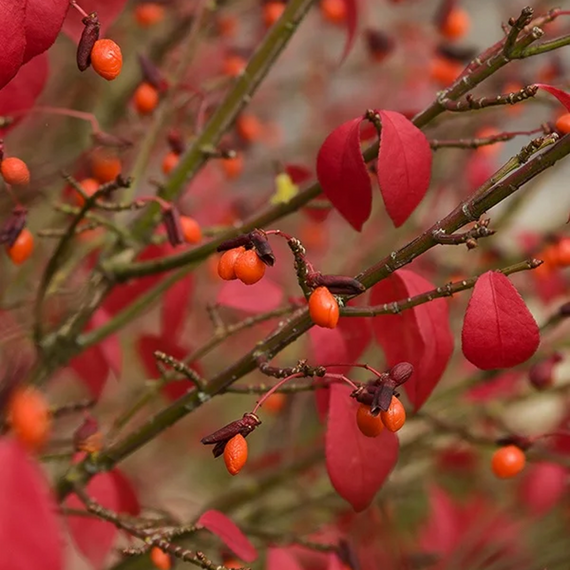
Cole's Compact Burning Bush (Euonymus alatus 'Cole's Compact') is one of the most celebrated deciduous shrubs for four-season landscape interest, offering rich, deep green summer foliage that transforms into an absolutely breathtaking display of fiery scarlet-red in autumn. A refined selection of the beloved winged euonymus, this variety stands apart from the species with its notably finer branching, smaller leaves, and a tighter, more uniform rounded habit that makes it ideal for a wide range of garden applications. The stems are adorned with subtle, corky wings that reveal themselves once the foliage drops, providing delicate textural interest throughout the winter months alongside small ornamental red berry capsules that split open to expose orange-coated seeds attractive to birds. Native to eastern Asia and hardy in USDA Zones 4 through 9, Cole's Compact Burning Bush is a long-lived, slow-to-moderate growing shrub that adapts to nearly any well-drained soil and thrives in everything from full sun to full shade, making it a go-to choice for hedges, mass plantings, specimen accents, and mixed shrub borders across Southern Oregon and Northern California gardens.
Plant Description
Cole's Compact Burning Bush is a dense, multi-stemmed deciduous shrub prized above all else for its sensational autumn color. Throughout spring and summer, the plant is clothed in pointed, elliptic leaves of a clean, rich deep green that provide a lush, tidy backdrop in the landscape. As temperatures cool in fall, the foliage ignites into a brilliant, uniform scarlet red — one of the most intensely vivid fall displays of any shrub in temperate gardens. This transformation is remarkably consistent from year to year and tends to last for an extended period before the leaves shed cleanly to the ground. After leaf drop, the plant's architectural structure comes to the forefront: the stems carry distinctive, thin corky wings that give the species its common name of Winged Euonymus. Small red fruit capsules split open in autumn to reveal bright orange-coated seeds that dangle into early winter. In late spring to early summer, tiny, inconspicuous greenish-yellow flowers appear, blending into the foliage. As a selected variety with finer texture and more compact branching than the straight species, Cole's Compact offers all of this ornamental interest in a well-behaved, refined package suited to modern residential gardens.
Mature Size and Growth Rate
| Characteristic | Details |
|---|---|
| Mature Height | 6 to 8 feet |
| Mature Spread | 6 to 8 feet |
| Growth Rate | Slow to moderate |
| Habit | Dense, multi-stemmed, broadly rounded |
| Longevity | 50 years or more under ideal conditions |
| Suitable Under Power Lines | Yes |
Because of its slow to moderate growth rate and naturally tidy, rounded form, Cole's Compact fills in evenly from the ground up and rarely needs aggressive pruning to maintain an attractive shape. It typically reaches its mature dimensions over many years, making it a reliable long-term investment in the landscape.
Hardiness Zones
Cole's Compact Burning Bush is hardy in USDA Plant Hardiness Zones 4 through 9, tolerating winter minimum temperatures as low as -30 degrees F. This exceptional cold hardiness makes it suitable for a very wide geographic range. In the Southern Oregon and Northern California region, it performs reliably across the diverse microclimates found in both the Rogue Valley and the foothills of the Siskiyous and Cascades. It is also adaptable to higher elevations, growing successfully up to approximately 6,500 feet. Heat Zones 1 through 9 are tolerated as well, reflecting its versatility across varying summer temperature extremes.
Sunlight Requirements
Cole's Compact Burning Bush is one of the most sun-adaptable shrubs available, performing well across the full spectrum from full sun to full shade. However, the intensity and vibrancy of its fall foliage color is directly influenced by light exposure:
- Full Sun (6+ hours of direct sun): Produces the most brilliant, deeply saturated scarlet fall color. Ideal placement for maximum seasonal impact.
- Partial Sun / Partial Shade (3 to 6 hours): Still produces attractive fall color and maintains a healthy, dense form. A solid choice for spots with morning sun and afternoon shade.
- Full Shade: The plant will grow and remain healthy, but fall color may be less intense compared to sunnier exposures. Useful for filling difficult shaded areas where seasonal interest is still desired.
For the most spectacular autumn display, a location with at least 4 to 6 hours of direct sunlight is recommended.
Soil and pH Preferences
One of the great strengths of Cole's Compact Burning Bush is its remarkable tolerance of a wide range of soil conditions. It is not particular about soil type or pH, adapting readily to most landscape situations.
- Soil Types: Grows well in chalk, clay, loam, and sandy soils
- Soil pH: Tolerates acidic, neutral, and alkaline conditions
- Drainage: Prefers moist but well-drained soil; does not tolerate standing water or consistently boggy conditions
- Drought Tolerance: Becomes drought-tolerant once well established, adapting to both dry and average moisture conditions
- Urban Soils: Highly tolerant of compacted urban soils and pollution, making it suitable for street-side and city garden plantings
For best establishment, amend heavy clay soils with organic matter to improve drainage, or work compost into sandy soils to improve moisture retention prior to planting.
Watering Guide
Proper watering is especially important during the first one to two growing seasons as the root system establishes. Follow these guidelines for best results:
- At Planting: Water thoroughly at the time of planting to settle the soil and eliminate air pockets around the roots.
- First Season: Water regularly, approximately once or twice per week depending on heat and soil type, keeping the root zone consistently moist but never waterlogged.
- Second Season: Gradually reduce watering frequency as the plant establishes a deeper root system. Deep, infrequent watering is preferable to frequent shallow watering, as it encourages deeper root development.
- Established Plants: Once fully established, Cole's Compact Burning Bush is quite drought tolerant and typically requires supplemental irrigation only during extended dry spells in summer, especially in the warmer climates of Northern California.
- Avoid Overwatering: Do not allow the root zone to remain saturated for extended periods, as this can lead to root rot. Ensure soil drains freely.
Fertilizing
Cole's Compact Burning Bush is a low-demand shrub that does not require heavy feeding. A modest, consistent fertilization routine supports healthy growth and vibrant foliage:
- Timing: Apply a balanced, slow-release granular shrub or all-purpose fertilizer in early spring as new growth emerges, and again in early fall.
- Product Type: A balanced fertilizer formulated for woody shrubs works well. Avoid high-nitrogen formulations that promote excessive, soft growth at the expense of the plant's natural form.
- Established Shrubs: Well-established plants growing in average garden soil may require little to no supplemental fertilization, especially if a layer of organic mulch is maintained around the root zone.
- Application: Follow label directions for rates and application methods. Water thoroughly after applying granular fertilizer to move nutrients into the root zone.
- Avoid Late-Season Feeding: Do not fertilize after midsummer, as late-season growth stimulated by fertilizer may be more susceptible to frost damage.
Pruning and Maintenance
Cole's Compact Burning Bush has a naturally attractive, dense rounded form that requires very little pruning to maintain its shape. It is considered a low-maintenance shrub overall.
- General Shaping: Light pruning for shaping may be done once or twice per year, ideally in spring or early summer while the plant is in active growth.
- Timing: Avoid heavy pruning in late summer or fall, as this can stimulate tender new growth that may be damaged by early frosts.
- Hard Pruning: Heavy or severe pruning is strongly discouraged. Significant stress from hard pruning can make the plant more susceptible to insect damage and disease.
- Dead or Damaged Branches: Remove any dead, damaged, or crossing branches at any time of year using clean, sharp pruning tools.
- Mulching: Apply a 2 to 3 inch layer of organic mulch around the base of the plant, keeping it a few inches away from the main stems, to conserve moisture, moderate soil temperature, and suppress weeds.
- Overall Maintenance Level: Low. This shrub tends to fill out evenly to the ground on its own and rarely needs intervention beyond light touch-ups.
Planting Instructions
- Select a Site: Choose a location with full sun to partial shade and well-drained soil. Allow enough space for the plant to reach its mature spread of 6 to 8 feet without crowding structures or neighboring plants.
- Dig the Hole: Dig a hole two to three times as wide as the root ball and no deeper than the height of the root ball. A wide, shallow hole encourages horizontal root expansion.
- Amend the Soil: If your native soil is very heavy clay or very sandy, mix in compost or aged organic matter to improve drainage or moisture retention respectively.
- Position the Plant: Set the plant in the hole so the top of the root ball sits level with or very slightly above the surrounding soil grade. Avoid planting too deep.
- Backfill: Fill the hole with native soil, tamping gently in layers to eliminate large air pockets. Avoid over-compacting the soil around the roots.
- Water Thoroughly: Water deeply immediately after planting to settle the soil and ensure good root-to-soil contact.
- Mulch: Apply a 2 to 3 inch layer of mulch over the root zone, keeping it pulled back a few inches from the base of the stems to prevent moisture buildup against the bark.
- For Hedges or Screens: Space plants approximately 5 to 6 feet apart for a dense hedge effect, or up to 8 feet apart for a more open grouping.
Seasonal Interest
| Season | Ornamental Features |
|---|---|
| Spring | Fresh, clean deep green foliage emerges; tiny inconspicuous greenish-yellow flowers appear in late spring |
| Summer | Dense, lush, deep green foliage provides a solid backdrop or screen; compact rounded form is at its fullest |
| Fall | Spectacular, long-lasting fiery scarlet-red foliage — the plant's signature feature; ornamental red fruit capsules split to reveal bright orange-coated seeds |
| Winter | Distinctive corky winged branches provide architectural interest; orange-coated seeds may persist and attract birds; warm golden-tan branch color is visible against winter skies |
Landscape Uses
Cole's Compact Burning Bush is one of the most versatile deciduous shrubs for residential and commercial landscapes alike. Its adaptability to varying sun levels, soils, and moisture conditions opens up a broad range of applications:
- Specimen or Accent Plant: Use as a standalone focal point where the blazing fall color can be fully appreciated, particularly striking when backlit by the sun
- Informal Hedge or Screen: Dense branching from ground level makes it an excellent choice for informal hedges and privacy screens without the need for facer plants
- Mass Plantings: Plant in groups of three or more for a bold mass of autumn color along slopes, hillsides, or along property borders
- Mixed Shrub Borders: Blends beautifully into mixed borders, providing seasonal contrast against evergreens, ornamental grasses, and broadleaf companions
- Foundation Planting: Works well in larger foundation plantings where its clean form and stunning fall color add seasonal drama
- Urban Landscapes: Its high tolerance for pollution, compacted soils, and a wide range of environmental conditions makes it reliable in urban and suburban settings
- Under Power Lines: Mature height of 6 to 8 feet makes it suitable for planting in areas with overhead utility lines
For maximum visual impact, plant Cole's Compact Burning Bush against a backdrop of dark evergreens such as juniper, arborvitae, or yew, which dramatically set off the incandescent fall foliage color.
Companion Plants
The fiery scarlet fall color of Cole's Compact Burning Bush pairs beautifully with plants that either echo or contrast that vivid hue. Consider these companion planting ideas for a cohesive, multi-season display:
- Ornamental Grasses (e.g., Purple Fountain Grass, Blue Fescue, Japanese Blood Grass): Graceful grass textures provide a striking contrast to the dense shrub form, while warm-toned grasses complement the fall palette beautifully
- Evergreen Conifers (e.g., Dwarf Alberta Spruce, 'Sky Pencil' Holly, Arborvitae): Dark green or blue-green evergreens provide a dramatic backdrop that amplifies the intensity of the scarlet fall color
- Gold or Yellow Fall-Colored Shrubs (e.g., Forsythia, Spirea 'Gold Mound'): Pairing the red of Cole's Compact with gold-leaved or gold fall-colored plants creates a stunning two-tone autumn combination
- Fall-Blooming Asters: Low-growing asters in purple or lavender bloom at the same time as the fall foliage display, creating a beautiful color harmony
- Japanese Maples: Complementary red, orange, and burgundy tones in Japanese maple fall foliage create a layered, richly colored autumn scene
- Ornamental Kale or Cabbage: For seasonal container or border combinations, the cool purples and creams of ornamental brassicas contrast beautifully with the vivid red foliage nearby
Pests and Diseases
Cole's Compact Burning Bush is generally considered a pest-resistant and disease-resistant shrub, making it one of the more trouble-free deciduous shrubs in the landscape. However, occasional issues may arise:
- Powdery Mildew: The most commonly noted disease concern for this plant. May appear as a white powdery coating on leaves during periods of high humidity and poor air circulation. Improve air circulation through light pruning and avoid overhead watering to minimize risk. Fungicide applications are available if needed.
- Scale Insects: Euonymus scale is an occasional pest on Euonymus species. Look for small white or gray encrusted bumps on branches. Treat with horticultural oil in late winter to early spring before new growth emerges, or with appropriate insecticides during the crawler stage in late spring.
- Crown Gall: Occasionally affects plants with damaged roots. Avoid injury to roots and stems during planting and maintenance. There is no cure; affected plants should be removed and soil replaced before replanting.
- Caterpillars and Leaf Miners: Minor leaf-feeding insects may occasionally be present but rarely cause serious long-term damage to established plants.
- Root Rot: Can occur in poorly drained or consistently waterlogged soils. Ensure the planting site has good drainage to prevent this issue.
Overall, healthy plants growing in appropriate conditions with good air circulation will rarely experience significant pest or disease problems.
Wildlife Value and Toxicity
Wildlife Value:
The ornamental red berry capsules of Cole's Compact Burning Bush split open in autumn to reveal bright orange-coated seeds that can attract some bird species during late fall and winter, particularly when other food sources become scarce. The dense branching structure of the shrub may also provide shelter and nesting sites for small birds and other wildlife.
Important Toxicity Information:
All parts of Euonymus alatus, including the leaves, bark, and berries, are considered toxic if ingested. This plant is known to be toxic to dogs, cats, and horses, and all parts may cause severe discomfort if consumed by humans as well. Keep this in mind when selecting placement in gardens frequented by pets and small children, and take appropriate precautions.
- Toxic to dogs
- Toxic to cats
- Toxic to horses
- May cause severe discomfort if any part is ingested by humans
Contact a veterinarian or poison control immediately if ingestion is suspected.
Origin and Botanical Information
| Category | Details |
|---|---|
| Botanical Name | Euonymus alatus 'Cole's Compact' |
| Common Names | Cole's Compact Burning Bush, Winged Euonymus, Burningbush |
| Plant Family | Celastraceae (Bittersweet family) |
| Plant Type | Deciduous shrub |
| Geographic Origin | Eastern Asia (Russia, Japan, China, Korea) |
| Notable Awards | Award of Garden Merit, Royal Horticultural Society |
| Distinguishing Features | Smaller leaves and thinner branches than standard burning bush; distinctive corky-winged stems |
- Electrifying scarlet-red fall foliage that rivals any shrub in the autumn landscape, putting on a spectacular seasonal display that lasts for weeks
- Distinctive corky, winged branches add year-round architectural interest, remaining showy even after the leaves have dropped in winter
- Finer texture than standard burning bush selections, with smaller leaves and thinner branches forming a dense, naturally rounded habit that requires minimal shaping
- Remarkably adaptable and low-maintenance — tolerates full sun to full shade, a wide range of soil types, drought once established, and even urban pollution
Cole's Compact Burning Bush (Euonymus alatus 'Cole's Compact') is one of the most celebrated deciduous shrubs for four-season landscape interest, offering rich, deep green summer foliage that transforms into an absolutely breathtaking display of fiery scarlet-red in autumn. A refined selection of the beloved winged euonymus, this variety stands apart from the species with its notably finer branching, smaller leaves, and a tighter, more uniform rounded habit that makes it ideal for a wide range of garden applications. The stems are adorned with subtle, corky wings that reveal themselves once the foliage drops, providing delicate textural interest throughout the winter months alongside small ornamental red berry capsules that split open to expose orange-coated seeds attractive to birds. Native to eastern Asia and hardy in USDA Zones 4 through 9, Cole's Compact Burning Bush is a long-lived, slow-to-moderate growing shrub that adapts to nearly any well-drained soil and thrives in everything from full sun to full shade, making it a go-to choice for hedges, mass plantings, specimen accents, and mixed shrub borders across Southern Oregon and Northern California gardens.
Plant Description
Cole's Compact Burning Bush is a dense, multi-stemmed deciduous shrub prized above all else for its sensational autumn color. Throughout spring and summer, the plant is clothed in pointed, elliptic leaves of a clean, rich deep green that provide a lush, tidy backdrop in the landscape. As temperatures cool in fall, the foliage ignites into a brilliant, uniform scarlet red — one of the most intensely vivid fall displays of any shrub in temperate gardens. This transformation is remarkably consistent from year to year and tends to last for an extended period before the leaves shed cleanly to the ground. After leaf drop, the plant's architectural structure comes to the forefront: the stems carry distinctive, thin corky wings that give the species its common name of Winged Euonymus. Small red fruit capsules split open in autumn to reveal bright orange-coated seeds that dangle into early winter. In late spring to early summer, tiny, inconspicuous greenish-yellow flowers appear, blending into the foliage. As a selected variety with finer texture and more compact branching than the straight species, Cole's Compact offers all of this ornamental interest in a well-behaved, refined package suited to modern residential gardens.
Mature Size and Growth Rate
| Characteristic | Details |
|---|---|
| Mature Height | 6 to 8 feet |
| Mature Spread | 6 to 8 feet |
| Growth Rate | Slow to moderate |
| Habit | Dense, multi-stemmed, broadly rounded |
| Longevity | 50 years or more under ideal conditions |
| Suitable Under Power Lines | Yes |
Because of its slow to moderate growth rate and naturally tidy, rounded form, Cole's Compact fills in evenly from the ground up and rarely needs aggressive pruning to maintain an attractive shape. It typically reaches its mature dimensions over many years, making it a reliable long-term investment in the landscape.
Hardiness Zones
Cole's Compact Burning Bush is hardy in USDA Plant Hardiness Zones 4 through 9, tolerating winter minimum temperatures as low as -30 degrees F. This exceptional cold hardiness makes it suitable for a very wide geographic range. In the Southern Oregon and Northern California region, it performs reliably across the diverse microclimates found in both the Rogue Valley and the foothills of the Siskiyous and Cascades. It is also adaptable to higher elevations, growing successfully up to approximately 6,500 feet. Heat Zones 1 through 9 are tolerated as well, reflecting its versatility across varying summer temperature extremes.
Sunlight Requirements
Cole's Compact Burning Bush is one of the most sun-adaptable shrubs available, performing well across the full spectrum from full sun to full shade. However, the intensity and vibrancy of its fall foliage color is directly influenced by light exposure:
- Full Sun (6+ hours of direct sun): Produces the most brilliant, deeply saturated scarlet fall color. Ideal placement for maximum seasonal impact.
- Partial Sun / Partial Shade (3 to 6 hours): Still produces attractive fall color and maintains a healthy, dense form. A solid choice for spots with morning sun and afternoon shade.
- Full Shade: The plant will grow and remain healthy, but fall color may be less intense compared to sunnier exposures. Useful for filling difficult shaded areas where seasonal interest is still desired.
For the most spectacular autumn display, a location with at least 4 to 6 hours of direct sunlight is recommended.
Soil and pH Preferences
One of the great strengths of Cole's Compact Burning Bush is its remarkable tolerance of a wide range of soil conditions. It is not particular about soil type or pH, adapting readily to most landscape situations.
- Soil Types: Grows well in chalk, clay, loam, and sandy soils
- Soil pH: Tolerates acidic, neutral, and alkaline conditions
- Drainage: Prefers moist but well-drained soil; does not tolerate standing water or consistently boggy conditions
- Drought Tolerance: Becomes drought-tolerant once well established, adapting to both dry and average moisture conditions
- Urban Soils: Highly tolerant of compacted urban soils and pollution, making it suitable for street-side and city garden plantings
For best establishment, amend heavy clay soils with organic matter to improve drainage, or work compost into sandy soils to improve moisture retention prior to planting.
Watering Guide
Proper watering is especially important during the first one to two growing seasons as the root system establishes. Follow these guidelines for best results:
- At Planting: Water thoroughly at the time of planting to settle the soil and eliminate air pockets around the roots.
- First Season: Water regularly, approximately once or twice per week depending on heat and soil type, keeping the root zone consistently moist but never waterlogged.
- Second Season: Gradually reduce watering frequency as the plant establishes a deeper root system. Deep, infrequent watering is preferable to frequent shallow watering, as it encourages deeper root development.
- Established Plants: Once fully established, Cole's Compact Burning Bush is quite drought tolerant and typically requires supplemental irrigation only during extended dry spells in summer, especially in the warmer climates of Northern California.
- Avoid Overwatering: Do not allow the root zone to remain saturated for extended periods, as this can lead to root rot. Ensure soil drains freely.
Fertilizing
Cole's Compact Burning Bush is a low-demand shrub that does not require heavy feeding. A modest, consistent fertilization routine supports healthy growth and vibrant foliage:
- Timing: Apply a balanced, slow-release granular shrub or all-purpose fertilizer in early spring as new growth emerges, and again in early fall.
- Product Type: A balanced fertilizer formulated for woody shrubs works well. Avoid high-nitrogen formulations that promote excessive, soft growth at the expense of the plant's natural form.
- Established Shrubs: Well-established plants growing in average garden soil may require little to no supplemental fertilization, especially if a layer of organic mulch is maintained around the root zone.
- Application: Follow label directions for rates and application methods. Water thoroughly after applying granular fertilizer to move nutrients into the root zone.
- Avoid Late-Season Feeding: Do not fertilize after midsummer, as late-season growth stimulated by fertilizer may be more susceptible to frost damage.
Pruning and Maintenance
Cole's Compact Burning Bush has a naturally attractive, dense rounded form that requires very little pruning to maintain its shape. It is considered a low-maintenance shrub overall.
- General Shaping: Light pruning for shaping may be done once or twice per year, ideally in spring or early summer while the plant is in active growth.
- Timing: Avoid heavy pruning in late summer or fall, as this can stimulate tender new growth that may be damaged by early frosts.
- Hard Pruning: Heavy or severe pruning is strongly discouraged. Significant stress from hard pruning can make the plant more susceptible to insect damage and disease.
- Dead or Damaged Branches: Remove any dead, damaged, or crossing branches at any time of year using clean, sharp pruning tools.
- Mulching: Apply a 2 to 3 inch layer of organic mulch around the base of the plant, keeping it a few inches away from the main stems, to conserve moisture, moderate soil temperature, and suppress weeds.
- Overall Maintenance Level: Low. This shrub tends to fill out evenly to the ground on its own and rarely needs intervention beyond light touch-ups.
Planting Instructions
- Select a Site: Choose a location with full sun to partial shade and well-drained soil. Allow enough space for the plant to reach its mature spread of 6 to 8 feet without crowding structures or neighboring plants.
- Dig the Hole: Dig a hole two to three times as wide as the root ball and no deeper than the height of the root ball. A wide, shallow hole encourages horizontal root expansion.
- Amend the Soil: If your native soil is very heavy clay or very sandy, mix in compost or aged organic matter to improve drainage or moisture retention respectively.
- Position the Plant: Set the plant in the hole so the top of the root ball sits level with or very slightly above the surrounding soil grade. Avoid planting too deep.
- Backfill: Fill the hole with native soil, tamping gently in layers to eliminate large air pockets. Avoid over-compacting the soil around the roots.
- Water Thoroughly: Water deeply immediately after planting to settle the soil and ensure good root-to-soil contact.
- Mulch: Apply a 2 to 3 inch layer of mulch over the root zone, keeping it pulled back a few inches from the base of the stems to prevent moisture buildup against the bark.
- For Hedges or Screens: Space plants approximately 5 to 6 feet apart for a dense hedge effect, or up to 8 feet apart for a more open grouping.
Seasonal Interest
| Season | Ornamental Features |
|---|---|
| Spring | Fresh, clean deep green foliage emerges; tiny inconspicuous greenish-yellow flowers appear in late spring |
| Summer | Dense, lush, deep green foliage provides a solid backdrop or screen; compact rounded form is at its fullest |
| Fall | Spectacular, long-lasting fiery scarlet-red foliage — the plant's signature feature; ornamental red fruit capsules split to reveal bright orange-coated seeds |
| Winter | Distinctive corky winged branches provide architectural interest; orange-coated seeds may persist and attract birds; warm golden-tan branch color is visible against winter skies |
Landscape Uses
Cole's Compact Burning Bush is one of the most versatile deciduous shrubs for residential and commercial landscapes alike. Its adaptability to varying sun levels, soils, and moisture conditions opens up a broad range of applications:
- Specimen or Accent Plant: Use as a standalone focal point where the blazing fall color can be fully appreciated, particularly striking when backlit by the sun
- Informal Hedge or Screen: Dense branching from ground level makes it an excellent choice for informal hedges and privacy screens without the need for facer plants
- Mass Plantings: Plant in groups of three or more for a bold mass of autumn color along slopes, hillsides, or along property borders
- Mixed Shrub Borders: Blends beautifully into mixed borders, providing seasonal contrast against evergreens, ornamental grasses, and broadleaf companions
- Foundation Planting: Works well in larger foundation plantings where its clean form and stunning fall color add seasonal drama
- Urban Landscapes: Its high tolerance for pollution, compacted soils, and a wide range of environmental conditions makes it reliable in urban and suburban settings
- Under Power Lines: Mature height of 6 to 8 feet makes it suitable for planting in areas with overhead utility lines
For maximum visual impact, plant Cole's Compact Burning Bush against a backdrop of dark evergreens such as juniper, arborvitae, or yew, which dramatically set off the incandescent fall foliage color.
Companion Plants
The fiery scarlet fall color of Cole's Compact Burning Bush pairs beautifully with plants that either echo or contrast that vivid hue. Consider these companion planting ideas for a cohesive, multi-season display:
- Ornamental Grasses (e.g., Purple Fountain Grass, Blue Fescue, Japanese Blood Grass): Graceful grass textures provide a striking contrast to the dense shrub form, while warm-toned grasses complement the fall palette beautifully
- Evergreen Conifers (e.g., Dwarf Alberta Spruce, 'Sky Pencil' Holly, Arborvitae): Dark green or blue-green evergreens provide a dramatic backdrop that amplifies the intensity of the scarlet fall color
- Gold or Yellow Fall-Colored Shrubs (e.g., Forsythia, Spirea 'Gold Mound'): Pairing the red of Cole's Compact with gold-leaved or gold fall-colored plants creates a stunning two-tone autumn combination
- Fall-Blooming Asters: Low-growing asters in purple or lavender bloom at the same time as the fall foliage display, creating a beautiful color harmony
- Japanese Maples: Complementary red, orange, and burgundy tones in Japanese maple fall foliage create a layered, richly colored autumn scene
- Ornamental Kale or Cabbage: For seasonal container or border combinations, the cool purples and creams of ornamental brassicas contrast beautifully with the vivid red foliage nearby
Pests and Diseases
Cole's Compact Burning Bush is generally considered a pest-resistant and disease-resistant shrub, making it one of the more trouble-free deciduous shrubs in the landscape. However, occasional issues may arise:
- Powdery Mildew: The most commonly noted disease concern for this plant. May appear as a white powdery coating on leaves during periods of high humidity and poor air circulation. Improve air circulation through light pruning and avoid overhead watering to minimize risk. Fungicide applications are available if needed.
- Scale Insects: Euonymus scale is an occasional pest on Euonymus species. Look for small white or gray encrusted bumps on branches. Treat with horticultural oil in late winter to early spring before new growth emerges, or with appropriate insecticides during the crawler stage in late spring.
- Crown Gall: Occasionally affects plants with damaged roots. Avoid injury to roots and stems during planting and maintenance. There is no cure; affected plants should be removed and soil replaced before replanting.
- Caterpillars and Leaf Miners: Minor leaf-feeding insects may occasionally be present but rarely cause serious long-term damage to established plants.
- Root Rot: Can occur in poorly drained or consistently waterlogged soils. Ensure the planting site has good drainage to prevent this issue.
Overall, healthy plants growing in appropriate conditions with good air circulation will rarely experience significant pest or disease problems.
Wildlife Value and Toxicity
Wildlife Value:
The ornamental red berry capsules of Cole's Compact Burning Bush split open in autumn to reveal bright orange-coated seeds that can attract some bird species during late fall and winter, particularly when other food sources become scarce. The dense branching structure of the shrub may also provide shelter and nesting sites for small birds and other wildlife.
Important Toxicity Information:
All parts of Euonymus alatus, including the leaves, bark, and berries, are considered toxic if ingested. This plant is known to be toxic to dogs, cats, and horses, and all parts may cause severe discomfort if consumed by humans as well. Keep this in mind when selecting placement in gardens frequented by pets and small children, and take appropriate precautions.
- Toxic to dogs
- Toxic to cats
- Toxic to horses
- May cause severe discomfort if any part is ingested by humans
Contact a veterinarian or poison control immediately if ingestion is suspected.
Origin and Botanical Information
| Category | Details |
|---|---|
| Botanical Name | Euonymus alatus 'Cole's Compact' |
| Common Names | Cole's Compact Burning Bush, Winged Euonymus, Burningbush |
| Plant Family | Celastraceae (Bittersweet family) |
| Plant Type | Deciduous shrub |
| Geographic Origin | Eastern Asia (Russia, Japan, China, Korea) |
| Notable Awards | Award of Garden Merit, Royal Horticultural Society |
| Distinguishing Features | Smaller leaves and thinner branches than standard burning bush; distinctive corky-winged stems |