

Bloodgood London Planetree
- Iconic exfoliating bark peels away in irregular patches to reveal a stunning mosaic of creamy white, gray, and pale green — delivering bold year-round visual interest even in winter.
- Improved anthracnose resistance compared to the species makes this cultivar a more reliable choice for landscapes where disease pressure is a concern.
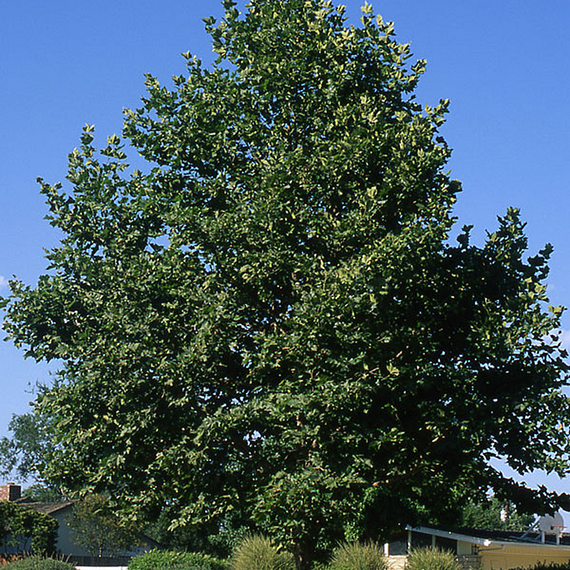
- A fast-growing, broadly pyramidal shade tree with large, bold maple-like foliage that casts deep, cooling shade — ideal for parks, wide medians, spacious lawns, and large residential properties.
- Exceptional urban toughness — tolerates air pollution, compacted soil, clay soil, alkaline pH, and occasional flooding, making it one of the most adaptable large shade trees available.
The Bloodgood London Planetree (Platanus x acerifolia 'Bloodgood') is a time-honored deciduous shade tree of impressive stature, prized for its striking exfoliating bark, bold canopy, and exceptional urban resilience. A natural hybrid between the American sycamore (Platanus occidentalis) and the Oriental planetree (Platanus orientalis), this cultivar has been widely planted in city parks, boulevards, and large residential landscapes for centuries thanks to its legendary tolerance of urban conditions including air pollution, compacted soils, and periodic flooding. The broadly pyramidal crown fills in with large, 3- to 5-lobed medium to dark green leaves that closely resemble maple foliage and reach up to 9 inches wide, providing a rich, dense canopy of cooling shade throughout the growing season. Come fall, the foliage transitions to warm shades of yellow before dropping to reveal the tree's most celebrated feature — bark that continuously exfoliates in irregular scales, exposing an eye-catching patchwork of creamy white, gray, green, and brown that brightens the winter landscape and makes this tree identifiable from a great distance. Small, inconspicuous monoecious flowers appear in spring, and round, ball-like seed heads develop in pairs on long stalks, persisting into early winter. The 'Bloodgood' cultivar is specifically noted for its improved resistance to sycamore anthracnose relative to the straight species, making it a smarter planting choice where disease has historically been a challenge. Mature trees typically reach 50 to 75 feet tall with a spread of 40 to 60 feet, transplant well, and establish with moderate care — a bold, majestic statement tree for any landscape with room to grow large.
Plant Description
The Bloodgood London Planetree is a large, deciduous shade tree celebrated for its commanding presence and multi-season ornamental appeal. It bears the classic hallmarks of the London Planetree lineage — an expansive, broadly pyramidal to rounded canopy, large bold foliage, and the most distinctive feature of any tree in cultivation: its exfoliating bark. As the bark matures and sheds in irregular, jigsaw-like plates, it exposes inner layers of creamy white, pale gray, and soft green, creating a mottled, camouflage-like pattern on the trunk and major limbs. On mature specimens, the upper portions of the trunk and branches become nearly white, making the tree instantly recognizable even from a distance in winter. The 'Bloodgood' selection is specifically chosen for its enhanced resistance to sycamore anthracnose, giving it a distinct advantage over the straight species in landscapes where this fungal disease has historically been a problem.
Mature Size
| Characteristic | Detail |
|---|---|
| Mature Height | 50 to 75 feet (occasionally to 100 feet) |
| Mature Spread | 40 to 60 feet |
| Growth Rate | Fast — can add 3 to 4 feet per year under good conditions |
| Tree Form | Broadly pyramidal when young, developing a wide, rounded canopy with age |
| Trunk | Stout, single trunk; mature diameter can reach 3 to 8 feet on old specimens |
Hardiness Zones
The Bloodgood London Planetree is hardy in USDA Zones 5 through 8. This range covers a wide swath of the United States, including most of the Pacific Northwest, Northern California, the Great Plains, the Midwest, and much of the Eastern Seaboard. It performs reliably in Southern Oregon and Northern California climates, tolerating both hot, dry summers (with appropriate water) and cold winters down to approximately -20°F (-28°C).
Sunlight Requirements
Bloodgood London Planetree thrives in full sun, requiring a minimum of 6 hours of direct sunlight per day for best growth, vigor, and canopy density. It can tolerate partial shade (4 to 6 hours of light daily), but growth may be somewhat reduced and the canopy less dense under lower light conditions. For optimal health and the most attractive form, choose a planting site with open, unobstructed sun exposure. Avoid deeply shaded locations, as this tree does not tolerate heavy shade.
Soil and pH Preferences
This tree is notably adaptable when it comes to soil. It performs best in deep, rich, moist, well-drained soils but demonstrates considerable tolerance for a range of less-than-ideal conditions. Key soil considerations include:
- Soil texture: Grows well in loam, clay, and sandy soils; tolerates clay and compacted urban soils better than many large shade trees.
- Drainage: Prefers well-drained to moderately moist conditions; also tolerates occasional flooding and wet sites.
- Soil pH: Adaptable to a wide range of pH levels; tolerates alkaline soils, which is uncommon among large deciduous trees.
- Organic matter: Performs best when planted in soils amended with compost or organic matter to support rapid establishment.
- Urban soils: One of its great strengths — it is among the most urban-tolerant large trees available, handling compacted, poor-quality soils with remarkable resilience.
Watering Guide
Proper watering is most critical during the first one to three years after planting while the root system is establishing. Follow these guidelines for best results:
- At planting: Water deeply and thoroughly at the time of installation to settle the soil around the root ball and eliminate air pockets.
- First growing season: Water regularly — approximately once or twice per week depending on soil type and temperature — keeping the root zone consistently moist but not waterlogged.
- After establishment: Once the tree is established (typically after 2 to 3 growing seasons), reduce watering frequency. The tree becomes moderately drought tolerant but will benefit from supplemental irrigation during prolonged dry spells or extreme heat.
- Mulching: Apply 3 to 4 inches of organic mulch such as arborist wood chips around the base of the tree, keeping mulch a few inches away from the trunk. This retains soil moisture, moderates soil temperature, and reduces the need for frequent watering.
- Avoid: Prolonged standing water around the root crown, which can promote root rot and canker diseases.
Fertilizing
The Bloodgood London Planetree is a vigorous, fast-growing tree that benefits from periodic fertilization, particularly in managed landscape settings where soils may lack sufficient organic matter or nutrients.
- Young trees: Apply a balanced, slow-release granular fertilizer (such as a 10-10-10 or similar formulation) in early spring before new growth begins to support rapid establishment and healthy canopy development.
- Established trees: Fertilize once a year in early spring, or enrich the root zone with a 2- to 3-inch layer of finished compost spread out to the drip line.
- Organic options: Well-composted organic matter worked into the soil surface or applied as a top dressing is an excellent long-term fertility strategy and also improves soil structure.
- Avoid over-fertilizing: Excessive nitrogen can stimulate overly rapid, weak growth that is more susceptible to wind damage and pest pressure.
- Soil testing: In cases of suspected deficiencies or poor performance, a soil test can guide a more targeted fertilization program.
Pruning and Maintenance
The Bloodgood London Planetree is generally considered low maintenance once established, but routine pruning helps maintain structural integrity and a clean, attractive form.
- Timing: Prune in late winter or early spring while the tree is still dormant, just before new growth begins. Dormant-season pruning minimizes stress and reduces exposure to insects and pathogens through fresh wounds.
- Structural pruning: Remove crossing, rubbing, or poorly attached branches on young trees to establish a strong scaffold structure early on.
- Dead, diseased, or damaged wood: Remove at any time of year as needed to maintain tree health and prevent the spread of disease.
- Crown raising: Lower limbs can be selectively removed over time to raise the canopy for clearance over lawns, walkways, or structures.
- Size control: This is a large tree that should not routinely be topped. If space is a concern, this tree may not be the right choice for tight sites. Select the planting location carefully to allow for its full mature size.
- Litter management: Plan for seasonal litter including large leaves, exfoliating bark plates, small twigs, and round seed balls. Collected leaves make excellent compost material.
Planting Instructions
Follow these steps for successful establishment of your Bloodgood London Planetree:
- Site selection: Choose a location in full sun with ample space — at least 30 feet from structures, pavement, foundations, or underground utilities. Avoid planting directly over sewer or water lines, as the root system is extensive.
- Dig the hole: Dig a hole 2 to 3 times as wide as the root ball but no deeper than the root ball's height. A wide, shallow hole encourages lateral root spread.
- Inspect the root ball: Remove any burlap, wire baskets, or container materials as directed. Gently loosen circling or compacted roots before placing the tree in the hole.
- Set the tree: Position the tree so that the root flare (where the trunk widens at the base) sits at or slightly above the surrounding soil grade. Never bury the root flare.
- Backfill: Fill the hole with native soil, tamping gently in layers to eliminate air pockets. Avoid adding heavy amendments directly to the backfill in most situations, as this can discourage roots from venturing into the native soil.
- Water in thoroughly: Water deeply immediately after planting to settle the soil.
- Mulch: Apply a 3- to 4-inch layer of organic mulch in a wide ring around the tree, keeping it several inches away from the trunk to prevent moisture-related rot.
- Stake only if necessary: Stake the tree only if the site is exposed to strong, persistent winds. Remove stakes after the first growing season to allow the trunk to develop natural strength.
Foliage and Fall Color
The foliage of the Bloodgood London Planetree is one of its most eye-catching features during the growing season. The leaves are large — typically 6 to 9 inches wide — leathery in texture, and display 3 to 5 distinct lobes with coarsely toothed margins, closely resembling maple leaves in shape (hence the species name acerifolia, meaning "with leaves like Acer"). Leaf color is a rich medium to dark green on the upper surface with a paler green underside. The bold, tropical-scale foliage creates a dense, lush canopy that casts deep shade throughout summer. In fall, the foliage transitions to yellow, occasionally yellow-brown before dropping. While fall color is not the primary ornamental feature of this tree, the large, handsome leaves are effective composting material when collected. The bare winter silhouette, combined with the tree's spectacular exfoliating bark, ensures continued visual interest well after leaf drop.
Bark and Winter Interest
The exfoliating bark of the Bloodgood London Planetree is widely considered one of the most distinctive and beautiful features of any large deciduous tree in cultivation. As the bark matures, it sheds in irregular, puzzle-piece-shaped plates to continuously reveal inner layers of creamy white, pale green, and warm gray — creating a mottled, camouflage-like pattern that becomes more pronounced with age. On mature specimens, the upper portions of the trunk and main branches become strikingly white, allowing the tree to be identified from considerable distances in winter. This living tapestry of color and texture is particularly dramatic when sunlight filters through the leafless canopy and plays off the pale bark in winter and early spring. The contrasting tones of brown, cream, and white create an architectural focal point that few other large trees can match during the dormant season.
Landscape Uses
The Bloodgood London Planetree is one of the most versatile and widely used large shade trees for expansive landscape settings. Its combination of fast growth, urban tolerance, and year-round ornamental appeal makes it a top choice for many applications:
- Parks and recreational areas: An exceptional lawn and park tree where its broad canopy provides deep, cooling shade over large areas.
- Street and boulevard planting: Widely used in wide medians, parkways, and roadside plantings where there is adequate space for its full mature width.
- Specimen or focal point tree: The striking bark and bold canopy make it a dramatic stand-alone specimen in large residential or commercial landscapes.
- Privacy screening: When planted in rows along property lines, it creates a substantial visual screen with relatively fast results.
- Rain gardens and water features: Tolerates occasionally wet soils, making it suitable for rain garden applications where its deep roots help filter stormwater runoff.
- Commercial and institutional landscapes: A long-standing choice for shopping centers, corporate campuses, schools, and public plazas where a bold, durable tree is needed.
- Energy savings: When planted on the south or southwest side of a home or building, its dense summer canopy provides significant shade that can help reduce cooling costs.
Note: Due to its large mature size and significant litter from leaves, bark, and seed balls, this tree is best suited to spacious sites where these characteristics can be managed easily. It is not recommended for small residential yards or planting near foundations, pavement, or underground infrastructure.
Pests and Diseases
The 'Bloodgood' cultivar was selected in part for improved resistance to sycamore anthracnose, which is the most common and damaging disease of London Planetrees and American sycamores. However, gardeners should remain aware of the following potential issues:
- Anthracnose (Apiognomonia veneta): A fungal disease that causes leaf blight, twig dieback, and defoliation, particularly during cool, wet springs. 'Bloodgood' shows greater resistance than the straight species, though resistance may vary.
- Canker stain (Ceratocystis fimbriata): A serious and potentially fatal vascular disease. Minimize the risk by avoiding pruning wounds during warm, wet weather and by sterilizing pruning tools between cuts.
- Powdery mildew: A surface fungal infection that produces white, powdery patches on leaf surfaces; rarely fatal but can affect appearance.
- Leaf spot: Various fungal leaf spot diseases can cause cosmetic damage; rarely requires treatment on established trees.
- Canker diseases: Various canker fungi can infect stressed trees; maintaining good plant health is the best prevention.
- Borers: Flatheaded and other wood-boring insects can attack weakened trees. Keep trees healthy and vigorous to reduce susceptibility.
- Scale insects: Occasional infestations; treat with horticultural oil when pest pressure is significant.
- Japanese beetles, caterpillars, and mites: Occasional defoliators; healthy, established trees typically recover without intervention.
- Frost cracks: Young trees in colder climates may be susceptible; trunk wraps in the first few winters can offer protection.
Wildlife Value
While not a primary wildlife plant, the Bloodgood London Planetree provides meaningful habitat and food value in the urban and suburban landscape:
- Birds: The round, ball-like seed heads (achenes) persist into early winter and provide a food source for birds such as finches and other seed-eating species. The dense canopy also provides nesting and roosting habitat for a variety of songbirds.
- Insect pollinators: The small spring flowers attract a range of early-season insect pollinators, including native bees, before many other landscape plants have come into bloom.
- Small mammals: Squirrels and other small mammals make use of the seeds and the tree's large canopy for foraging and shelter.
- Bark habitat: The deeply textured, exfoliating bark provides microhabitat for insects and small invertebrates that in turn support insectivorous birds and other wildlife in the broader garden ecosystem.
Companion Plants
When planning plantings beneath or around a Bloodgood London Planetree, consider the tree's large canopy, significant leaf litter, and the somewhat dry conditions that can develop under its canopy once mature. Effective companion plants include:
- Hosta: Bold, shade-tolerant perennials that complement the tree's large-scale foliage and thrive in the dappled light beneath the canopy.
- Coral Bells (Heuchera): Low-growing perennials with colorful foliage that work well under the dripline and contrast beautifully with the tree's bark tones.
- Hydrangea: Large-flowered shrubs that can take partial shade and provide summer color contrast beneath the canopy's outer edges.
- Liriope and mondo grass: Tough, low-growing groundcovers that handle root competition and varying moisture well.
- Native ferns: Shade-tolerant species like sword fern (Polystichum munitum) thrive under large deciduous trees in Pacific Northwest and Northern California settings.
- Ornamental grasses: Planted at the sunny perimeter of the canopy, ornamental grasses provide textural contrast to the tree's bold foliage and architectural bark.
Avoid planting shallow-rooted or moisture-sensitive plants directly beneath a mature specimen, as the extensive root system will compete aggressively for water and nutrients close to the trunk.
Frequently Asked Questions
- How much space does this tree need? Plan for a minimum of 30 feet of open space in all directions from the trunk. Avoid planting within 30 feet of foundations, sewer lines, water mains, or underground utilities.
- Is this tree messy? Yes — it is considered a moderately high-litter tree. It sheds large leaves in fall, exfoliating bark throughout the year, small twigs, and round seed balls in autumn and early winter. Site it where litter can be managed easily, and consider using fallen leaves as compost material.
- How fast will it grow? Under good conditions with adequate water and full sun, expect 3 to 4 feet of height gain per year when young. Growth slows somewhat as the tree matures.
- Is 'Bloodgood' truly disease resistant? It shows improved resistance to anthracnose compared to the London Planetree species and the American sycamore, but no tree is entirely immune. Resistance can vary, and good cultural practices — proper siting, adequate water, and avoiding unnecessary wounding — remain important.
- Can I plant this near a sidewalk or driveway? This is generally not recommended. The extensive and powerful root system can lift pavement over time. Maintain adequate setbacks from all hardscape surfaces.
- Will this tree work as a street tree? It can be used in very wide medians and parkways with ample soil volume, but it is generally considered too large and too messy for standard narrow street tree applications.
- Iconic exfoliating bark peels away in irregular patches to reveal a stunning mosaic of creamy white, gray, and pale green — delivering bold year-round visual interest even in winter.
- Improved anthracnose resistance compared to the species makes this cultivar a more reliable choice for landscapes where disease pressure is a concern.
- A fast-growing, broadly pyramidal shade tree with large, bold maple-like foliage that casts deep, cooling shade — ideal for parks, wide medians, spacious lawns, and large residential properties.
- Exceptional urban toughness — tolerates air pollution, compacted soil, clay soil, alkaline pH, and occasional flooding, making it one of the most adaptable large shade trees available.
The Bloodgood London Planetree (Platanus x acerifolia 'Bloodgood') is a time-honored deciduous shade tree of impressive stature, prized for its striking exfoliating bark, bold canopy, and exceptional urban resilience. A natural hybrid between the American sycamore (Platanus occidentalis) and the Oriental planetree (Platanus orientalis), this cultivar has been widely planted in city parks, boulevards, and large residential landscapes for centuries thanks to its legendary tolerance of urban conditions including air pollution, compacted soils, and periodic flooding. The broadly pyramidal crown fills in with large, 3- to 5-lobed medium to dark green leaves that closely resemble maple foliage and reach up to 9 inches wide, providing a rich, dense canopy of cooling shade throughout the growing season. Come fall, the foliage transitions to warm shades of yellow before dropping to reveal the tree's most celebrated feature — bark that continuously exfoliates in irregular scales, exposing an eye-catching patchwork of creamy white, gray, green, and brown that brightens the winter landscape and makes this tree identifiable from a great distance. Small, inconspicuous monoecious flowers appear in spring, and round, ball-like seed heads develop in pairs on long stalks, persisting into early winter. The 'Bloodgood' cultivar is specifically noted for its improved resistance to sycamore anthracnose relative to the straight species, making it a smarter planting choice where disease has historically been a challenge. Mature trees typically reach 50 to 75 feet tall with a spread of 40 to 60 feet, transplant well, and establish with moderate care — a bold, majestic statement tree for any landscape with room to grow large.
Plant Description
The Bloodgood London Planetree is a large, deciduous shade tree celebrated for its commanding presence and multi-season ornamental appeal. It bears the classic hallmarks of the London Planetree lineage — an expansive, broadly pyramidal to rounded canopy, large bold foliage, and the most distinctive feature of any tree in cultivation: its exfoliating bark. As the bark matures and sheds in irregular, jigsaw-like plates, it exposes inner layers of creamy white, pale gray, and soft green, creating a mottled, camouflage-like pattern on the trunk and major limbs. On mature specimens, the upper portions of the trunk and branches become nearly white, making the tree instantly recognizable even from a distance in winter. The 'Bloodgood' selection is specifically chosen for its enhanced resistance to sycamore anthracnose, giving it a distinct advantage over the straight species in landscapes where this fungal disease has historically been a problem.
Mature Size
| Characteristic | Detail |
|---|---|
| Mature Height | 50 to 75 feet (occasionally to 100 feet) |
| Mature Spread | 40 to 60 feet |
| Growth Rate | Fast — can add 3 to 4 feet per year under good conditions |
| Tree Form | Broadly pyramidal when young, developing a wide, rounded canopy with age |
| Trunk | Stout, single trunk; mature diameter can reach 3 to 8 feet on old specimens |
Hardiness Zones
The Bloodgood London Planetree is hardy in USDA Zones 5 through 8. This range covers a wide swath of the United States, including most of the Pacific Northwest, Northern California, the Great Plains, the Midwest, and much of the Eastern Seaboard. It performs reliably in Southern Oregon and Northern California climates, tolerating both hot, dry summers (with appropriate water) and cold winters down to approximately -20°F (-28°C).
Sunlight Requirements
Bloodgood London Planetree thrives in full sun, requiring a minimum of 6 hours of direct sunlight per day for best growth, vigor, and canopy density. It can tolerate partial shade (4 to 6 hours of light daily), but growth may be somewhat reduced and the canopy less dense under lower light conditions. For optimal health and the most attractive form, choose a planting site with open, unobstructed sun exposure. Avoid deeply shaded locations, as this tree does not tolerate heavy shade.
Soil and pH Preferences
This tree is notably adaptable when it comes to soil. It performs best in deep, rich, moist, well-drained soils but demonstrates considerable tolerance for a range of less-than-ideal conditions. Key soil considerations include:
- Soil texture: Grows well in loam, clay, and sandy soils; tolerates clay and compacted urban soils better than many large shade trees.
- Drainage: Prefers well-drained to moderately moist conditions; also tolerates occasional flooding and wet sites.
- Soil pH: Adaptable to a wide range of pH levels; tolerates alkaline soils, which is uncommon among large deciduous trees.
- Organic matter: Performs best when planted in soils amended with compost or organic matter to support rapid establishment.
- Urban soils: One of its great strengths — it is among the most urban-tolerant large trees available, handling compacted, poor-quality soils with remarkable resilience.
Watering Guide
Proper watering is most critical during the first one to three years after planting while the root system is establishing. Follow these guidelines for best results:
- At planting: Water deeply and thoroughly at the time of installation to settle the soil around the root ball and eliminate air pockets.
- First growing season: Water regularly — approximately once or twice per week depending on soil type and temperature — keeping the root zone consistently moist but not waterlogged.
- After establishment: Once the tree is established (typically after 2 to 3 growing seasons), reduce watering frequency. The tree becomes moderately drought tolerant but will benefit from supplemental irrigation during prolonged dry spells or extreme heat.
- Mulching: Apply 3 to 4 inches of organic mulch such as arborist wood chips around the base of the tree, keeping mulch a few inches away from the trunk. This retains soil moisture, moderates soil temperature, and reduces the need for frequent watering.
- Avoid: Prolonged standing water around the root crown, which can promote root rot and canker diseases.
Fertilizing
The Bloodgood London Planetree is a vigorous, fast-growing tree that benefits from periodic fertilization, particularly in managed landscape settings where soils may lack sufficient organic matter or nutrients.
- Young trees: Apply a balanced, slow-release granular fertilizer (such as a 10-10-10 or similar formulation) in early spring before new growth begins to support rapid establishment and healthy canopy development.
- Established trees: Fertilize once a year in early spring, or enrich the root zone with a 2- to 3-inch layer of finished compost spread out to the drip line.
- Organic options: Well-composted organic matter worked into the soil surface or applied as a top dressing is an excellent long-term fertility strategy and also improves soil structure.
- Avoid over-fertilizing: Excessive nitrogen can stimulate overly rapid, weak growth that is more susceptible to wind damage and pest pressure.
- Soil testing: In cases of suspected deficiencies or poor performance, a soil test can guide a more targeted fertilization program.
Pruning and Maintenance
The Bloodgood London Planetree is generally considered low maintenance once established, but routine pruning helps maintain structural integrity and a clean, attractive form.
- Timing: Prune in late winter or early spring while the tree is still dormant, just before new growth begins. Dormant-season pruning minimizes stress and reduces exposure to insects and pathogens through fresh wounds.
- Structural pruning: Remove crossing, rubbing, or poorly attached branches on young trees to establish a strong scaffold structure early on.
- Dead, diseased, or damaged wood: Remove at any time of year as needed to maintain tree health and prevent the spread of disease.
- Crown raising: Lower limbs can be selectively removed over time to raise the canopy for clearance over lawns, walkways, or structures.
- Size control: This is a large tree that should not routinely be topped. If space is a concern, this tree may not be the right choice for tight sites. Select the planting location carefully to allow for its full mature size.
- Litter management: Plan for seasonal litter including large leaves, exfoliating bark plates, small twigs, and round seed balls. Collected leaves make excellent compost material.
Planting Instructions
Follow these steps for successful establishment of your Bloodgood London Planetree:
- Site selection: Choose a location in full sun with ample space — at least 30 feet from structures, pavement, foundations, or underground utilities. Avoid planting directly over sewer or water lines, as the root system is extensive.
- Dig the hole: Dig a hole 2 to 3 times as wide as the root ball but no deeper than the root ball's height. A wide, shallow hole encourages lateral root spread.
- Inspect the root ball: Remove any burlap, wire baskets, or container materials as directed. Gently loosen circling or compacted roots before placing the tree in the hole.
- Set the tree: Position the tree so that the root flare (where the trunk widens at the base) sits at or slightly above the surrounding soil grade. Never bury the root flare.
- Backfill: Fill the hole with native soil, tamping gently in layers to eliminate air pockets. Avoid adding heavy amendments directly to the backfill in most situations, as this can discourage roots from venturing into the native soil.
- Water in thoroughly: Water deeply immediately after planting to settle the soil.
- Mulch: Apply a 3- to 4-inch layer of organic mulch in a wide ring around the tree, keeping it several inches away from the trunk to prevent moisture-related rot.
- Stake only if necessary: Stake the tree only if the site is exposed to strong, persistent winds. Remove stakes after the first growing season to allow the trunk to develop natural strength.
Foliage and Fall Color
The foliage of the Bloodgood London Planetree is one of its most eye-catching features during the growing season. The leaves are large — typically 6 to 9 inches wide — leathery in texture, and display 3 to 5 distinct lobes with coarsely toothed margins, closely resembling maple leaves in shape (hence the species name acerifolia, meaning "with leaves like Acer"). Leaf color is a rich medium to dark green on the upper surface with a paler green underside. The bold, tropical-scale foliage creates a dense, lush canopy that casts deep shade throughout summer. In fall, the foliage transitions to yellow, occasionally yellow-brown before dropping. While fall color is not the primary ornamental feature of this tree, the large, handsome leaves are effective composting material when collected. The bare winter silhouette, combined with the tree's spectacular exfoliating bark, ensures continued visual interest well after leaf drop.
Bark and Winter Interest
The exfoliating bark of the Bloodgood London Planetree is widely considered one of the most distinctive and beautiful features of any large deciduous tree in cultivation. As the bark matures, it sheds in irregular, puzzle-piece-shaped plates to continuously reveal inner layers of creamy white, pale green, and warm gray — creating a mottled, camouflage-like pattern that becomes more pronounced with age. On mature specimens, the upper portions of the trunk and main branches become strikingly white, allowing the tree to be identified from considerable distances in winter. This living tapestry of color and texture is particularly dramatic when sunlight filters through the leafless canopy and plays off the pale bark in winter and early spring. The contrasting tones of brown, cream, and white create an architectural focal point that few other large trees can match during the dormant season.
Landscape Uses
The Bloodgood London Planetree is one of the most versatile and widely used large shade trees for expansive landscape settings. Its combination of fast growth, urban tolerance, and year-round ornamental appeal makes it a top choice for many applications:
- Parks and recreational areas: An exceptional lawn and park tree where its broad canopy provides deep, cooling shade over large areas.
- Street and boulevard planting: Widely used in wide medians, parkways, and roadside plantings where there is adequate space for its full mature width.
- Specimen or focal point tree: The striking bark and bold canopy make it a dramatic stand-alone specimen in large residential or commercial landscapes.
- Privacy screening: When planted in rows along property lines, it creates a substantial visual screen with relatively fast results.
- Rain gardens and water features: Tolerates occasionally wet soils, making it suitable for rain garden applications where its deep roots help filter stormwater runoff.
- Commercial and institutional landscapes: A long-standing choice for shopping centers, corporate campuses, schools, and public plazas where a bold, durable tree is needed.
- Energy savings: When planted on the south or southwest side of a home or building, its dense summer canopy provides significant shade that can help reduce cooling costs.
Note: Due to its large mature size and significant litter from leaves, bark, and seed balls, this tree is best suited to spacious sites where these characteristics can be managed easily. It is not recommended for small residential yards or planting near foundations, pavement, or underground infrastructure.
Pests and Diseases
The 'Bloodgood' cultivar was selected in part for improved resistance to sycamore anthracnose, which is the most common and damaging disease of London Planetrees and American sycamores. However, gardeners should remain aware of the following potential issues:
- Anthracnose (Apiognomonia veneta): A fungal disease that causes leaf blight, twig dieback, and defoliation, particularly during cool, wet springs. 'Bloodgood' shows greater resistance than the straight species, though resistance may vary.
- Canker stain (Ceratocystis fimbriata): A serious and potentially fatal vascular disease. Minimize the risk by avoiding pruning wounds during warm, wet weather and by sterilizing pruning tools between cuts.
- Powdery mildew: A surface fungal infection that produces white, powdery patches on leaf surfaces; rarely fatal but can affect appearance.
- Leaf spot: Various fungal leaf spot diseases can cause cosmetic damage; rarely requires treatment on established trees.
- Canker diseases: Various canker fungi can infect stressed trees; maintaining good plant health is the best prevention.
- Borers: Flatheaded and other wood-boring insects can attack weakened trees. Keep trees healthy and vigorous to reduce susceptibility.
- Scale insects: Occasional infestations; treat with horticultural oil when pest pressure is significant.
- Japanese beetles, caterpillars, and mites: Occasional defoliators; healthy, established trees typically recover without intervention.
- Frost cracks: Young trees in colder climates may be susceptible; trunk wraps in the first few winters can offer protection.
Wildlife Value
While not a primary wildlife plant, the Bloodgood London Planetree provides meaningful habitat and food value in the urban and suburban landscape:
- Birds: The round, ball-like seed heads (achenes) persist into early winter and provide a food source for birds such as finches and other seed-eating species. The dense canopy also provides nesting and roosting habitat for a variety of songbirds.
- Insect pollinators: The small spring flowers attract a range of early-season insect pollinators, including native bees, before many other landscape plants have come into bloom.
- Small mammals: Squirrels and other small mammals make use of the seeds and the tree's large canopy for foraging and shelter.
- Bark habitat: The deeply textured, exfoliating bark provides microhabitat for insects and small invertebrates that in turn support insectivorous birds and other wildlife in the broader garden ecosystem.
Companion Plants
When planning plantings beneath or around a Bloodgood London Planetree, consider the tree's large canopy, significant leaf litter, and the somewhat dry conditions that can develop under its canopy once mature. Effective companion plants include:
- Hosta: Bold, shade-tolerant perennials that complement the tree's large-scale foliage and thrive in the dappled light beneath the canopy.
- Coral Bells (Heuchera): Low-growing perennials with colorful foliage that work well under the dripline and contrast beautifully with the tree's bark tones.
- Hydrangea: Large-flowered shrubs that can take partial shade and provide summer color contrast beneath the canopy's outer edges.
- Liriope and mondo grass: Tough, low-growing groundcovers that handle root competition and varying moisture well.
- Native ferns: Shade-tolerant species like sword fern (Polystichum munitum) thrive under large deciduous trees in Pacific Northwest and Northern California settings.
- Ornamental grasses: Planted at the sunny perimeter of the canopy, ornamental grasses provide textural contrast to the tree's bold foliage and architectural bark.
Avoid planting shallow-rooted or moisture-sensitive plants directly beneath a mature specimen, as the extensive root system will compete aggressively for water and nutrients close to the trunk.
Frequently Asked Questions
- How much space does this tree need? Plan for a minimum of 30 feet of open space in all directions from the trunk. Avoid planting within 30 feet of foundations, sewer lines, water mains, or underground utilities.
- Is this tree messy? Yes — it is considered a moderately high-litter tree. It sheds large leaves in fall, exfoliating bark throughout the year, small twigs, and round seed balls in autumn and early winter. Site it where litter can be managed easily, and consider using fallen leaves as compost material.
- How fast will it grow? Under good conditions with adequate water and full sun, expect 3 to 4 feet of height gain per year when young. Growth slows somewhat as the tree matures.
- Is 'Bloodgood' truly disease resistant? It shows improved resistance to anthracnose compared to the London Planetree species and the American sycamore, but no tree is entirely immune. Resistance can vary, and good cultural practices — proper siting, adequate water, and avoiding unnecessary wounding — remain important.
- Can I plant this near a sidewalk or driveway? This is generally not recommended. The extensive and powerful root system can lift pavement over time. Maintain adequate setbacks from all hardscape surfaces.
- Will this tree work as a street tree? It can be used in very wide medians and parkways with ample soil volume, but it is generally considered too large and too messy for standard narrow street tree applications.