

Zoom the image with the mouse
Skyline Honeylocust - 5 Gallon
SKU:
1156365
$42.99
- Thornless and nearly seedless cultivar with a strong central leader and broadly pyramidal form — ideal for lawns, streetscapes, and urban landscapes
- Fine-textured, medium green compound foliage casts a desirable sun-dappled shade that transitions to brilliant golden yellow each fall
- Exceptionally tough and adaptable — tolerates drought, heat, wind, clay soil, air pollution, and even saline conditions once established
- Fast-growing shade tree reaching 35–45 feet tall, hardy in USDA Zones 3–8, and well suited to a wide range of challenging planting sites
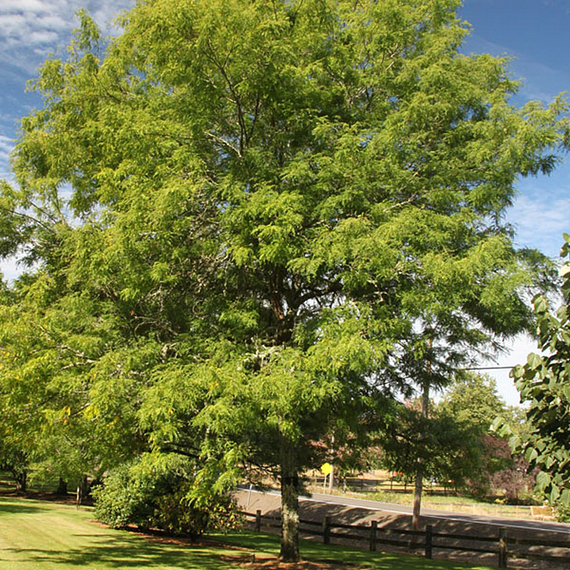
Skyline Honeylocust (Gleditsia triacanthos 'Skycole') is one of the most widely planted and trusted shade tree cultivars in the nursery trade, and it's easy to see why. This thornless, nearly seedless selection features a naturally strong central leader and an upright, broadly pyramidal form with well-spaced, ascending branches — delivering the classic good looks of a mature shade tree right from the start. The fine-textured, pinnate to bipinnate dark green leaves create a beautiful filtered canopy that lets sunlight reach turfgrass and perennial beds below, and in autumn the foliage transforms into a stunning display of golden yellow before dropping cleanly. Unlike wild honeylocust species, Skyline produces no dangerous thorns and minimal seed pods, making it a safe, low-maintenance choice for high-traffic areas. It thrives in full sun across a wide range of soils — including compacted urban soils, clay, and even saline sites — and is remarkably tolerant of summer heat, drought, deer, and air pollution once established. Whether you're planting along a street, shading a patio, anchoring a large lawn, or lining a driveway, Skyline Honeylocust delivers outstanding structural beauty and four-season appeal with minimal maintenance demands.
Plant Description
Skyline Honeylocust is a deciduous shade tree prized for its refined, upright pyramidal habit and airy, fine-textured canopy. Grown under the cultivar name 'Skycole' and trademarked as Skyline, this selection was granted US Plant Patent 1,619 in 1957 — a testament to its long-recognized superiority in form and performance. It belongs to the pea family (Fabaceae) and is a cultivar of the thornless form of honey locust (Gleditsia triacanthos f. inermis), meaning it carries none of the formidable thorns found on wild species plants. Its upright branching angles — typically 60 to 90 degrees from the trunk — and well-spaced scaffold limbs give it a naturally tidy, structurally sound silhouette that requires little corrective pruning. Small, inconspicuous greenish-white flowers appear in late spring (May to June) in short racemes and are mildly fragrant. The overall effect throughout the growing season is a bright, graceful canopy that feels open and airy without sacrificing meaningful shade.
Mature Size
| Characteristic | Measurement |
|---|---|
| Mature Height | 35 to 45 feet |
| Mature Spread | 25 to 35 feet |
| Growth Rate | Fast — up to 2 feet per year under good conditions |
| Growth Habit | Broadly pyramidal with a strong central leader |
| Canopy Character | Open, airy, and fine-textured; casts sun-dappled shade |
Hardiness Zones
Skyline Honeylocust is cold hardy in USDA Zones 3 through 8, making it one of the most cold-tolerant large shade trees available. It withstands brutal winter temperatures in the northern plains states while also performing reliably in the heat of the South and Southwest. For gardeners in Southern Oregon and Northern California, it is well within the comfortable range of typical Zone 7–9 conditions and thrives in the warm, dry summers of the region when given adequate irrigation during establishment.
Sunlight Requirements
Skyline Honeylocust requires full sun to grow and perform at its best. It should receive a minimum of 6 hours of direct, unobstructed sunlight per day — and it will happily take more. Full sun exposure promotes dense foliage development, a tight pyramidal form, and the strongest structural branch development. Planting in partial shade will result in looser, more open branching, reduced growth rate, and a less defined canopy shape. This tree is not recommended for shaded positions.
Soil and pH Preferences
One of the standout traits of Skyline Honeylocust is its remarkable tolerance of a wide range of soil conditions. While it performs best in organically rich, moist, well-drained soils, it will adapt to:
- Heavy clay soils with poor drainage
- Sandy or gravelly, fast-draining soils
- Compacted urban soils with low organic matter
- Alkaline or slightly acidic soils across a broad pH range
- Saline or roadside soils affected by de-icing salts
It is also listed as tolerant of black walnut (Juglans nigra) juglone toxicity, which opens up planting possibilities beneath or near existing black walnut trees where many other species fail. For best establishment, amend compacted or very poor soils with compost at planting time.
Watering Guide
During the first one to two growing seasons after planting, consistent and thorough watering is essential to help Skyline Honeylocust develop a deep, wide root system. Follow these general guidelines:
- Newly planted trees: Water deeply 1 to 2 times per week during the first growing season, providing approximately 1 to 2 inches of water per session. Allow the soil to dry slightly between waterings to avoid waterlogging.
- Second season: Taper watering to once per week during dry periods, allowing the tree to begin adjusting to natural rainfall patterns.
- Established trees: Once established (typically after 2 to 3 years), Skyline Honeylocust is quite drought tolerant and generally requires supplemental irrigation only during extended dry spells or intense summer heat. In the dry summers of Southern Oregon and Northern California, occasional deep watering through July and August is beneficial even for established trees.
- Avoid: Frequent shallow watering, which encourages a weak, surface-level root system. Deep, infrequent watering is always preferred.
Fertilizing
Skyline Honeylocust is not a heavy feeder and, when planted in reasonably fertile soil, will typically require little to no fertilizing once established. However, young trees or those growing in poor or compacted soils can benefit from supplemental nutrition:
- Apply a balanced, slow-release granular fertilizer (such as 10-10-10 or a tree and shrub formula) in early spring before new growth begins.
- Incorporate compost into the planting hole at installation to provide a slow, steady source of organic nutrition during establishment.
- In poor or sandy soils, a light annual application of a balanced fertilizer in early spring can support healthy, vigorous growth.
- Avoid over-fertilizing with high-nitrogen formulas, which can produce excessive, weak growth that is more susceptible to wind damage and pests.
- Top-dressing the root zone with a 2–3 inch layer of organic mulch each year is an excellent low-maintenance way to improve soil fertility and moisture retention over time.
Pruning and Maintenance
Skyline Honeylocust's naturally strong central leader and well-spaced branching habit mean that structural pruning needs are minimal compared to many other shade trees. Follow these guidelines for best results:
- Young trees (years 1–5): Focus pruning efforts on reinforcing the central leader. Remove any competing co-dominant stems early to establish a single, dominant trunk. Also remove any branches with narrow, V-shaped crotch angles that may be prone to failure.
- Ongoing maintenance: Remove dead, damaged, or crossing branches as needed. The open branching habit rarely requires heavy thinning.
- Best timing: Prune during late winter or early spring while the tree is still dormant to minimize stress and promote rapid wound closure. Light touch-up pruning can also be done in midsummer.
- Avoid: Heavy pruning in fall or early winter, as this can stimulate new growth that is susceptible to frost damage.
- Leaf cleanup: The fine-textured, small leaflets dry quickly and often blow away or break down rapidly into the lawn, making fall cleanup minimal compared to large-leafed shade trees.
Planting Instructions
- Select a planting site that receives full sun (6 or more hours of direct sunlight daily) with enough space for the tree to reach its mature spread of 25–35 feet without interference from structures, utilities, or other trees.
- Dig a planting hole that is 2 to 3 times as wide as the root ball and no deeper than the height of the root ball. A wide, shallow hole encourages outward root growth into the native soil.
- Remove all packaging materials. If container-grown, gently loosen and spread any circling roots before placing the tree in the hole.
- Set the tree so that the root flare (where the trunk widens at its base) is at or just slightly above the surrounding soil grade. Never bury the trunk flare.
- Backfill with the native soil removed from the hole. For very poor or compacted soils, blend in compost at a ratio of no more than 1 part compost to 3 parts native soil.
- Tamp lightly to eliminate large air pockets and water thoroughly immediately after planting.
- Apply a 2–3 inch layer of organic mulch (wood chips, shredded bark) in a wide ring around the tree, keeping the mulch pulled back a few inches from the trunk to prevent rot.
- Water deeply 1 to 2 times per week for the first growing season, then taper off as the tree becomes established.
- Staking is generally only necessary if the tree is planted in a very windy location. If staking is used, remove all stakes and ties after the first growing season to allow the trunk to develop natural strength.
Seasonal Interest
| Season | Ornamental Interest |
|---|---|
| Spring | Fresh emergence of fine-textured, bright green compound foliage; inconspicuous greenish-white fragrant flowers appear in May to June |
| Summer | Full medium-green canopy casts a filtered, sun-dappled shade; open branching keeps the canopy light and airy throughout the heat of summer |
| Fall | Brilliant golden yellow fall foliage color provides a warm seasonal display; small leaflets drop cleanly with minimal raking required |
| Winter | Attractive upright pyramidal branching structure and clean bark provide winter silhouette interest; no messy seed pods to clean up |
Landscape Uses
Skyline Honeylocust is one of the most versatile large shade trees available and excels in a wide range of landscape applications:
- Street and boulevard tree: Its tolerance of compacted soil, air pollution, road salt, heat, and drought makes it a top-tier choice for parking lot islands, median strips, sidewalk cutouts, and highway plantings.
- Lawn and yard shade tree: The filtered canopy allows enough sunlight through for turfgrass to thrive beneath the tree, unlike the dense shade cast by maples or lindens.
- Specimen or focal point tree: The strong pyramidal form and golden fall color make it an excellent standalone specimen in a large lawn or open garden space.
- Formal allee or avenue planting: Its uniform, predictable growth habit makes it ideal for planting in rows along driveways, entrances, or property borders.
- Near patios and walkways: The absence of thorns and minimal seed pod production makes it a safe and low-mess choice near high-traffic areas and hardscapes.
- Difficult urban sites: One of the best choices for locations with poor drainage, compacted soil, air pollution, or reflected heat from pavement.
Companion Plants
The filtered, sun-dappled shade cast by Skyline Honeylocust creates a unique planting environment beneath its canopy — brighter than true shade but cooler and less intense than full sun. Plants that perform well in partial to bright shade and tolerate moderate soil competition make excellent companions:
- Groundcovers: Vinca minor (periwinkle), Ajuga reptans (bugleweed), and creeping thyme thrive in the dappled light beneath the canopy and tolerate some root competition.
- Spring bulbs: Daffodils, tulips, and alliums can be planted beneath the tree to take advantage of the full spring sunlight before the canopy fully leafs out.
- Ornamental grasses: Prairie dropseed (Sporobolus heterolepis), blue oat grass (Helictotrichon sempervirens), or Karl Foerster feather reed grass complement the fine texture of the honeylocust foliage.
- Perennials: Daylilies, coneflowers (Echinacea), and black-eyed Susans (Rudbeckia) all tolerate the partial shade at the canopy edge and mirror the warm yellow tones of fall foliage.
- Companion trees: Kentucky coffeetree (Gymnocladus dioicus) and yellowwood (Cladrastis kentukea) share similar urban toughness and complement the honeylocust's aesthetic in larger landscape designs.
- Note: Turfgrass such as tall fescue performs particularly well beneath Skyline Honeylocust due to the tree's open, filtered canopy that allows enough sunlight for lawn maintenance.
Pests and Diseases
Skyline Honeylocust is a resilient tree but, like all honeylocusts, may be subject to certain pest and disease pressures. Being aware of these issues allows for early detection and intervention:
- Mimosa webworm (Homadaula anisocentra): The most common and significant pest of honeylocusts. Caterpillars web together and feed on leaflets in midsummer, causing browning and dieback of affected foliage. Severe infestations can brown large portions of the canopy, though established trees usually recover. Treatments include Bt (Bacillus thuringiensis) or insecticidal sprays targeting young larvae.
- Honeylocust plant bug: Small insects that feed on new foliage in spring, causing distorted and spotted leaves. Damage is usually cosmetic and rarely warrants treatment on established trees.
- Borers: Trunk and branch borers may attack stressed or newly planted trees. Maintaining good tree vigor through proper watering and mulching is the best prevention.
- Spider mites: Can become problematic during hot, dry weather, causing stippled or bronzed foliage. Monitor during summer drought periods and treat with miticide or strong water sprays if necessary.
- Bagworms: Occasionally infest honeylocusts; hand-removal of bags in late fall or winter, or Bt sprays on young larvae in spring, are effective controls.
- Leaf spot and rust: Fungal leaf diseases may appear during wet seasons but are rarely serious enough to threaten tree health. Good air circulation and avoiding overhead irrigation help minimize occurrence.
- Canker diseases: Thyronectria canker can affect honeylocusts, particularly those under stress. Prevent by maintaining tree vigor and avoiding mechanical injury to the trunk and roots.
- Powdery mildew: Occasionally seen on foliage but rarely severe on this cultivar. Adequate spacing and air circulation are the best preventive measures.
Wildlife Value
While Skyline Honeylocust is a nearly seedless cultivar and therefore does not produce the large seed pods that wildlife such as deer and squirrels feed on from wild honeylocust trees, it still offers meaningful ecological value in the landscape:
- Pollinators: The small greenish-white flowers produced in May and June attract bees and other pollinators, contributing to the local pollinator ecosystem even though the blooms are not showy to human observers.
- Birds: The open canopy and branching structure provide nesting habitat for various songbirds. The tree's upright form makes it a useful perching post for birds in open landscape settings.
- Deer resistance: Skyline Honeylocust is listed as deer tolerant, making it a good choice in areas with high deer pressure where other ornamental trees may suffer significant browse damage.
- Insects: The foliage supports a modest community of native insects, which in turn provides food for insectivorous birds and other wildlife in the local food web.
Urban Toughness and Tolerance Summary
Skyline Honeylocust is widely regarded as one of the most environmentally tolerant large shade trees available, making it a go-to choice for challenging urban and suburban planting conditions. Its documented tolerances include:
- Drought — excellent once established; one of the more drought-tolerant large shade trees for inland climates
- Heat — handles high summer temperatures including reflected heat from pavement and buildings
- Wind — strong structural branch angles and a resilient root system make it wind firm
- Clay soil — adapts well to heavy, poorly drained soils where many trees struggle
- Compacted soil — among the best large trees for parking lots, medians, and other compacted urban sites
- Air pollution — proven performance in urban environments with elevated pollutant levels
- Road salt and saline soils — tolerates salt spray and soil salinity better than most ornamental shade trees
- Black walnut (juglone) — one of relatively few large trees that is not harmed by the juglone toxin released by black walnut roots
- Deer — generally avoided by deer, adding value in rural and semi-rural landscapes
- Thornless and nearly seedless cultivar with a strong central leader and broadly pyramidal form — ideal for lawns, streetscapes, and urban landscapes
- Fine-textured, medium green compound foliage casts a desirable sun-dappled shade that transitions to brilliant golden yellow each fall
- Exceptionally tough and adaptable — tolerates drought, heat, wind, clay soil, air pollution, and even saline conditions once established
- Fast-growing shade tree reaching 35–45 feet tall, hardy in USDA Zones 3–8, and well suited to a wide range of challenging planting sites
Skyline Honeylocust (Gleditsia triacanthos 'Skycole') is one of the most widely planted and trusted shade tree cultivars in the nursery trade, and it's easy to see why. This thornless, nearly seedless selection features a naturally strong central leader and an upright, broadly pyramidal form with well-spaced, ascending branches — delivering the classic good looks of a mature shade tree right from the start. The fine-textured, pinnate to bipinnate dark green leaves create a beautiful filtered canopy that lets sunlight reach turfgrass and perennial beds below, and in autumn the foliage transforms into a stunning display of golden yellow before dropping cleanly. Unlike wild honeylocust species, Skyline produces no dangerous thorns and minimal seed pods, making it a safe, low-maintenance choice for high-traffic areas. It thrives in full sun across a wide range of soils — including compacted urban soils, clay, and even saline sites — and is remarkably tolerant of summer heat, drought, deer, and air pollution once established. Whether you're planting along a street, shading a patio, anchoring a large lawn, or lining a driveway, Skyline Honeylocust delivers outstanding structural beauty and four-season appeal with minimal maintenance demands.
Plant Description
Skyline Honeylocust is a deciduous shade tree prized for its refined, upright pyramidal habit and airy, fine-textured canopy. Grown under the cultivar name 'Skycole' and trademarked as Skyline, this selection was granted US Plant Patent 1,619 in 1957 — a testament to its long-recognized superiority in form and performance. It belongs to the pea family (Fabaceae) and is a cultivar of the thornless form of honey locust (Gleditsia triacanthos f. inermis), meaning it carries none of the formidable thorns found on wild species plants. Its upright branching angles — typically 60 to 90 degrees from the trunk — and well-spaced scaffold limbs give it a naturally tidy, structurally sound silhouette that requires little corrective pruning. Small, inconspicuous greenish-white flowers appear in late spring (May to June) in short racemes and are mildly fragrant. The overall effect throughout the growing season is a bright, graceful canopy that feels open and airy without sacrificing meaningful shade.
Mature Size
| Characteristic | Measurement |
|---|---|
| Mature Height | 35 to 45 feet |
| Mature Spread | 25 to 35 feet |
| Growth Rate | Fast — up to 2 feet per year under good conditions |
| Growth Habit | Broadly pyramidal with a strong central leader |
| Canopy Character | Open, airy, and fine-textured; casts sun-dappled shade |
Hardiness Zones
Skyline Honeylocust is cold hardy in USDA Zones 3 through 8, making it one of the most cold-tolerant large shade trees available. It withstands brutal winter temperatures in the northern plains states while also performing reliably in the heat of the South and Southwest. For gardeners in Southern Oregon and Northern California, it is well within the comfortable range of typical Zone 7–9 conditions and thrives in the warm, dry summers of the region when given adequate irrigation during establishment.
Sunlight Requirements
Skyline Honeylocust requires full sun to grow and perform at its best. It should receive a minimum of 6 hours of direct, unobstructed sunlight per day — and it will happily take more. Full sun exposure promotes dense foliage development, a tight pyramidal form, and the strongest structural branch development. Planting in partial shade will result in looser, more open branching, reduced growth rate, and a less defined canopy shape. This tree is not recommended for shaded positions.
Soil and pH Preferences
One of the standout traits of Skyline Honeylocust is its remarkable tolerance of a wide range of soil conditions. While it performs best in organically rich, moist, well-drained soils, it will adapt to:
- Heavy clay soils with poor drainage
- Sandy or gravelly, fast-draining soils
- Compacted urban soils with low organic matter
- Alkaline or slightly acidic soils across a broad pH range
- Saline or roadside soils affected by de-icing salts
It is also listed as tolerant of black walnut (Juglans nigra) juglone toxicity, which opens up planting possibilities beneath or near existing black walnut trees where many other species fail. For best establishment, amend compacted or very poor soils with compost at planting time.
Watering Guide
During the first one to two growing seasons after planting, consistent and thorough watering is essential to help Skyline Honeylocust develop a deep, wide root system. Follow these general guidelines:
- Newly planted trees: Water deeply 1 to 2 times per week during the first growing season, providing approximately 1 to 2 inches of water per session. Allow the soil to dry slightly between waterings to avoid waterlogging.
- Second season: Taper watering to once per week during dry periods, allowing the tree to begin adjusting to natural rainfall patterns.
- Established trees: Once established (typically after 2 to 3 years), Skyline Honeylocust is quite drought tolerant and generally requires supplemental irrigation only during extended dry spells or intense summer heat. In the dry summers of Southern Oregon and Northern California, occasional deep watering through July and August is beneficial even for established trees.
- Avoid: Frequent shallow watering, which encourages a weak, surface-level root system. Deep, infrequent watering is always preferred.
Fertilizing
Skyline Honeylocust is not a heavy feeder and, when planted in reasonably fertile soil, will typically require little to no fertilizing once established. However, young trees or those growing in poor or compacted soils can benefit from supplemental nutrition:
- Apply a balanced, slow-release granular fertilizer (such as 10-10-10 or a tree and shrub formula) in early spring before new growth begins.
- Incorporate compost into the planting hole at installation to provide a slow, steady source of organic nutrition during establishment.
- In poor or sandy soils, a light annual application of a balanced fertilizer in early spring can support healthy, vigorous growth.
- Avoid over-fertilizing with high-nitrogen formulas, which can produce excessive, weak growth that is more susceptible to wind damage and pests.
- Top-dressing the root zone with a 2–3 inch layer of organic mulch each year is an excellent low-maintenance way to improve soil fertility and moisture retention over time.
Pruning and Maintenance
Skyline Honeylocust's naturally strong central leader and well-spaced branching habit mean that structural pruning needs are minimal compared to many other shade trees. Follow these guidelines for best results:
- Young trees (years 1–5): Focus pruning efforts on reinforcing the central leader. Remove any competing co-dominant stems early to establish a single, dominant trunk. Also remove any branches with narrow, V-shaped crotch angles that may be prone to failure.
- Ongoing maintenance: Remove dead, damaged, or crossing branches as needed. The open branching habit rarely requires heavy thinning.
- Best timing: Prune during late winter or early spring while the tree is still dormant to minimize stress and promote rapid wound closure. Light touch-up pruning can also be done in midsummer.
- Avoid: Heavy pruning in fall or early winter, as this can stimulate new growth that is susceptible to frost damage.
- Leaf cleanup: The fine-textured, small leaflets dry quickly and often blow away or break down rapidly into the lawn, making fall cleanup minimal compared to large-leafed shade trees.
Planting Instructions
- Select a planting site that receives full sun (6 or more hours of direct sunlight daily) with enough space for the tree to reach its mature spread of 25–35 feet without interference from structures, utilities, or other trees.
- Dig a planting hole that is 2 to 3 times as wide as the root ball and no deeper than the height of the root ball. A wide, shallow hole encourages outward root growth into the native soil.
- Remove all packaging materials. If container-grown, gently loosen and spread any circling roots before placing the tree in the hole.
- Set the tree so that the root flare (where the trunk widens at its base) is at or just slightly above the surrounding soil grade. Never bury the trunk flare.
- Backfill with the native soil removed from the hole. For very poor or compacted soils, blend in compost at a ratio of no more than 1 part compost to 3 parts native soil.
- Tamp lightly to eliminate large air pockets and water thoroughly immediately after planting.
- Apply a 2–3 inch layer of organic mulch (wood chips, shredded bark) in a wide ring around the tree, keeping the mulch pulled back a few inches from the trunk to prevent rot.
- Water deeply 1 to 2 times per week for the first growing season, then taper off as the tree becomes established.
- Staking is generally only necessary if the tree is planted in a very windy location. If staking is used, remove all stakes and ties after the first growing season to allow the trunk to develop natural strength.
Seasonal Interest
| Season | Ornamental Interest |
|---|---|
| Spring | Fresh emergence of fine-textured, bright green compound foliage; inconspicuous greenish-white fragrant flowers appear in May to June |
| Summer | Full medium-green canopy casts a filtered, sun-dappled shade; open branching keeps the canopy light and airy throughout the heat of summer |
| Fall | Brilliant golden yellow fall foliage color provides a warm seasonal display; small leaflets drop cleanly with minimal raking required |
| Winter | Attractive upright pyramidal branching structure and clean bark provide winter silhouette interest; no messy seed pods to clean up |
Landscape Uses
Skyline Honeylocust is one of the most versatile large shade trees available and excels in a wide range of landscape applications:
- Street and boulevard tree: Its tolerance of compacted soil, air pollution, road salt, heat, and drought makes it a top-tier choice for parking lot islands, median strips, sidewalk cutouts, and highway plantings.
- Lawn and yard shade tree: The filtered canopy allows enough sunlight through for turfgrass to thrive beneath the tree, unlike the dense shade cast by maples or lindens.
- Specimen or focal point tree: The strong pyramidal form and golden fall color make it an excellent standalone specimen in a large lawn or open garden space.
- Formal allee or avenue planting: Its uniform, predictable growth habit makes it ideal for planting in rows along driveways, entrances, or property borders.
- Near patios and walkways: The absence of thorns and minimal seed pod production makes it a safe and low-mess choice near high-traffic areas and hardscapes.
- Difficult urban sites: One of the best choices for locations with poor drainage, compacted soil, air pollution, or reflected heat from pavement.
Companion Plants
The filtered, sun-dappled shade cast by Skyline Honeylocust creates a unique planting environment beneath its canopy — brighter than true shade but cooler and less intense than full sun. Plants that perform well in partial to bright shade and tolerate moderate soil competition make excellent companions:
- Groundcovers: Vinca minor (periwinkle), Ajuga reptans (bugleweed), and creeping thyme thrive in the dappled light beneath the canopy and tolerate some root competition.
- Spring bulbs: Daffodils, tulips, and alliums can be planted beneath the tree to take advantage of the full spring sunlight before the canopy fully leafs out.
- Ornamental grasses: Prairie dropseed (Sporobolus heterolepis), blue oat grass (Helictotrichon sempervirens), or Karl Foerster feather reed grass complement the fine texture of the honeylocust foliage.
- Perennials: Daylilies, coneflowers (Echinacea), and black-eyed Susans (Rudbeckia) all tolerate the partial shade at the canopy edge and mirror the warm yellow tones of fall foliage.
- Companion trees: Kentucky coffeetree (Gymnocladus dioicus) and yellowwood (Cladrastis kentukea) share similar urban toughness and complement the honeylocust's aesthetic in larger landscape designs.
- Note: Turfgrass such as tall fescue performs particularly well beneath Skyline Honeylocust due to the tree's open, filtered canopy that allows enough sunlight for lawn maintenance.
Pests and Diseases
Skyline Honeylocust is a resilient tree but, like all honeylocusts, may be subject to certain pest and disease pressures. Being aware of these issues allows for early detection and intervention:
- Mimosa webworm (Homadaula anisocentra): The most common and significant pest of honeylocusts. Caterpillars web together and feed on leaflets in midsummer, causing browning and dieback of affected foliage. Severe infestations can brown large portions of the canopy, though established trees usually recover. Treatments include Bt (Bacillus thuringiensis) or insecticidal sprays targeting young larvae.
- Honeylocust plant bug: Small insects that feed on new foliage in spring, causing distorted and spotted leaves. Damage is usually cosmetic and rarely warrants treatment on established trees.
- Borers: Trunk and branch borers may attack stressed or newly planted trees. Maintaining good tree vigor through proper watering and mulching is the best prevention.
- Spider mites: Can become problematic during hot, dry weather, causing stippled or bronzed foliage. Monitor during summer drought periods and treat with miticide or strong water sprays if necessary.
- Bagworms: Occasionally infest honeylocusts; hand-removal of bags in late fall or winter, or Bt sprays on young larvae in spring, are effective controls.
- Leaf spot and rust: Fungal leaf diseases may appear during wet seasons but are rarely serious enough to threaten tree health. Good air circulation and avoiding overhead irrigation help minimize occurrence.
- Canker diseases: Thyronectria canker can affect honeylocusts, particularly those under stress. Prevent by maintaining tree vigor and avoiding mechanical injury to the trunk and roots.
- Powdery mildew: Occasionally seen on foliage but rarely severe on this cultivar. Adequate spacing and air circulation are the best preventive measures.
Wildlife Value
While Skyline Honeylocust is a nearly seedless cultivar and therefore does not produce the large seed pods that wildlife such as deer and squirrels feed on from wild honeylocust trees, it still offers meaningful ecological value in the landscape:
- Pollinators: The small greenish-white flowers produced in May and June attract bees and other pollinators, contributing to the local pollinator ecosystem even though the blooms are not showy to human observers.
- Birds: The open canopy and branching structure provide nesting habitat for various songbirds. The tree's upright form makes it a useful perching post for birds in open landscape settings.
- Deer resistance: Skyline Honeylocust is listed as deer tolerant, making it a good choice in areas with high deer pressure where other ornamental trees may suffer significant browse damage.
- Insects: The foliage supports a modest community of native insects, which in turn provides food for insectivorous birds and other wildlife in the local food web.
Urban Toughness and Tolerance Summary
Skyline Honeylocust is widely regarded as one of the most environmentally tolerant large shade trees available, making it a go-to choice for challenging urban and suburban planting conditions. Its documented tolerances include:
- Drought — excellent once established; one of the more drought-tolerant large shade trees for inland climates
- Heat — handles high summer temperatures including reflected heat from pavement and buildings
- Wind — strong structural branch angles and a resilient root system make it wind firm
- Clay soil — adapts well to heavy, poorly drained soils where many trees struggle
- Compacted soil — among the best large trees for parking lots, medians, and other compacted urban sites
- Air pollution — proven performance in urban environments with elevated pollutant levels
- Road salt and saline soils — tolerates salt spray and soil salinity better than most ornamental shade trees
- Black walnut (juglone) — one of relatively few large trees that is not harmed by the juglone toxin released by black walnut roots
- Deer — generally avoided by deer, adding value in rural and semi-rural landscapes
Related Products