
Zoom the image with the mouse
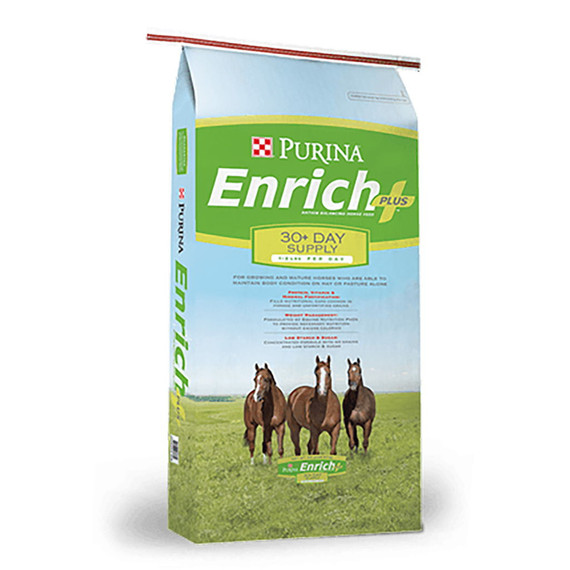
Purina Enrich Plus Ration Balancing Horse Feed - 50 lb
SKU:
1482880
UPC:
804273038889
$41.99
Horses need more nutrition than forage alone can provide.
Today's horses are typically limited to a single type of forage in one geographic area. Pastures in the same area or even different sections of the same pasture can have inconsistent nutrient values. Unfortified grains such as straight oats and corn can also have variable amounts of protein, minerals, and vitamins. So horses need your help to achieve the nutritional balance they once derived naturally.
Enrich plus ration balancing feed adds necessary nutrients to your horse's diet.
Enrich plus is a concentrated, pelleted ration balancing horse feed that may be fed as a horse's sole ration along with quality hay or pasture to provide the proper balance of protein, vitamins, and minerals without unnecessary calories. It can also be fed with unfortified whole grains.
Enrich Plus Ration Balancing Feed is Best Suited for
- Easy keepers - Easy keepers who maintain body weight and condition on hay or pasture alone, or are not able to eat the minimum recommended amount of another feed without gaining unwanted weight
- Young, growing horses - Young, growing horses may require concentrated nutrition to support growth and development, but with fewer calories to support a slower growth rate or reduced body condition when recommended
- Stallions & early gestation mares - Stallions & early gestation mares may need a more concentrated source of nutrition. Also appropriate for working horses who may need protein, vitamin, and mineral supplementation
Features
- Added antioxidants - Including selenium and vitamin e to help address the damaging effects of free radicals
- Added vegetable oils - For a shinier, healthier hair coat, skin and hooves
- B Vitamins - Help maintain metabolic function
- Concentrate feed - Designed to be fed with hay or pasture
- Concentrated formula - Provides required nutrition without excess calories
- Corn-free and oat-free - For horses with specific sensitivities
- high-quality protein - With essential amino acids lysine and methionine to support muscle maintenance, growth, and repair
- Low starch & sugar - Concentrated formula with no grain and low starch and sugar
- Protein, vitamin & mineral fortification - Fills nutritional gaps common in forage and unfortified grains
- Quality ingredients - Highly digestible and naturally palatable
- vitamin & mineral fortification - provides 100% of the required vitamins and minerals when fed as directed
based on "Nutrient requirements of horses sixth revised edition'2007" published by the national research council - Weight management - Formulated by Ph.D. Equine nutritionists to provide necessary nutrition without excess calories
Life Stage
- Active pleasure
- Any life stage
- Senior
- Special needs
Type
- Ration balancing feed
Form
- Pelleted
Nutrients
- Crude Protein Min: 32.00 %
- Lysine Min: 2.70 %
- Crude Fat Min: 5.00 %
- Crude Fiber Max: 5.50 %
- Acid Detergent Fiber (ADF) Max: 8.00 %
- Neutral Detergent Fiber (NDF) Max: 14.00 %
- Starch Max: 5.00 %
- Sugars Max: 10.00 %
- Calcium (Ca) Min: 3.25 %
- Calcium (Ca) Max: 4.25 %
- Phosphorus (P) Min: 1.60 %
- Copper (Cu) Min: 185.00 ppm
- Selenium (Se) Min: 2.0 ppm
- Zinc (Zn) Min: 500.00 ppm
- Vitamin A Min: 18,000 lu/lb
- Vitamin E Min: 600 lu/lb
Feeding Directions
Description
Purina enrich plus ration balancing horse feed is designed to complement and fortify hay or pasture. The feeding recommendations are based on the following assumptions an expected mature weight of approximately 1,100 pounds* and the horse is consuming at least 2.0%** of its body weight in hay or pasture (dry matter).
For horses that do not approximate this expected mature weight (such as miniature horses, ponies, and draft horses), feeding rates for mature horses at maintenance can be estimated based on 0.1 - 0.2 lb purina enrich plus per 100 lb body weight per day.
Always provide a minimum of 1% of the horse's body weight in hay or the equivalent in pasture.
More rapid rates of growth can be achieved by adding grain to the diet. However, given the inherent nutritional inconsistencies of straight grain diets, more rapid rates of gain are more safely and successfully achieved by using one of the completely fortified and balanced horse feeds by purina. Contact your local purina retailer for the feed that best suits your needs. The nutritional needs of foals less than four months of age are better satisfied with products such as purina ultium growth, strategy GX, or Omolene #300 horse feeds.
Maintenance & Reproduction
(based on 1,100 lb mature weight).
The additional calories needed during the last trimester of gestation and during lactation can be provided by adding grain to the diet. However, given the inherent nutritional inconsistencies of straight grain diets, a more nutritionally balanced and desirable source of calories can be provided by using an appropriate purina horse feed designed to meet the needs of gestating and lactating broodmares. Contact your local purina retailer for the feed that best suits your needs.
Moderate Performance
The additional calorie and nutrient demands of such horses may be better satisfied with products such as purina ultium competition, strategy GX, strategy healthy edge, Omolene #100 or #200, #400 or #500 horse feeds.
Best Results
For horses sensitive to dietary soluble carbohydrates, please consult with a veterinarian or nutritionist for a recommended diet. The recommended feeding rate should not be exceeded. Do not feed more than 0.5 lb per 100 lb of body weight in one serving. Do not feed free choice.
Feed at regular times divides total daily feeding into at least two servings with three daily servings preferred. Reduce and/or delay feeding a horse that is hot, excited, or showing pain, fever, or diarrhea. Be sure to weigh your feed using a scale. A small scale can be purchased in the fishing department of many sporting goods stores.
Feed horse in a natural position from troughs placed at normal head height or lower. Have plenty of fresh, clean water available at all times. Provide your horse with access to salt.
Maintain an effective control program for internal parasites. Be sure that horses are free of dental problems. Prevent the rapid eating by the horses of any feedstuff. Observe your horses' condition daily. Consult your veterinarian if any problems arise.
Changing To
Make the feed change gradually over a period of 7 to 10 days. Changes in the rate of feeding should not exceed 1 lb per day for each horse. Mix the new feed with the old, gradually increasing the amount of the new feed while decreasing an equal amount of the old.
Caution
Follow label directions. Store in a dry, well-ventilated area protected from rodents and insects. Do not feed moldy or insect-infested feed to animals as it may cause illness, performance loss, or death. Feeding added selenium resulting in total diet levels in excess of 0.3 ppm is prohibited.
Specifications
- Size: 50 lb
Horses need more nutrition than forage alone can provide.
Today's horses are typically limited to a single type of forage in one geographic area. Pastures in the same area or even different sections of the same pasture can have inconsistent nutrient values. Unfortified grains such as straight oats and corn can also have variable amounts of protein, minerals, and vitamins. So horses need your help to achieve the nutritional balance they once derived naturally.
Enrich plus ration balancing feed adds necessary nutrients to your horse's diet.
Enrich plus is a concentrated, pelleted ration balancing horse feed that may be fed as a horse's sole ration along with quality hay or pasture to provide the proper balance of protein, vitamins, and minerals without unnecessary calories. It can also be fed with unfortified whole grains.
Enrich Plus Ration Balancing Feed is Best Suited for
- Easy keepers - Easy keepers who maintain body weight and condition on hay or pasture alone, or are not able to eat the minimum recommended amount of another feed without gaining unwanted weight
- Young, growing horses - Young, growing horses may require concentrated nutrition to support growth and development, but with fewer calories to support a slower growth rate or reduced body condition when recommended
- Stallions & early gestation mares - Stallions & early gestation mares may need a more concentrated source of nutrition. Also appropriate for working horses who may need protein, vitamin, and mineral supplementation
Features
- Added antioxidants - Including selenium and vitamin e to help address the damaging effects of free radicals
- Added vegetable oils - For a shinier, healthier hair coat, skin and hooves
- B Vitamins - Help maintain metabolic function
- Concentrate feed - Designed to be fed with hay or pasture
- Concentrated formula - Provides required nutrition without excess calories
- Corn-free and oat-free - For horses with specific sensitivities
- high-quality protein - With essential amino acids lysine and methionine to support muscle maintenance, growth, and repair
- Low starch & sugar - Concentrated formula with no grain and low starch and sugar
- Protein, vitamin & mineral fortification - Fills nutritional gaps common in forage and unfortified grains
- Quality ingredients - Highly digestible and naturally palatable
- vitamin & mineral fortification - provides 100% of the required vitamins and minerals when fed as directed
based on "Nutrient requirements of horses sixth revised edition'2007" published by the national research council - Weight management - Formulated by Ph.D. Equine nutritionists to provide necessary nutrition without excess calories
Life Stage
- Active pleasure
- Any life stage
- Senior
- Special needs
Type
- Ration balancing feed
Form
- Pelleted
Nutrients
- Crude Protein Min: 32.00 %
- Lysine Min: 2.70 %
- Crude Fat Min: 5.00 %
- Crude Fiber Max: 5.50 %
- Acid Detergent Fiber (ADF) Max: 8.00 %
- Neutral Detergent Fiber (NDF) Max: 14.00 %
- Starch Max: 5.00 %
- Sugars Max: 10.00 %
- Calcium (Ca) Min: 3.25 %
- Calcium (Ca) Max: 4.25 %
- Phosphorus (P) Min: 1.60 %
- Copper (Cu) Min: 185.00 ppm
- Selenium (Se) Min: 2.0 ppm
- Zinc (Zn) Min: 500.00 ppm
- Vitamin A Min: 18,000 lu/lb
- Vitamin E Min: 600 lu/lb
Feeding Directions
Description
Purina enrich plus ration balancing horse feed is designed to complement and fortify hay or pasture. The feeding recommendations are based on the following assumptions an expected mature weight of approximately 1,100 pounds* and the horse is consuming at least 2.0%** of its body weight in hay or pasture (dry matter).
For horses that do not approximate this expected mature weight (such as miniature horses, ponies, and draft horses), feeding rates for mature horses at maintenance can be estimated based on 0.1 - 0.2 lb purina enrich plus per 100 lb body weight per day.
Always provide a minimum of 1% of the horse's body weight in hay or the equivalent in pasture.
More rapid rates of growth can be achieved by adding grain to the diet. However, given the inherent nutritional inconsistencies of straight grain diets, more rapid rates of gain are more safely and successfully achieved by using one of the completely fortified and balanced horse feeds by purina. Contact your local purina retailer for the feed that best suits your needs. The nutritional needs of foals less than four months of age are better satisfied with products such as purina ultium growth, strategy GX, or Omolene #300 horse feeds.
Maintenance & Reproduction
(based on 1,100 lb mature weight).
The additional calories needed during the last trimester of gestation and during lactation can be provided by adding grain to the diet. However, given the inherent nutritional inconsistencies of straight grain diets, a more nutritionally balanced and desirable source of calories can be provided by using an appropriate purina horse feed designed to meet the needs of gestating and lactating broodmares. Contact your local purina retailer for the feed that best suits your needs.
Moderate Performance
The additional calorie and nutrient demands of such horses may be better satisfied with products such as purina ultium competition, strategy GX, strategy healthy edge, Omolene #100 or #200, #400 or #500 horse feeds.
Best Results
For horses sensitive to dietary soluble carbohydrates, please consult with a veterinarian or nutritionist for a recommended diet. The recommended feeding rate should not be exceeded. Do not feed more than 0.5 lb per 100 lb of body weight in one serving. Do not feed free choice.
Feed at regular times divides total daily feeding into at least two servings with three daily servings preferred. Reduce and/or delay feeding a horse that is hot, excited, or showing pain, fever, or diarrhea. Be sure to weigh your feed using a scale. A small scale can be purchased in the fishing department of many sporting goods stores.
Feed horse in a natural position from troughs placed at normal head height or lower. Have plenty of fresh, clean water available at all times. Provide your horse with access to salt.
Maintain an effective control program for internal parasites. Be sure that horses are free of dental problems. Prevent the rapid eating by the horses of any feedstuff. Observe your horses' condition daily. Consult your veterinarian if any problems arise.
Changing To
Make the feed change gradually over a period of 7 to 10 days. Changes in the rate of feeding should not exceed 1 lb per day for each horse. Mix the new feed with the old, gradually increasing the amount of the new feed while decreasing an equal amount of the old.
Caution
Follow label directions. Store in a dry, well-ventilated area protected from rodents and insects. Do not feed moldy or insect-infested feed to animals as it may cause illness, performance loss, or death. Feeding added selenium resulting in total diet levels in excess of 0.3 ppm is prohibited.
Specifications
- Size: 50 lb