
Zoom the image with the mouse
Leyland Cypress - 5 Gallon
SKU:
195860
UPC:
753768038364
$39.99
$35.99
(You save
$4.00
)
- Extremely fast growing evergreen reaching 20 to 30 feet in just 10 years with a potential mature height of 50 feet, growing up to 3 feet per year in youth
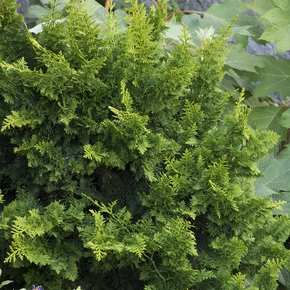
- Densely packed, bright emerald green foliage creates a solid year-round privacy screen, windbreak, or noise buffer with exceptional visual density
- Deer resistant and tolerant of most soil types, requiring very little maintenance once established across USDA Hardiness Zones 5 through 9
- Ideal fast-growth solution for estates, large properties, and commercial sites where rapid screening and wind protection are top priorities
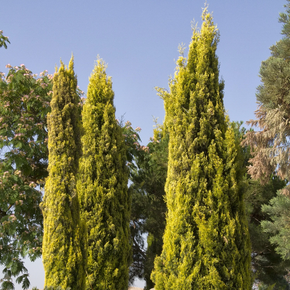
Leyland Cypress (x Cupressocyparis leylandii) is an extremely fast-growing evergreen conifer renowned for its ability to provide rapid privacy screening, windbreak protection, and dense year-round foliage coverage. With growth rates of up to 3 feet per year during youth, it reaches 20 to 30 feet in just 10 years and can eventually achieve a mature height of 50 feet tall and 20 feet wide, making it one of the fastest screening solutions available for large-scale residential, estate, and commercial landscapes. The densely packed, bright emerald green foliage maintains its rich color year-round, creating a solid visual and wind barrier that few other conifers can match at the same speed of establishment. Deer resistant and tolerant of most soil types across USDA Zones 5 through 9, Leyland Cypress is a low-maintenance, high-impact evergreen best suited for properties with ample space where its impressive ultimate size can be fully accommodated.
Plant Details
| Attribute | Details |
|---|---|
| Botanical Name | x Cupressocyparis leylandii |
| Plant Type | Evergreen Conifer |
| Foliage Color | Bright emerald green |
| Bloom Time | Conifer; prized for foliage |
| Growth Rate | Very fast (up to 3 ft. per year in youth) |
| Mature Size | 50 ft. tall, 20 ft. wide (20-30 ft. in 10 years) |
| USDA Zones | 5 - 9 |
| Light | Full sun |
| Water | When top 2 in. of soil is dry; tolerates mild drought once established |
| Special Features | Easy Care, Waterwise, Fast Growing |
| Landscape Use | Privacy Screen, Windbreak, Sound Barrier |
| Deer Resistant | Yes |
Size and Growth Habit
Leyland Cypress is one of the fastest-growing screening conifers available, capable of adding up to 3 feet of height per year during its juvenile growth phase. It reaches 20 to 30 feet in approximately 10 years and can eventually mature to 50 feet tall and 20 feet wide if left unpruned. Its broadly pyramidal to columnar form is naturally dense, producing a solid wall of foliage when planted in rows at 6 to 10 foot spacing. Due to its large ultimate size, this conifer is best reserved for estates, large residential lots, commercial properties, and rural settings where it has ample room to develop without overwhelming the landscape or neighboring properties.
Sunlight Requirements
Leyland Cypress thrives in full sun with at least 6 hours of direct sunlight per day. Full sun exposure promotes the densest branching, the richest emerald green foliage color, and the fastest growth rate. In shaded conditions, the foliage becomes thin and open, significantly reducing the plant's effectiveness as a privacy screen. For optimal density and screening performance, plant in the most open, sunny location available on the property.
Watering
Water Leyland Cypress deeply and regularly during the first growing season to establish an extensive root system that supports its rapid growth. Once established, reduce watering frequency; this conifer tolerates mild drought, particularly in coastal and cool-summer regions. In hot, dry inland climates, supplemental deep watering during extended summer dry spells will help maintain foliage quality and density. Avoid overwatering or planting in areas with poor drainage, as this conifer is susceptible to root diseases in persistently waterlogged soils.
Soil Requirements
Leyland Cypress is highly adaptable and performs best in well-drained, average to enriched soils. It tolerates a broad range of soil types including clay, loam, sandy, and moderately alkaline conditions. While it accepts average soil fertility, amending planting sites with compost helps support the rapid growth rate during establishment. The key soil requirement is adequate drainage; consistently saturated soils promote root diseases that can cause decline in established trees.
Care and Maintenance
- Fertilizing: Apply a general-purpose fertilizer before new growth begins in spring to support vigorous annual growth.
- Pruning: May be pruned periodically to shape or control height and width; avoid cutting into bare, old wood which does not regenerate green growth.
- Spacing: Plant 6 to 10 feet apart for a dense screen; wider spacing allows for individual specimen development.
- Disease watch: Monitor for Seiridium canker, the most common disease of Leyland Cypress in humid southeastern climates; ensure good air circulation.
- Bagworms: Inspect for bagworm infestations in late spring; hand-pick bags or treat with Bt (Bacillus thuringiensis) if detected early.
Landscape Uses
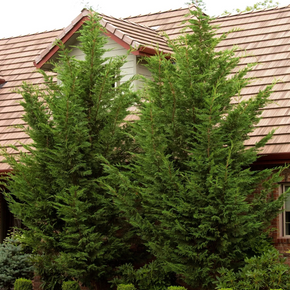
Leyland Cypress is primarily valued as one of the fastest solutions for creating dense privacy screens, windbreaks, and noise barriers on large properties. When planted in rows, the dense emerald green foliage knits together quickly to form a solid living wall that blocks views, reduces wind speed, and absorbs sound effectively. It is widely used along property boundaries, around swimming pools, and along roadways on estates and large commercial sites. Its rapid growth also makes it popular for Christmas tree farms. As an individual specimen, its large pyramidal form makes a bold architectural statement, but its ultimate size should be carefully considered relative to the available space.
Companion Plants
| Plant | Why It Works |
|---|---|
| Magnolia (Magnolia) | Large, glossy-leafed flowering tree that complements the formal evergreen backdrop with seasonal bloom |
| Rose (Rosa) | Classic colorful shrub that benefits from the wind protection provided by the cypress screen behind it |
| Potentilla (Potentilla) | Low, cheerful yellow-flowering shrub at the base adds color contrast against the deep green foliage |
| Maiden Grass (Miscanthus) | Graceful ornamental grass adds textural movement and seasonal interest alongside the solid evergreen |
| Spirea (Spiraea) | Mounding deciduous shrub provides complementary three-season color and texture in front of the screen |
Important Sizing Considerations
Before planting Leyland Cypress, carefully consider its substantial mature dimensions of up to 50 feet tall and 20 feet wide. This conifer is best reserved for properties with ample space, including estates, large suburban lots, rural properties, and commercial sites. It is not well-suited for small residential yards, narrow side-yard plantings, or locations near building foundations, power lines, or septic systems where its extensive root system and ultimate height may cause problems. If space is a limiting factor, consider narrower columnar conifers or slower-growing screening alternatives that are more proportionate to the available area.
USDA Hardiness Zones
Leyland Cypress is rated for USDA Hardiness Zones 5 through 9. In Zone 5, it survives winter lows to approximately -20 degrees Fahrenheit, though growth may be slightly slower than in milder zones. In Zones 6 through 8, it achieves its fastest growth rates and densest screening performance. In Zone 9, it performs well in coastal and mild inland areas but may show some stress during extreme summer heat combined with drought. As a hybrid between Monterey Cypress and Nootka Cypress, it inherits vigor and adaptability from both parent species.
History and Background
Leyland Cypress is an intergeneric hybrid (x Cupressocyparis leylandii) between Monterey Cypress (Cupressus macrocarpa) and Nootka Cypress (Chamaecyparis nootkatensis), first arising as an accidental cross at Leighton Hall in Wales in 1888. The hybrid was later recognized and named after Christopher Leyland, the property owner. Its extraordinary vigor, rapid growth rate, and tolerance for a wide range of conditions made it one of the most widely planted screening conifers in the world during the 20th century. While its popularity has prompted some cautionary notes about disease susceptibility in certain humid climates, it remains an unmatched choice for rapid, dense screening when properly sited with adequate spacing and air circulation.
- Extremely fast growing evergreen reaching 20 to 30 feet in just 10 years with a potential mature height of 50 feet, growing up to 3 feet per year in youth
- Densely packed, bright emerald green foliage creates a solid year-round privacy screen, windbreak, or noise buffer with exceptional visual density
- Deer resistant and tolerant of most soil types, requiring very little maintenance once established across USDA Hardiness Zones 5 through 9
- Ideal fast-growth solution for estates, large properties, and commercial sites where rapid screening and wind protection are top priorities
Leyland Cypress (x Cupressocyparis leylandii) is an extremely fast-growing evergreen conifer renowned for its ability to provide rapid privacy screening, windbreak protection, and dense year-round foliage coverage. With growth rates of up to 3 feet per year during youth, it reaches 20 to 30 feet in just 10 years and can eventually achieve a mature height of 50 feet tall and 20 feet wide, making it one of the fastest screening solutions available for large-scale residential, estate, and commercial landscapes. The densely packed, bright emerald green foliage maintains its rich color year-round, creating a solid visual and wind barrier that few other conifers can match at the same speed of establishment. Deer resistant and tolerant of most soil types across USDA Zones 5 through 9, Leyland Cypress is a low-maintenance, high-impact evergreen best suited for properties with ample space where its impressive ultimate size can be fully accommodated.
Plant Details
| Attribute | Details |
|---|---|
| Botanical Name | x Cupressocyparis leylandii |
| Plant Type | Evergreen Conifer |
| Foliage Color | Bright emerald green |
| Bloom Time | Conifer; prized for foliage |
| Growth Rate | Very fast (up to 3 ft. per year in youth) |
| Mature Size | 50 ft. tall, 20 ft. wide (20-30 ft. in 10 years) |
| USDA Zones | 5 - 9 |
| Light | Full sun |
| Water | When top 2 in. of soil is dry; tolerates mild drought once established |
| Special Features | Easy Care, Waterwise, Fast Growing |
| Landscape Use | Privacy Screen, Windbreak, Sound Barrier |
| Deer Resistant | Yes |
Size and Growth Habit
Leyland Cypress is one of the fastest-growing screening conifers available, capable of adding up to 3 feet of height per year during its juvenile growth phase. It reaches 20 to 30 feet in approximately 10 years and can eventually mature to 50 feet tall and 20 feet wide if left unpruned. Its broadly pyramidal to columnar form is naturally dense, producing a solid wall of foliage when planted in rows at 6 to 10 foot spacing. Due to its large ultimate size, this conifer is best reserved for estates, large residential lots, commercial properties, and rural settings where it has ample room to develop without overwhelming the landscape or neighboring properties.
Sunlight Requirements
Leyland Cypress thrives in full sun with at least 6 hours of direct sunlight per day. Full sun exposure promotes the densest branching, the richest emerald green foliage color, and the fastest growth rate. In shaded conditions, the foliage becomes thin and open, significantly reducing the plant's effectiveness as a privacy screen. For optimal density and screening performance, plant in the most open, sunny location available on the property.
Watering
Water Leyland Cypress deeply and regularly during the first growing season to establish an extensive root system that supports its rapid growth. Once established, reduce watering frequency; this conifer tolerates mild drought, particularly in coastal and cool-summer regions. In hot, dry inland climates, supplemental deep watering during extended summer dry spells will help maintain foliage quality and density. Avoid overwatering or planting in areas with poor drainage, as this conifer is susceptible to root diseases in persistently waterlogged soils.
Soil Requirements
Leyland Cypress is highly adaptable and performs best in well-drained, average to enriched soils. It tolerates a broad range of soil types including clay, loam, sandy, and moderately alkaline conditions. While it accepts average soil fertility, amending planting sites with compost helps support the rapid growth rate during establishment. The key soil requirement is adequate drainage; consistently saturated soils promote root diseases that can cause decline in established trees.
Care and Maintenance
- Fertilizing: Apply a general-purpose fertilizer before new growth begins in spring to support vigorous annual growth.
- Pruning: May be pruned periodically to shape or control height and width; avoid cutting into bare, old wood which does not regenerate green growth.
- Spacing: Plant 6 to 10 feet apart for a dense screen; wider spacing allows for individual specimen development.
- Disease watch: Monitor for Seiridium canker, the most common disease of Leyland Cypress in humid southeastern climates; ensure good air circulation.
- Bagworms: Inspect for bagworm infestations in late spring; hand-pick bags or treat with Bt (Bacillus thuringiensis) if detected early.
Landscape Uses
Leyland Cypress is primarily valued as one of the fastest solutions for creating dense privacy screens, windbreaks, and noise barriers on large properties. When planted in rows, the dense emerald green foliage knits together quickly to form a solid living wall that blocks views, reduces wind speed, and absorbs sound effectively. It is widely used along property boundaries, around swimming pools, and along roadways on estates and large commercial sites. Its rapid growth also makes it popular for Christmas tree farms. As an individual specimen, its large pyramidal form makes a bold architectural statement, but its ultimate size should be carefully considered relative to the available space.
Companion Plants
| Plant | Why It Works |
|---|---|
| Magnolia (Magnolia) | Large, glossy-leafed flowering tree that complements the formal evergreen backdrop with seasonal bloom |
| Rose (Rosa) | Classic colorful shrub that benefits from the wind protection provided by the cypress screen behind it |
| Potentilla (Potentilla) | Low, cheerful yellow-flowering shrub at the base adds color contrast against the deep green foliage |
| Maiden Grass (Miscanthus) | Graceful ornamental grass adds textural movement and seasonal interest alongside the solid evergreen |
| Spirea (Spiraea) | Mounding deciduous shrub provides complementary three-season color and texture in front of the screen |
Important Sizing Considerations
Before planting Leyland Cypress, carefully consider its substantial mature dimensions of up to 50 feet tall and 20 feet wide. This conifer is best reserved for properties with ample space, including estates, large suburban lots, rural properties, and commercial sites. It is not well-suited for small residential yards, narrow side-yard plantings, or locations near building foundations, power lines, or septic systems where its extensive root system and ultimate height may cause problems. If space is a limiting factor, consider narrower columnar conifers or slower-growing screening alternatives that are more proportionate to the available area.
USDA Hardiness Zones
Leyland Cypress is rated for USDA Hardiness Zones 5 through 9. In Zone 5, it survives winter lows to approximately -20 degrees Fahrenheit, though growth may be slightly slower than in milder zones. In Zones 6 through 8, it achieves its fastest growth rates and densest screening performance. In Zone 9, it performs well in coastal and mild inland areas but may show some stress during extreme summer heat combined with drought. As a hybrid between Monterey Cypress and Nootka Cypress, it inherits vigor and adaptability from both parent species.
History and Background
Leyland Cypress is an intergeneric hybrid (x Cupressocyparis leylandii) between Monterey Cypress (Cupressus macrocarpa) and Nootka Cypress (Chamaecyparis nootkatensis), first arising as an accidental cross at Leighton Hall in Wales in 1888. The hybrid was later recognized and named after Christopher Leyland, the property owner. Its extraordinary vigor, rapid growth rate, and tolerance for a wide range of conditions made it one of the most widely planted screening conifers in the world during the 20th century. While its popularity has prompted some cautionary notes about disease susceptibility in certain humid climates, it remains an unmatched choice for rapid, dense screening when properly sited with adequate spacing and air circulation.
Related Products