

The Joan Lionetti Texas Live Oak (Quercus fusiformis ‘Joan Lionetti’, PP27,646) is a resilient, evergreen shade tree selected for dependable structure and year‑round beauty in warm, arid to semi‑arid regions. Its dense, upright canopy of dark‑green leaves creates cooling shade while maintaining a clean silhouette, and its exceptional soil adaptability—including alkaline and calcareous soils—makes it an easy, low‑maintenance choice for Southwestern and Southern landscapes. Plant in full sun (or light afternoon shade) and provide deep watering during establishment for a long‑lived anchor that stays handsome with minimal upkeep.
Evergreen live oak with a naturally dense, upward‑reaching crown and dark‑green foliage. Selected specifically for consistent form and reduced seedling production versus typical seedling live oaks.
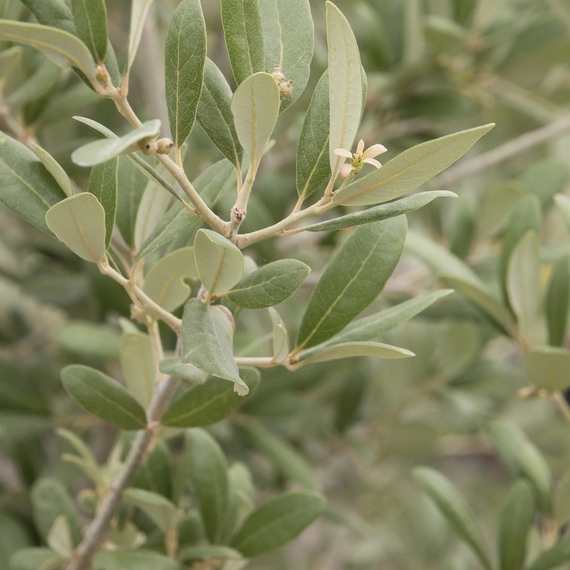
Leathery, dark‑green leaves on a strong framework form a broad, symmetrical canopy that provides cool, dappled shade and a refined, architectural presence.
Full sun to partial sun; full sun is best for dense canopy development and uniform form.
Water deeply and regularly during the first few growing seasons to establish an extensive root system; thereafter, water when the top ~2 inches of soil begin to dry—tolerates periodic dry spells once established.
Thrives in rocky, sandy, clay, or loam soils; highly adaptable to alkaline or slightly acidic conditions and calcareous soils (including caliche). Ensure drainage is adequate for best performance.
Moderate growth; typically matures to about 30 ft. tall and 30 ft. wide with age, forming a broad shade canopy suited to streetscapes and larger residential lots.
USDA Zones 7–10; heat‑tolerant and well adapted to the warm, dry conditions of the American Southwest and South.
Waterwise once established; deer and rabbit resistant; excellent alkaline tolerance; produces minimal seedlings relative to typical seed‑grown Texas live oaks.
Long‑lived shade tree for streets, large lawns, and parkways; dependable anchor for xeric and regionally adapted designs; pairs well with redbuds, crape myrtles, and native grasses.
Set at or slightly above grade in well‑drained soil. Mulch broadly (keep mulch off the trunk). Deep‑water during establishment; reduce frequency once roots are established. Fertilize lightly in early spring if growth is slow. Prune in late winter to maintain clearance and structure.
A cultivated selection of Texas live oak chosen for stable, upright form, dark foliage, and lower mast production; native species range from Oklahoma through Texas into NE Mexico.
Cultivar ‘Joan Lionetti’ • U.S. Plant Patent PP27,646.
The Joan Lionetti Texas Live Oak (Quercus fusiformis ‘Joan Lionetti’, PP27,646) is a resilient, evergreen shade tree selected for dependable structure and year‑round beauty in warm, arid to semi‑arid regions. Its dense, upright canopy of dark‑green leaves creates cooling shade while maintaining a clean silhouette, and its exceptional soil adaptability—including alkaline and calcareous soils—makes it an easy, low‑maintenance choice for Southwestern and Southern landscapes. Plant in full sun (or light afternoon shade) and provide deep watering during establishment for a long‑lived anchor that stays handsome with minimal upkeep.
Evergreen live oak with a naturally dense, upward‑reaching crown and dark‑green foliage. Selected specifically for consistent form and reduced seedling production versus typical seedling live oaks.
Leathery, dark‑green leaves on a strong framework form a broad, symmetrical canopy that provides cool, dappled shade and a refined, architectural presence.
Full sun to partial sun; full sun is best for dense canopy development and uniform form.
Water deeply and regularly during the first few growing seasons to establish an extensive root system; thereafter, water when the top ~2 inches of soil begin to dry—tolerates periodic dry spells once established.
Thrives in rocky, sandy, clay, or loam soils; highly adaptable to alkaline or slightly acidic conditions and calcareous soils (including caliche). Ensure drainage is adequate for best performance.
Moderate growth; typically matures to about 30 ft. tall and 30 ft. wide with age, forming a broad shade canopy suited to streetscapes and larger residential lots.
USDA Zones 7–10; heat‑tolerant and well adapted to the warm, dry conditions of the American Southwest and South.
Waterwise once established; deer and rabbit resistant; excellent alkaline tolerance; produces minimal seedlings relative to typical seed‑grown Texas live oaks.
Long‑lived shade tree for streets, large lawns, and parkways; dependable anchor for xeric and regionally adapted designs; pairs well with redbuds, crape myrtles, and native grasses.
Set at or slightly above grade in well‑drained soil. Mulch broadly (keep mulch off the trunk). Deep‑water during establishment; reduce frequency once roots are established. Fertilize lightly in early spring if growth is slow. Prune in late winter to maintain clearance and structure.
A cultivated selection of Texas live oak chosen for stable, upright form, dark foliage, and lower mast production; native species range from Oklahoma through Texas into NE Mexico.
Cultivar ‘Joan Lionetti’ • U.S. Plant Patent PP27,646.