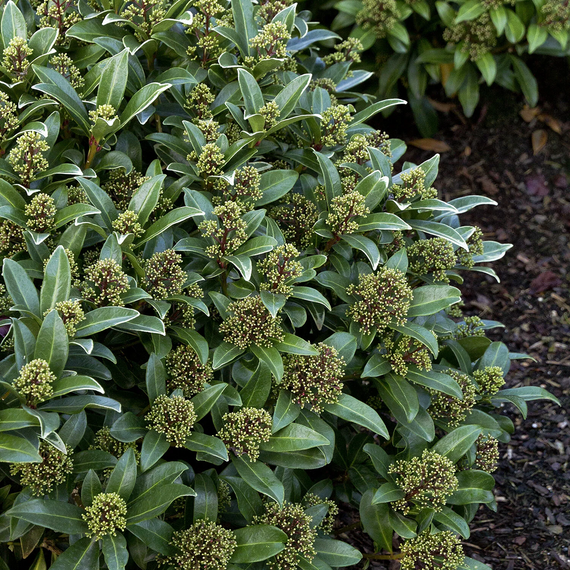


Japanese Skimmia Male (Skimmia japonica) is a slow-growing, densely branched, mounding broadleaf evergreen shrub that delivers four-season ornamental interest in the shade garden. Native to the woodlands of Japan, Taiwan, and neighboring regions of northeast Asia, this refined shrub is a standout performer in USDA Hardiness Zones 6 to 8, making it a versatile choice for landscapes across Southern Oregon and Northern California. In spring, upright terminal panicles of creamy white, star-shaped flowers emerge from colorful reddish-pink buds, filling the surrounding garden with a sweet, distinctive fragrance - male flower clusters are notably larger and more intensely fragrant than those of female plants. Through fall and winter, the ornamental buds of male plants provide continued visual interest and serve as a visual cue that spring blooms are on their way. The leathery, elliptical deep green leaves, measuring 3 to 5 inches in length and clustered at the branch tips, emit a pleasant citrusy-spicy aroma when bruised - an aromatic quality shared with its fellow members of the Rutaceae (citrus) family. Forming a tidy, naturally rounded mound typically reaching 3 to 4 feet tall and 4 to 5 feet wide at maturity, this shrub requires virtually no pruning to maintain its attractive form. It thrives in organically rich, moist but well-drained, slightly acidic soil in partial to full shade, and shows impressive tolerance of urban pollution, deer browsing, and heavy shade conditions. Whether used as a specimen, foundation planting, woodland understory accent, hedge, or elegant container specimen on a shaded patio, this male Japanese skimmia is an indispensable choice for gardeners seeking year-round beauty and fragrance in challenging low-light landscapes.
Japanese Skimmia Male (Skimmia japonica) is a broadleaf evergreen shrub in the Rutaceae (citrus) family, native to the woodlands of Japan, Taiwan, and the surrounding regions of northeast Asia. It forms a naturally dense, dome-shaped, mounding habit with no pruning required to maintain its tidy silhouette. The species is dioecious, meaning individual plants are either male or female. Male plants are especially prized for their exceptionally large and fragrant spring flower clusters - significantly more showy and sweetly scented than those on female plants - as well as their role as the essential pollinator for nearby female plants to produce their vivid red winter berries.
The leathery, elliptical to ovate leaves are a rich, glossy dark green on the upper surface and paler yellow-green beneath. Arranged alternately along the stems and clustered toward the branch tips in a whorl-like fashion, the foliage gives the plant a lush, full appearance year-round. When a leaf is bruised or crushed, it releases a pleasant, spicy-citrusy fragrance. The bark and buds have attractive green-tinged and reddish-purple coloring that adds winter detail to the overall presentation of the shrub.
| Characteristic | Details |
|---|---|
| Mature Height | 3 to 4 feet (some species forms can reach up to 6 to 7 feet over many years) |
| Mature Spread | 4 to 5 feet wide |
| Growth Rate | Slow |
| Time to Maturity | Approximately 5 to 10 years |
| Growth Habit | Dense, mounding, dome-shaped |
| Maintenance Level | Low - naturally compact with little to no pruning required |
Japanese Skimmia Male is suited for growth in USDA Hardiness Zones 6 through 8, making it an excellent fit for the mild, temperate climates of Southern Oregon and Northern California. It performs best in landscapes that experience distinct seasons, cool winters, and moist summers - conditions that closely mimic its native woodland habitat in northeast Asia. In warmer parts of Zone 8 or in areas with strong reflected heat, providing ample shade and consistent moisture will help the plant thrive. In the coldest parts of Zone 6, planting in a sheltered location and applying a protective winter mulch will help insulate the roots during deep freezes.
This shrub is a true shade lover and performs best in partial shade to full shade. Ideal placement is beneath deciduous trees or in a location that receives dappled, filtered light throughout the day. Morning sun with afternoon shade is also well tolerated. Direct afternoon sun or prolonged exposure to intense sunlight will cause leaf scorch, bleaching, and overall decline. In very deep shade the plant may grow somewhat open and leggy, so dappled or filtered light is the sweet spot for the most compact, floriferous performance. This adaptability to shaded conditions makes it one of the most valuable flowering evergreen shrubs for difficult low-light areas in the landscape.
During the first growing season, water regularly to keep the soil consistently and evenly moist while the root system becomes established. Aim to provide approximately one inch of water per week, combining rainfall and supplemental irrigation as needed. Once fully established - typically after one to two growing seasons - supplemental watering is generally only necessary during extended periods of drought or prolonged heat. Avoid overwatering or allowing the plant to sit in waterlogged soil, as this promotes root and crown rot. Applying a two-inch layer of organic mulch around the base of the plant (keeping it a few inches away from the stem) is an effective way to conserve soil moisture, moderate soil temperature, and reduce irrigation needs. Container-grown plants will require more frequent watering, as pots dry out faster than in-ground plantings - check containers regularly and water before the soil dries out completely.
Japanese Skimmia is not a heavy feeder and, in organically rich soil, additional fertilizing is often unnecessary. When feeding is warranted, use an acid-forming fertilizer formulated for acid-loving plants such as azaleas, camellias, and rhododendrons. Apply once in late winter or early spring as new growth is beginning to emerge. Signs that fertilizing may be beneficial include pale or yellowing foliage, visibly stunted growth, or reduced flowering. Avoid over-fertilizing, as excess nutrients - particularly nitrogen - can result in weak, spindly growth and diminished flowering. Never apply fertilizer to dry soil; always water the plant well before and after feeding. Top-dressing with a layer of compost or aged bark each spring is a gentle, natural way to maintain long-term soil fertility and a healthy soil pH.
One of the great virtues of Japanese Skimmia Male is its naturally tidy, self-maintaining growth habit, which rarely requires pruning. Its dense, dome-shaped form holds its shape well without intervention. When shaping or light pruning is desired, the best time is immediately after flowering in spring, so as not to sacrifice the upcoming season's bud development. Use clean, sharp pruning shears to selectively remove any dead, damaged, or crossing branches at their point of origin. To reduce overall size or refine the shape, lightly trim any wayward stems while preserving the plant's naturally rounded silhouette. Avoid heavy or hard pruning, as this can stress the plant and reduce flowering for the following season. A few fragrant sprigs can also be cut during the winter months and brought indoors for seasonal arrangements - the buds and foliage both make beautiful, long-lasting holiday greenery.
| Season | Ornamental Features |
|---|---|
| Spring | Large, upright panicles of highly fragrant creamy white, star-shaped flowers emerge from showy reddish-pink buds; one of the finest fragrant spring-flowering shrubs for shade |
| Summer | Dense, lustrous, deep green evergreen foliage provides lush texture and cooling shade-garden presence; spicy-citrus leaf fragrance when brushed |
| Fall | Colorful reddish-purple buds begin to develop for the next season's bloom; foliage retains its deep, rich green color |
| Winter | Attractive reddish-tinged buds and deep green leathery foliage provide structure and color in the winter garden; fragrant cut sprigs excellent for holiday arrangements |
Japanese Skimmia Male thrives alongside other shade-tolerant, acid-loving plants that enjoy similar soil and moisture conditions. Excellent companion choices include:
Japanese Skimmia Male is notably resistant to most serious pest and disease problems, making it one of the more carefree broadleaf evergreen shrubs for the home landscape. The following occasional issues may arise, particularly under stressful growing conditions:
Overall, a plant grown in the right conditions - shade, moist but well-drained organically rich soil, and adequate air circulation - will rarely experience significant pest or disease pressure.
Japanese Skimmia Male is an outstanding container plant and makes a sophisticated long-term specimen for shaded patios, entryways, decks, and courtyards. Its compact, slow-growing nature means it will thrive in a container for many years without becoming unmanageable. Follow these guidelines for success:
Japanese Skimmia Male plays a meaningful role in supporting garden wildlife, particularly in combination with nearby female plants. Key wildlife benefits include:
Note: Although the red berries produced by pollinated female plants are attractive to birds, they are toxic to humans, dogs, and cats and should not be consumed. Plant in areas away from children and pets who may be tempted by the colorful fruit.
All parts of Skimmia japonica should be considered potentially harmful if ingested by humans or pets. The bright red berries produced by female plants (enabled by this male pollinator) are the most concerning part of the plant - ingestion of berries in quantity can cause nausea, and potentially serious cardiac effects in large amounts. Contact with the sap may cause mild skin irritation in sensitive individuals; wear gloves when handling or pruning. Keep this plant out of reach of young children, and avoid planting in areas freely accessed by dogs or cats. Despite these considerations, this shrub presents no contact hazard simply from being in the garden and is safe for general landscape use when planted responsibly.
Japanese Skimmia Male (Skimmia japonica) is a slow-growing, densely branched, mounding broadleaf evergreen shrub that delivers four-season ornamental interest in the shade garden. Native to the woodlands of Japan, Taiwan, and neighboring regions of northeast Asia, this refined shrub is a standout performer in USDA Hardiness Zones 6 to 8, making it a versatile choice for landscapes across Southern Oregon and Northern California. In spring, upright terminal panicles of creamy white, star-shaped flowers emerge from colorful reddish-pink buds, filling the surrounding garden with a sweet, distinctive fragrance - male flower clusters are notably larger and more intensely fragrant than those of female plants. Through fall and winter, the ornamental buds of male plants provide continued visual interest and serve as a visual cue that spring blooms are on their way. The leathery, elliptical deep green leaves, measuring 3 to 5 inches in length and clustered at the branch tips, emit a pleasant citrusy-spicy aroma when bruised - an aromatic quality shared with its fellow members of the Rutaceae (citrus) family. Forming a tidy, naturally rounded mound typically reaching 3 to 4 feet tall and 4 to 5 feet wide at maturity, this shrub requires virtually no pruning to maintain its attractive form. It thrives in organically rich, moist but well-drained, slightly acidic soil in partial to full shade, and shows impressive tolerance of urban pollution, deer browsing, and heavy shade conditions. Whether used as a specimen, foundation planting, woodland understory accent, hedge, or elegant container specimen on a shaded patio, this male Japanese skimmia is an indispensable choice for gardeners seeking year-round beauty and fragrance in challenging low-light landscapes.
Japanese Skimmia Male (Skimmia japonica) is a broadleaf evergreen shrub in the Rutaceae (citrus) family, native to the woodlands of Japan, Taiwan, and the surrounding regions of northeast Asia. It forms a naturally dense, dome-shaped, mounding habit with no pruning required to maintain its tidy silhouette. The species is dioecious, meaning individual plants are either male or female. Male plants are especially prized for their exceptionally large and fragrant spring flower clusters - significantly more showy and sweetly scented than those on female plants - as well as their role as the essential pollinator for nearby female plants to produce their vivid red winter berries.
The leathery, elliptical to ovate leaves are a rich, glossy dark green on the upper surface and paler yellow-green beneath. Arranged alternately along the stems and clustered toward the branch tips in a whorl-like fashion, the foliage gives the plant a lush, full appearance year-round. When a leaf is bruised or crushed, it releases a pleasant, spicy-citrusy fragrance. The bark and buds have attractive green-tinged and reddish-purple coloring that adds winter detail to the overall presentation of the shrub.
| Characteristic | Details |
|---|---|
| Mature Height | 3 to 4 feet (some species forms can reach up to 6 to 7 feet over many years) |
| Mature Spread | 4 to 5 feet wide |
| Growth Rate | Slow |
| Time to Maturity | Approximately 5 to 10 years |
| Growth Habit | Dense, mounding, dome-shaped |
| Maintenance Level | Low - naturally compact with little to no pruning required |
Japanese Skimmia Male is suited for growth in USDA Hardiness Zones 6 through 8, making it an excellent fit for the mild, temperate climates of Southern Oregon and Northern California. It performs best in landscapes that experience distinct seasons, cool winters, and moist summers - conditions that closely mimic its native woodland habitat in northeast Asia. In warmer parts of Zone 8 or in areas with strong reflected heat, providing ample shade and consistent moisture will help the plant thrive. In the coldest parts of Zone 6, planting in a sheltered location and applying a protective winter mulch will help insulate the roots during deep freezes.
This shrub is a true shade lover and performs best in partial shade to full shade. Ideal placement is beneath deciduous trees or in a location that receives dappled, filtered light throughout the day. Morning sun with afternoon shade is also well tolerated. Direct afternoon sun or prolonged exposure to intense sunlight will cause leaf scorch, bleaching, and overall decline. In very deep shade the plant may grow somewhat open and leggy, so dappled or filtered light is the sweet spot for the most compact, floriferous performance. This adaptability to shaded conditions makes it one of the most valuable flowering evergreen shrubs for difficult low-light areas in the landscape.
During the first growing season, water regularly to keep the soil consistently and evenly moist while the root system becomes established. Aim to provide approximately one inch of water per week, combining rainfall and supplemental irrigation as needed. Once fully established - typically after one to two growing seasons - supplemental watering is generally only necessary during extended periods of drought or prolonged heat. Avoid overwatering or allowing the plant to sit in waterlogged soil, as this promotes root and crown rot. Applying a two-inch layer of organic mulch around the base of the plant (keeping it a few inches away from the stem) is an effective way to conserve soil moisture, moderate soil temperature, and reduce irrigation needs. Container-grown plants will require more frequent watering, as pots dry out faster than in-ground plantings - check containers regularly and water before the soil dries out completely.
Japanese Skimmia is not a heavy feeder and, in organically rich soil, additional fertilizing is often unnecessary. When feeding is warranted, use an acid-forming fertilizer formulated for acid-loving plants such as azaleas, camellias, and rhododendrons. Apply once in late winter or early spring as new growth is beginning to emerge. Signs that fertilizing may be beneficial include pale or yellowing foliage, visibly stunted growth, or reduced flowering. Avoid over-fertilizing, as excess nutrients - particularly nitrogen - can result in weak, spindly growth and diminished flowering. Never apply fertilizer to dry soil; always water the plant well before and after feeding. Top-dressing with a layer of compost or aged bark each spring is a gentle, natural way to maintain long-term soil fertility and a healthy soil pH.
One of the great virtues of Japanese Skimmia Male is its naturally tidy, self-maintaining growth habit, which rarely requires pruning. Its dense, dome-shaped form holds its shape well without intervention. When shaping or light pruning is desired, the best time is immediately after flowering in spring, so as not to sacrifice the upcoming season's bud development. Use clean, sharp pruning shears to selectively remove any dead, damaged, or crossing branches at their point of origin. To reduce overall size or refine the shape, lightly trim any wayward stems while preserving the plant's naturally rounded silhouette. Avoid heavy or hard pruning, as this can stress the plant and reduce flowering for the following season. A few fragrant sprigs can also be cut during the winter months and brought indoors for seasonal arrangements - the buds and foliage both make beautiful, long-lasting holiday greenery.
| Season | Ornamental Features |
|---|---|
| Spring | Large, upright panicles of highly fragrant creamy white, star-shaped flowers emerge from showy reddish-pink buds; one of the finest fragrant spring-flowering shrubs for shade |
| Summer | Dense, lustrous, deep green evergreen foliage provides lush texture and cooling shade-garden presence; spicy-citrus leaf fragrance when brushed |
| Fall | Colorful reddish-purple buds begin to develop for the next season's bloom; foliage retains its deep, rich green color |
| Winter | Attractive reddish-tinged buds and deep green leathery foliage provide structure and color in the winter garden; fragrant cut sprigs excellent for holiday arrangements |
Japanese Skimmia Male thrives alongside other shade-tolerant, acid-loving plants that enjoy similar soil and moisture conditions. Excellent companion choices include:
Japanese Skimmia Male is notably resistant to most serious pest and disease problems, making it one of the more carefree broadleaf evergreen shrubs for the home landscape. The following occasional issues may arise, particularly under stressful growing conditions:
Overall, a plant grown in the right conditions - shade, moist but well-drained organically rich soil, and adequate air circulation - will rarely experience significant pest or disease pressure.
Japanese Skimmia Male is an outstanding container plant and makes a sophisticated long-term specimen for shaded patios, entryways, decks, and courtyards. Its compact, slow-growing nature means it will thrive in a container for many years without becoming unmanageable. Follow these guidelines for success:
Japanese Skimmia Male plays a meaningful role in supporting garden wildlife, particularly in combination with nearby female plants. Key wildlife benefits include:
Note: Although the red berries produced by pollinated female plants are attractive to birds, they are toxic to humans, dogs, and cats and should not be consumed. Plant in areas away from children and pets who may be tempted by the colorful fruit.
All parts of Skimmia japonica should be considered potentially harmful if ingested by humans or pets. The bright red berries produced by female plants (enabled by this male pollinator) are the most concerning part of the plant - ingestion of berries in quantity can cause nausea, and potentially serious cardiac effects in large amounts. Contact with the sap may cause mild skin irritation in sensitive individuals; wear gloves when handling or pruning. Keep this plant out of reach of young children, and avoid planting in areas freely accessed by dogs or cats. Despite these considerations, this shrub presents no contact hazard simply from being in the garden and is safe for general landscape use when planted responsibly.