
Zoom the image with the mouse
Green Tower Boxwood
SKU:
1898420-P
UPC:
1390000100000
$14.99 - $59.99
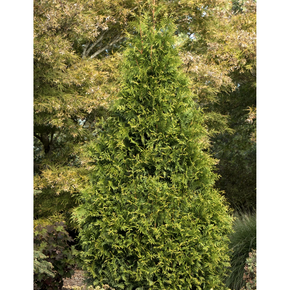
- Perfectly columnar, narrow evergreen boxwood with lustrous dark green foliage reaching 9 feet tall by just 1 to 2 feet wide — ideal for tight spaces and formal vertical accents
- Naturally tidy columnar habit adapts equally well to shearing into formal shapes or growing unhindered as an elegant, slender hedge or privacy screen
- Deer resistant, rabbit resistant, and an exceptional shelter plant for birds, with medium to fine textured foliage that does not brown in winter
- Hardy across USDA Zones 5 through 9, providing year-round evergreen structure for narrow side yards, privacy screens, topiary, and formal borders
Green Tower Boxwood (Buxus sempervirens 'Monrue') is the perfect evergreen solution for situations where a tall, narrow privacy screen, hedge, or formal vertical accent is needed without sacrificing precious horizontal space. With a distinctly columnar growth habit, it reaches 9 feet tall while maintaining a remarkably slender 1 to 2 foot width, creating an elegant, pencil-like silhouette that fits into the most space-limited landscape situations. The lustrous dark green leaves have a lighter green underside, medium to fine texture, and remarkable winter foliage retention — not bronzing in cold weather like some boxwoods. Deer resistant and rabbit resistant with proven value as bird shelter habitat, Green Tower Boxwood is a versatile formal garden performer across USDA Zones 5 through 9, offering unmatched narrow-profile evergreen structure for hedges, topiary, foundation plantings, and formal garden design.
Plant Details
| Attribute | Details |
|---|---|
| Botanical Name | Buxus sempervirens 'Monrue' |
| Plant Type | Evergreen Shrub |
| Foliage Color | Lustrous dark green (lighter green underside) |
| Bloom Time | Inconspicuous; prized for foliage |
| Growth Rate | Moderate |
| Growth Habit | Columnar / Fastigiate |
| Mature Size | 9 ft. tall, 1-2 ft. wide |
| USDA Zones | 5 - 9 |
| Light | Full sun to partial sun |
| Water | When top 3 in. of soil is dry; mulch to retain moisture |
| Special Features | Easy Care, Benefits Birds, Columnar Form |
| Landscape Use | Border, Container, Hedge, Privacy Screen, Topiary |
| Deer Resistant | Yes |
| Rabbit Resistant | Yes |
Size and Columnar Growth Habit
Green Tower Boxwood reaches a mature height of approximately 9 feet while maintaining just 1 to 2 feet of width, creating one of the most dramatic height-to-width ratios of any boxwood available. This extremely columnar, fastigiate habit — where branches grow strongly upward rather than outward — produces a naturally narrow silhouette that fits into very tight planting spaces including narrow side yards between homes, along fence lines at windows, and in spots where a broader shrub would be completely impractical. The dense, upward-growing branching structure is the defining architectural characteristic that makes this variety uniquely valuable in landscape design.
Sunlight Requirements
Green Tower Boxwood performs well in full sun to partial sun. In full sun, it produces the densest, most compact columnar branching and the deepest, richest dark green foliage color. In partial shade, growth remains attractive but may be slightly less dense and compact. Protecting plants from harsh west-facing sun exposures in hot summer climates helps prevent foliage scorch, while the east or north exposures can also work well, particularly in the southern parts of its range where summer heat is most intense.
Watering
Water Green Tower Boxwood deeply and regularly during the first few growing seasons to establish an extensive root system that supports its vertical growth. Once established, water when the top 3 inches of soil feel dry. Consistent moisture is important for boxwood health, particularly during hot, dry summers. Mulching the root zone heavily is one of the most beneficial practices for boxwood, moderating soil temperature, retaining moisture, and preventing the drought stress that can weaken plants and make them more susceptible to box blight and other diseases. Avoid allowing soil to dry out completely, particularly in summer heat.
Soil Requirements
Green Tower Boxwood thrives in enriched, well-drained, neutral to slightly acidic soils. Incorporate compost into planting beds to improve drainage and fertility. Apply and annually renew a 2 to 3 inch layer of organic mulch over the root zone to maintain consistent moisture levels and keep roots cool. Like all boxwood varieties, it will not tolerate poorly drained or waterlogged soils, which promote root rot. Good drainage and consistent moisture — rather than alternating dry and wet conditions — are the key soil management priorities for long-term boxwood health.
Care and Maintenance
- Shearing: Adapts well to shearing for formal hedges; remains naturally narrow and elegant when allowed to grow unhindered — both approaches work well.
- Fertilizing: Apply a balanced fertilizer formulated for evergreen shrubs in early spring before new growth begins.
- Mulching: Maintain a 2-3 inch organic mulch layer; keep mulch away from direct contact with the stems to prevent crown rot.
- Disease monitoring: Monitor for boxwood blight in humid climates; ensure good air circulation around plants and avoid overhead watering.
- Pruning timing: Prune in late winter before new growth emerges or in mid-summer after the new growth has hardened; avoid late-season pruning.
Landscape Uses
Green Tower Boxwood's remarkable narrow profile opens landscape possibilities that broader evergreens cannot accommodate. Plant tightly spaced for a carefree evergreen hedge barrier — the density is ideal for boundary hedges that define garden space without consuming it. The narrow diameter is particularly valuable in side yards for privacy screens along fence lines or at windows. Use as single columnar specimens or in pairs to flank gates or entry pathways with elegant vertical bookends. It adapts well to shearing for precise formal hedges but remains naturally narrow and handsome if allowed to grow freely. An exceptional evergreen foundation plant for softening large bare walls and cloaking utility meters without crowding.
Companion Plants
| Plant | Why It Works |
|---|---|
| Spirea (Spiraea) | Mounding, flowering deciduous shrub provides seasonal color contrast at a complementary lower scale beside the columnar boxwood |
| Weigela (Weigela) | Bold spring-flowering shrub creates a beautiful seasonal contrast against the evergreen structure |
| Coneflower (Echinacea) | Upright summer perennial with bold daisy flowers provides warm seasonal color beside the formal evergreen column |
| Blue Fescue (Festuca) | Cool blue-grey ornamental grass provides textural and color contrast at the base of the dark green columns |
| Blanket Flower (Gaillardia) | Warm-toned summer perennial provides vivid color contrast and pollinator value alongside the evergreen structure |
USDA Hardiness Zones
Green Tower Boxwood is rated for USDA Zones 5 through 9. In Zone 5, it survives winter lows to approximately -20 degrees Fahrenheit and is among the hardier boxwood selections available for cold-climate gardeners. One of its notable advantages is that the foliage does not bronze or discolor in winter as some boxwood varieties do, maintaining its attractive dark green color through cold months. In warmer zones through Zone 9, it performs as a reliable, long-lived evergreen hedge and specimen plant throughout the year.
History and Background
Buxus sempervirens, the common or English boxwood, is native to the Mediterranean region, southern Europe, and western Asia, where it became celebrated in classical Roman gardens and remains essential to Italian landscape design to this day. The ancient art of topiary — shearing plants into ornamental shapes — was developed using boxwood and later became central to French and Italian parterres. The Roman author Pliny grew Buxus for making musical instruments, and the Latin Buxus is also the root word for "box," possibly reflecting its historical use in making small wooden containers. The Green Tower cultivar ('Monrue') was developed specifically for its exceptionally narrow, columnar growth habit and outstanding winter foliage color retention, addressing the need for a formal, narrow boxwood suited to modern space-conscious landscapes. As a patented variety, asexual reproduction of Green Tower Boxwood is prohibited under the Plant Patent Act.
- Perfectly columnar, narrow evergreen boxwood with lustrous dark green foliage reaching 9 feet tall by just 1 to 2 feet wide — ideal for tight spaces and formal vertical accents
- Naturally tidy columnar habit adapts equally well to shearing into formal shapes or growing unhindered as an elegant, slender hedge or privacy screen
- Deer resistant, rabbit resistant, and an exceptional shelter plant for birds, with medium to fine textured foliage that does not brown in winter
- Hardy across USDA Zones 5 through 9, providing year-round evergreen structure for narrow side yards, privacy screens, topiary, and formal borders
Green Tower Boxwood (Buxus sempervirens 'Monrue') is the perfect evergreen solution for situations where a tall, narrow privacy screen, hedge, or formal vertical accent is needed without sacrificing precious horizontal space. With a distinctly columnar growth habit, it reaches 9 feet tall while maintaining a remarkably slender 1 to 2 foot width, creating an elegant, pencil-like silhouette that fits into the most space-limited landscape situations. The lustrous dark green leaves have a lighter green underside, medium to fine texture, and remarkable winter foliage retention — not bronzing in cold weather like some boxwoods. Deer resistant and rabbit resistant with proven value as bird shelter habitat, Green Tower Boxwood is a versatile formal garden performer across USDA Zones 5 through 9, offering unmatched narrow-profile evergreen structure for hedges, topiary, foundation plantings, and formal garden design.
Plant Details
| Attribute | Details |
|---|---|
| Botanical Name | Buxus sempervirens 'Monrue' |
| Plant Type | Evergreen Shrub |
| Foliage Color | Lustrous dark green (lighter green underside) |
| Bloom Time | Inconspicuous; prized for foliage |
| Growth Rate | Moderate |
| Growth Habit | Columnar / Fastigiate |
| Mature Size | 9 ft. tall, 1-2 ft. wide |
| USDA Zones | 5 - 9 |
| Light | Full sun to partial sun |
| Water | When top 3 in. of soil is dry; mulch to retain moisture |
| Special Features | Easy Care, Benefits Birds, Columnar Form |
| Landscape Use | Border, Container, Hedge, Privacy Screen, Topiary |
| Deer Resistant | Yes |
| Rabbit Resistant | Yes |
Size and Columnar Growth Habit
Green Tower Boxwood reaches a mature height of approximately 9 feet while maintaining just 1 to 2 feet of width, creating one of the most dramatic height-to-width ratios of any boxwood available. This extremely columnar, fastigiate habit — where branches grow strongly upward rather than outward — produces a naturally narrow silhouette that fits into very tight planting spaces including narrow side yards between homes, along fence lines at windows, and in spots where a broader shrub would be completely impractical. The dense, upward-growing branching structure is the defining architectural characteristic that makes this variety uniquely valuable in landscape design.
Sunlight Requirements
Green Tower Boxwood performs well in full sun to partial sun. In full sun, it produces the densest, most compact columnar branching and the deepest, richest dark green foliage color. In partial shade, growth remains attractive but may be slightly less dense and compact. Protecting plants from harsh west-facing sun exposures in hot summer climates helps prevent foliage scorch, while the east or north exposures can also work well, particularly in the southern parts of its range where summer heat is most intense.
Watering
Water Green Tower Boxwood deeply and regularly during the first few growing seasons to establish an extensive root system that supports its vertical growth. Once established, water when the top 3 inches of soil feel dry. Consistent moisture is important for boxwood health, particularly during hot, dry summers. Mulching the root zone heavily is one of the most beneficial practices for boxwood, moderating soil temperature, retaining moisture, and preventing the drought stress that can weaken plants and make them more susceptible to box blight and other diseases. Avoid allowing soil to dry out completely, particularly in summer heat.
Soil Requirements
Green Tower Boxwood thrives in enriched, well-drained, neutral to slightly acidic soils. Incorporate compost into planting beds to improve drainage and fertility. Apply and annually renew a 2 to 3 inch layer of organic mulch over the root zone to maintain consistent moisture levels and keep roots cool. Like all boxwood varieties, it will not tolerate poorly drained or waterlogged soils, which promote root rot. Good drainage and consistent moisture — rather than alternating dry and wet conditions — are the key soil management priorities for long-term boxwood health.
Care and Maintenance
- Shearing: Adapts well to shearing for formal hedges; remains naturally narrow and elegant when allowed to grow unhindered — both approaches work well.
- Fertilizing: Apply a balanced fertilizer formulated for evergreen shrubs in early spring before new growth begins.
- Mulching: Maintain a 2-3 inch organic mulch layer; keep mulch away from direct contact with the stems to prevent crown rot.
- Disease monitoring: Monitor for boxwood blight in humid climates; ensure good air circulation around plants and avoid overhead watering.
- Pruning timing: Prune in late winter before new growth emerges or in mid-summer after the new growth has hardened; avoid late-season pruning.
Landscape Uses
Green Tower Boxwood's remarkable narrow profile opens landscape possibilities that broader evergreens cannot accommodate. Plant tightly spaced for a carefree evergreen hedge barrier — the density is ideal for boundary hedges that define garden space without consuming it. The narrow diameter is particularly valuable in side yards for privacy screens along fence lines or at windows. Use as single columnar specimens or in pairs to flank gates or entry pathways with elegant vertical bookends. It adapts well to shearing for precise formal hedges but remains naturally narrow and handsome if allowed to grow freely. An exceptional evergreen foundation plant for softening large bare walls and cloaking utility meters without crowding.
Companion Plants
| Plant | Why It Works |
|---|---|
| Spirea (Spiraea) | Mounding, flowering deciduous shrub provides seasonal color contrast at a complementary lower scale beside the columnar boxwood |
| Weigela (Weigela) | Bold spring-flowering shrub creates a beautiful seasonal contrast against the evergreen structure |
| Coneflower (Echinacea) | Upright summer perennial with bold daisy flowers provides warm seasonal color beside the formal evergreen column |
| Blue Fescue (Festuca) | Cool blue-grey ornamental grass provides textural and color contrast at the base of the dark green columns |
| Blanket Flower (Gaillardia) | Warm-toned summer perennial provides vivid color contrast and pollinator value alongside the evergreen structure |
USDA Hardiness Zones
Green Tower Boxwood is rated for USDA Zones 5 through 9. In Zone 5, it survives winter lows to approximately -20 degrees Fahrenheit and is among the hardier boxwood selections available for cold-climate gardeners. One of its notable advantages is that the foliage does not bronze or discolor in winter as some boxwood varieties do, maintaining its attractive dark green color through cold months. In warmer zones through Zone 9, it performs as a reliable, long-lived evergreen hedge and specimen plant throughout the year.
History and Background
Buxus sempervirens, the common or English boxwood, is native to the Mediterranean region, southern Europe, and western Asia, where it became celebrated in classical Roman gardens and remains essential to Italian landscape design to this day. The ancient art of topiary — shearing plants into ornamental shapes — was developed using boxwood and later became central to French and Italian parterres. The Roman author Pliny grew Buxus for making musical instruments, and the Latin Buxus is also the root word for "box," possibly reflecting its historical use in making small wooden containers. The Green Tower cultivar ('Monrue') was developed specifically for its exceptionally narrow, columnar growth habit and outstanding winter foliage color retention, addressing the need for a formal, narrow boxwood suited to modern space-conscious landscapes. As a patented variety, asexual reproduction of Green Tower Boxwood is prohibited under the Plant Patent Act.