

Zoom the image with the mouse
Golf Ball Pittosporum - 1 Gallon
SKU:
2102425
UPC:
014949005231
$19.99
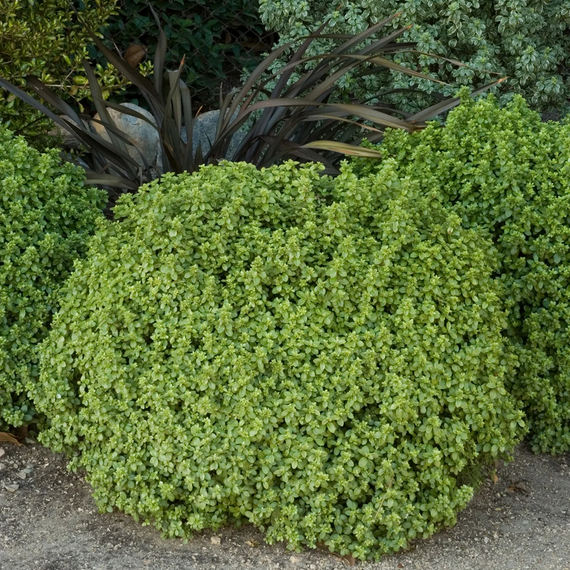
- Dense, formal, naturally globe-shaped evergreen shrub with bright light green foliage that maintains a near-perfect rounded shape requiring almost no pruning
- Moderate growing to a manageable 3 to 4 feet tall and wide, ideal for containers, low hedges, formal garden borders, and walkway edging as a boxwood alternative
- Easy care, waterwise, and tolerant of urban pollution across USDA Zones 8 through 11 with excellent drought tolerance once established
- Provides year-round bright green foliage interest on patios, porches, and terraces in containers with virtually no maintenance
Golf Ball Pittosporum (Pittosporum tenuifolium 'Golf Ball') is a versatile, dense, naturally globe-shaped evergreen shrub that delivers year-round beauty with bright, fresh green foliage on a compact, self-maintaining form that rarely needs pruning. Growing to a tidy 3 to 4 feet tall and wide at a moderate rate, it is ideal for use as a low hedge in place of boxwood, as a container specimen for patios and terraces, as formal edging along walkways and garden entries, and for surrounding rose or perennial gardens with a crisp evergreen border. Its natural rounded shape requires minimal shearing to maintain, and it adapts beautifully to both natural and lightly clipped forms. Easy care, drought tolerant once established, and tolerant of urban air pollution, Golf Ball Pittosporum is an outstanding, low-maintenance evergreen for warm-climate gardens across USDA Zones 8 through 11.
Plant Details
| Attribute | Details |
|---|---|
| Botanical Name | Pittosporum tenuifolium 'Golf Ball' |
| Plant Type | Evergreen Shrub |
| Foliage Color | Bright light green (small, slightly wavy leaves) |
| Bloom Time | Inconspicuous; prized for foliage |
| Growth Rate | Moderate |
| Growth Habit | Rounded / Globe-shaped (self-maintaining) |
| Mature Size | 3-4 ft. tall and wide |
| USDA Zones | 8 - 11 |
| Light | Full sun to partial sun |
| Water | Allow soil to dry slightly; drought tolerant once established |
| Special Features | Easy Care, Waterwise, Compact Form, Boxwood Alternative |
| Landscape Use | Border, Container, Hedge, Edging, Walkway Accent |
| Urban Pollution Tolerant | Yes |
Size and Growth Habit
Golf Ball Pittosporum earns its name from its remarkably consistent, naturally globe-shaped growth habit that closely resembles — at least in form — a very large golf ball. At maturity, it reaches 3 to 4 feet in both height and spread, growing at a moderate rate that keeps it manageable without constant pruning. The even growth pattern and naturally rounded shape hold beautifully without shearing in casual garden settings, or respond perfectly to light periodic trimming for a more formal, precisely geometric form. The small, slightly wavy, bright green leaves create a fine-textured, visually solid mass that is ornamentally appealing year-round.
Sunlight Requirements
Golf Ball Pittosporum thrives in full sun to partial sun. In full sun with 6 or more hours of direct sunlight per day, it produces the most compact, densely branched growth and the brightest foliage color. In partial shade, growth remains healthy and ornamentally attractive but may be slightly more open in habit. The plant's adaptability to both sun and partial shade makes it useful in a wider range of landscape situations than more demanding formal shrubs. In very hot inland climates, some afternoon shade protection helps prevent foliage stress during peak summer heat.
Watering
Allow the soil to dry slightly between waterings. Once established, Golf Ball Pittosporum demonstrates good drought tolerance and does not require frequent supplemental irrigation in most warm-climate gardens. During the first growing season, water deeply and regularly to establish an extensive root system. After establishment, reduce frequency significantly; overwatering promotes soft, overly lush growth and can increase disease susceptibility. In containers, check soil moisture more frequently than in-ground plants and water when the top inch feels dry, ensuring excellent drainage through container holes at every watering.
Soil Requirements
Golf Ball Pittosporum is adaptable to a wide range of average, well-drained soils. It does not require particularly rich or heavily amended ground and actually performs well in average to lean soil conditions. Good drainage is the most critical soil requirement; pittosporum will not tolerate consistently waterlogged roots. In the landscape, a deep initial watering hole and some compost incorporation at planting time provides the best start. In containers, use a high-quality, well-draining all-purpose potting mix. Apply a slow-release fertilizer at planting time in containers to support establishment and ongoing growth.
Care and Maintenance
- Pruning: Minimal — the self-maintaining rounded form rarely needs shaping. Light pruning in spring maintains a tidy appearance without disrupting the natural form.
- Fertilizing: Apply a slow-release, all-purpose fertilizer before new growth begins in spring to support healthy foliage and vigorous growth.
- Watering: Allow soil to dry slightly between waterings; avoid over-irrigation which reduces plant vigor and increases disease risk.
- Container care: In containers, feed every 4-6 weeks during the growing season with a balanced liquid fertilizer as nutrients deplete faster than in-ground.
- Pest monitoring: Generally pest-free; monitor for aphids or scale insects and treat with insecticidal soap if detected.
Landscape Uses
Golf Ball Pittosporum's even growth and dense habit yield a near-perfect shrub for hedges in formal gardens, parterres, and as edging for walks and entries. Single specimens lend themselves to simply sheared geometric shapes — spheres, cubes, and simple topiary forms. Light pruning renders a tidy natural form that is a reliable source of bright green in mixed beds and borders. It is well adapted to growing in containers for semi-formal effects on porches, patios, and terraces, and serves as an outstanding boxwood alternative in warm climates where boxwood struggles with heat and humidity.
Companion Plants
| Plant | Why It Works |
|---|---|
| Agapanthus (Agapanthus) | Strappy foliage and blue globe flowers provide bold seasonal color contrast against the fine-textured green pittosporum |
| Heavenly Bamboo (Nandina) | Colorful foliage in red and green tones provides dramatic seasonal color contrast beside the uniform green pittosporum |
| Loropetalum (Loropetalum) | Burgundy foliage and pink fringed flowers create a vivid warm-cool contrast with the bright green pittosporum |
| Bottlebrush (Callistemon) | Bold red flower spikes and similar drought tolerance create a striking flowering contrast alongside the formal pittosporum |
| Blue Oat Grass (Helictotrichon) | Fine-textured blue-grey ornamental grass adds cool color and gentle movement alongside the structured pittosporum globe |
Container Growing
Golf Ball Pittosporum is particularly well-adapted to growing in containers for semi-formal effects on porches, patios, and terraces. Choose a container at least 12 to 14 inches in diameter with excellent drainage holes and use a high-quality, well-draining potting mix. Water regularly in containers — the self-contained nature of the root system means the soil dries out faster than in-ground plantings. Fertilize every 4 to 6 weeks during the growing season with a balanced liquid fertilizer. The naturally rounded form creates a sophisticated, polished container specimen that requires virtually no pruning to maintain its attractive shape.
USDA Hardiness Zones
Golf Ball Pittosporum is rated for USDA Zones 8 through 11, making it an ideal choice for warm-climate gardens in the American South, Southwest, and Pacific Coast regions. In Zone 8, it is reliably cold hardy to approximately 10 to 15 degrees Fahrenheit. It is not cold hardy enough for zones colder than Zone 8, where it should be grown as a container plant and moved indoors before hard frost. In its ideal growing zones, it provides outstanding year-round performance as a fully evergreen landscape shrub.
History and Background
Pittosporum tenuifolium is native to New Zealand, where it is commonly known as kohuhu or tawhiwhi and grows as a small tree or large shrub in coastal and lowland forests. The species was classified by Sir Joseph Banks, one of the great English botanical explorers of the 18th and 19th centuries. While other Pittosporum species like P. tobira have been common landscape plants for decades, P. tenuifolium has been more recently entering North American and European markets. 'Golf Ball' is a selection specifically developed for its naturally compact, rounded habit and has become one of the most popular compact pittosporum cultivars for formal and semi-formal landscape use. Interestingly, the Maori people of New Zealand traditionally used the plant's naturally occurring saponins, which have a toxic effect on fish, to stun fish in small pools for easier harvesting.
- Dense, formal, naturally globe-shaped evergreen shrub with bright light green foliage that maintains a near-perfect rounded shape requiring almost no pruning
- Moderate growing to a manageable 3 to 4 feet tall and wide, ideal for containers, low hedges, formal garden borders, and walkway edging as a boxwood alternative
- Easy care, waterwise, and tolerant of urban pollution across USDA Zones 8 through 11 with excellent drought tolerance once established
- Provides year-round bright green foliage interest on patios, porches, and terraces in containers with virtually no maintenance
Golf Ball Pittosporum (Pittosporum tenuifolium 'Golf Ball') is a versatile, dense, naturally globe-shaped evergreen shrub that delivers year-round beauty with bright, fresh green foliage on a compact, self-maintaining form that rarely needs pruning. Growing to a tidy 3 to 4 feet tall and wide at a moderate rate, it is ideal for use as a low hedge in place of boxwood, as a container specimen for patios and terraces, as formal edging along walkways and garden entries, and for surrounding rose or perennial gardens with a crisp evergreen border. Its natural rounded shape requires minimal shearing to maintain, and it adapts beautifully to both natural and lightly clipped forms. Easy care, drought tolerant once established, and tolerant of urban air pollution, Golf Ball Pittosporum is an outstanding, low-maintenance evergreen for warm-climate gardens across USDA Zones 8 through 11.
Plant Details
| Attribute | Details |
|---|---|
| Botanical Name | Pittosporum tenuifolium 'Golf Ball' |
| Plant Type | Evergreen Shrub |
| Foliage Color | Bright light green (small, slightly wavy leaves) |
| Bloom Time | Inconspicuous; prized for foliage |
| Growth Rate | Moderate |
| Growth Habit | Rounded / Globe-shaped (self-maintaining) |
| Mature Size | 3-4 ft. tall and wide |
| USDA Zones | 8 - 11 |
| Light | Full sun to partial sun |
| Water | Allow soil to dry slightly; drought tolerant once established |
| Special Features | Easy Care, Waterwise, Compact Form, Boxwood Alternative |
| Landscape Use | Border, Container, Hedge, Edging, Walkway Accent |
| Urban Pollution Tolerant | Yes |
Size and Growth Habit
Golf Ball Pittosporum earns its name from its remarkably consistent, naturally globe-shaped growth habit that closely resembles — at least in form — a very large golf ball. At maturity, it reaches 3 to 4 feet in both height and spread, growing at a moderate rate that keeps it manageable without constant pruning. The even growth pattern and naturally rounded shape hold beautifully without shearing in casual garden settings, or respond perfectly to light periodic trimming for a more formal, precisely geometric form. The small, slightly wavy, bright green leaves create a fine-textured, visually solid mass that is ornamentally appealing year-round.
Sunlight Requirements
Golf Ball Pittosporum thrives in full sun to partial sun. In full sun with 6 or more hours of direct sunlight per day, it produces the most compact, densely branched growth and the brightest foliage color. In partial shade, growth remains healthy and ornamentally attractive but may be slightly more open in habit. The plant's adaptability to both sun and partial shade makes it useful in a wider range of landscape situations than more demanding formal shrubs. In very hot inland climates, some afternoon shade protection helps prevent foliage stress during peak summer heat.
Watering
Allow the soil to dry slightly between waterings. Once established, Golf Ball Pittosporum demonstrates good drought tolerance and does not require frequent supplemental irrigation in most warm-climate gardens. During the first growing season, water deeply and regularly to establish an extensive root system. After establishment, reduce frequency significantly; overwatering promotes soft, overly lush growth and can increase disease susceptibility. In containers, check soil moisture more frequently than in-ground plants and water when the top inch feels dry, ensuring excellent drainage through container holes at every watering.
Soil Requirements
Golf Ball Pittosporum is adaptable to a wide range of average, well-drained soils. It does not require particularly rich or heavily amended ground and actually performs well in average to lean soil conditions. Good drainage is the most critical soil requirement; pittosporum will not tolerate consistently waterlogged roots. In the landscape, a deep initial watering hole and some compost incorporation at planting time provides the best start. In containers, use a high-quality, well-draining all-purpose potting mix. Apply a slow-release fertilizer at planting time in containers to support establishment and ongoing growth.
Care and Maintenance
- Pruning: Minimal — the self-maintaining rounded form rarely needs shaping. Light pruning in spring maintains a tidy appearance without disrupting the natural form.
- Fertilizing: Apply a slow-release, all-purpose fertilizer before new growth begins in spring to support healthy foliage and vigorous growth.
- Watering: Allow soil to dry slightly between waterings; avoid over-irrigation which reduces plant vigor and increases disease risk.
- Container care: In containers, feed every 4-6 weeks during the growing season with a balanced liquid fertilizer as nutrients deplete faster than in-ground.
- Pest monitoring: Generally pest-free; monitor for aphids or scale insects and treat with insecticidal soap if detected.
Landscape Uses
Golf Ball Pittosporum's even growth and dense habit yield a near-perfect shrub for hedges in formal gardens, parterres, and as edging for walks and entries. Single specimens lend themselves to simply sheared geometric shapes — spheres, cubes, and simple topiary forms. Light pruning renders a tidy natural form that is a reliable source of bright green in mixed beds and borders. It is well adapted to growing in containers for semi-formal effects on porches, patios, and terraces, and serves as an outstanding boxwood alternative in warm climates where boxwood struggles with heat and humidity.
Companion Plants
| Plant | Why It Works |
|---|---|
| Agapanthus (Agapanthus) | Strappy foliage and blue globe flowers provide bold seasonal color contrast against the fine-textured green pittosporum |
| Heavenly Bamboo (Nandina) | Colorful foliage in red and green tones provides dramatic seasonal color contrast beside the uniform green pittosporum |
| Loropetalum (Loropetalum) | Burgundy foliage and pink fringed flowers create a vivid warm-cool contrast with the bright green pittosporum |
| Bottlebrush (Callistemon) | Bold red flower spikes and similar drought tolerance create a striking flowering contrast alongside the formal pittosporum |
| Blue Oat Grass (Helictotrichon) | Fine-textured blue-grey ornamental grass adds cool color and gentle movement alongside the structured pittosporum globe |
Container Growing
Golf Ball Pittosporum is particularly well-adapted to growing in containers for semi-formal effects on porches, patios, and terraces. Choose a container at least 12 to 14 inches in diameter with excellent drainage holes and use a high-quality, well-draining potting mix. Water regularly in containers — the self-contained nature of the root system means the soil dries out faster than in-ground plantings. Fertilize every 4 to 6 weeks during the growing season with a balanced liquid fertilizer. The naturally rounded form creates a sophisticated, polished container specimen that requires virtually no pruning to maintain its attractive shape.
USDA Hardiness Zones
Golf Ball Pittosporum is rated for USDA Zones 8 through 11, making it an ideal choice for warm-climate gardens in the American South, Southwest, and Pacific Coast regions. In Zone 8, it is reliably cold hardy to approximately 10 to 15 degrees Fahrenheit. It is not cold hardy enough for zones colder than Zone 8, where it should be grown as a container plant and moved indoors before hard frost. In its ideal growing zones, it provides outstanding year-round performance as a fully evergreen landscape shrub.
History and Background
Pittosporum tenuifolium is native to New Zealand, where it is commonly known as kohuhu or tawhiwhi and grows as a small tree or large shrub in coastal and lowland forests. The species was classified by Sir Joseph Banks, one of the great English botanical explorers of the 18th and 19th centuries. While other Pittosporum species like P. tobira have been common landscape plants for decades, P. tenuifolium has been more recently entering North American and European markets. 'Golf Ball' is a selection specifically developed for its naturally compact, rounded habit and has become one of the most popular compact pittosporum cultivars for formal and semi-formal landscape use. Interestingly, the Maori people of New Zealand traditionally used the plant's naturally occurring saponins, which have a toxic effect on fish, to stun fish in small pools for easier harvesting.
Related Products