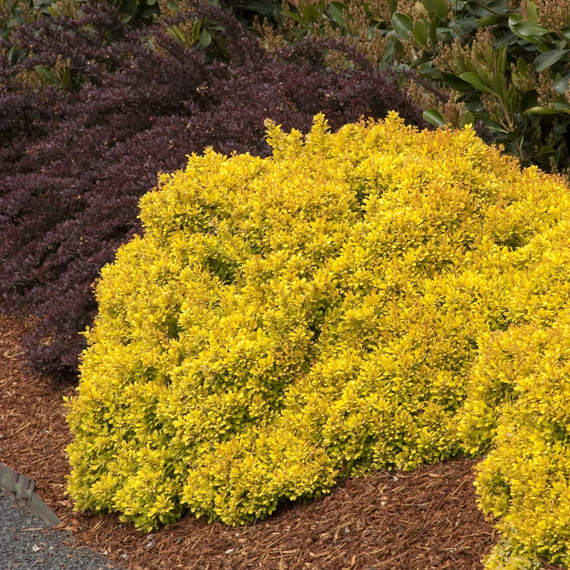


The Golden Nugget Dwarf Japanese Barberry (Berberis thunbergii 'Monlers' CPBR #3489) is a standout foliage shrub for gardeners seeking reliable, season-long color in a truly compact, low-care package. Unlike full-sized golden barberries that require frequent shearing to stay in bounds, Golden Nugget holds its naturally mounded, dwarf form year after year — staying under 18 inches tall with minimal pruning. Its small, rounded chartreuse-to-golden-orange leaves are prized for their non-burning quality, holding an exceptionally vibrant hue through spring, summer, and fall without fading in heat or full sun exposure. An outstanding landscape workhorse, Golden Nugget excels as a bright edging plant, a striking accent in mixed shrub borders, a low hedge along walkways, and an eye-catching specimen in rock gardens or foundation plantings. The vivid golden foliage creates spectacular contrast when planted alongside deep green or burgundy-leaved shrubs, making adjacent plants appear to literally pop. Hardy across USDA Zones 4–8 and tolerating temperatures as low as −30°F, this Monrovia-exclusive cultivar performs with equal distinction in cold northern gardens and warm southern landscapes. In spring, clusters of small yellow flowers emerge along the stems; by fall, these are replaced by brilliant red berries that persist through winter and attract birds. Dense and thorny by nature, Golden Nugget also serves as an effective low-growing barrier or deer-resistant border plant wherever added protection is needed.
| Botanical Name | Berberis thunbergii 'Monlers' CPBR #3489 |
| Common Name | Golden Nugget Dwarf Japanese Barberry |
| Plant Family | Berberidaceae |
| Plant Type | Deciduous dwarf shrub |
| Mature Height | 12–18 in. (30–46 cm) |
| Mature Spread | 18–24 in. (45–60 cm) |
| Growth Rate | Slow |
| Growth Habit | Compact, mounded, rounded |
| Foliage Color | Golden-yellow to golden-orange (spring through fall); deepens to orange-red in autumn |
| Foliage Type | Deciduous; small, rounded leaves on thorny arching stems |
| Flower Color | Yellow (small clusters; spring) |
| Bloom Season | Spring |
| Fruit / Berry | Bright red ornamental berries; fall through winter |
| USDA Hardiness Zones | 4–8 |
| Minimum Temperature | −30°F (−34°C) |
| Sunlight | Full sun to part shade (full sun preferred for best color) |
| Water Needs | Moderate; drought-tolerant once established |
| Soil | Average, well-drained; adaptable to most soil types |
| Deer Resistant | Yes |
| Attracts Wildlife | Birds, butterflies |
| Origin | Japan; cultivar developed in North America |
Golden Nugget Barberry performs best in full sun, defined as 6 or more hours of direct sunlight per day. Full sun exposure produces the most saturated golden-orange foliage color and the best berry production in fall.
It will tolerate partial shade (3–6 hours of sun), but foliage color will be notably less intense — leaves shift toward a more muted chartreuse-yellow rather than the vibrant gold the plant is known for. Berry production may also be reduced in shadier spots.
Best placement options:
Avoid planting in areas where standing water collects after rain — barberries are highly susceptible to root rot in poorly drained, boggy conditions.
Once established, Golden Nugget Barberry has good drought tolerance, but consistent moisture during the first growing season is essential for successful root establishment.
Watering by stage:
Signs of overwatering: yellowing leaves, wilting despite wet soil, mushy stem bases. If these appear, improve drainage immediately and reduce watering frequency.
Signs of underwatering: leaf scorch (brown, crispy leaf edges), premature leaf drop. During hot summers, monitor new plantings closely.
Golden Nugget Barberry is highly adaptable and will thrive in most soil types as long as drainage is adequate. It is one of the more forgiving landscape shrubs when it comes to soil conditions.
Soil preferences:
Planting steps:
Spacing: For mass planting or low hedges, space plants 18–24 inches apart on center to allow for mature spread without overcrowding.
Golden Nugget Barberry is not a heavy feeder and performs well in average garden soils with minimal supplemental nutrition. Over-fertilizing, particularly with excess nitrogen, promotes excessive soft growth that is more susceptible to pests and disease and can alter the plant's compact form.
One of Golden Nugget's greatest advantages is its naturally compact, mounded habit — it rarely requires pruning to stay in shape and maintains its tidy, rounded form without intervention. However, occasional pruning improves plant health and appearance.
Routine pruning:
Rejuvenation pruning (every 3–5 years):
Safety note: Always wear thick leather gloves when pruning barberry — the stems are densely covered in sharp thorns. Long sleeves are also recommended.
Golden Nugget is generally a tough, pest-resistant shrub, but a few issues can occasionally arise:
| Powdery Mildew | A white, powdery fungal coating may appear on leaves in humid conditions with poor air circulation. Improve spacing and airflow; apply a fungicidal spray if severe. Golden Nugget has better resistance than many older barberry varieties. |
| Root Rot | The most serious threat; caused by poorly drained or waterlogged soil. Ensure excellent drainage at planting. Symptoms include sudden wilting, yellowing, and stem dieback. |
| Verticillium Wilt | A soilborne fungal disease causing sudden branch dieback and leaf wilting. Remove and destroy affected branches; avoid replanting barberry in confirmed infected soil. |
| Fungal Leaf Spot | Brown or black spots on leaves, usually in wet seasons. Rake and dispose of fallen leaves; avoid overhead watering. Fungicide sprays can control severe cases. |
| Spider Mites | May appear in hot, dry conditions. Stippled, faded foliage and fine webbing are signs. Treat with insecticidal soap or horticultural oil; improve irrigation during heat. |
| Scale Insects | Small, waxy bumps on stems. Control with dormant horticultural oil applied in late winter or insecticidal soap during the growing season. |
| Japanese Barberry Weevil | Larvae feed inside stems, causing dieback. Remove and destroy infested stems. Adult weevils feed on foliage at night; treat with appropriate pesticide if populations are high. |
| Pale / Washed-Out Color | Usually caused by insufficient sunlight. Move to a sunnier location, or note that a chartreuse tone in part shade is normal for this cultivar — deep gold only develops in full sun. |
Golden Nugget's vivid year-round foliage color and compact habit make it one of the most design-versatile dwarf shrubs available. Its golden tones create electric contrast in almost any planting combination.
Despite being a cultivated ornamental, Golden Nugget Barberry provides genuine ecological value in the home garden:
| Late Winter & Early Spring | Bare stems with a sculptural silhouette; bright red berries from the previous season may still cling to stems, providing continued bird interest. New golden leaf buds begin to swell. |
| Spring | Fresh golden-yellow leaves emerge and expand rapidly. Small clusters of delicate yellow flowers appear along the arching stems, attracting early pollinators. The plant achieves its freshest, brightest gold tone. |
| Summer | Full golden-orange foliage at peak intensity. Unlike many yellow-leaved shrubs, Golden Nugget holds its color without burning or fading even in intense heat and sun. A continuous, bold landscape presence. |
| Fall | Foliage deepens from gold to rich orange and crimson-orange tones as temperatures cool — one of the most dramatic fall color transitions among dwarf shrubs. Bright red berries ripen along the stems, attracting migrating songbirds. |
| Winter | Deciduous; loses its leaves after hard frost. Exposed thorny stems and lingering red berries provide structure and wildlife value through winter. Hardy to −30°F with no winter protection needed in Zones 4–8. |
Berberis thunbergii (Japanese Barberry) has been identified as invasive in several U.S. states, particularly in the Northeast and upper Midwest, where it can escape cultivated gardens via bird-dispersed seeds and colonize forest edges and natural areas.
States where Berberis thunbergii is regulated or banned as of 2024:
Important: Regulations vary by state and are subject to change. Always verify current local invasive plant restrictions with your state's Department of Agriculture or local Extension Service before purchasing and planting Japanese barberry, even compact cultivars. Gardeners in unregulated states should be aware of the plant's potential to spread in naturalized areas and consider planting in contained settings or replacing fallen berries before birds can disperse them.
In states where planting is permitted, Golden Nugget's slower growth and dwarf habit reduce (but do not eliminate) seed-spread concerns compared to full-sized Japanese barberry varieties.
The Golden Nugget Dwarf Japanese Barberry (Berberis thunbergii 'Monlers' CPBR #3489) is a standout foliage shrub for gardeners seeking reliable, season-long color in a truly compact, low-care package. Unlike full-sized golden barberries that require frequent shearing to stay in bounds, Golden Nugget holds its naturally mounded, dwarf form year after year — staying under 18 inches tall with minimal pruning. Its small, rounded chartreuse-to-golden-orange leaves are prized for their non-burning quality, holding an exceptionally vibrant hue through spring, summer, and fall without fading in heat or full sun exposure. An outstanding landscape workhorse, Golden Nugget excels as a bright edging plant, a striking accent in mixed shrub borders, a low hedge along walkways, and an eye-catching specimen in rock gardens or foundation plantings. The vivid golden foliage creates spectacular contrast when planted alongside deep green or burgundy-leaved shrubs, making adjacent plants appear to literally pop. Hardy across USDA Zones 4–8 and tolerating temperatures as low as −30°F, this Monrovia-exclusive cultivar performs with equal distinction in cold northern gardens and warm southern landscapes. In spring, clusters of small yellow flowers emerge along the stems; by fall, these are replaced by brilliant red berries that persist through winter and attract birds. Dense and thorny by nature, Golden Nugget also serves as an effective low-growing barrier or deer-resistant border plant wherever added protection is needed.
| Botanical Name | Berberis thunbergii 'Monlers' CPBR #3489 |
| Common Name | Golden Nugget Dwarf Japanese Barberry |
| Plant Family | Berberidaceae |
| Plant Type | Deciduous dwarf shrub |
| Mature Height | 12–18 in. (30–46 cm) |
| Mature Spread | 18–24 in. (45–60 cm) |
| Growth Rate | Slow |
| Growth Habit | Compact, mounded, rounded |
| Foliage Color | Golden-yellow to golden-orange (spring through fall); deepens to orange-red in autumn |
| Foliage Type | Deciduous; small, rounded leaves on thorny arching stems |
| Flower Color | Yellow (small clusters; spring) |
| Bloom Season | Spring |
| Fruit / Berry | Bright red ornamental berries; fall through winter |
| USDA Hardiness Zones | 4–8 |
| Minimum Temperature | −30°F (−34°C) |
| Sunlight | Full sun to part shade (full sun preferred for best color) |
| Water Needs | Moderate; drought-tolerant once established |
| Soil | Average, well-drained; adaptable to most soil types |
| Deer Resistant | Yes |
| Attracts Wildlife | Birds, butterflies |
| Origin | Japan; cultivar developed in North America |
Golden Nugget Barberry performs best in full sun, defined as 6 or more hours of direct sunlight per day. Full sun exposure produces the most saturated golden-orange foliage color and the best berry production in fall.
It will tolerate partial shade (3–6 hours of sun), but foliage color will be notably less intense — leaves shift toward a more muted chartreuse-yellow rather than the vibrant gold the plant is known for. Berry production may also be reduced in shadier spots.
Best placement options:
Avoid planting in areas where standing water collects after rain — barberries are highly susceptible to root rot in poorly drained, boggy conditions.
Once established, Golden Nugget Barberry has good drought tolerance, but consistent moisture during the first growing season is essential for successful root establishment.
Watering by stage:
Signs of overwatering: yellowing leaves, wilting despite wet soil, mushy stem bases. If these appear, improve drainage immediately and reduce watering frequency.
Signs of underwatering: leaf scorch (brown, crispy leaf edges), premature leaf drop. During hot summers, monitor new plantings closely.
Golden Nugget Barberry is highly adaptable and will thrive in most soil types as long as drainage is adequate. It is one of the more forgiving landscape shrubs when it comes to soil conditions.
Soil preferences:
Planting steps:
Spacing: For mass planting or low hedges, space plants 18–24 inches apart on center to allow for mature spread without overcrowding.
Golden Nugget Barberry is not a heavy feeder and performs well in average garden soils with minimal supplemental nutrition. Over-fertilizing, particularly with excess nitrogen, promotes excessive soft growth that is more susceptible to pests and disease and can alter the plant's compact form.
One of Golden Nugget's greatest advantages is its naturally compact, mounded habit — it rarely requires pruning to stay in shape and maintains its tidy, rounded form without intervention. However, occasional pruning improves plant health and appearance.
Routine pruning:
Rejuvenation pruning (every 3–5 years):
Safety note: Always wear thick leather gloves when pruning barberry — the stems are densely covered in sharp thorns. Long sleeves are also recommended.
Golden Nugget is generally a tough, pest-resistant shrub, but a few issues can occasionally arise:
| Powdery Mildew | A white, powdery fungal coating may appear on leaves in humid conditions with poor air circulation. Improve spacing and airflow; apply a fungicidal spray if severe. Golden Nugget has better resistance than many older barberry varieties. |
| Root Rot | The most serious threat; caused by poorly drained or waterlogged soil. Ensure excellent drainage at planting. Symptoms include sudden wilting, yellowing, and stem dieback. |
| Verticillium Wilt | A soilborne fungal disease causing sudden branch dieback and leaf wilting. Remove and destroy affected branches; avoid replanting barberry in confirmed infected soil. |
| Fungal Leaf Spot | Brown or black spots on leaves, usually in wet seasons. Rake and dispose of fallen leaves; avoid overhead watering. Fungicide sprays can control severe cases. |
| Spider Mites | May appear in hot, dry conditions. Stippled, faded foliage and fine webbing are signs. Treat with insecticidal soap or horticultural oil; improve irrigation during heat. |
| Scale Insects | Small, waxy bumps on stems. Control with dormant horticultural oil applied in late winter or insecticidal soap during the growing season. |
| Japanese Barberry Weevil | Larvae feed inside stems, causing dieback. Remove and destroy infested stems. Adult weevils feed on foliage at night; treat with appropriate pesticide if populations are high. |
| Pale / Washed-Out Color | Usually caused by insufficient sunlight. Move to a sunnier location, or note that a chartreuse tone in part shade is normal for this cultivar — deep gold only develops in full sun. |
Golden Nugget's vivid year-round foliage color and compact habit make it one of the most design-versatile dwarf shrubs available. Its golden tones create electric contrast in almost any planting combination.
Despite being a cultivated ornamental, Golden Nugget Barberry provides genuine ecological value in the home garden:
| Late Winter & Early Spring | Bare stems with a sculptural silhouette; bright red berries from the previous season may still cling to stems, providing continued bird interest. New golden leaf buds begin to swell. |
| Spring | Fresh golden-yellow leaves emerge and expand rapidly. Small clusters of delicate yellow flowers appear along the arching stems, attracting early pollinators. The plant achieves its freshest, brightest gold tone. |
| Summer | Full golden-orange foliage at peak intensity. Unlike many yellow-leaved shrubs, Golden Nugget holds its color without burning or fading even in intense heat and sun. A continuous, bold landscape presence. |
| Fall | Foliage deepens from gold to rich orange and crimson-orange tones as temperatures cool — one of the most dramatic fall color transitions among dwarf shrubs. Bright red berries ripen along the stems, attracting migrating songbirds. |
| Winter | Deciduous; loses its leaves after hard frost. Exposed thorny stems and lingering red berries provide structure and wildlife value through winter. Hardy to −30°F with no winter protection needed in Zones 4–8. |
Berberis thunbergii (Japanese Barberry) has been identified as invasive in several U.S. states, particularly in the Northeast and upper Midwest, where it can escape cultivated gardens via bird-dispersed seeds and colonize forest edges and natural areas.
States where Berberis thunbergii is regulated or banned as of 2024:
Important: Regulations vary by state and are subject to change. Always verify current local invasive plant restrictions with your state's Department of Agriculture or local Extension Service before purchasing and planting Japanese barberry, even compact cultivars. Gardeners in unregulated states should be aware of the plant's potential to spread in naturalized areas and consider planting in contained settings or replacing fallen berries before birds can disperse them.
In states where planting is permitted, Golden Nugget's slower growth and dwarf habit reduce (but do not eliminate) seed-spread concerns compared to full-sized Japanese barberry varieties.