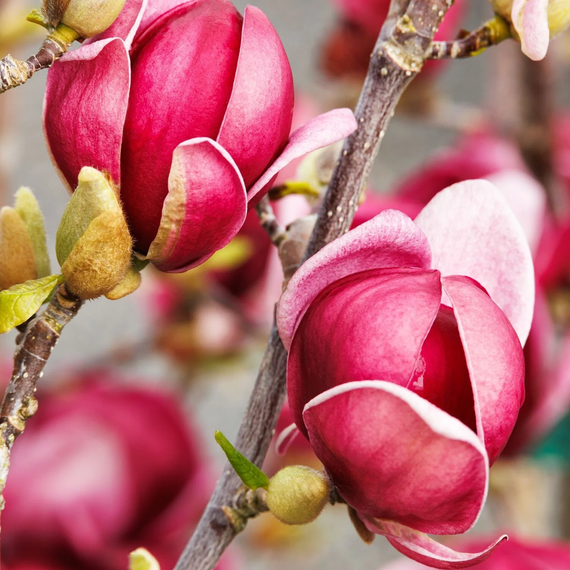

Genie Magnolia (Magnolia × ‘Genie’, PP20,748) brings dramatic, jewel‑toned flowers to modest landscapes. From black‑red buds to lush maroon‑purple, lightly fragrant tulip blooms, Genie lights up early spring and often repeats later in the season. Its naturally narrow, pyramidal form (about 10–13 feet tall by 5–6 feet wide) fits beautifully near patios, entries, and mixed borders, thriving in full to partial sun and consistently moist, well‑drained soil.
A compact, deciduous magnolia with a tidy, upright pyramidal habit. New season flowers appear on bare branches, followed by fresh green foliage that frames lingering blooms into early summer.
Early spring through early summer, with a second, lighter flush in late summer when moisture is adequate. Upright, tulip‑shaped blossoms open from very dark buds to rich maroon‑purple petals with lighter inner tones; subtly sweet fragrance enhances close‑up plantings.
Naturally narrow and space‑saving—generally reaches about 10–13 ft. tall and 5–6 ft. wide, making it ideal for small gardens, borders, and focal points near seating areas.
Full sun to partial sun. In hotter regions, provide light afternoon shade to protect buds and foliage and to encourage a longer bloom window.
Plant in consistently moist, slightly acidic, organically enriched, well‑drained soil. Water deeply and regularly during the first growing season to establish; dry conditions can reduce or prevent the summer rebloom.
USDA Zones 4–9. Site in a spot sheltered from strong, cold winds and late frosts to protect developing buds and open flowers.
Repeat flowering; compact form suited to small spaces; lightly fragrant blooms; generally deer and rabbit resistant when established.
Singular specimen by entries and patios, mixed‑shrub borders for spring drama, narrow street‑side plantings, or as a small focal tree against evergreen backdrops.
Feed with a balanced, general‑purpose fertilizer just before spring growth. Maintain a wide mulch ring to conserve moisture and moderate soil temperature. Prune immediately after the main spring bloom to refine structure (avoid late‑season pruning that can remove the next year’s buds).
Allow 6–8 ft. of lateral space for the mature canopy and good air movement. Position where the upright flowers can be viewed at eye level from paths, windows, or seating areas.
Pair with early‑spring bulbs and fine‑textured evergreens to spotlight bloom color; underplant with shade‑tolerant perennials for summer texture once the canopy leafs out.
Hybrid of Magnolia × soulangeana × M. liliflora; bred in New Zealand for compact habit and saturated bloom color. U.S. Plant Patent PP20,748.
Genie Magnolia (Magnolia × ‘Genie’, PP20,748) brings dramatic, jewel‑toned flowers to modest landscapes. From black‑red buds to lush maroon‑purple, lightly fragrant tulip blooms, Genie lights up early spring and often repeats later in the season. Its naturally narrow, pyramidal form (about 10–13 feet tall by 5–6 feet wide) fits beautifully near patios, entries, and mixed borders, thriving in full to partial sun and consistently moist, well‑drained soil.
A compact, deciduous magnolia with a tidy, upright pyramidal habit. New season flowers appear on bare branches, followed by fresh green foliage that frames lingering blooms into early summer.
Early spring through early summer, with a second, lighter flush in late summer when moisture is adequate. Upright, tulip‑shaped blossoms open from very dark buds to rich maroon‑purple petals with lighter inner tones; subtly sweet fragrance enhances close‑up plantings.
Naturally narrow and space‑saving—generally reaches about 10–13 ft. tall and 5–6 ft. wide, making it ideal for small gardens, borders, and focal points near seating areas.
Full sun to partial sun. In hotter regions, provide light afternoon shade to protect buds and foliage and to encourage a longer bloom window.
Plant in consistently moist, slightly acidic, organically enriched, well‑drained soil. Water deeply and regularly during the first growing season to establish; dry conditions can reduce or prevent the summer rebloom.
USDA Zones 4–9. Site in a spot sheltered from strong, cold winds and late frosts to protect developing buds and open flowers.
Repeat flowering; compact form suited to small spaces; lightly fragrant blooms; generally deer and rabbit resistant when established.
Singular specimen by entries and patios, mixed‑shrub borders for spring drama, narrow street‑side plantings, or as a small focal tree against evergreen backdrops.
Feed with a balanced, general‑purpose fertilizer just before spring growth. Maintain a wide mulch ring to conserve moisture and moderate soil temperature. Prune immediately after the main spring bloom to refine structure (avoid late‑season pruning that can remove the next year’s buds).
Allow 6–8 ft. of lateral space for the mature canopy and good air movement. Position where the upright flowers can be viewed at eye level from paths, windows, or seating areas.
Pair with early‑spring bulbs and fine‑textured evergreens to spotlight bloom color; underplant with shade‑tolerant perennials for summer texture once the canopy leafs out.
Hybrid of Magnolia × soulangeana × M. liliflora; bred in New Zealand for compact habit and saturated bloom color. U.S. Plant Patent PP20,748.