

Zoom the image with the mouse
Feelin' Blue Deodar Cedar - 5 Gallon Patio Tree
SKU:
2096765
UPC:
014949005385
$169.99
- Dwarf, ground‑hugging deodar cedar with a unique, leader‑less spreading form.
- Striking blue‑green needles provide year‑round color and soft, cascading texture.
- Space‑saving scale—about 4–5 ft tall and 6–10 ft wide in 10 years.
- Easy‑care and waterwise once established; great for rock gardens, banks, and containers.
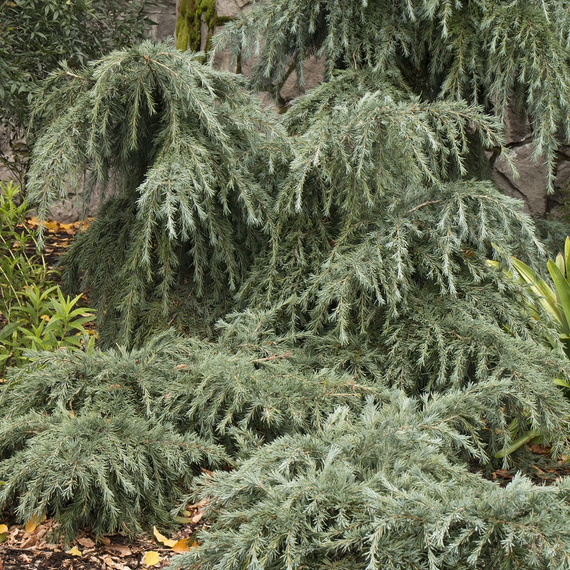
Feelin’ Blue Deodar Cedar (Cedrus deodara ‘Feelin’ Blue’) is the lowest of the dwarf cedars, valued for its naturally spreading, leader‑less habit and luminous blue‑green foliage. Perfect for small spaces, it drapes over boulders, softens retaining walls, or spills from large containers, and can also be staked to create a graceful small patio tree. Plant in full sun and well‑drained soil; after establishment, it’s a low‑maintenance, drought‑tolerant accent that delivers four‑season color and texture with minimal effort.
Plant Description
A dwarf, evergreen conifer with arching branches and a naturally leader‑less, horizontal habit. Its low profile makes it ideal where height must be limited without sacrificing year‑round impact.
Foliage & Color
Long, soft, blue‑green needles create a cool, silvery wash across beds and slopes. Color holds through all seasons for consistent contrast against greens and warm‑toned hardscape.
Form & Training
Naturally spreading and cascading; may be staked to form a small, weeping patio tree or trained as an informal topiary for vertical accents without losing its graceful drape.
Sun Requirements
Full sun (6+ hours daily) for densest growth and the brightest blue‑green needle color.
Watering Needs
Water deeply and regularly during the first seasons to establish a broad root system; thereafter, water deeply only as needed—allow the topsoil to dry between waterings.
Soil Requirements
Adapts to a wide range of soils, provided drainage is excellent. Avoid poorly drained or chronically soggy sites. Mulch to moderate soil temperature and conserve moisture.
Growth & Size
Expect roughly 4–5 ft tall and 6–10 ft wide in about 10 years, with a moderate growth rate and a naturally layered, spreading outline.
Hardiness
USDA Zones 6–9; winter‑hardy into Zone 6 with some protection in exposed sites.
Special Features
Easy care; waterwise once established; tolerant of coastal exposure and urban conditions; generally deer and rabbit resistant; valuable for erosion control on banks and slopes.
Landscape Uses
Superb for rock gardens, Asian‑inspired compositions, and spilling over walls or raised planters. Works as a low evergreen groundcover on slopes, or as a statement plant in large containers.
Care Instructions
Plant at or slightly above grade in well‑drained soil. Feed lightly in early spring if desired. Minimal pruning needed—remove only any damaged or wayward shoots to preserve the natural drape.
Design Tips
Pair with Japanese maples, azaleas, camellias, or magnolias for four‑season contrast. Let it cascade off boulders or retaining walls, or stake a single leader for a compact, weeping tree form.
- Dwarf, ground‑hugging deodar cedar with a unique, leader‑less spreading form.
- Striking blue‑green needles provide year‑round color and soft, cascading texture.
- Space‑saving scale—about 4–5 ft tall and 6–10 ft wide in 10 years.
- Easy‑care and waterwise once established; great for rock gardens, banks, and containers.
Feelin’ Blue Deodar Cedar (Cedrus deodara ‘Feelin’ Blue’) is the lowest of the dwarf cedars, valued for its naturally spreading, leader‑less habit and luminous blue‑green foliage. Perfect for small spaces, it drapes over boulders, softens retaining walls, or spills from large containers, and can also be staked to create a graceful small patio tree. Plant in full sun and well‑drained soil; after establishment, it’s a low‑maintenance, drought‑tolerant accent that delivers four‑season color and texture with minimal effort.
Plant Description
A dwarf, evergreen conifer with arching branches and a naturally leader‑less, horizontal habit. Its low profile makes it ideal where height must be limited without sacrificing year‑round impact.
Foliage & Color
Long, soft, blue‑green needles create a cool, silvery wash across beds and slopes. Color holds through all seasons for consistent contrast against greens and warm‑toned hardscape.
Form & Training
Naturally spreading and cascading; may be staked to form a small, weeping patio tree or trained as an informal topiary for vertical accents without losing its graceful drape.
Sun Requirements
Full sun (6+ hours daily) for densest growth and the brightest blue‑green needle color.
Watering Needs
Water deeply and regularly during the first seasons to establish a broad root system; thereafter, water deeply only as needed—allow the topsoil to dry between waterings.
Soil Requirements
Adapts to a wide range of soils, provided drainage is excellent. Avoid poorly drained or chronically soggy sites. Mulch to moderate soil temperature and conserve moisture.
Growth & Size
Expect roughly 4–5 ft tall and 6–10 ft wide in about 10 years, with a moderate growth rate and a naturally layered, spreading outline.
Hardiness
USDA Zones 6–9; winter‑hardy into Zone 6 with some protection in exposed sites.
Special Features
Easy care; waterwise once established; tolerant of coastal exposure and urban conditions; generally deer and rabbit resistant; valuable for erosion control on banks and slopes.
Landscape Uses
Superb for rock gardens, Asian‑inspired compositions, and spilling over walls or raised planters. Works as a low evergreen groundcover on slopes, or as a statement plant in large containers.
Care Instructions
Plant at or slightly above grade in well‑drained soil. Feed lightly in early spring if desired. Minimal pruning needed—remove only any damaged or wayward shoots to preserve the natural drape.
Design Tips
Pair with Japanese maples, azaleas, camellias, or magnolias for four‑season contrast. Let it cascade off boulders or retaining walls, or stake a single leader for a compact, weeping tree form.