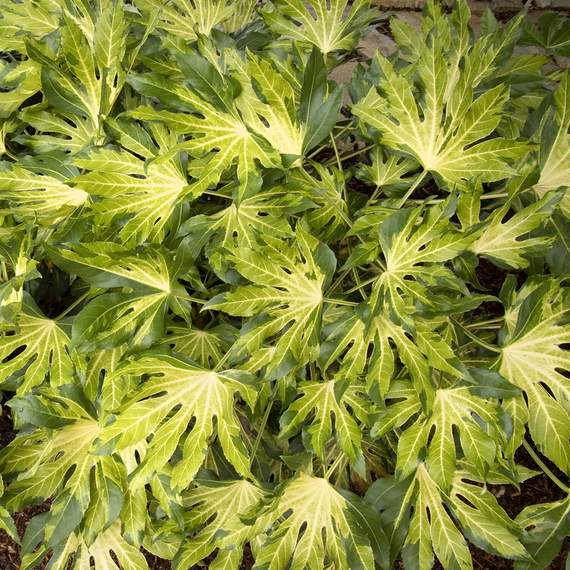


Fatsia japonica 'Camouflage' — sold under the trade name Camouflage Variegated Japanese Aralia — is a stunning broadleaf evergreen shrub that transforms shade gardens and indoor spaces alike with its bold, tropical presence. Each dramatically large, deeply lobed leaf is an intricate mosaic of yellow, lime, and deep green, giving the plant its fitting name and providing a dazzling, constantly shifting display of color throughout all four seasons. Native to the coastal woodlands of southern Japan, South Korea, and Taiwan, this architectural beauty belongs to the Araliaceae family and is prized worldwide for its ability to thrive where most ornamental shrubs struggle — in low light, damp shade, and even polluted urban environments. Growing into a rounded, multi-stemmed shrub typically reaching 6 to 10 feet tall and wide at maturity, Camouflage Japanese Aralia makes an outstanding specimen plant, a lush privacy screen, or a show-stopping container subject on a shaded porch or patio. In late autumn, mature plants reward gardeners with spherical clusters of creamy white flowers held on upright panicles, followed by clusters of small black berries that persist through winter and attract birds to the garden. Its exceptionally large, glossy, palm-shaped leaves — each divided into 7 to 11 pointed lobes and capable of reaching up to 16 inches across — bring a lush, jungle-like texture that few temperate shrubs can match. With its ease of care, four-season interest, non-toxic profile, and striking variegated foliage, Fatsia japonica 'Camouflage' is an indispensable addition to Pacific Northwest and Northern California gardens seeking bold texture and effortless sophistication in the shade.
Camouflage Variegated Japanese Aralia (Fatsia japonica 'Camouflage') is a broadleaf evergreen shrub celebrated for its dramatic, tropical-looking foliage. Each large, glossy leaf is deeply cut into 7 to 11 pointed lobes and displays an eye-catching blend of creamy yellow, chartreuse lime, and deep forest green, producing a natural camouflage effect that gives this cultivar its name. The leaf surface is thick, leathery, and glossy, with the variegation most vivid and striking on newer growth. Stems are stout and upright, creating a dense, rounded to vase-shaped canopy. In late fall, the plant sends up tall, branched flower panicles topped with spherical clusters of small, creamy white blossoms reminiscent of drumsticks or mop heads. These are followed in winter by clusters of small, round black berries. Native to the coastal forests and sheltered ravines of southern Japan, South Korea, and Taiwan, Camouflage Japanese Aralia belongs to the Araliaceae family and is closely related to English ivy. It is sometimes called the "false castor oil plant" due to the similarity of its foliage to Ricinus communis.
| Characteristic | Details |
|---|---|
| Mature Height | 6 to 10 feet |
| Mature Spread | 6 to 10 feet |
| Growth Rate | Moderate |
| Growth Habit | Upright, rounded, multi-stemmed shrub |
| Leaf Size | Up to 16 inches wide |
| Plant Form | Architectural, tropical appearance |
Camouflage Japanese Aralia is reliably hardy in USDA Hardiness Zones 7b through 10b, making it an excellent permanent landscape shrub throughout Southern Oregon and Northern California. It thrives in the mild, maritime-influenced climates typical of the Pacific Coast, where winters are wet and cool rather than brutally cold. In hotter inland valleys, it benefits from afternoon shade and supplemental summer watering. The plant performs best where temperatures remain above 15°F in winter; in the coldest parts of its range it may experience some tip dieback but will typically resprout from the base in spring. It adapts well to coastal conditions, tolerating salt air and wind better than many tropical-looking plants. In regions colder than Zone 7b, it can be grown as a striking houseplant or overwintered container plant with great success.
This shrub is at its best in partial to full shade, making it one of the most valuable large-leaved plants for low-light garden situations. Dappled shade beneath a high tree canopy is ideal, providing filtered light throughout the day without the damaging intensity of direct afternoon sun. It will also perform well on the north or east sides of buildings or fences where it receives gentle morning light or bright indirect light. In mild coastal climates, Camouflage Japanese Aralia can tolerate a few hours of gentle morning sun, but direct afternoon sun should always be avoided as it will bleach and scorch the magnificent variegated leaves. Deep shade slows growth and may reduce the vividness of the variegation; the brightest leaf color is achieved with bright, indirect light. When grown as a houseplant, a spot near a north- or east-facing window or set back from a bright window works well.
Camouflage Japanese Aralia grows best in organically rich, consistently moist, well-draining soil. It tolerates a range of soil textures — from sandy loam to clay — as long as drainage is adequate and the soil never becomes waterlogged. Heavy, compacted soils that remain saturated after rain should be amended with compost and perlite before planting. The ideal soil pH range is slightly acidic to neutral, between 6.0 and 7.5. Before planting, work 3 to 4 inches of aged compost or quality garden compost into the planting area to improve both fertility and soil structure. Mulching around the root zone with a 2 to 3 inch layer of shredded bark or compost helps maintain soil moisture, moderate soil temperature, and suppress weeds. Avoid planting in low-lying areas prone to standing water, as prolonged wet feet can lead to root rot.
Consistent moisture is key to a healthy, vigorous Camouflage Japanese Aralia, especially during its first one to two years in the ground as it establishes its root system. Water deeply and thoroughly after planting, and continue to water regularly through the first two growing seasons whenever rainfall is insufficient. Once established, this shrub develops moderate drought tolerance, though it looks its finest with steady, even moisture throughout the growing season. During hot summer months, check soil moisture at least once or twice a week and water when the top 1 to 2 inches of soil feel dry. Reduce watering frequency in fall and winter as growth slows, but do not allow the root zone to dry out completely. When grown in containers, water more frequently — checking every few days in summer — and ensure pots have drainage holes to prevent waterlogging. Signs of overwatering include yellowing leaves and soft, mushy stem bases; underwatering presents as drooping leaves and dry, brown leaf edges.
Feed Camouflage Japanese Aralia in early spring, just as new growth begins, with a balanced slow-release granular fertilizer formulated for shrubs or a general-purpose product such as a 10-10-10 blend. Apply according to label directions and water in thoroughly. For additional support during the active growing season (spring through early fall), supplemental applications of a balanced liquid fertilizer every four to six weeks will promote lush, vibrant foliage and strong growth. Avoid fertilizing in late summer or fall, as stimulating tender new growth before cold weather arrives can result in frost damage. Container-grown plants generally need fertilizing more frequently than in-ground specimens — a balanced liquid feed every two to three weeks through the growing season is appropriate. Organic options such as fish emulsion, worm castings, or compost tea are excellent choices for enriching the soil and feeding the plant gently. Discontinue feeding entirely in winter when the plant is largely dormant.
Camouflage Japanese Aralia requires minimal pruning to remain healthy and attractive. The plant naturally develops a pleasing, rounded form without heavy intervention. Remove any dead, damaged, or heavily spotted leaves at any time of year, cutting cleanly at the base of the leaf stem with clean, sharp pruners. To maintain a compact shape or control the size of the plant, prune back stems in late winter to early spring just before new growth emerges. For rejuvenation of an older or overgrown plant, you may cut all stems back severely in late winter — the plant will resprout vigorously from the base. Alternatively, remove only one-third of the oldest stems each year over a three-year period for a gentler approach. Watch for and remove any stems that revert to solid green foliage, as these can eventually outcompete the variegated growth. Always use sterilized pruning tools to reduce the risk of transmitting disease between cuts.
| Season | What to Expect |
|---|---|
| Spring | Flush of vibrant new growth; fresh leaves emerge with the most intense yellow and lime variegation |
| Summer | Full, lush canopy of large variegated leaves provides bold tropical texture in the shade garden |
| Fall | Globe-shaped clusters of creamy white flowers appear on tall upright panicles; blooms attract late-season pollinators |
| Winter | Clusters of small, round black berries persist after flowering; fully evergreen foliage provides structure and color during the dormant season |
Camouflage Japanese Aralia is one of the most versatile and impactful large-leaved shrubs available for shaded Pacific Northwest and Northern California landscapes. Its bold, tropical texture makes it an outstanding specimen plant — a single well-placed plant becomes an immediate focal point in any shaded bed or corner. It excels as a foundation planting along north or east-facing walls of homes and commercial buildings, providing year-round evergreen structure with dramatic foliage. Use it to anchor a layered shade garden, as the back-of-border structural element behind lower shade perennials and groundcovers. Its tolerance for urban pollution and coastal conditions makes it a strong choice for city gardens, courtyard plantings, and seaside landscapes. Camouflage Japanese Aralia thrives in large decorative containers on shaded porches, patios, and entryways, where its bold leaves create an instant resort or tropical garden atmosphere. It can also be grown indoors as a dramatic houseplant in bright, indirect light.
Camouflage Japanese Aralia pairs beautifully with a wide range of shade-loving plants that complement its bold tropical texture and variegated foliage. Consider these companions for a cohesive, layered shade garden:
Camouflage Japanese Aralia is generally a tough, low-maintenance shrub with good resistance to most serious pests and diseases. However, the following issues may occasionally arise:
Camouflage Japanese Aralia is an exceptional container subject and one of the most dramatic potted plants available for shaded patios, decks, and entryways. Choose a large, sturdy container with ample drainage holes — a pot at least 18 to 24 inches in diameter is recommended for best results, as this shrub develops a substantial root system. Use a high-quality, well-draining potting mix enriched with perlite and compost to ensure good drainage and fertility. Container plants dry out more quickly than in-ground specimens, so check soil moisture regularly and water thoroughly when the top inch or two feels dry. Feed container-grown plants with a balanced liquid fertilizer every two to three weeks during the growing season. Repot every two to three years in spring, stepping up to the next pot size when roots begin to crowd the container. In Southern Oregon and Northern California, container plants are hardy enough to stay outside year-round in most locations, but should be moved to a sheltered spot during any extended hard freezes. Indoors, place near a bright window with no direct sun for best foliage color and growth.
Despite its exotic appearance, Camouflage Japanese Aralia provides genuine wildlife benefits in the garden. The clusters of small, creamy white flowers that appear in late fall are a valuable late-season nectar source for bees and other pollinators at a time when most garden plants have finished blooming. The small black berries that follow the flowers are eagerly eaten by birds, including thrushes, robins, and other berry-feeding species, providing a valuable winter food source. The large, dense canopy of evergreen foliage offers year-round shelter and nesting cover for small birds and beneficial insects. The plant is non-toxic to cats, dogs, and horses, making it a safe and wildlife-friendly choice for family gardens and pet-friendly outdoor spaces.
There is some variation in reported toxicity for Fatsia japonica, and gardeners with pets should be aware of the following guidance. Some horticultural sources, including the ASPCA, list Fatsia japonica as non-toxic to cats, dogs, and horses. However, other references note that all parts of the plant contain saponins, which can cause mild gastrointestinal irritation, including nausea, vomiting, or diarrhea, if ingested in significant quantities by pets or humans. As a precaution, it is advisable to discourage pets and young children from chewing on the leaves or berries. If ingestion is suspected, contact your veterinarian or poison control center for guidance. The plant is generally considered safe for wildlife and is not considered harmful to birds that consume the berries.
Fatsia japonica 'Camouflage' — sold under the trade name Camouflage Variegated Japanese Aralia — is a stunning broadleaf evergreen shrub that transforms shade gardens and indoor spaces alike with its bold, tropical presence. Each dramatically large, deeply lobed leaf is an intricate mosaic of yellow, lime, and deep green, giving the plant its fitting name and providing a dazzling, constantly shifting display of color throughout all four seasons. Native to the coastal woodlands of southern Japan, South Korea, and Taiwan, this architectural beauty belongs to the Araliaceae family and is prized worldwide for its ability to thrive where most ornamental shrubs struggle — in low light, damp shade, and even polluted urban environments. Growing into a rounded, multi-stemmed shrub typically reaching 6 to 10 feet tall and wide at maturity, Camouflage Japanese Aralia makes an outstanding specimen plant, a lush privacy screen, or a show-stopping container subject on a shaded porch or patio. In late autumn, mature plants reward gardeners with spherical clusters of creamy white flowers held on upright panicles, followed by clusters of small black berries that persist through winter and attract birds to the garden. Its exceptionally large, glossy, palm-shaped leaves — each divided into 7 to 11 pointed lobes and capable of reaching up to 16 inches across — bring a lush, jungle-like texture that few temperate shrubs can match. With its ease of care, four-season interest, non-toxic profile, and striking variegated foliage, Fatsia japonica 'Camouflage' is an indispensable addition to Pacific Northwest and Northern California gardens seeking bold texture and effortless sophistication in the shade.
Camouflage Variegated Japanese Aralia (Fatsia japonica 'Camouflage') is a broadleaf evergreen shrub celebrated for its dramatic, tropical-looking foliage. Each large, glossy leaf is deeply cut into 7 to 11 pointed lobes and displays an eye-catching blend of creamy yellow, chartreuse lime, and deep forest green, producing a natural camouflage effect that gives this cultivar its name. The leaf surface is thick, leathery, and glossy, with the variegation most vivid and striking on newer growth. Stems are stout and upright, creating a dense, rounded to vase-shaped canopy. In late fall, the plant sends up tall, branched flower panicles topped with spherical clusters of small, creamy white blossoms reminiscent of drumsticks or mop heads. These are followed in winter by clusters of small, round black berries. Native to the coastal forests and sheltered ravines of southern Japan, South Korea, and Taiwan, Camouflage Japanese Aralia belongs to the Araliaceae family and is closely related to English ivy. It is sometimes called the "false castor oil plant" due to the similarity of its foliage to Ricinus communis.
| Characteristic | Details |
|---|---|
| Mature Height | 6 to 10 feet |
| Mature Spread | 6 to 10 feet |
| Growth Rate | Moderate |
| Growth Habit | Upright, rounded, multi-stemmed shrub |
| Leaf Size | Up to 16 inches wide |
| Plant Form | Architectural, tropical appearance |
Camouflage Japanese Aralia is reliably hardy in USDA Hardiness Zones 7b through 10b, making it an excellent permanent landscape shrub throughout Southern Oregon and Northern California. It thrives in the mild, maritime-influenced climates typical of the Pacific Coast, where winters are wet and cool rather than brutally cold. In hotter inland valleys, it benefits from afternoon shade and supplemental summer watering. The plant performs best where temperatures remain above 15°F in winter; in the coldest parts of its range it may experience some tip dieback but will typically resprout from the base in spring. It adapts well to coastal conditions, tolerating salt air and wind better than many tropical-looking plants. In regions colder than Zone 7b, it can be grown as a striking houseplant or overwintered container plant with great success.
This shrub is at its best in partial to full shade, making it one of the most valuable large-leaved plants for low-light garden situations. Dappled shade beneath a high tree canopy is ideal, providing filtered light throughout the day without the damaging intensity of direct afternoon sun. It will also perform well on the north or east sides of buildings or fences where it receives gentle morning light or bright indirect light. In mild coastal climates, Camouflage Japanese Aralia can tolerate a few hours of gentle morning sun, but direct afternoon sun should always be avoided as it will bleach and scorch the magnificent variegated leaves. Deep shade slows growth and may reduce the vividness of the variegation; the brightest leaf color is achieved with bright, indirect light. When grown as a houseplant, a spot near a north- or east-facing window or set back from a bright window works well.
Camouflage Japanese Aralia grows best in organically rich, consistently moist, well-draining soil. It tolerates a range of soil textures — from sandy loam to clay — as long as drainage is adequate and the soil never becomes waterlogged. Heavy, compacted soils that remain saturated after rain should be amended with compost and perlite before planting. The ideal soil pH range is slightly acidic to neutral, between 6.0 and 7.5. Before planting, work 3 to 4 inches of aged compost or quality garden compost into the planting area to improve both fertility and soil structure. Mulching around the root zone with a 2 to 3 inch layer of shredded bark or compost helps maintain soil moisture, moderate soil temperature, and suppress weeds. Avoid planting in low-lying areas prone to standing water, as prolonged wet feet can lead to root rot.
Consistent moisture is key to a healthy, vigorous Camouflage Japanese Aralia, especially during its first one to two years in the ground as it establishes its root system. Water deeply and thoroughly after planting, and continue to water regularly through the first two growing seasons whenever rainfall is insufficient. Once established, this shrub develops moderate drought tolerance, though it looks its finest with steady, even moisture throughout the growing season. During hot summer months, check soil moisture at least once or twice a week and water when the top 1 to 2 inches of soil feel dry. Reduce watering frequency in fall and winter as growth slows, but do not allow the root zone to dry out completely. When grown in containers, water more frequently — checking every few days in summer — and ensure pots have drainage holes to prevent waterlogging. Signs of overwatering include yellowing leaves and soft, mushy stem bases; underwatering presents as drooping leaves and dry, brown leaf edges.
Feed Camouflage Japanese Aralia in early spring, just as new growth begins, with a balanced slow-release granular fertilizer formulated for shrubs or a general-purpose product such as a 10-10-10 blend. Apply according to label directions and water in thoroughly. For additional support during the active growing season (spring through early fall), supplemental applications of a balanced liquid fertilizer every four to six weeks will promote lush, vibrant foliage and strong growth. Avoid fertilizing in late summer or fall, as stimulating tender new growth before cold weather arrives can result in frost damage. Container-grown plants generally need fertilizing more frequently than in-ground specimens — a balanced liquid feed every two to three weeks through the growing season is appropriate. Organic options such as fish emulsion, worm castings, or compost tea are excellent choices for enriching the soil and feeding the plant gently. Discontinue feeding entirely in winter when the plant is largely dormant.
Camouflage Japanese Aralia requires minimal pruning to remain healthy and attractive. The plant naturally develops a pleasing, rounded form without heavy intervention. Remove any dead, damaged, or heavily spotted leaves at any time of year, cutting cleanly at the base of the leaf stem with clean, sharp pruners. To maintain a compact shape or control the size of the plant, prune back stems in late winter to early spring just before new growth emerges. For rejuvenation of an older or overgrown plant, you may cut all stems back severely in late winter — the plant will resprout vigorously from the base. Alternatively, remove only one-third of the oldest stems each year over a three-year period for a gentler approach. Watch for and remove any stems that revert to solid green foliage, as these can eventually outcompete the variegated growth. Always use sterilized pruning tools to reduce the risk of transmitting disease between cuts.
| Season | What to Expect |
|---|---|
| Spring | Flush of vibrant new growth; fresh leaves emerge with the most intense yellow and lime variegation |
| Summer | Full, lush canopy of large variegated leaves provides bold tropical texture in the shade garden |
| Fall | Globe-shaped clusters of creamy white flowers appear on tall upright panicles; blooms attract late-season pollinators |
| Winter | Clusters of small, round black berries persist after flowering; fully evergreen foliage provides structure and color during the dormant season |
Camouflage Japanese Aralia is one of the most versatile and impactful large-leaved shrubs available for shaded Pacific Northwest and Northern California landscapes. Its bold, tropical texture makes it an outstanding specimen plant — a single well-placed plant becomes an immediate focal point in any shaded bed or corner. It excels as a foundation planting along north or east-facing walls of homes and commercial buildings, providing year-round evergreen structure with dramatic foliage. Use it to anchor a layered shade garden, as the back-of-border structural element behind lower shade perennials and groundcovers. Its tolerance for urban pollution and coastal conditions makes it a strong choice for city gardens, courtyard plantings, and seaside landscapes. Camouflage Japanese Aralia thrives in large decorative containers on shaded porches, patios, and entryways, where its bold leaves create an instant resort or tropical garden atmosphere. It can also be grown indoors as a dramatic houseplant in bright, indirect light.
Camouflage Japanese Aralia pairs beautifully with a wide range of shade-loving plants that complement its bold tropical texture and variegated foliage. Consider these companions for a cohesive, layered shade garden:
Camouflage Japanese Aralia is generally a tough, low-maintenance shrub with good resistance to most serious pests and diseases. However, the following issues may occasionally arise:
Camouflage Japanese Aralia is an exceptional container subject and one of the most dramatic potted plants available for shaded patios, decks, and entryways. Choose a large, sturdy container with ample drainage holes — a pot at least 18 to 24 inches in diameter is recommended for best results, as this shrub develops a substantial root system. Use a high-quality, well-draining potting mix enriched with perlite and compost to ensure good drainage and fertility. Container plants dry out more quickly than in-ground specimens, so check soil moisture regularly and water thoroughly when the top inch or two feels dry. Feed container-grown plants with a balanced liquid fertilizer every two to three weeks during the growing season. Repot every two to three years in spring, stepping up to the next pot size when roots begin to crowd the container. In Southern Oregon and Northern California, container plants are hardy enough to stay outside year-round in most locations, but should be moved to a sheltered spot during any extended hard freezes. Indoors, place near a bright window with no direct sun for best foliage color and growth.
Despite its exotic appearance, Camouflage Japanese Aralia provides genuine wildlife benefits in the garden. The clusters of small, creamy white flowers that appear in late fall are a valuable late-season nectar source for bees and other pollinators at a time when most garden plants have finished blooming. The small black berries that follow the flowers are eagerly eaten by birds, including thrushes, robins, and other berry-feeding species, providing a valuable winter food source. The large, dense canopy of evergreen foliage offers year-round shelter and nesting cover for small birds and beneficial insects. The plant is non-toxic to cats, dogs, and horses, making it a safe and wildlife-friendly choice for family gardens and pet-friendly outdoor spaces.
There is some variation in reported toxicity for Fatsia japonica, and gardeners with pets should be aware of the following guidance. Some horticultural sources, including the ASPCA, list Fatsia japonica as non-toxic to cats, dogs, and horses. However, other references note that all parts of the plant contain saponins, which can cause mild gastrointestinal irritation, including nausea, vomiting, or diarrhea, if ingested in significant quantities by pets or humans. As a precaution, it is advisable to discourage pets and young children from chewing on the leaves or berries. If ingestion is suspected, contact your veterinarian or poison control center for guidance. The plant is generally considered safe for wildlife and is not considered harmful to birds that consume the berries.