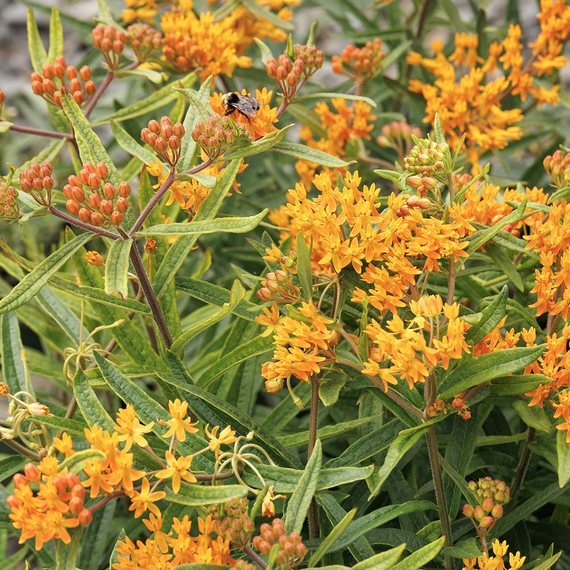


Butterfly Weed (Asclepias tuberosa) is a hardy, free-flowering, and well-behaved North American native perennial that has earned its place as a garden classic and a wildlife conservation essential. Bright orange, flat-topped flower clusters adorn the upright stems throughout summer, creating a vivid, sustained display that draws monarch butterflies, native bees, and other essential pollinators in remarkable numbers. Growing to 2 to 3 feet tall and 2 feet wide in an upright, well-behaved habit, it tolerates lean, unimproved soils that would challenge most ornamental plants, and becomes exceptionally drought tolerant once established. The 2017 Perennial Plant of the Year, Butterfly Weed is a rabbit-resistant, virtually self-sufficient choice for naturalized areas, meadow gardens, and sunny perennial borders across USDA Zones 4 through 9, delivering season-long color and invaluable ecological value with minimal care.
| Attribute | Details |
|---|---|
| Botanical Name | Asclepias tuberosa |
| Plant Type | Herbaceous Perennial (North American Native) |
| Flower Color | Bright orange (red buds opening to orange) |
| Foliage Color | Green |
| Bloom Time | Summer |
| Growth Rate | Fast |
| Growth Habit | Upright |
| Mature Size | 2-3 ft. tall, 2 ft. wide |
| USDA Zones | 4 - 9 |
| Light | Full sun |
| Water | Once established, does not need regular watering |
| Special Features | Easy Care, Waterwise, North American Native, Fast Growing |
| Landscape Use | Border, Container, Naturalized Area, Meadow Garden |
| Rabbit Resistant | Yes |
| Drought Tolerant | Yes (once established) |
Asclepias tuberosa is one of the most ecologically important plants available to home gardeners, serving as a critical host plant for monarch butterfly caterpillars. Female monarchs lay their eggs exclusively on milkweed plants, and the caterpillars feed on the leaves as they develop. The milky latex sap in Asclepias leaves contains cardenolides, toxic compounds that the caterpillars sequester in their bodies, making adult monarchs unpalatable to most predators — a key survival adaptation. As monarch populations have declined dramatically due to habitat loss, planting Asclepias tuberosa in home gardens makes a meaningful, direct contribution to monarch conservation efforts. Note that A. tuberosa produces less milky latex than many other milkweed species, making it somewhat less irritating to work with while still providing full wildlife value.
Butterfly Weed grows in an upright, well-branched habit reaching 2 to 3 feet tall and approximately 2 feet wide. The stems are stiff and self-supporting, requiring no staking. It begins the season slowly — emerging late from dormancy in spring, often well after other perennials have leafed out, so avoid disturbing the area before growth begins. Once growing, it develops quickly through the season. Its deep taproot makes it exceptionally drought tolerant but also means established plants resent transplanting. Choose the planting location carefully, as the plant is best left undisturbed once established.
Butterfly Weed requires full sun with at least 6 hours of direct sunlight per day for the most prolific flowering and strongest plant development. As a prairie native adapted to open, sun-drenched meadow conditions, it performs poorly in shade, producing few flowers and becoming weak and floppy. Maximum sun exposure encourages the most compact, self-supporting growth habit and the richest, most vibrant orange flower color. It is one of the most sun-tolerant and heat-tolerant perennials available, thriving in the hottest, sunniest garden positions where other flowering plants may struggle.
Once established, Butterfly Weed does not need regular supplemental watering and actually performs better without it in most climates. During the first growing season, water deeply and regularly to establish the deep taproot system that underpins its exceptional drought tolerance in subsequent years. Once established, reduce frequency to occasional deep watering only during extended, severe droughts. This is a plant that thrives on neglect once its root system is established. Avoid consistently moist or waterlogged soils at all times, as Butterfly Weed absolutely does not tolerate poorly drained or soggy conditions and will decline rapidly in overly wet situations.
Butterfly Weed grows easily in average, well-drained soils and is notably tolerant of lean, unimproved, and poor soils that would challenge most ornamental perennials. It does not tolerate soggy or poorly drained soils. Unlike many garden perennials, it does not require rich, heavily amended soil and may actually produce more compact, floriferous growth in less fertile conditions. Its deep taproot allows it to access subsoil moisture that shorter-rooted plants cannot reach, contributing to its exceptional drought performance. A wide range of soil pH from acidic to neutral is tolerated.
Butterfly Weed is ideal for naturalized areas, meadow gardens, and wildflower plantings where its brilliant orange summer flowers create a vivid seasonal accent. In traditional borders, it provides a reliable orange color note in the middle or front section, paired beautifully with purple and blue companions. It is excellent in cut flower gardens, and the decorative seed pods that follow blooming are prized in dried arrangements. Plant it in masses on sunny slopes and well-drained banks where its deep taproot provides erosion control benefits alongside its ornamental value. It is particularly effective in xeriscape and waterwise gardens where regular irrigation is minimized.
| Plant | Why It Works |
|---|---|
| Coneflower (Echinacea) | Purple-pink daisy blooms provide classic warm-cool contrast alongside the vivid orange Butterfly Weed |
| Salvia (Salvia) | Blue or purple spikes provide cool-toned contrast and simultaneous peak summer bloom alongside the orange |
| Butterfly Bush (Buddleja) | Both attract monarch butterflies and combine for a focused pollinator station in the summer garden |
| Ornamental Onion (Allium) | Purple globe flowers in early summer provide cool color contrast before the orange Butterfly Weed peaks |
| Wallflower (Erysimum) | Early-season warm-toned bloom complements the Butterfly Weed color palette through spring into summer |
Butterfly Weed is one of the most wildlife-valuable plants available to home gardeners. Monarch butterfly caterpillars require milkweed as their sole food source, and adult monarchs, swallowtails, fritillaries, and many other butterfly species nectar at the flowers. Native bees, bumble bees, honey bees, and hummingbirds also visit the nectar-rich blooms regularly. The later-season seed pods, when mature, split open to release silky-tufted seeds that are eaten by birds. Because of its critical role in the monarch butterfly life cycle, planting Butterfly Weed in home gardens directly supports the survival of this iconic migratory species.
Butterfly Weed is rated for USDA Zones 4 through 9. In Zone 4, it reliably returns each spring from winter lows as cold as -30 degrees Fahrenheit, demonstrating the exceptional cold hardiness that makes it such a reliable perennial across a broad range of North American climates. Its deep taproot insulates the plant's crown through cold winters. In Zone 9 and the warmer parts of Zone 8, it may struggle slightly during prolonged summer heat combined with high humidity; ensuring excellent drainage and avoiding overwatering are the most important factors in maintaining long-term health in warmer climates.
Asclepias tuberosa is native to the open prairies, meadows, and dry rocky hillsides of eastern North America, from New England south to Florida and west to the Great Plains. It is one of approximately 70 Asclepias species native to North America, all of which serve as host plants for the monarch butterfly to varying degrees. The genus is named for Asclepius, the Greek god of medicine, reflecting the historical use of milkweed species by Indigenous peoples and early American settlers for a variety of medicinal purposes. Butterfly Weed was named the Perennial Plant Association's Perennial Plant of the Year in 2017, recognition that brought widespread attention to its exceptional garden performance, wildlife value, and ease of cultivation in residential landscapes.
Butterfly Weed (Asclepias tuberosa) is a hardy, free-flowering, and well-behaved North American native perennial that has earned its place as a garden classic and a wildlife conservation essential. Bright orange, flat-topped flower clusters adorn the upright stems throughout summer, creating a vivid, sustained display that draws monarch butterflies, native bees, and other essential pollinators in remarkable numbers. Growing to 2 to 3 feet tall and 2 feet wide in an upright, well-behaved habit, it tolerates lean, unimproved soils that would challenge most ornamental plants, and becomes exceptionally drought tolerant once established. The 2017 Perennial Plant of the Year, Butterfly Weed is a rabbit-resistant, virtually self-sufficient choice for naturalized areas, meadow gardens, and sunny perennial borders across USDA Zones 4 through 9, delivering season-long color and invaluable ecological value with minimal care.
| Attribute | Details |
|---|---|
| Botanical Name | Asclepias tuberosa |
| Plant Type | Herbaceous Perennial (North American Native) |
| Flower Color | Bright orange (red buds opening to orange) |
| Foliage Color | Green |
| Bloom Time | Summer |
| Growth Rate | Fast |
| Growth Habit | Upright |
| Mature Size | 2-3 ft. tall, 2 ft. wide |
| USDA Zones | 4 - 9 |
| Light | Full sun |
| Water | Once established, does not need regular watering |
| Special Features | Easy Care, Waterwise, North American Native, Fast Growing |
| Landscape Use | Border, Container, Naturalized Area, Meadow Garden |
| Rabbit Resistant | Yes |
| Drought Tolerant | Yes (once established) |
Asclepias tuberosa is one of the most ecologically important plants available to home gardeners, serving as a critical host plant for monarch butterfly caterpillars. Female monarchs lay their eggs exclusively on milkweed plants, and the caterpillars feed on the leaves as they develop. The milky latex sap in Asclepias leaves contains cardenolides, toxic compounds that the caterpillars sequester in their bodies, making adult monarchs unpalatable to most predators — a key survival adaptation. As monarch populations have declined dramatically due to habitat loss, planting Asclepias tuberosa in home gardens makes a meaningful, direct contribution to monarch conservation efforts. Note that A. tuberosa produces less milky latex than many other milkweed species, making it somewhat less irritating to work with while still providing full wildlife value.
Butterfly Weed grows in an upright, well-branched habit reaching 2 to 3 feet tall and approximately 2 feet wide. The stems are stiff and self-supporting, requiring no staking. It begins the season slowly — emerging late from dormancy in spring, often well after other perennials have leafed out, so avoid disturbing the area before growth begins. Once growing, it develops quickly through the season. Its deep taproot makes it exceptionally drought tolerant but also means established plants resent transplanting. Choose the planting location carefully, as the plant is best left undisturbed once established.
Butterfly Weed requires full sun with at least 6 hours of direct sunlight per day for the most prolific flowering and strongest plant development. As a prairie native adapted to open, sun-drenched meadow conditions, it performs poorly in shade, producing few flowers and becoming weak and floppy. Maximum sun exposure encourages the most compact, self-supporting growth habit and the richest, most vibrant orange flower color. It is one of the most sun-tolerant and heat-tolerant perennials available, thriving in the hottest, sunniest garden positions where other flowering plants may struggle.
Once established, Butterfly Weed does not need regular supplemental watering and actually performs better without it in most climates. During the first growing season, water deeply and regularly to establish the deep taproot system that underpins its exceptional drought tolerance in subsequent years. Once established, reduce frequency to occasional deep watering only during extended, severe droughts. This is a plant that thrives on neglect once its root system is established. Avoid consistently moist or waterlogged soils at all times, as Butterfly Weed absolutely does not tolerate poorly drained or soggy conditions and will decline rapidly in overly wet situations.
Butterfly Weed grows easily in average, well-drained soils and is notably tolerant of lean, unimproved, and poor soils that would challenge most ornamental perennials. It does not tolerate soggy or poorly drained soils. Unlike many garden perennials, it does not require rich, heavily amended soil and may actually produce more compact, floriferous growth in less fertile conditions. Its deep taproot allows it to access subsoil moisture that shorter-rooted plants cannot reach, contributing to its exceptional drought performance. A wide range of soil pH from acidic to neutral is tolerated.
Butterfly Weed is ideal for naturalized areas, meadow gardens, and wildflower plantings where its brilliant orange summer flowers create a vivid seasonal accent. In traditional borders, it provides a reliable orange color note in the middle or front section, paired beautifully with purple and blue companions. It is excellent in cut flower gardens, and the decorative seed pods that follow blooming are prized in dried arrangements. Plant it in masses on sunny slopes and well-drained banks where its deep taproot provides erosion control benefits alongside its ornamental value. It is particularly effective in xeriscape and waterwise gardens where regular irrigation is minimized.
| Plant | Why It Works |
|---|---|
| Coneflower (Echinacea) | Purple-pink daisy blooms provide classic warm-cool contrast alongside the vivid orange Butterfly Weed |
| Salvia (Salvia) | Blue or purple spikes provide cool-toned contrast and simultaneous peak summer bloom alongside the orange |
| Butterfly Bush (Buddleja) | Both attract monarch butterflies and combine for a focused pollinator station in the summer garden |
| Ornamental Onion (Allium) | Purple globe flowers in early summer provide cool color contrast before the orange Butterfly Weed peaks |
| Wallflower (Erysimum) | Early-season warm-toned bloom complements the Butterfly Weed color palette through spring into summer |
Butterfly Weed is one of the most wildlife-valuable plants available to home gardeners. Monarch butterfly caterpillars require milkweed as their sole food source, and adult monarchs, swallowtails, fritillaries, and many other butterfly species nectar at the flowers. Native bees, bumble bees, honey bees, and hummingbirds also visit the nectar-rich blooms regularly. The later-season seed pods, when mature, split open to release silky-tufted seeds that are eaten by birds. Because of its critical role in the monarch butterfly life cycle, planting Butterfly Weed in home gardens directly supports the survival of this iconic migratory species.
Butterfly Weed is rated for USDA Zones 4 through 9. In Zone 4, it reliably returns each spring from winter lows as cold as -30 degrees Fahrenheit, demonstrating the exceptional cold hardiness that makes it such a reliable perennial across a broad range of North American climates. Its deep taproot insulates the plant's crown through cold winters. In Zone 9 and the warmer parts of Zone 8, it may struggle slightly during prolonged summer heat combined with high humidity; ensuring excellent drainage and avoiding overwatering are the most important factors in maintaining long-term health in warmer climates.
Asclepias tuberosa is native to the open prairies, meadows, and dry rocky hillsides of eastern North America, from New England south to Florida and west to the Great Plains. It is one of approximately 70 Asclepias species native to North America, all of which serve as host plants for the monarch butterfly to varying degrees. The genus is named for Asclepius, the Greek god of medicine, reflecting the historical use of milkweed species by Indigenous peoples and early American settlers for a variety of medicinal purposes. Butterfly Weed was named the Perennial Plant Association's Perennial Plant of the Year in 2017, recognition that brought widespread attention to its exceptional garden performance, wildlife value, and ease of cultivation in residential landscapes.