
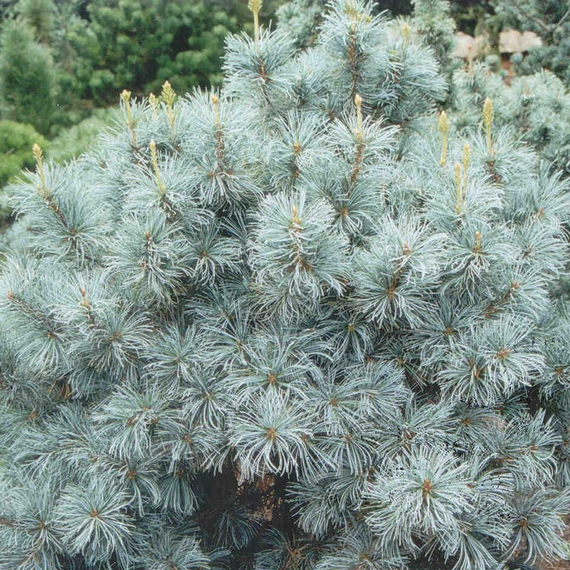



Blue Angel White Pine (Pinus parviflora ‘Blue Angel’) elevates compact spaces with luminous, silvery blue‑green needles and a naturally tidy, upright habit that stays dense without shearing. Selected for its brighter color and uniform branching, this slow‑growing Japanese white pine is an elegant four‑season focal point for small gardens, mixed borders, and modern courtyards. Plant in full sun and well‑drained, sandy or gravelly loam; water deeply during establishment, then enjoy a resilient, low‑maintenance conifer that delivers sculptural form and refined color all year.
Compact Japanese white pine with a uniform, densely branched, upright form and naturally refined silhouette that requires no routine pruning to look finished.
Soft, silvery blue‑green needles provide a brighter, cool‑toned accent than many pines; color holds through the seasons for dependable contrast and texture.
Slow‑growing, narrowly pyramidal to upright habit that fits small footprints yet reads as a sculptural, designer‑grade specimen.
Full sun for best color, density, and uniform branching.
Water deeply and regularly during the first growing season to establish; thereafter, water when the top 2 inches of soil are dry—tolerates moderate drought once established.
Thrives in deep, average, well‑drained, sandy or gravelly loams; avoid poorly drained or soggy sites. Apply a spring fertilizer to support steady growth.
Typically reaches about 7–8 ft. tall and 3–4 ft. wide at maturity; slow growth rate keeps size manageable for foundation beds and intimate gardens.
Deer and rabbit resistant; benefits birds; tolerant of road salt; moderately drought tolerant once established; low maintenance with no shearing required.
Use as a luminous specimen in small gardens, a vertical accent in mixed borders, or to bring year‑round structure to Asian‑inspired and contemporary designs.
Plant in full sun and well‑drained soil at or slightly above grade. Mulch to conserve moisture and moderate soil temperature, keeping mulch a few inches from the trunk. Fertilize in early spring; pruning is not required to maintain shape.
Blue Angel White Pine (Pinus parviflora ‘Blue Angel’) elevates compact spaces with luminous, silvery blue‑green needles and a naturally tidy, upright habit that stays dense without shearing. Selected for its brighter color and uniform branching, this slow‑growing Japanese white pine is an elegant four‑season focal point for small gardens, mixed borders, and modern courtyards. Plant in full sun and well‑drained, sandy or gravelly loam; water deeply during establishment, then enjoy a resilient, low‑maintenance conifer that delivers sculptural form and refined color all year.
Compact Japanese white pine with a uniform, densely branched, upright form and naturally refined silhouette that requires no routine pruning to look finished.
Soft, silvery blue‑green needles provide a brighter, cool‑toned accent than many pines; color holds through the seasons for dependable contrast and texture.
Slow‑growing, narrowly pyramidal to upright habit that fits small footprints yet reads as a sculptural, designer‑grade specimen.
Full sun for best color, density, and uniform branching.
Water deeply and regularly during the first growing season to establish; thereafter, water when the top 2 inches of soil are dry—tolerates moderate drought once established.
Thrives in deep, average, well‑drained, sandy or gravelly loams; avoid poorly drained or soggy sites. Apply a spring fertilizer to support steady growth.
Typically reaches about 7–8 ft. tall and 3–4 ft. wide at maturity; slow growth rate keeps size manageable for foundation beds and intimate gardens.
Deer and rabbit resistant; benefits birds; tolerant of road salt; moderately drought tolerant once established; low maintenance with no shearing required.
Use as a luminous specimen in small gardens, a vertical accent in mixed borders, or to bring year‑round structure to Asian‑inspired and contemporary designs.
Plant in full sun and well‑drained soil at or slightly above grade. Mulch to conserve moisture and moderate soil temperature, keeping mulch a few inches from the trunk. Fertilize in early spring; pruning is not required to maintain shape.


