

Agapanthus
- Showy, deep blue flower clusters rise above lush, strap‑like foliage for a bold summer display.
- Clumping, evergreen habit in mild climates; excellent in groups, borders, and containers.
- Easy‑care and waterwise once established; suitable for full sun to partial sun.
- Reliable late spring–early summer bloom, with potential for light rebloom when deadheaded.
Agapanthus—also called Lily of the Nile or African lily—delivers tropical flair with spherical clusters of blue blooms held on sturdy stalks above neat mounds of glossy, strap‑like leaves. This carefree perennial thrives in full to partial sun and well‑drained soil, bringing long‑lasting color to poolside plantings, borders, and patio pots. In colder regions, it shines as a container accent that can be overwintered indoors, while in warm climates its evergreen foliage and clumping habit provide dependable, low‑maintenance structure all year.
Plant Description
Herbaceous perennial forming dense, clumping mounds of narrow, strap‑like foliage. Rounded umbels of deep blue, trumpet‑shaped flowers are carried on leafless stalks above the foliage for striking visual impact.
Flowers & Bloom Time
Late spring to early summer bloom, with occasional rebloom when spent stems are removed. Long, sturdy scapes hold showy, cut‑worthy flower clusters ideal for borders and containers.
Habit & Size
Foliage typically reaches about 18 in. tall and wide; flower stalks extend to roughly 30 in., creating a tiered effect that reads clearly from a distance.
Sun Requirements
Performs best in full sun to partial sun. In hotter regions, afternoon shade helps preserve foliage quality and extends bloom.
Water & Soil
Plant in average, well‑drained soil. Water deeply and regularly during the first growing season to establish; once established, reduce frequency—plants tolerate mild drought yet bloom best with consistent moisture.
Hardiness
USDA Zones 8–11 in the ground (evergreen in mild winters). In colder zones, grow in containers and overwinter in a frost‑free location.
Special Features
Attracts pollinators (including hummingbirds); easy‑care and waterwise once established; suitable for coastal exposure and erosion control on gentle slopes.
Landscape Uses
Border and edging, poolside and Mediterranean schemes, mass plantings for a “drift” of color, and statement containers where the vertical bloom stems add height and rhythm.
Care & Feeding
Fertilize in early spring, then again after flowering. Avoid frequent division—plants bloom best when undisturbed; divide only when clumps become crowded.
Spacing & Planting
Space clumps 18–24 in. apart for a filled border. Set crowns at the same depth they grew in the pot; water to settle soil and mulch to conserve moisture.
Container Tips
Use a high‑quality, well‑drained potting mix in a container at least 14–18 in. wide. Provide full sun, water when the top 2–3 in. of mix are dry, and feed lightly during active growth.
Design Notes
Pair with silver or fine‑textured companions (e.g., lavender, society garlic, feather grasses) to emphasize the architectural scapes, or mass multiple pots for a resort‑style poolside effect.
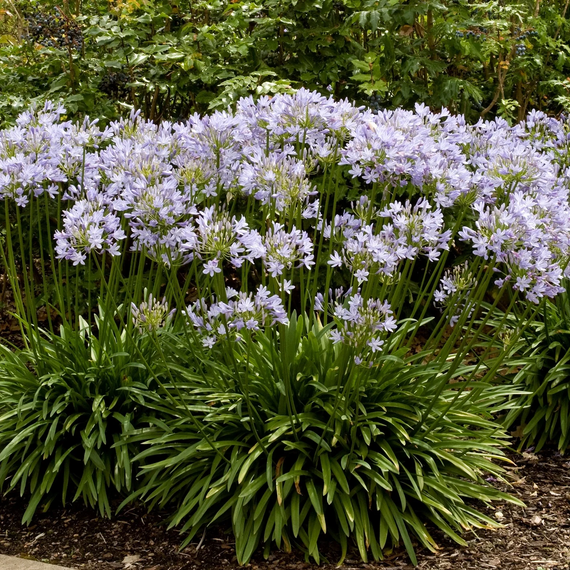
- Showy, deep blue flower clusters rise above lush, strap‑like foliage for a bold summer display.
- Clumping, evergreen habit in mild climates; excellent in groups, borders, and containers.
- Easy‑care and waterwise once established; suitable for full sun to partial sun.
- Reliable late spring–early summer bloom, with potential for light rebloom when deadheaded.
Agapanthus—also called Lily of the Nile or African lily—delivers tropical flair with spherical clusters of blue blooms held on sturdy stalks above neat mounds of glossy, strap‑like leaves. This carefree perennial thrives in full to partial sun and well‑drained soil, bringing long‑lasting color to poolside plantings, borders, and patio pots. In colder regions, it shines as a container accent that can be overwintered indoors, while in warm climates its evergreen foliage and clumping habit provide dependable, low‑maintenance structure all year.
Plant Description
Herbaceous perennial forming dense, clumping mounds of narrow, strap‑like foliage. Rounded umbels of deep blue, trumpet‑shaped flowers are carried on leafless stalks above the foliage for striking visual impact.
Flowers & Bloom Time
Late spring to early summer bloom, with occasional rebloom when spent stems are removed. Long, sturdy scapes hold showy, cut‑worthy flower clusters ideal for borders and containers.
Habit & Size
Foliage typically reaches about 18 in. tall and wide; flower stalks extend to roughly 30 in., creating a tiered effect that reads clearly from a distance.
Sun Requirements
Performs best in full sun to partial sun. In hotter regions, afternoon shade helps preserve foliage quality and extends bloom.
Water & Soil
Plant in average, well‑drained soil. Water deeply and regularly during the first growing season to establish; once established, reduce frequency—plants tolerate mild drought yet bloom best with consistent moisture.
Hardiness
USDA Zones 8–11 in the ground (evergreen in mild winters). In colder zones, grow in containers and overwinter in a frost‑free location.
Special Features
Attracts pollinators (including hummingbirds); easy‑care and waterwise once established; suitable for coastal exposure and erosion control on gentle slopes.
Landscape Uses
Border and edging, poolside and Mediterranean schemes, mass plantings for a “drift” of color, and statement containers where the vertical bloom stems add height and rhythm.
Care & Feeding
Fertilize in early spring, then again after flowering. Avoid frequent division—plants bloom best when undisturbed; divide only when clumps become crowded.
Spacing & Planting
Space clumps 18–24 in. apart for a filled border. Set crowns at the same depth they grew in the pot; water to settle soil and mulch to conserve moisture.
Container Tips
Use a high‑quality, well‑drained potting mix in a container at least 14–18 in. wide. Provide full sun, water when the top 2–3 in. of mix are dry, and feed lightly during active growth.
Design Notes
Pair with silver or fine‑textured companions (e.g., lavender, society garlic, feather grasses) to emphasize the architectural scapes, or mass multiple pots for a resort‑style poolside effect.